
Emergency Medical Kits for Workplaces: Required Contents by Risk Level and Site Type
Why do emergency medical kits for workplaces need a risk-based approach?
Emergency medical kits for workplaces are often treated as a simple checklist item. In practice, that is where many gaps begin.
A low-risk office, a battery assembly line, and a logistics yard do not face the same injuries, response times, or staffing patterns.
That is why the required contents should be matched to actual hazards, not only to a generic first aid box standard.
The better question is not, “Do we have a kit?” It is, “Will this kit support the first ten minutes of a likely incident?”
In many sectors covered by TradeNexus Pro, especially advanced manufacturing, green energy, smart electronics, and healthcare technology, that distinction matters.
Sites now combine automation, chemicals, electrical systems, heat sources, sharp tools, and distributed work areas. Generic contents rarely cover that mix well.
A practical emergency medical kit for workplaces should reflect three variables: injury type, workforce size, and external medical response time.
If ambulance access is delayed, the kit must bridge a longer treatment window. If the site is compact and urban, the same stock level may be excessive.
This is also where audit readiness improves. A documented hazard-based kit is easier to defend than a box purchased without site analysis.
What should every workplace kit contain before risk-specific items are added?
Most emergency medical kits for workplaces need a core layer of supplies, even before site-specific upgrades are considered.
These baseline items support common injuries such as cuts, minor burns, eye contamination, and soft tissue injuries.
- Adhesive bandages in multiple sizes
- Sterile gauze pads and roller bandages
- Triangular bandages or slings
- Medical tape and trauma shears
- Disposable nitrile gloves
- Antiseptic wipes and saline pods
- Burn dressings or burn gel
- Eye pads and sterile eye wash access
- Instant cold packs
- CPR face shield or pocket mask
- Emergency blanket and basic first aid instructions
Need to include medications? That depends on local law, internal medical oversight, storage controls, and expiration management.
More common practice is to keep medication decisions separate from general kit stocking, unless policy clearly allows it.
It is also worth separating “first aid convenience” from “injury response priority.” Cotton swabs and skin creams are common, but not always mission-critical.
By contrast, bleed control supplies, eye irrigation, and barrier protection should rarely be missing from emergency medical kits for workplaces.
How do required contents change by risk level?
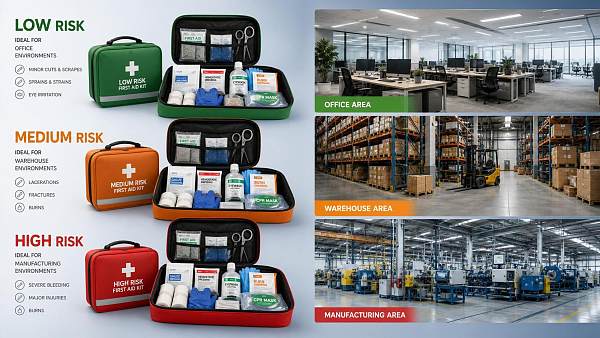
A useful way to organize emergency medical kits for workplaces is to divide them into low, medium, and high-risk profiles.
The table below summarizes what usually changes across those levels.
Low-risk sites still need complete emergency medical kits for workplaces. Low risk does not mean no risk.
Medium-risk sites usually need broader quantities, not just broader categories. Repeated minor injuries can exhaust supplies faster than expected.
High-risk sites need tighter alignment with the formal risk assessment. Severe bleeding, burns, chemical splash, and eye injury supplies become central.
Where local standards apply, contents should be mapped against those requirements and then adjusted upward for operational reality.
Which workplace types usually need different kit configurations?
Site type often changes the kit more than company size does. The injury pattern is what drives the contents.
Office and administrative spaces
These locations mainly see slips, cuts, headaches, minor burns from kitchen areas, and occasional fainting or cardiac emergencies.
A compact kit with CPR protection, cold packs, dressings, and clear signage is usually appropriate.
Warehousing and logistics sites
Forklift movement, pallet handling, and racking create crush, abrasion, and laceration risks.
Emergency medical kits for workplaces in these areas often need larger sterile dressings, elastic wraps, eye wash, and more glove stock.
Manufacturing and technical production areas
Sharp edges, hot surfaces, soldering, rotating tools, and powered equipment change the profile significantly.
That is common across sectors tracked by TradeNexus Pro, where process safety and quality systems are increasingly linked.
Here, eye care, burn treatment, trauma pads, and location-specific kit placement matter as much as content choice.
Chemical, battery, and energy facilities
These sites may require special decontamination support, rapid eye irrigation, and clear separation between general first aid and chemical response equipment.
In practical terms, the emergency medical kit for workplaces may be only one layer within a larger emergency station.
Remote field and service teams
Longer travel times justify more robust emergency medical kits for workplaces, including weather protection, larger trauma supplies, and duplicate essentials.
What do audits and standards usually check beyond the box itself?
Many nonconformities are not about missing items. They are about weak system control.
Auditors often look for evidence that emergency medical kits for workplaces are selected, placed, inspected, and replenished through a defined process.
- Risk assessment linked to kit contents
- Inspection frequency and refill records
- Expiry date control
- Visibility, signage, and access during shifts
- Training level of available responders
- Integration with eyewash, AED, and emergency communication points
This is where standards work becomes more strategic. A compliant kit without usable governance can still fail under incident review.
A recurring issue is centralizing all supplies in one room. That may satisfy inventory control, but not response time.
Another common mistake is copying one kit format across all buildings. Multi-site operations rarely share identical hazard maps.
Well-structured industrial intelligence platforms such as TradeNexus Pro often emphasize this broader point: operational credibility depends on documented, decision-grade controls.
Where do teams usually get emergency medical kits for workplaces wrong?
The most common error is buying for convenience instead of buying for exposure.
Another is underestimating quantity. A site may choose the right item types, yet still stock too little for real shift volume.
There is also a tendency to overfocus on headline emergencies and miss common, high-frequency injuries.
For example, eye irritation and small cuts may happen far more often than major trauma, especially in electronics and light production settings.
A more reliable review method is to compare kit contents against:
- Last 12 months of incident records
- Machine, chemical, and thermal hazard registers
- Shift staffing and contractor presence
- Distance to clinic, nurse room, or ambulance access point
- Seasonal or temporary work changes
That review should happen at least annually, and sooner after process changes, line expansions, or layout changes.
If the goal is stronger preparedness, the next step is simple. Map hazards by area, define required contents by risk level, verify quantities by headcount, and document refill ownership.
Emergency medical kits for workplaces work best when they are treated as part of a live safety system, not a static purchase.
Get weekly intelligence in your inbox.
No noise. No sponsored content. Pure intelligence.
 Oct 08, 2026How Digital Health Improves Diagnostic Accuracy and Workflow in Clinical LabsHow Digital Health Improves Diagnostic Accuracy and Workflow in Clinical Labs
 Oct 07, 2026Selecting Voice Picking Systems for German Warehouses: Integration, Languages and ROISelecting Voice Picking Systems for German Warehouses: Integration, Languages and ROI
 Oct 06, 2026How to Choose Last Mile Dispatch Software for On-Time Delivery at ScaleHow to Choose Last Mile Dispatch Software for On-Time Delivery at Scale
 Oct 05, 2026Vietnam’s Consumer Electronics Market: Demand Shifts and Sourcing OpportunitiesVietnam’s Consumer Electronics Market: Demand Shifts and Sourcing Opportunities
 Oct 04, 2026Digital Health Investment Priorities for Providers: Improving Access, Outcomes, and EfficiencyDigital Health Investment Priorities for Providers: Improving Access, Outcomes, and Efficiency
 Oct 03, 2026How to Specify an FR4 Custom PCB Board for High-Voltage and High-Heat DesignsHow to Specify an FR4 Custom PCB Board for High-Voltage and High-Heat Designs
 Oct 02, 2026ERP Software Market Intelligence: Adoption, Pricing, and Vendor Signals to WatchERP Software Market Intelligence: Adoption, Pricing, and Vendor Signals to Watch
 Oct 01, 2026How to Select Calibrated Temperature Data Loggers for GMP Cold Storage MonitoringHow to Select Calibrated Temperature Data Loggers for GMP Cold Storage Monitoring
 Sep 30, 2026Custom Molded Rubber Pricing: What Drives Unit Cost and Tooling Fees?Custom Molded Rubber Pricing: What Drives Unit Cost and Tooling Fees?
 Sep 29, 2026How to Evaluate Energy Management Software Vendors for Multi-Site OperationsHow to Evaluate Energy Management Software Vendors for Multi-Site Operations
 Sep 28, 2026How to Select a DIN Rail Smart Meter for Multi-Circuit Energy MonitoringHow to Select a DIN Rail Smart Meter for Multi-Circuit Energy Monitoring
 Sep 27, 2026TWS Earbuds in Vietnam: Demand Drivers, Price Tiers, and Retail Channel OpportunitiesTWS Earbuds in Vietnam: Demand Drivers, Price Tiers, and Retail Channel Opportunities
 Sep 26, 2026How UAE Clinics Can Qualify a Smart Glucometer Supplier for Accuracy and ComplianceHow UAE Clinics Can Qualify a Smart Glucometer Supplier for Accuracy and Compliance
 Sep 25, 2026Buying Aesthetic Lasers in the USA: FDA Status, Wavelengths, and Service SupportBuying Aesthetic Lasers in the USA: FDA Status, Wavelengths, and Service Support
 Sep 24, 2026Laser Cutting Brass Sheet: How to Prevent Burrs and Heat Marks on Thin PartsLaser Cutting Brass Sheet: How to Prevent Burrs and Heat Marks on Thin Parts
 Sep 23, 2026How to Choose Lightweight ANC Headphones for Comfortable All-Day TravelHow to Choose Lightweight ANC Headphones for Comfortable All-Day Travel
 Sep 22, 2026IPX5 TWS Bluetooth Earbuds: What Protection Do They Offer for Workouts?IPX5 TWS Bluetooth Earbuds: What Protection Do They Offer for Workouts?
 Sep 21, 2026What to Look for in a Grid Integration Company for Utility-Scale Solar ProjectsWhat to Look for in a Grid Integration Company for Utility-Scale Solar Projects
 Sep 20, 2026Microgrid Controller Pricing: What Drives Cost in Commercial Energy Projects?Microgrid Controller Pricing: What Drives Cost in Commercial Energy Projects?
 Sep 19, 2026How to Choose a GaN Charger for Laptops Without Compromising Power or PortabilityHow to Choose a GaN Charger for Laptops Without Compromising Power or Portability
 Sep 18, 2026Floating Solar Farm Costs: CAPEX, OPEX, and the Site Factors That Shape ROIFloating Solar Farm Costs: CAPEX, OPEX, and the Site Factors That Shape ROI
 Sep 17, 2026Drone Delivery Solutions for Last-Mile Routes: Site, Payload, and Range PlanningDrone Delivery Solutions for Last-Mile Routes: Site, Payload, and Range Planning
 Sep 16, 2026When Low-Volume Electronics Manufacturing Makes More Sense Than Mass ProductionWhen Low-Volume Electronics Manufacturing Makes More Sense Than Mass Production
 Sep 15, 2026Wholesale WiFi Smart Switches: What Buyers Should Verify Before OrderingWholesale WiFi Smart Switches: What Buyers Should Verify Before Ordering
 Sep 14, 2026How to Select IoT Sensors for Reliable Monitoring in Harsh Industrial EnvironmentsHow to Select IoT Sensors for Reliable Monitoring in Harsh Industrial Environments
 Sep 13, 2026How Procurement Teams Can Improve Supplier Reliability With Supply Chain VisibilityHow Procurement Teams Can Improve Supplier Reliability With Supply Chain Visibility
 Sep 12, 2026Smart Manufacturing Trends 2026: What Leaders Should Prioritize for ROISmart Manufacturing Trends 2026: What Leaders Should Prioritize for ROI



























