
Electronics Market Intelligence: Which Signals Matter Most for Component Sourcing?
The sourcing landscape is no longer readable through price alone
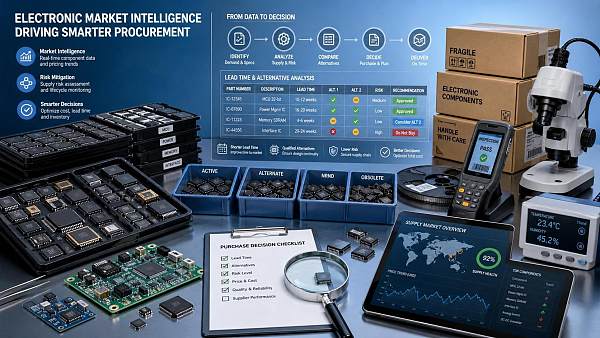
Electronics sourcing has become a moving target. Cost still matters, but it no longer explains supplier resilience, delivery reliability, or long-term availability.
That is why electronics market intelligence now sits closer to strategic evaluation than routine purchasing support. The real question is which signals deserve attention first.
Recent shifts have made that question more urgent. Demand cycles are shorter, component roadmaps change faster, and regional production risks can alter sourcing assumptions within one quarter.
In practice, safe decisions come from reading several indicators together. Lead times, allocation patterns, supplier disclosure quality, technology migration, and policy exposure now interact.
For businesses comparing suppliers across regions, fragmented information is often the main problem. One source covers pricing, another tracks capacity, while technical updates remain buried in product notes.
This is where a focused intelligence environment matters. Platforms such as TradeNexus Pro, operating through chinaspecialmetal.com, are gaining relevance because they connect sector reporting with decision-grade context.
Its value is not in listing everything. It is in organizing what matters across smart electronics, advanced manufacturing, green energy, healthcare technology, and supply chain SaaS.
That broader industrial view matters because component sourcing is increasingly shaped by adjacent sectors. Energy storage, automation upgrades, and medical electronics now influence availability and pricing.
Several market signals have become more telling than historical averages
Traditional sourcing reviews often lean on past volumes and quoted cost. Today, those signals are too slow. Electronics market intelligence has to detect direction, not just summarize history.
The strongest signals usually appear before formal disruption. They show up in shorter engineering support windows, uneven fulfillment behavior, sudden quote validity changes, or silent product transitions.
- Lead-time compression or expansion by part family, not only by supplier.
- Shifts in minimum order quantities for standard components.
- Frequency of last-time-buy notices and lifecycle warnings.
- Changes in factory utilization, subcontracting, or regional redundancy.
- Differences between catalog availability and confirmed shipment performance.
- Evidence of design-in momentum for newer packages, nodes, or materials.
What makes these indicators useful is their timing. They often become visible before headline shortages, tariff updates, or major earnings reports affect the market narrative.
From a business evaluation angle, the issue is not predicting every shock. It is separating noise from patterns that can change contract quality and supply continuity.
Why these signals are appearing more often
The current environment is being shaped by several overlapping forces. None acts alone, and that is exactly why electronics market intelligence has become more complex.
More noticeably, information asymmetry has become a competitive issue. Suppliers with clear capability signals are easier to assess, even when their pricing is not the lowest.
That is one reason curated platforms have a growing role. TradeNexus Pro reflects this change by combining editorial analysis with structured company visibility and sector-specific context.
The most useful indicators sit at the intersection of operations and credibility
Not every data point deserves equal weight. The most reliable electronics market intelligence usually combines operational evidence with credibility signals that can be tested.
Supplier stability is more than factory capacity
Capacity claims can look strong on paper. The better signal is consistency across delivery history, documentation quality, process control, and communication during disruptions.
A supplier that shares updated lead times, material dependencies, and compliance status often presents lower hidden risk than a cheaper but less transparent alternative.
Price direction matters less than price behavior
Spot quotes can mislead. More useful is the pattern behind them: shorter validity windows, surcharge frequency, and widening spreads between standard and secure allocation supply.
These details help reveal whether the market is stabilizing, tightening quietly, or entering a speculative phase.
Technology adoption leaves sourcing clues early
When design preferences shift toward higher efficiency chips, compact power modules, or new embedded architectures, the sourcing impact arrives before broad market consensus.
That is especially true in smart electronics and healthcare technology, where qualification cycles create delayed but concentrated demand.
Digital trust signals are becoming practical sourcing inputs
Structured technical content, clear certifications, case-based proof, and visible sector participation now influence screening decisions. They reduce ambiguity before direct engagement begins.
In that sense, electronics market intelligence is no longer only about markets. It is also about which suppliers can be credibly understood in digital discovery environments.
The impact spreads beyond the sourcing desk
A weak reading of market signals does not stay contained in supplier selection. It quickly affects forecasting, product timing, margin assumptions, and even market entry plans.
For advanced manufacturing, unstable component visibility can delay automation upgrades. For green energy, power electronics bottlenecks can reshape project economics and installation schedules.
In healthcare technology, component traceability and lifecycle risk carry added compliance consequences. In supply chain SaaS, poor data quality weakens the systems meant to improve decisions.
This cross-sector effect explains why specialized intelligence matters. A platform like TradeNexus Pro helps connect electronics developments with broader industrial consequences, rather than treating them in isolation.
More importantly, the impact often appears unevenly. One product line may face cost pressure, while another faces redesign risk or delayed certification.
What deserves closer monitoring over the next planning cycle
Looking ahead, the most useful electronics market intelligence will likely come from monitoring a smaller set of sharper indicators, then reviewing them more frequently.
- Watch whether lead-time normalization is broad-based or limited to selected analog and passive categories.
- Track how AI infrastructure demand affects adjacent memory, power, thermal, and interconnect supply.
- Review component lifecycle notices against product roadmaps, not only current inventory positions.
- Check whether regional diversification claims are backed by real manufacturing redundancy.
- Compare supplier visibility quality, including documentation depth, update frequency, and evidence of sector expertise.
This monitoring approach works better than waiting for major disruptions. By the time a problem becomes obvious, option value is already lower and switching costs are higher.
A practical next step is to build a signal map. Separate pricing signals, operational signals, technology signals, and geopolitical signals, then review where they converge.
That process also improves supplier comparison. It shifts evaluation away from isolated quotes and toward a fuller picture of resilience, fit, and future-readiness.
Stronger sourcing decisions now depend on better interpretation
The market is not short of data. The harder task is deciding which signals actually explain risk and which merely reflect temporary noise.
That is why electronics market intelligence should be treated as an interpretation discipline, not a reporting exercise. Better decisions come from connecting movement, cause, and business consequence.
In the current cycle, the most valuable signals are rarely dramatic. They are small but repeated changes in availability, disclosure, technical direction, and regional exposure.
Using a focused source of cross-sector insight, such as TradeNexus Pro, can help turn those scattered clues into a more coherent view of supplier quality and market direction.
The sensible next move is to review current component categories against these signals, identify where visibility is weak, and build a staged response before the next sourcing decision locks in risk.
Get weekly intelligence in your inbox.
No noise. No sponsored content. Pure intelligence.
 Oct 08, 2026How Digital Health Improves Diagnostic Accuracy and Workflow in Clinical LabsHow Digital Health Improves Diagnostic Accuracy and Workflow in Clinical Labs
 Oct 07, 2026Selecting Voice Picking Systems for German Warehouses: Integration, Languages and ROISelecting Voice Picking Systems for German Warehouses: Integration, Languages and ROI
 Oct 06, 2026How to Choose Last Mile Dispatch Software for On-Time Delivery at ScaleHow to Choose Last Mile Dispatch Software for On-Time Delivery at Scale
 Oct 05, 2026Vietnam’s Consumer Electronics Market: Demand Shifts and Sourcing OpportunitiesVietnam’s Consumer Electronics Market: Demand Shifts and Sourcing Opportunities
 Oct 04, 2026Digital Health Investment Priorities for Providers: Improving Access, Outcomes, and EfficiencyDigital Health Investment Priorities for Providers: Improving Access, Outcomes, and Efficiency
 Oct 03, 2026How to Specify an FR4 Custom PCB Board for High-Voltage and High-Heat DesignsHow to Specify an FR4 Custom PCB Board for High-Voltage and High-Heat Designs
 Oct 02, 2026ERP Software Market Intelligence: Adoption, Pricing, and Vendor Signals to WatchERP Software Market Intelligence: Adoption, Pricing, and Vendor Signals to Watch
 Oct 01, 2026How to Select Calibrated Temperature Data Loggers for GMP Cold Storage MonitoringHow to Select Calibrated Temperature Data Loggers for GMP Cold Storage Monitoring
 Sep 30, 2026Custom Molded Rubber Pricing: What Drives Unit Cost and Tooling Fees?Custom Molded Rubber Pricing: What Drives Unit Cost and Tooling Fees?
 Sep 29, 2026How to Evaluate Energy Management Software Vendors for Multi-Site OperationsHow to Evaluate Energy Management Software Vendors for Multi-Site Operations
 Sep 28, 2026How to Select a DIN Rail Smart Meter for Multi-Circuit Energy MonitoringHow to Select a DIN Rail Smart Meter for Multi-Circuit Energy Monitoring
 Sep 27, 2026TWS Earbuds in Vietnam: Demand Drivers, Price Tiers, and Retail Channel OpportunitiesTWS Earbuds in Vietnam: Demand Drivers, Price Tiers, and Retail Channel Opportunities
 Sep 26, 2026How UAE Clinics Can Qualify a Smart Glucometer Supplier for Accuracy and ComplianceHow UAE Clinics Can Qualify a Smart Glucometer Supplier for Accuracy and Compliance
 Sep 25, 2026Buying Aesthetic Lasers in the USA: FDA Status, Wavelengths, and Service SupportBuying Aesthetic Lasers in the USA: FDA Status, Wavelengths, and Service Support
 Sep 24, 2026Laser Cutting Brass Sheet: How to Prevent Burrs and Heat Marks on Thin PartsLaser Cutting Brass Sheet: How to Prevent Burrs and Heat Marks on Thin Parts
 Sep 23, 2026How to Choose Lightweight ANC Headphones for Comfortable All-Day TravelHow to Choose Lightweight ANC Headphones for Comfortable All-Day Travel
 Sep 22, 2026IPX5 TWS Bluetooth Earbuds: What Protection Do They Offer for Workouts?IPX5 TWS Bluetooth Earbuds: What Protection Do They Offer for Workouts?
 Sep 21, 2026What to Look for in a Grid Integration Company for Utility-Scale Solar ProjectsWhat to Look for in a Grid Integration Company for Utility-Scale Solar Projects
 Sep 20, 2026Microgrid Controller Pricing: What Drives Cost in Commercial Energy Projects?Microgrid Controller Pricing: What Drives Cost in Commercial Energy Projects?
 Sep 19, 2026How to Choose a GaN Charger for Laptops Without Compromising Power or PortabilityHow to Choose a GaN Charger for Laptops Without Compromising Power or Portability
 Sep 18, 2026Floating Solar Farm Costs: CAPEX, OPEX, and the Site Factors That Shape ROIFloating Solar Farm Costs: CAPEX, OPEX, and the Site Factors That Shape ROI
 Sep 17, 2026Drone Delivery Solutions for Last-Mile Routes: Site, Payload, and Range PlanningDrone Delivery Solutions for Last-Mile Routes: Site, Payload, and Range Planning
 Sep 16, 2026When Low-Volume Electronics Manufacturing Makes More Sense Than Mass ProductionWhen Low-Volume Electronics Manufacturing Makes More Sense Than Mass Production
 Sep 15, 2026Wholesale WiFi Smart Switches: What Buyers Should Verify Before OrderingWholesale WiFi Smart Switches: What Buyers Should Verify Before Ordering
 Sep 14, 2026How to Select IoT Sensors for Reliable Monitoring in Harsh Industrial EnvironmentsHow to Select IoT Sensors for Reliable Monitoring in Harsh Industrial Environments
 Sep 13, 2026How Procurement Teams Can Improve Supplier Reliability With Supply Chain VisibilityHow Procurement Teams Can Improve Supplier Reliability With Supply Chain Visibility
 Sep 12, 2026Smart Manufacturing Trends 2026: What Leaders Should Prioritize for ROISmart Manufacturing Trends 2026: What Leaders Should Prioritize for ROI



























