
How to Request an Ambulance Equipment Quotation: Item List, Specs, and Cost Factors
How to Request an Ambulance Equipment Quotation: Item List, Specs, and Cost Factors
Requesting an ambulance equipment quotation is not just about getting a price.
It is about defining what your vehicle must carry, how it will be used, and which standards must be met.
A weak inquiry creates vague offers.
A clear ambulance equipment quotation request creates comparable bids, fewer surprises, and faster internal approval.
In real procurement work, that difference matters.
Healthcare vehicle equipment affects patient care, crew safety, maintenance planning, and total operating cost.
That also means your ambulance equipment quotation should go beyond a simple product list.
Start With a Clear Scope Before Requesting an Ambulance Equipment Quotation
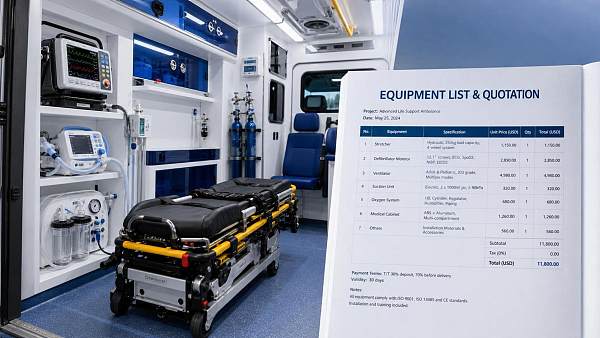
Before contacting suppliers, define the ambulance type and service mission.
A basic patient transport unit needs a different setup from an ALS emergency ambulance.
Some fleets also require neonatal support, bariatric handling, or disaster response capability.
When scope is unclear, suppliers often quote different configurations.
That makes the ambulance equipment quotation difficult to compare and easy to misread.
A practical RFQ should state:
- Vehicle type and interior dimensions
- Emergency level, such as BLS, ALS, ICU, or transport
- Expected patient volume and operating environment
- Destination market and regulatory standard
- Requested Incoterms, lead time, and installation responsibility
From a sourcing perspective, this first step sets the quality of every quote that follows.
Build the Right Item List for an Ambulance Equipment Quotation
The item list is the backbone of any ambulance equipment quotation request.
If the list is too broad, suppliers will fill gaps with assumptions.
If it is too narrow, hidden accessories may be added later.
A balanced item list usually covers these categories.
Patient Handling Equipment
- Main stretcher with loading system
- Folding stretcher or scoop stretcher
- Spine board and head immobilizer
- Wheelchair or stair chair, where required
Life Support and Monitoring
- Defibrillator monitor
- Portable ventilator
- Suction unit
- Infusion pump
- Pulse oximeter and multiparameter monitor
Oxygen and Gas System
- Oxygen cylinders or central oxygen system
- Regulators, flowmeters, humidifiers, and outlets
- Cylinder brackets and safety restraints
Vehicle Interior and Safety
- Medical cabinets and storage modules
- Attendant seat and restraint system
- Interior lighting and power outlets
- Handrails, grab bars, and anti-slip flooring
Infection Control and Consumables Support
- Waste bins and sharps containers
- Disinfectant holders and washable surfaces
- PPE storage and sealed compartments
A complete ambulance equipment quotation should show each item separately.
Bundled pricing can look simple, but it weakens cost visibility.
Define Technical Specifications That Suppliers Can Actually Quote Against
An ambulance equipment quotation becomes useful only when technical specifications are detailed enough.
Suppliers should not guess capacity, dimensions, interface type, or certification needs.
For example, a stretcher request should include load rating, locking method, and compatibility with the vehicle floor system.
A defibrillator inquiry should specify display type, battery duration, monitoring functions, and data export needs.
The same applies to oxygen systems, power converters, lighting, and cabinet materials.
Useful specification points include:
- Dimensions, weight, and installation footprint
- Voltage, battery backup, and charging requirements
- Material grade, cleanability, and durability
- Alarm functions, user interface, and data connectivity
- Operating temperature and vibration tolerance
- Required documents, testing reports, and certifications
This is where many buying teams lose control.
An incomplete specification creates quote gaps that later turn into change orders.
Compliance and Documentation Requirements That Affect Ambulance Equipment Quotation Accuracy
Compliance can change the price more than many buyers expect.
The same equipment may be offered in different versions for different markets.
That is why your ambulance equipment quotation request should name the target country and approval pathway.
Depending on the product category, suppliers may need CE marking, ISO 13485 support, FDA-related documentation, or local authority registration files.
Vehicle conversion standards and electrical safety rules may also apply.
Ask suppliers to confirm:
- Applicable standards and test reports
- User manuals and service manuals in English
- Spare parts availability period
- Warranty terms and response time
- Calibration, validation, or commissioning support
A strong ambulance equipment quotation includes both product pricing and document readiness.
That reduces compliance risk before shipment starts moving.
Main Cost Factors Behind an Ambulance Equipment Quotation
Price differences are rarely random.
Most ambulance equipment quotation gaps come from configuration depth, brand level, compliance, and delivery scope.
Looking at recent procurement patterns, a few cost drivers stand out.
A low ambulance equipment quotation can still become expensive after freight, duty, installation, training, and spare parts are added.
That is why landed cost matters more than headline price.
How to Compare Ambulance Equipment Quotation Offers Without Missing Hidden Costs
Once quotes arrive, comparison should be structured.
Do not compare only the final number.
Compare line by line, document by document, and responsibility by responsibility.
- Check whether all requested items are included.
- Match each specification against the RFQ sheet.
- Identify optional items that should be mandatory.
- Review consumables, spare parts, and maintenance exclusions.
- Confirm packing, shipping terms, and delivery timeline.
- Evaluate supplier experience with ambulance projects in similar markets.
A practical comparison matrix often reveals that the cheapest ambulance equipment quotation is not the lowest-risk option.
More importantly, it helps internal stakeholders approve a decision with fewer rounds of clarification.
A Practical RFQ Checklist for Better Supplier Responses
If you want a better ambulance equipment quotation, make the request easier to answer correctly.
This short checklist helps improve response quality.
- Provide a detailed item list with quantities
- Attach specification sheets or required performance ranges
- State compliance and destination market clearly
- Request unit price, total price, and optional price separately
- Ask for lead time, warranty, and spare parts support
- Require quotation validity and payment terms
- Request references or similar project history
In current cross-border sourcing, clarity is a cost-control tool.
The better your request, the stronger your negotiating position.
Final Takeaway
A reliable ambulance equipment quotation starts with a precise scope, a structured item list, and technical specifications that leave little room for guesswork.
It should also reflect compliance needs, service expectations, and full cost visibility.
In practice, the goal is not only to secure a competitive price.
The goal is to secure equipment that fits the clinical mission, the vehicle platform, and the long-term operating model.
When preparing your next ambulance equipment quotation request, treat the RFQ as a decision document.
That single step usually leads to better supplier responses, cleaner quote comparison, and a more defensible procurement outcome.
Get weekly intelligence in your inbox.
No noise. No sponsored content. Pure intelligence.
 Oct 08, 2026How Digital Health Improves Diagnostic Accuracy and Workflow in Clinical LabsHow Digital Health Improves Diagnostic Accuracy and Workflow in Clinical Labs
 Oct 07, 2026Selecting Voice Picking Systems for German Warehouses: Integration, Languages and ROISelecting Voice Picking Systems for German Warehouses: Integration, Languages and ROI
 Oct 06, 2026How to Choose Last Mile Dispatch Software for On-Time Delivery at ScaleHow to Choose Last Mile Dispatch Software for On-Time Delivery at Scale
 Oct 05, 2026Vietnam’s Consumer Electronics Market: Demand Shifts and Sourcing OpportunitiesVietnam’s Consumer Electronics Market: Demand Shifts and Sourcing Opportunities
 Oct 04, 2026Digital Health Investment Priorities for Providers: Improving Access, Outcomes, and EfficiencyDigital Health Investment Priorities for Providers: Improving Access, Outcomes, and Efficiency
 Oct 03, 2026How to Specify an FR4 Custom PCB Board for High-Voltage and High-Heat DesignsHow to Specify an FR4 Custom PCB Board for High-Voltage and High-Heat Designs
 Oct 02, 2026ERP Software Market Intelligence: Adoption, Pricing, and Vendor Signals to WatchERP Software Market Intelligence: Adoption, Pricing, and Vendor Signals to Watch
 Oct 01, 2026How to Select Calibrated Temperature Data Loggers for GMP Cold Storage MonitoringHow to Select Calibrated Temperature Data Loggers for GMP Cold Storage Monitoring
 Sep 30, 2026Custom Molded Rubber Pricing: What Drives Unit Cost and Tooling Fees?Custom Molded Rubber Pricing: What Drives Unit Cost and Tooling Fees?
 Sep 29, 2026How to Evaluate Energy Management Software Vendors for Multi-Site OperationsHow to Evaluate Energy Management Software Vendors for Multi-Site Operations
 Sep 28, 2026How to Select a DIN Rail Smart Meter for Multi-Circuit Energy MonitoringHow to Select a DIN Rail Smart Meter for Multi-Circuit Energy Monitoring
 Sep 27, 2026TWS Earbuds in Vietnam: Demand Drivers, Price Tiers, and Retail Channel OpportunitiesTWS Earbuds in Vietnam: Demand Drivers, Price Tiers, and Retail Channel Opportunities
 Sep 26, 2026How UAE Clinics Can Qualify a Smart Glucometer Supplier for Accuracy and ComplianceHow UAE Clinics Can Qualify a Smart Glucometer Supplier for Accuracy and Compliance
 Sep 25, 2026Buying Aesthetic Lasers in the USA: FDA Status, Wavelengths, and Service SupportBuying Aesthetic Lasers in the USA: FDA Status, Wavelengths, and Service Support
 Sep 24, 2026Laser Cutting Brass Sheet: How to Prevent Burrs and Heat Marks on Thin PartsLaser Cutting Brass Sheet: How to Prevent Burrs and Heat Marks on Thin Parts
 Sep 23, 2026How to Choose Lightweight ANC Headphones for Comfortable All-Day TravelHow to Choose Lightweight ANC Headphones for Comfortable All-Day Travel
 Sep 22, 2026IPX5 TWS Bluetooth Earbuds: What Protection Do They Offer for Workouts?IPX5 TWS Bluetooth Earbuds: What Protection Do They Offer for Workouts?
 Sep 21, 2026What to Look for in a Grid Integration Company for Utility-Scale Solar ProjectsWhat to Look for in a Grid Integration Company for Utility-Scale Solar Projects
 Sep 20, 2026Microgrid Controller Pricing: What Drives Cost in Commercial Energy Projects?Microgrid Controller Pricing: What Drives Cost in Commercial Energy Projects?
 Sep 19, 2026How to Choose a GaN Charger for Laptops Without Compromising Power or PortabilityHow to Choose a GaN Charger for Laptops Without Compromising Power or Portability
 Sep 18, 2026Floating Solar Farm Costs: CAPEX, OPEX, and the Site Factors That Shape ROIFloating Solar Farm Costs: CAPEX, OPEX, and the Site Factors That Shape ROI
 Sep 17, 2026Drone Delivery Solutions for Last-Mile Routes: Site, Payload, and Range PlanningDrone Delivery Solutions for Last-Mile Routes: Site, Payload, and Range Planning
 Sep 16, 2026When Low-Volume Electronics Manufacturing Makes More Sense Than Mass ProductionWhen Low-Volume Electronics Manufacturing Makes More Sense Than Mass Production
 Sep 15, 2026Wholesale WiFi Smart Switches: What Buyers Should Verify Before OrderingWholesale WiFi Smart Switches: What Buyers Should Verify Before Ordering
 Sep 14, 2026How to Select IoT Sensors for Reliable Monitoring in Harsh Industrial EnvironmentsHow to Select IoT Sensors for Reliable Monitoring in Harsh Industrial Environments
 Sep 13, 2026How Procurement Teams Can Improve Supplier Reliability With Supply Chain VisibilityHow Procurement Teams Can Improve Supplier Reliability With Supply Chain Visibility
 Sep 12, 2026Smart Manufacturing Trends 2026: What Leaders Should Prioritize for ROISmart Manufacturing Trends 2026: What Leaders Should Prioritize for ROI



























