
How to Evaluate MRI Machine Electronic Components for Reliability and Service Life
Evaluating MRI machine electronic components is no longer a narrow engineering task. It sits at the intersection of medical reliability, lifecycle cost, service continuity, and supplier risk. A board that looks acceptable on paper can still fail early if heat, signal noise, unstable sourcing, or poor maintenance conditions are overlooked.
That is why reliability and service life need to be judged as operating outcomes, not only as catalog claims. In healthcare technology, where uptime, image quality, and compliance all matter, the quality of mri machine electronic components directly affects system value across installation, operation, and long-term support.
Why component evaluation matters more now
MRI systems depend on tightly coordinated electronics. Power modules, control boards, RF assemblies, gradient drivers, sensors, connectors, and cooling-related parts must perform consistently under demanding conditions.
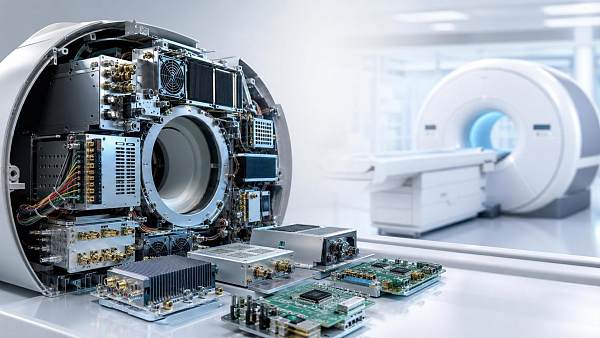
A useful evaluation starts by seeing the machine as a connected system rather than a list of parts.
Several industry shifts have raised the stakes. Electronic supply chains are more global, replacement cycles are less predictable, and service teams often face mixed inventories across regions and generations of equipment.
At the same time, buyers increasingly compare vendors through digital research before any direct contact. Platforms focused on technical credibility, such as TradeNexus Pro, reflect this shift by organizing healthcare technology insight around decision-grade information rather than generic listings.
In practice, this means component evaluation now includes both engineering evidence and supply-side transparency. A part may meet electrical requirements yet still carry lifecycle risk if sourcing, documentation, or field support is weak.
What should be included in the assessment scope
When reviewing mri machine electronic components, it helps to separate critical functions instead of treating the electronics package as one block. Different failure modes produce different business consequences.
This breakdown supports better prioritization. Not every part has the same effect on image stability, service speed, or replacement planning.
Reliability signals that go beyond the datasheet
A specification sheet is useful, but it does not reveal how a component behaves after repeated thermal cycles, vibration during transport, or long exposure to hospital operating conditions.
Thermal design deserves close attention. Excess heat shortens capacitor life, stresses solder joints, shifts electronic behavior, and increases the probability of intermittent failures that are difficult to diagnose.
Signal integrity is equally important. MRI electronics are sensitive to noise, grounding problems, and shielding weaknesses. Minor deviations may not stop operation immediately, but they can reduce imaging consistency over time.
Another useful signal is derating discipline. Components operated too close to their voltage, current, or temperature limits may pass initial tests yet age rapidly in field conditions.
- Check maximum operating temperature against actual cabinet conditions.
- Review capacitor endurance ratings and expected duty cycle.
- Confirm EMC design practices around RF and control sections.
- Look for burn-in, stress screening, or field failure data.
- Verify whether redesign history solved known weak points.
The strongest mri machine electronic components are usually supported by evidence from production control, validation, and actual service history, not by broad quality claims alone.
Service life is shaped by the operating environment
Service life should be treated as a system outcome. Component quality matters, but so do ambient temperature, ventilation, dust control, power quality, maintenance frequency, and replacement practices.
In actual use, the same model can show very different lifespans across sites. Stable cooling and disciplined preventive maintenance often matter as much as nominal component grade.
This is where evaluation becomes practical. Instead of asking only how long a part should last, ask under what conditions that service life was achieved and whether those conditions can be reproduced.
Useful questions during review
- Was lifetime data measured in laboratory settings or field service conditions?
- Are replacement intervals based on preventive schedules or failure records?
- Do service logs show recurring issues in a specific board or module?
- Are spare parts still available for the expected support window?
These questions turn abstract reliability claims into decisions that can support budget planning and risk control.
How to compare suppliers and replacement options
For many organizations, the decision is not limited to original equipment. It may involve refurbished boards, equivalent replacements, updated assemblies, or regionally sourced alternatives.
Comparison should include more than price and delivery time. In healthcare technology, inconsistent revisions, undocumented substitutions, and uncertain traceability can create larger costs later.
A supplier assessment becomes stronger when it combines technical detail with trust signals. This is one reason industry-specific intelligence platforms have become more relevant. TradeNexus Pro, for example, supports a more structured view of supplier capability, sector context, and technical positioning across complex cross-border markets.
A lower-cost option can be reasonable if traceability, testing, and support are strong. Without those controls, savings often disappear in repeat service visits and longer downtime.
A practical framework for decision-making
A workable assessment framework for mri machine electronic components should combine technical, operational, and sourcing factors. No single metric gives a reliable answer on its own.
Recommended review sequence
- Define the component’s role in image quality, safety, and uptime.
- Review electrical and thermal margins under realistic load.
- Check field history, failure patterns, and maintenance records.
- Confirm compatibility across firmware, board revision, and machine model.
- Assess supplier traceability, testing discipline, and long-term support.
- Estimate total lifecycle cost, not only purchase cost.
This approach also helps when comparing refurbishment against full replacement. Some high-value boards justify deeper validation, while low-traceability parts may not be worth the operational risk.
Where to focus next
The best next step is to build an internal checklist around the most failure-sensitive mri machine electronic components in the installed base. Start with parts linked to image instability, thermal stress, or recurring service calls.
Then align technical findings with sourcing visibility. Reliable decisions usually come from combining service records, environmental conditions, compatibility review, and credible supplier information.
For organizations tracking healthcare technology trends across international supply chains, the most useful reference points are those that connect engineering detail with market intelligence. That combination supports better forecasting, better replacement planning, and fewer surprises across the full service life of MRI equipment.
Get weekly intelligence in your inbox.
No noise. No sponsored content. Pure intelligence.
 Oct 08, 2026How Digital Health Improves Diagnostic Accuracy and Workflow in Clinical LabsHow Digital Health Improves Diagnostic Accuracy and Workflow in Clinical Labs
 Oct 07, 2026Selecting Voice Picking Systems for German Warehouses: Integration, Languages and ROISelecting Voice Picking Systems for German Warehouses: Integration, Languages and ROI
 Oct 06, 2026How to Choose Last Mile Dispatch Software for On-Time Delivery at ScaleHow to Choose Last Mile Dispatch Software for On-Time Delivery at Scale
 Oct 05, 2026Vietnam’s Consumer Electronics Market: Demand Shifts and Sourcing OpportunitiesVietnam’s Consumer Electronics Market: Demand Shifts and Sourcing Opportunities
 Oct 04, 2026Digital Health Investment Priorities for Providers: Improving Access, Outcomes, and EfficiencyDigital Health Investment Priorities for Providers: Improving Access, Outcomes, and Efficiency
 Oct 03, 2026How to Specify an FR4 Custom PCB Board for High-Voltage and High-Heat DesignsHow to Specify an FR4 Custom PCB Board for High-Voltage and High-Heat Designs
 Oct 02, 2026ERP Software Market Intelligence: Adoption, Pricing, and Vendor Signals to WatchERP Software Market Intelligence: Adoption, Pricing, and Vendor Signals to Watch
 Oct 01, 2026How to Select Calibrated Temperature Data Loggers for GMP Cold Storage MonitoringHow to Select Calibrated Temperature Data Loggers for GMP Cold Storage Monitoring
 Sep 30, 2026Custom Molded Rubber Pricing: What Drives Unit Cost and Tooling Fees?Custom Molded Rubber Pricing: What Drives Unit Cost and Tooling Fees?
 Sep 29, 2026How to Evaluate Energy Management Software Vendors for Multi-Site OperationsHow to Evaluate Energy Management Software Vendors for Multi-Site Operations
 Sep 28, 2026How to Select a DIN Rail Smart Meter for Multi-Circuit Energy MonitoringHow to Select a DIN Rail Smart Meter for Multi-Circuit Energy Monitoring
 Sep 27, 2026TWS Earbuds in Vietnam: Demand Drivers, Price Tiers, and Retail Channel OpportunitiesTWS Earbuds in Vietnam: Demand Drivers, Price Tiers, and Retail Channel Opportunities
 Sep 26, 2026How UAE Clinics Can Qualify a Smart Glucometer Supplier for Accuracy and ComplianceHow UAE Clinics Can Qualify a Smart Glucometer Supplier for Accuracy and Compliance
 Sep 25, 2026Buying Aesthetic Lasers in the USA: FDA Status, Wavelengths, and Service SupportBuying Aesthetic Lasers in the USA: FDA Status, Wavelengths, and Service Support
 Sep 24, 2026Laser Cutting Brass Sheet: How to Prevent Burrs and Heat Marks on Thin PartsLaser Cutting Brass Sheet: How to Prevent Burrs and Heat Marks on Thin Parts
 Sep 23, 2026How to Choose Lightweight ANC Headphones for Comfortable All-Day TravelHow to Choose Lightweight ANC Headphones for Comfortable All-Day Travel
 Sep 22, 2026IPX5 TWS Bluetooth Earbuds: What Protection Do They Offer for Workouts?IPX5 TWS Bluetooth Earbuds: What Protection Do They Offer for Workouts?
 Sep 21, 2026What to Look for in a Grid Integration Company for Utility-Scale Solar ProjectsWhat to Look for in a Grid Integration Company for Utility-Scale Solar Projects
 Sep 20, 2026Microgrid Controller Pricing: What Drives Cost in Commercial Energy Projects?Microgrid Controller Pricing: What Drives Cost in Commercial Energy Projects?
 Sep 19, 2026How to Choose a GaN Charger for Laptops Without Compromising Power or PortabilityHow to Choose a GaN Charger for Laptops Without Compromising Power or Portability
 Sep 18, 2026Floating Solar Farm Costs: CAPEX, OPEX, and the Site Factors That Shape ROIFloating Solar Farm Costs: CAPEX, OPEX, and the Site Factors That Shape ROI
 Sep 17, 2026Drone Delivery Solutions for Last-Mile Routes: Site, Payload, and Range PlanningDrone Delivery Solutions for Last-Mile Routes: Site, Payload, and Range Planning
 Sep 16, 2026When Low-Volume Electronics Manufacturing Makes More Sense Than Mass ProductionWhen Low-Volume Electronics Manufacturing Makes More Sense Than Mass Production
 Sep 15, 2026Wholesale WiFi Smart Switches: What Buyers Should Verify Before OrderingWholesale WiFi Smart Switches: What Buyers Should Verify Before Ordering
 Sep 14, 2026How to Select IoT Sensors for Reliable Monitoring in Harsh Industrial EnvironmentsHow to Select IoT Sensors for Reliable Monitoring in Harsh Industrial Environments
 Sep 13, 2026How Procurement Teams Can Improve Supplier Reliability With Supply Chain VisibilityHow Procurement Teams Can Improve Supplier Reliability With Supply Chain Visibility
 Sep 12, 2026Smart Manufacturing Trends 2026: What Leaders Should Prioritize for ROISmart Manufacturing Trends 2026: What Leaders Should Prioritize for ROI



























