B2B Ecommerce Platforms for Manufacturers: How to Compare ERP, MOQ, and RFQ Features
B2B Ecommerce Platforms for Manufacturers: How to Compare ERP, MOQ, and RFQ Features
Choosing among b2b ecommerce platforms for manufacturers is no longer just a software decision. It shapes sourcing speed, order flexibility, and supplier coordination across daily operations.
For companies managing cross-border procurement, the platform often becomes the control point between sales teams, factories, distributors, and buyers.
That is why ERP integration, MOQ management, and RFQ workflows deserve close comparison. These three areas usually decide whether the system helps the business scale or slows it down.
In practical terms, the best b2b ecommerce platforms for manufacturers support real buying behavior. They handle negotiated pricing, technical specifications, multi-stage approvals, and supplier communication without creating new friction.
Why Manufacturers Need a Different Platform Standard
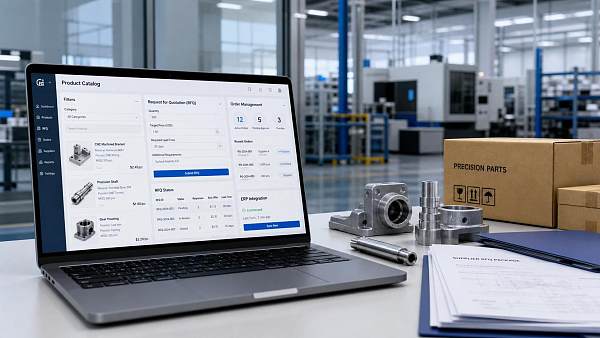
Many general ecommerce systems were built for simple catalogs and fixed-price transactions. Manufacturing environments rarely work that way.
Orders can involve custom dimensions, batch production, compliance documents, lead-time checks, and negotiated shipping terms. A lightweight storefront often cannot manage that complexity.
This is where b2b ecommerce platforms for manufacturers separate themselves. They support deeper account structures, workflow logic, and data connections with operational systems.
The strongest platforms do not only display products. They connect product data, customer-specific pricing, stock visibility, and procurement communication in one usable process.
From a decision perspective, the question is simple. Can the platform reflect how your buyers and internal teams already work, or will they need workarounds every day?
Start with ERP Integration, Not Front-End Design
ERP integration should be the first checkpoint. A polished interface means little if pricing, inventory, order status, and invoice data stay disconnected.
In manufacturing, ERP is usually the source of truth. It holds customer records, production planning, credit limits, fulfillment rules, and inventory commitments.
When evaluating b2b ecommerce platforms for manufacturers, ask how the ERP connection works in detail. Native connectors are useful, but workflow fit matters more than marketing labels.
Key ERP questions to test
- Does the platform sync customer-specific pricing in real time or by batch?
- Can it reflect available stock, allocated stock, and production lead times separately?
- How are canceled orders, partial shipments, and returns written back into ERP?
- Does it support multiple warehouses, currencies, and tax rules?
- Can product specifications and compliance data flow without manual copying?
A weak integration creates hidden cost. Teams begin checking spreadsheets, chasing sales reps, and manually correcting order details.
A strong integration reduces duplicate work and improves trust in the platform. Buyers see accurate information, while internal teams spend less time fixing preventable errors.
MOQ Management Is a Revenue and Operations Issue
MOQ is often treated as a simple product rule. In reality, it affects margin, production efficiency, and customer access.
Manufacturers may apply different minimum order quantities by product family, customer tier, region, packaging unit, or contract agreement. Static settings are rarely enough.
This is another area where b2b ecommerce platforms for manufacturers need industry depth. Buyers should understand what is possible before submitting an order.
What good MOQ logic should support
- Different MOQ rules by SKU, category, or account type
- Mixed-cart validation for bundled or related products
- Exceptions for approved distributors or strategic buyers
- Clear prompts when quantity falls below the required threshold
- Links between MOQ rules and freight, packaging, or production batches
Better MOQ handling improves conversion quality. It filters unrealistic orders early while preserving flexibility for serious buyers.
It also reduces negotiation noise. Sales and operations teams no longer need to manually explain the same order constraints every week.
If a platform cannot model your MOQ reality, it may push buyers away or allow low-quality orders that damage profitability.
RFQ Workflows Often Decide Platform Value
For many manufacturers, RFQ capability is more important than direct checkout. Buyers often need quotes before they can place formal orders.
That quote may depend on material grade, tolerance, certifications, shipment volume, or project timing. A basic contact form is not enough.
The better b2b ecommerce platforms for manufacturers treat RFQ as a structured commercial workflow. They capture information cleanly and move it through internal review without delay.
Features worth comparing closely
- Custom RFQ forms for technical details, drawings, and compliance needs
- Routing rules by product type, geography, or customer segment
- Quote version control for revised specifications or pricing changes
- Approval flows for finance, engineering, or export controls
- Conversion from approved quote to order without re-entering data
This matters even more in cross-border business. Buyers expect faster response times, but internal checks are becoming stricter.
A mature RFQ workflow balances both sides. It speeds communication while protecting pricing discipline and technical accuracy.
A Practical Comparison Framework
When reviewing b2b ecommerce platforms for manufacturers, scoring each vendor against a practical framework keeps the process grounded.
This kind of scorecard keeps evaluation tied to business outcomes. It also helps separate feature claims from usable capability.
Questions to Ask Before Shortlisting a Vendor
Short demos can hide operational gaps. A stronger evaluation process uses scenario-based questions instead of broad product tours.
- How does the platform handle a buyer requesting mixed quantities below standard MOQ?
- Can an RFQ include drawings, test standards, and alternative material requests?
- What happens when ERP pricing changes after a quote is issued?
- Can regional sales teams apply controlled pricing adjustments?
- How are contract customers treated differently from new inquiries?
- What implementation work is required from internal IT and operations teams?
These questions reveal whether the vendor understands manufacturing tradeoffs. They also expose integration risk before contracts are signed.
How to Make the Final Decision
The right b2b ecommerce platforms for manufacturers are not always the ones with the longest feature list. The better choice is usually the one that supports core commercial workflows with less friction.
In most cases, ERP fit should carry the highest weight. After that, focus on MOQ flexibility and RFQ maturity, because these directly affect conversion quality and operational discipline.
It also helps to test with live scenarios, not generic examples. Use real products, real account rules, and real quote conditions during vendor review.
That approach makes tradeoffs visible early. It shows whether the platform can support scalable procurement and stronger supplier coordination in real business conditions.
For manufacturers expanding into new regions or digital channels, this decision has long-term impact. A well-matched platform improves responsiveness, credibility, and execution across the entire buying cycle.
If the goal is a more reliable digital commerce foundation, compare b2b ecommerce platforms for manufacturers through the lens of operational reality. That is where the best decisions usually become obvious.
Get weekly intelligence in your inbox.
No noise. No sponsored content. Pure intelligence.
 Oct 08, 2026How Digital Health Improves Diagnostic Accuracy and Workflow in Clinical LabsHow Digital Health Improves Diagnostic Accuracy and Workflow in Clinical Labs
 Oct 07, 2026Selecting Voice Picking Systems for German Warehouses: Integration, Languages and ROISelecting Voice Picking Systems for German Warehouses: Integration, Languages and ROI
 Oct 06, 2026How to Choose Last Mile Dispatch Software for On-Time Delivery at ScaleHow to Choose Last Mile Dispatch Software for On-Time Delivery at Scale
 Oct 05, 2026Vietnam’s Consumer Electronics Market: Demand Shifts and Sourcing OpportunitiesVietnam’s Consumer Electronics Market: Demand Shifts and Sourcing Opportunities
 Oct 04, 2026Digital Health Investment Priorities for Providers: Improving Access, Outcomes, and EfficiencyDigital Health Investment Priorities for Providers: Improving Access, Outcomes, and Efficiency
 Oct 03, 2026How to Specify an FR4 Custom PCB Board for High-Voltage and High-Heat DesignsHow to Specify an FR4 Custom PCB Board for High-Voltage and High-Heat Designs
 Oct 02, 2026ERP Software Market Intelligence: Adoption, Pricing, and Vendor Signals to WatchERP Software Market Intelligence: Adoption, Pricing, and Vendor Signals to Watch
 Oct 01, 2026How to Select Calibrated Temperature Data Loggers for GMP Cold Storage MonitoringHow to Select Calibrated Temperature Data Loggers for GMP Cold Storage Monitoring
 Sep 30, 2026Custom Molded Rubber Pricing: What Drives Unit Cost and Tooling Fees?Custom Molded Rubber Pricing: What Drives Unit Cost and Tooling Fees?
 Sep 29, 2026How to Evaluate Energy Management Software Vendors for Multi-Site OperationsHow to Evaluate Energy Management Software Vendors for Multi-Site Operations
 Sep 28, 2026How to Select a DIN Rail Smart Meter for Multi-Circuit Energy MonitoringHow to Select a DIN Rail Smart Meter for Multi-Circuit Energy Monitoring
 Sep 27, 2026TWS Earbuds in Vietnam: Demand Drivers, Price Tiers, and Retail Channel OpportunitiesTWS Earbuds in Vietnam: Demand Drivers, Price Tiers, and Retail Channel Opportunities
 Sep 26, 2026How UAE Clinics Can Qualify a Smart Glucometer Supplier for Accuracy and ComplianceHow UAE Clinics Can Qualify a Smart Glucometer Supplier for Accuracy and Compliance
 Sep 25, 2026Buying Aesthetic Lasers in the USA: FDA Status, Wavelengths, and Service SupportBuying Aesthetic Lasers in the USA: FDA Status, Wavelengths, and Service Support
 Sep 24, 2026Laser Cutting Brass Sheet: How to Prevent Burrs and Heat Marks on Thin PartsLaser Cutting Brass Sheet: How to Prevent Burrs and Heat Marks on Thin Parts
 Sep 23, 2026How to Choose Lightweight ANC Headphones for Comfortable All-Day TravelHow to Choose Lightweight ANC Headphones for Comfortable All-Day Travel
 Sep 22, 2026IPX5 TWS Bluetooth Earbuds: What Protection Do They Offer for Workouts?IPX5 TWS Bluetooth Earbuds: What Protection Do They Offer for Workouts?
 Sep 21, 2026What to Look for in a Grid Integration Company for Utility-Scale Solar ProjectsWhat to Look for in a Grid Integration Company for Utility-Scale Solar Projects
 Sep 20, 2026Microgrid Controller Pricing: What Drives Cost in Commercial Energy Projects?Microgrid Controller Pricing: What Drives Cost in Commercial Energy Projects?
 Sep 19, 2026How to Choose a GaN Charger for Laptops Without Compromising Power or PortabilityHow to Choose a GaN Charger for Laptops Without Compromising Power or Portability
 Sep 18, 2026Floating Solar Farm Costs: CAPEX, OPEX, and the Site Factors That Shape ROIFloating Solar Farm Costs: CAPEX, OPEX, and the Site Factors That Shape ROI
 Sep 17, 2026Drone Delivery Solutions for Last-Mile Routes: Site, Payload, and Range PlanningDrone Delivery Solutions for Last-Mile Routes: Site, Payload, and Range Planning
 Sep 16, 2026When Low-Volume Electronics Manufacturing Makes More Sense Than Mass ProductionWhen Low-Volume Electronics Manufacturing Makes More Sense Than Mass Production
 Sep 15, 2026Wholesale WiFi Smart Switches: What Buyers Should Verify Before OrderingWholesale WiFi Smart Switches: What Buyers Should Verify Before Ordering
 Sep 14, 2026How to Select IoT Sensors for Reliable Monitoring in Harsh Industrial EnvironmentsHow to Select IoT Sensors for Reliable Monitoring in Harsh Industrial Environments
 Sep 13, 2026How Procurement Teams Can Improve Supplier Reliability With Supply Chain VisibilityHow Procurement Teams Can Improve Supplier Reliability With Supply Chain Visibility
 Sep 12, 2026Smart Manufacturing Trends 2026: What Leaders Should Prioritize for ROISmart Manufacturing Trends 2026: What Leaders Should Prioritize for ROI