
Route Optimization for Cold Chain: How to Cut Delays Without Violating Temperature Limits
Route Optimization for Cold Chain: How to Cut Delays Without Violating Temperature Limits
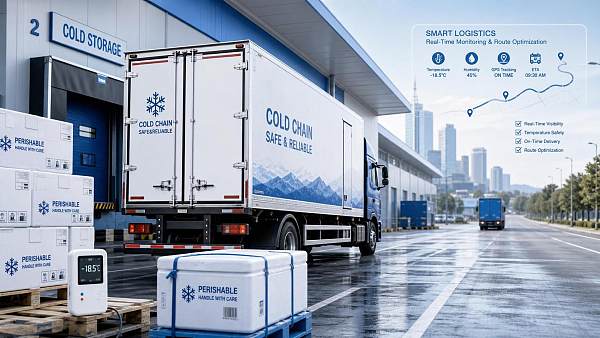
In cold chain logistics, a late delivery is not just a timing issue. It can trigger spoilage, compliance failures, rejected loads, and damaged customer trust.
That is why route optimization for cold chain has become a planning priority, not just a transport task.
For project-led operations, the challenge is rarely distance alone. The real issue is how to reduce delays while keeping strict temperature limits intact.
In practice, traffic volatility, loading delays, multi-stop routes, and poor handoff timing often cause more temperature exposure than long mileage.
A workable route optimization for cold chain strategy must combine scheduling, sensor visibility, vehicle constraints, and exception handling.
The goal is simple to state but harder to execute: deliver faster, protect the product, and keep the network stable under real operating pressure.
Why Traditional Routing Fails in Temperature-Controlled Distribution
Standard route planning usually optimizes for shortest distance or lowest fuel cost. Cold chain routing works under different rules.
Each shipment has a thermal clock. Every stop, door opening, waiting period, and transfer increases risk.
This becomes more serious in pharmaceuticals, fresh food, biologics, dairy, and specialty chemicals.
A route that looks efficient on paper may be unsafe once ambient temperature, unloading duration, and reefer recovery time are considered.
More importantly, static plans do not react well to real disruptions. Traffic incidents and dock congestion can erase the original schedule in hours.
That is why route optimization for cold chain must be dynamic, constraint-based, and tightly linked to operational data.
The Core Inputs Behind Better Route Optimization for Cold Chain
Better results start with better inputs. Many delays come from weak planning data, not weak drivers.
A strong route optimization for cold chain model usually needs five input groups.
- Product rules: required temperature range, excursion tolerance, shelf-life sensitivity, and handling restrictions.
- Vehicle capacity: pallet count, compartment zoning, reefer performance, and fuel or battery limits.
- Stop conditions: delivery windows, average unload time, site access rules, and dwell-time history.
- Route context: traffic patterns, weather exposure, road restrictions, and border or checkpoint delays.
- Live telemetry: GPS location, cargo temperature, door events, engine status, and estimated arrival changes.
When these data streams are missing, planners often compensate with buffer time. That protects service sometimes, but it also reduces fleet productivity.
The better approach is to use data to shrink uncertainty rather than padding every trip.
How to Cut Delays Without Raising Excursion Risk
Reducing delay in cold chain transport is usually a sequencing problem. The order of stops matters as much as total distance.
A practical route optimization for cold chain program often applies these actions first.
- Prioritize the most temperature-sensitive loads early in the route.
- Group stops by unloading speed, not only by geography.
- Separate high-risk urban stops from stable highway legs when possible.
- Avoid mixing products with conflicting thermal needs in one compartment.
- Build alternate stop sequences before dispatch, not after disruption occurs.
This reduces cumulative door openings, idle waiting, and route drift. It also gives dispatchers clearer options during live exceptions.
Another useful move is micro-slotting. Instead of broad delivery windows, tighter appointment bands improve dock flow and reduce on-site exposure.
From a project perspective, this often delivers faster gains than buying more vehicles.
Where Real-Time Visibility Changes Route Decisions
Live visibility turns route optimization for cold chain from a planning exercise into an operating capability.
Without telemetry, teams notice problems after delivery. With telemetry, they can act during the trip.
The most useful signals are not always complex. In many fleets, three alerts drive most interventions.
- ETA variance beyond a defined threshold.
- Temperature drift toward an upper or lower excursion limit.
- Unexpected door-open duration at a stop or in transit.
These signals support fast choices such as rerouting, stop reordering, customer rescheduling, or moving a load to a fallback facility.
More advanced networks also combine predictive ETA with thermal decay models. That helps planners estimate whether a delay is still recoverable.
This is especially relevant for cross-border lanes, urban healthcare deliveries, and last-mile food distribution.
Operational Design Choices That Improve Cold Chain Routing
Technology matters, but route optimization for cold chain also depends on network design choices.
Several operational changes tend to improve both speed and temperature stability.
These changes may look basic, yet they often unlock route efficiency faster than algorithm tuning alone.
In actual operations, better routing is usually the result of software, process discipline, and facility readiness working together.
A Practical Implementation Roadmap
For teams building a new route optimization for cold chain workflow, phased rollout works better than full-network replacement.
A four-step approach is easier to control and easier to measure.
- Map current failure points. Track late stops, excursion events, dwell time, and manual reroutes by lane.
- Define route constraints clearly. Include thermal limits, stop priorities, service windows, and vehicle rules.
- Pilot on one region or product class. Compare on-time rate, excursion rate, and route utilization before scaling.
- Build escalation rules. Specify who acts when ETA slips, temperature drifts, or a stop becomes unavailable.
This structure keeps the project grounded in measurable outcomes. It also prevents the common mistake of buying visibility without changing decisions.
Where supplier coordination matters, an intelligence-driven platform such as TradeNexus Pro can also help compare logistics technologies, cold chain service capabilities, and regional partner readiness.
Key Metrics That Show the Strategy Is Working
Route optimization for cold chain should be judged by business outcomes, not only route math.
The strongest scorecard usually combines service, compliance, and asset efficiency.
- On-time delivery rate by lane and customer type
- Temperature excursion frequency and duration
- Average dwell time per stop
- Door-open minutes per route
- Load rejection rate
- Fleet utilization and empty-mile ratio
When these indicators improve together, the routing model is usually creating real operational value.
If on-time performance rises but excursions also rise, the network is moving faster in the wrong way.
Final Takeaway
Effective route optimization for cold chain is not about choosing the shortest route. It is about choosing the most controllable route.
That means linking route logic with thermal limits, live visibility, stop behavior, and recovery options.
In fast-moving distribution networks, small delays quickly become product risk. The best response is not more buffer. It is better design.
Start with one lane, one product family, or one region. Tighten the data, test the constraints, and scale what proves reliable.
That is how route optimization for cold chain becomes a repeatable operating advantage instead of a one-time planning project.
Get weekly intelligence in your inbox.
No noise. No sponsored content. Pure intelligence.
 Oct 08, 2026How Digital Health Improves Diagnostic Accuracy and Workflow in Clinical LabsHow Digital Health Improves Diagnostic Accuracy and Workflow in Clinical Labs
 Oct 07, 2026Selecting Voice Picking Systems for German Warehouses: Integration, Languages and ROISelecting Voice Picking Systems for German Warehouses: Integration, Languages and ROI
 Oct 06, 2026How to Choose Last Mile Dispatch Software for On-Time Delivery at ScaleHow to Choose Last Mile Dispatch Software for On-Time Delivery at Scale
 Oct 05, 2026Vietnam’s Consumer Electronics Market: Demand Shifts and Sourcing OpportunitiesVietnam’s Consumer Electronics Market: Demand Shifts and Sourcing Opportunities
 Oct 04, 2026Digital Health Investment Priorities for Providers: Improving Access, Outcomes, and EfficiencyDigital Health Investment Priorities for Providers: Improving Access, Outcomes, and Efficiency
 Oct 03, 2026How to Specify an FR4 Custom PCB Board for High-Voltage and High-Heat DesignsHow to Specify an FR4 Custom PCB Board for High-Voltage and High-Heat Designs
 Oct 02, 2026ERP Software Market Intelligence: Adoption, Pricing, and Vendor Signals to WatchERP Software Market Intelligence: Adoption, Pricing, and Vendor Signals to Watch
 Oct 01, 2026How to Select Calibrated Temperature Data Loggers for GMP Cold Storage MonitoringHow to Select Calibrated Temperature Data Loggers for GMP Cold Storage Monitoring
 Sep 30, 2026Custom Molded Rubber Pricing: What Drives Unit Cost and Tooling Fees?Custom Molded Rubber Pricing: What Drives Unit Cost and Tooling Fees?
 Sep 29, 2026How to Evaluate Energy Management Software Vendors for Multi-Site OperationsHow to Evaluate Energy Management Software Vendors for Multi-Site Operations
 Sep 28, 2026How to Select a DIN Rail Smart Meter for Multi-Circuit Energy MonitoringHow to Select a DIN Rail Smart Meter for Multi-Circuit Energy Monitoring
 Sep 27, 2026TWS Earbuds in Vietnam: Demand Drivers, Price Tiers, and Retail Channel OpportunitiesTWS Earbuds in Vietnam: Demand Drivers, Price Tiers, and Retail Channel Opportunities
 Sep 26, 2026How UAE Clinics Can Qualify a Smart Glucometer Supplier for Accuracy and ComplianceHow UAE Clinics Can Qualify a Smart Glucometer Supplier for Accuracy and Compliance
 Sep 25, 2026Buying Aesthetic Lasers in the USA: FDA Status, Wavelengths, and Service SupportBuying Aesthetic Lasers in the USA: FDA Status, Wavelengths, and Service Support
 Sep 24, 2026Laser Cutting Brass Sheet: How to Prevent Burrs and Heat Marks on Thin PartsLaser Cutting Brass Sheet: How to Prevent Burrs and Heat Marks on Thin Parts
 Sep 23, 2026How to Choose Lightweight ANC Headphones for Comfortable All-Day TravelHow to Choose Lightweight ANC Headphones for Comfortable All-Day Travel
 Sep 22, 2026IPX5 TWS Bluetooth Earbuds: What Protection Do They Offer for Workouts?IPX5 TWS Bluetooth Earbuds: What Protection Do They Offer for Workouts?
 Sep 21, 2026What to Look for in a Grid Integration Company for Utility-Scale Solar ProjectsWhat to Look for in a Grid Integration Company for Utility-Scale Solar Projects
 Sep 20, 2026Microgrid Controller Pricing: What Drives Cost in Commercial Energy Projects?Microgrid Controller Pricing: What Drives Cost in Commercial Energy Projects?
 Sep 19, 2026How to Choose a GaN Charger for Laptops Without Compromising Power or PortabilityHow to Choose a GaN Charger for Laptops Without Compromising Power or Portability
 Sep 18, 2026Floating Solar Farm Costs: CAPEX, OPEX, and the Site Factors That Shape ROIFloating Solar Farm Costs: CAPEX, OPEX, and the Site Factors That Shape ROI
 Sep 17, 2026Drone Delivery Solutions for Last-Mile Routes: Site, Payload, and Range PlanningDrone Delivery Solutions for Last-Mile Routes: Site, Payload, and Range Planning
 Sep 16, 2026When Low-Volume Electronics Manufacturing Makes More Sense Than Mass ProductionWhen Low-Volume Electronics Manufacturing Makes More Sense Than Mass Production
 Sep 15, 2026Wholesale WiFi Smart Switches: What Buyers Should Verify Before OrderingWholesale WiFi Smart Switches: What Buyers Should Verify Before Ordering
 Sep 14, 2026How to Select IoT Sensors for Reliable Monitoring in Harsh Industrial EnvironmentsHow to Select IoT Sensors for Reliable Monitoring in Harsh Industrial Environments
 Sep 13, 2026How Procurement Teams Can Improve Supplier Reliability With Supply Chain VisibilityHow Procurement Teams Can Improve Supplier Reliability With Supply Chain Visibility
 Sep 12, 2026Smart Manufacturing Trends 2026: What Leaders Should Prioritize for ROISmart Manufacturing Trends 2026: What Leaders Should Prioritize for ROI



























