
How to judge a cargo lashing belts manufacturer in Europe
Choosing a reliable cargo lashing belts manufacturer in Europe affects safety, compliance, lead time, and total sourcing cost. A low quoted price can hide weak stitching, poor webbing, delayed shipments, or missing test records.
In cross-border trade, cargo restraint products sit at the intersection of transport safety, legal liability, and brand reputation. That makes supplier evaluation a strategic task, not a routine buying exercise.
This guide explains how to assess a cargo lashing belts manufacturer in Europe using practical criteria. It covers standards, production capability, customization, quality control, export readiness, and commercial risk signals.
What a cargo lashing belts manufacturer in Europe should deliver
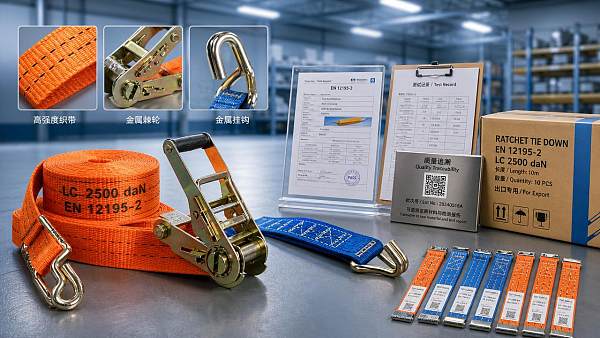
Cargo lashing belts secure goods during road, sea, rail, and intermodal transport. Their performance depends on webbing strength, ratchet durability, stitching quality, label accuracy, and traceable testing.
A qualified cargo lashing belts manufacturer in Europe should supply more than belts. It should provide documented conformity, stable batch consistency, responsive engineering support, and clear technical communication.
European sourcing often attracts buyers because regional standards are strict, documentation is stronger, and factory oversight can be more transparent. Still, not every supplier offers the same depth of control.
Core product elements to verify
- Webbing material, width, elongation, and abrasion resistance
- Ratchet, hooks, and end fittings material grade
- Breaking strength and lashing capacity consistency
- Sewing pattern repeatability and thread durability
- Labeling, batch coding, and traceability records
Current market signals in the European cargo restraint sector
The market for cargo securing products has changed. Buyers now watch not only unit cost, but also resilience against supply shocks, regulatory scrutiny, and customer claims related to transport damage.
A cargo lashing belts manufacturer in Europe is often evaluated through a wider operational lens. That includes raw material sourcing, energy costs, labor stability, and flexibility during demand spikes.
Certification and compliance checkpoints
When judging a cargo lashing belts manufacturer in Europe, compliance should come before negotiation. Product claims must match standard requirements, test evidence, and product marking without ambiguity.
For many applications, EN 12195-2 is the key reference for textile lashings. It defines labeling, safety conditions, and performance expectations used across transport and logistics operations.
Documents worth requesting
- Declaration of conformity linked to applicable standards
- Recent tensile test reports from qualified labs
- Material specifications for webbing and hardware
- Inspection procedures and final release criteria
- Label samples showing LC, STF, SHF, length, and traceability data
Check whether reports are current and product-specific. Generic files copied across models are a warning sign. Good suppliers connect each document to a clear SKU and production batch.
Production capability and quality consistency
A strong cargo lashing belts manufacturer in Europe should show repeatable production discipline. One successful sample does not prove the factory can maintain quality across large or urgent orders.
Evaluate the full process. That includes yarn or webbing sourcing, weaving or procurement control, dyeing consistency, cutting, stitching, hardware assembly, testing, packing, and shipment release.
Questions that reveal real capability
- What is the monthly output by width and lashing capacity?
- Which steps are in-house and which are outsourced?
- How are incoming materials approved and recorded?
- How often are tensile tests performed during production?
- What is the process for nonconforming batches?
Factories with mature systems answer directly and provide evidence. Vague replies usually mean weak process control or dependence on external subcontractors with limited visibility.
Commercial value beyond the quoted price
The cheapest cargo lashing belts manufacturer in Europe is rarely the most competitive over time. True cost includes rejection rates, claim exposure, delayed restocking, packaging errors, and service responsiveness.
A better supplier often improves margin through fewer complaints, better sell-through, and lower operational friction. That is especially important for private label distribution and repeat institutional orders.
Typical supplier types and selection fit
Not every cargo lashing belts manufacturer in Europe serves the same market position. Matching supplier type with business model helps avoid unnecessary cost or technical mismatch.
- High-volume standard producers: Suitable for recurring SKUs with stable specifications.
- Specialized technical factories: Better for heavy-duty, custom fittings, or niche transport uses.
- Private label focused suppliers: Useful when packaging, labels, and retail presentation matter.
- Hybrid traders with engineering support: Helpful when sourcing mixed restraint products across categories.
Selection fit matters because a factory optimized for industrial projects may not support retail-ready packaging. Likewise, a catalog supplier may struggle with unusual dimensions or hardware combinations.
Practical due diligence steps before approval
A structured review reduces sourcing risk. It also creates a consistent basis for comparing more than one cargo lashing belts manufacturer in Europe.
Recommended approval sequence
- Screen the website, product range, and standard claims for consistency.
- Request technical files, label samples, and recent test reports.
- Compare sample quality across stitching, ratchet finish, and labeling accuracy.
- Audit production capability through video, documents, or site visit.
- Run a pilot order with agreed inspection points and delivery milestones.
- Review service quality after the first shipment, not before.
During due diligence, pay attention to communication speed and technical clarity. Slow or inconsistent answers often create bigger problems after purchase orders are placed.
Warning signs that should not be ignored
Some risks appear early. A cargo lashing belts manufacturer in Europe may look credible online, yet basic checks can reveal gaps in control, transparency, or actual production ownership.
- No clear reference to applicable product standards
- Reluctance to share test reports or label details
- Large price changes without material explanation
- Unclear factory address or changing company identity
- Sample quality much better than bulk shipment consistency
These signs do not always mean fraud, but they often signal operational instability. In safety-related products, uncertainty should be treated as a direct commercial risk.
A disciplined next step for supplier shortlisting
To shortlist a cargo lashing belts manufacturer in Europe, create a simple scorecard. Rate compliance, sample quality, capacity, lead time, customization, export experience, and communication performance.
Then validate the top candidates through a pilot order and documented inspection plan. This method turns supplier selection into an evidence-based process instead of a price-driven guess.
For companies tracking industrial sourcing trends, TradeNexus Pro supports deeper evaluation with sector-focused market intelligence, technical context, and supply chain signals that improve supplier decisions across Europe.
Get weekly intelligence in your inbox.
No noise. No sponsored content. Pure intelligence.
 Oct 08, 2026How Digital Health Improves Diagnostic Accuracy and Workflow in Clinical LabsHow Digital Health Improves Diagnostic Accuracy and Workflow in Clinical Labs
 Oct 07, 2026Selecting Voice Picking Systems for German Warehouses: Integration, Languages and ROISelecting Voice Picking Systems for German Warehouses: Integration, Languages and ROI
 Oct 06, 2026How to Choose Last Mile Dispatch Software for On-Time Delivery at ScaleHow to Choose Last Mile Dispatch Software for On-Time Delivery at Scale
 Oct 05, 2026Vietnam’s Consumer Electronics Market: Demand Shifts and Sourcing OpportunitiesVietnam’s Consumer Electronics Market: Demand Shifts and Sourcing Opportunities
 Oct 04, 2026Digital Health Investment Priorities for Providers: Improving Access, Outcomes, and EfficiencyDigital Health Investment Priorities for Providers: Improving Access, Outcomes, and Efficiency
 Oct 03, 2026How to Specify an FR4 Custom PCB Board for High-Voltage and High-Heat DesignsHow to Specify an FR4 Custom PCB Board for High-Voltage and High-Heat Designs
 Oct 02, 2026ERP Software Market Intelligence: Adoption, Pricing, and Vendor Signals to WatchERP Software Market Intelligence: Adoption, Pricing, and Vendor Signals to Watch
 Oct 01, 2026How to Select Calibrated Temperature Data Loggers for GMP Cold Storage MonitoringHow to Select Calibrated Temperature Data Loggers for GMP Cold Storage Monitoring
 Sep 30, 2026Custom Molded Rubber Pricing: What Drives Unit Cost and Tooling Fees?Custom Molded Rubber Pricing: What Drives Unit Cost and Tooling Fees?
 Sep 29, 2026How to Evaluate Energy Management Software Vendors for Multi-Site OperationsHow to Evaluate Energy Management Software Vendors for Multi-Site Operations
 Sep 28, 2026How to Select a DIN Rail Smart Meter for Multi-Circuit Energy MonitoringHow to Select a DIN Rail Smart Meter for Multi-Circuit Energy Monitoring
 Sep 27, 2026TWS Earbuds in Vietnam: Demand Drivers, Price Tiers, and Retail Channel OpportunitiesTWS Earbuds in Vietnam: Demand Drivers, Price Tiers, and Retail Channel Opportunities
 Sep 26, 2026How UAE Clinics Can Qualify a Smart Glucometer Supplier for Accuracy and ComplianceHow UAE Clinics Can Qualify a Smart Glucometer Supplier for Accuracy and Compliance
 Sep 25, 2026Buying Aesthetic Lasers in the USA: FDA Status, Wavelengths, and Service SupportBuying Aesthetic Lasers in the USA: FDA Status, Wavelengths, and Service Support
 Sep 24, 2026Laser Cutting Brass Sheet: How to Prevent Burrs and Heat Marks on Thin PartsLaser Cutting Brass Sheet: How to Prevent Burrs and Heat Marks on Thin Parts
 Sep 23, 2026How to Choose Lightweight ANC Headphones for Comfortable All-Day TravelHow to Choose Lightweight ANC Headphones for Comfortable All-Day Travel
 Sep 22, 2026IPX5 TWS Bluetooth Earbuds: What Protection Do They Offer for Workouts?IPX5 TWS Bluetooth Earbuds: What Protection Do They Offer for Workouts?
 Sep 21, 2026What to Look for in a Grid Integration Company for Utility-Scale Solar ProjectsWhat to Look for in a Grid Integration Company for Utility-Scale Solar Projects
 Sep 20, 2026Microgrid Controller Pricing: What Drives Cost in Commercial Energy Projects?Microgrid Controller Pricing: What Drives Cost in Commercial Energy Projects?
 Sep 19, 2026How to Choose a GaN Charger for Laptops Without Compromising Power or PortabilityHow to Choose a GaN Charger for Laptops Without Compromising Power or Portability
 Sep 18, 2026Floating Solar Farm Costs: CAPEX, OPEX, and the Site Factors That Shape ROIFloating Solar Farm Costs: CAPEX, OPEX, and the Site Factors That Shape ROI
 Sep 17, 2026Drone Delivery Solutions for Last-Mile Routes: Site, Payload, and Range PlanningDrone Delivery Solutions for Last-Mile Routes: Site, Payload, and Range Planning
 Sep 16, 2026When Low-Volume Electronics Manufacturing Makes More Sense Than Mass ProductionWhen Low-Volume Electronics Manufacturing Makes More Sense Than Mass Production
 Sep 15, 2026Wholesale WiFi Smart Switches: What Buyers Should Verify Before OrderingWholesale WiFi Smart Switches: What Buyers Should Verify Before Ordering
 Sep 14, 2026How to Select IoT Sensors for Reliable Monitoring in Harsh Industrial EnvironmentsHow to Select IoT Sensors for Reliable Monitoring in Harsh Industrial Environments
 Sep 13, 2026How Procurement Teams Can Improve Supplier Reliability With Supply Chain VisibilityHow Procurement Teams Can Improve Supplier Reliability With Supply Chain Visibility
 Sep 12, 2026Smart Manufacturing Trends 2026: What Leaders Should Prioritize for ROISmart Manufacturing Trends 2026: What Leaders Should Prioritize for ROI



























