
Customs General Administration Adds 'Restriction ID' to Export Declarations
Starting May 20, 2026, the Customs General Administration of China will require all export customs declarations to include a new 'Restriction Identification Code' and associated declaration elements. The change applies specifically to sensitive categories including dual-use items, rare earths, unmanned aerial vehicles (UAVs), and AI chips — impacting exporters of CNC precision parts, electronic components, and intelligent devices. This update significantly increases the granularity of export compliance, with implications for global procurement teams, supply chain managers, and cross-border trade service providers.
Event Overview
Effective May 20, 2026, the Customs General Administration of China mandates the inclusion of a 'Restriction Identification Code' and related declaration elements on export customs declarations. The requirement covers goods classified as dual-use items, rare earths, UAVs, and AI chips. No further implementation details, transitional arrangements, or exemption criteria have been publicly released as of the effective date.
Industries Affected by Sector
Direct Exporters (Trading Enterprises)
Trading enterprises that declare exports directly face immediate operational impact: the new code must be accurately assigned and declared for covered goods. Errors or omissions may trigger customs holds, delays in release, or requests for post-submission verification — particularly for shipments involving precision-machined parts or integrated smart devices containing controlled components.
Contract Manufacturers & OEM/ODM Suppliers
Manufacturers producing CNC-machined parts, electronic assemblies, or AI-integrated equipment must now verify whether their finished products fall under the newly regulated categories — not only based on end-use but also on embedded components (e.g., AI accelerators, navigation modules). Their ability to provide compliant documentation — including the valid 'Restriction Identification Code' and supporting compliance statements — becomes a prerequisite for buyer acceptance.
Global Procurement & Import Compliance Teams
Overseas buyers sourcing from China — especially in aerospace, defense-adjacent sectors, semiconductor equipment, or autonomous systems — are now expected to proactively request the 'Restriction Identification Code' and supplier-issued compliance declarations. Failure to obtain and retain these may complicate import clearance in destination markets where end-use controls or licensing requirements apply.
Supply Chain Service Providers (Freight Forwarders, Customs Brokers)
Third-party logistics and customs service providers must update internal declaration templates, staff training materials, and client checklists to incorporate the new code field and its validation logic. Misclassification or inconsistent application across shipments may expose both service providers and clients to heightened scrutiny during customs audits.
What Enterprises and Practitioners Should Focus On Now
Monitor official guidance for interpretation and scope clarification
Analysis shows the initial announcement does not define how the 'Restriction Identification Code' is generated, assigned, or verified — nor does it specify whether it is issued by customs, industry authorities, or self-declared by exporters. Stakeholders should closely track follow-up notices from the Customs General Administration or the Ministry of Commerce for authoritative implementation rules.
Prioritize internal classification reviews for high-risk product lines
Observably, CNC precision parts, electronic modules, and intelligent devices are explicitly cited as examples where overseas buyers must obtain the code. Companies should review BOM-level component lists — especially for UAV control units, AI inference chips, or rare-earth-containing magnets — to determine applicability before May 20, 2026.
Distinguish between regulatory signal and operational readiness
From an industry perspective, this measure is best understood as a formalization of existing export control enforcement rather than a wholly new regime. However, the mandatory inclusion on the customs declaration form elevates visibility and accountability — meaning even historically low-risk shipments may now undergo systematic screening if flagged by the new code.
Prepare documentation workflows and supplier communication protocols
Current best practice involves updating procurement contracts and supplier questionnaires to require explicit confirmation of 'Restriction Identification Code' eligibility, along with retention of compliance statements. Internal ERP or export management systems should be configured to capture and archive these records alongside shipment data.
Editorial Perspective / Industry Observation
This regulatory update is more accurately interpreted as a procedural tightening than a substantive expansion of export controls. Analysis shows it reflects growing alignment between China’s customs declaration infrastructure and international end-use monitoring frameworks — particularly those applied by major importing jurisdictions such as the U.S., EU, and Japan. Observably, the emphasis on traceability for AI chips and UAVs signals continued prioritization of technology-sensitive supply chains. From an industry standpoint, the requirement is less about introducing new restrictions and more about enforcing consistent, auditable disclosure — making it a signal of institutionalized compliance expectations, not yet a fully matured enforcement outcome. Continued observation is warranted for how consistently the code is applied across ports and whether verification mechanisms evolve beyond declaration-level submission.
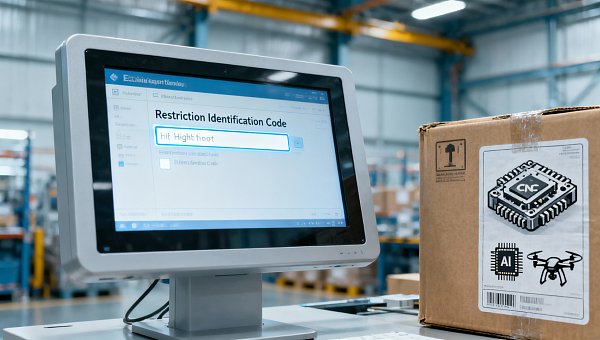
In summary, the introduction of the 'Restriction Identification Code' marks a structural shift toward higher transparency and accountability in China’s outbound trade documentation — particularly for technologically sensitive goods. It does not alter underlying export control laws, but it does raise the operational threshold for compliance verification. For stakeholders, this is best understood not as an isolated policy change, but as an incremental step in the broader trend toward harmonized, data-driven trade governance.
Source: Announcement issued by the Customs General Administration of China, effective May 20, 2026.
Note: Implementation guidelines, code assignment methodology, and verification procedures remain pending official publication and are subject to ongoing observation.
Get weekly intelligence in your inbox.
No noise. No sponsored content. Pure intelligence.
 Oct 08, 2026How Digital Health Improves Diagnostic Accuracy and Workflow in Clinical LabsHow Digital Health Improves Diagnostic Accuracy and Workflow in Clinical Labs
 Oct 07, 2026Selecting Voice Picking Systems for German Warehouses: Integration, Languages and ROISelecting Voice Picking Systems for German Warehouses: Integration, Languages and ROI
 Oct 06, 2026How to Choose Last Mile Dispatch Software for On-Time Delivery at ScaleHow to Choose Last Mile Dispatch Software for On-Time Delivery at Scale
 Oct 05, 2026Vietnam’s Consumer Electronics Market: Demand Shifts and Sourcing OpportunitiesVietnam’s Consumer Electronics Market: Demand Shifts and Sourcing Opportunities
 Oct 04, 2026Digital Health Investment Priorities for Providers: Improving Access, Outcomes, and EfficiencyDigital Health Investment Priorities for Providers: Improving Access, Outcomes, and Efficiency
 Oct 03, 2026How to Specify an FR4 Custom PCB Board for High-Voltage and High-Heat DesignsHow to Specify an FR4 Custom PCB Board for High-Voltage and High-Heat Designs
 Oct 02, 2026ERP Software Market Intelligence: Adoption, Pricing, and Vendor Signals to WatchERP Software Market Intelligence: Adoption, Pricing, and Vendor Signals to Watch
 Oct 01, 2026How to Select Calibrated Temperature Data Loggers for GMP Cold Storage MonitoringHow to Select Calibrated Temperature Data Loggers for GMP Cold Storage Monitoring
 Sep 30, 2026Custom Molded Rubber Pricing: What Drives Unit Cost and Tooling Fees?Custom Molded Rubber Pricing: What Drives Unit Cost and Tooling Fees?
 Sep 29, 2026How to Evaluate Energy Management Software Vendors for Multi-Site OperationsHow to Evaluate Energy Management Software Vendors for Multi-Site Operations
 Sep 28, 2026How to Select a DIN Rail Smart Meter for Multi-Circuit Energy MonitoringHow to Select a DIN Rail Smart Meter for Multi-Circuit Energy Monitoring
 Sep 27, 2026TWS Earbuds in Vietnam: Demand Drivers, Price Tiers, and Retail Channel OpportunitiesTWS Earbuds in Vietnam: Demand Drivers, Price Tiers, and Retail Channel Opportunities
 Sep 26, 2026How UAE Clinics Can Qualify a Smart Glucometer Supplier for Accuracy and ComplianceHow UAE Clinics Can Qualify a Smart Glucometer Supplier for Accuracy and Compliance
 Sep 25, 2026Buying Aesthetic Lasers in the USA: FDA Status, Wavelengths, and Service SupportBuying Aesthetic Lasers in the USA: FDA Status, Wavelengths, and Service Support
 Sep 24, 2026Laser Cutting Brass Sheet: How to Prevent Burrs and Heat Marks on Thin PartsLaser Cutting Brass Sheet: How to Prevent Burrs and Heat Marks on Thin Parts
 Sep 23, 2026How to Choose Lightweight ANC Headphones for Comfortable All-Day TravelHow to Choose Lightweight ANC Headphones for Comfortable All-Day Travel
 Sep 22, 2026IPX5 TWS Bluetooth Earbuds: What Protection Do They Offer for Workouts?IPX5 TWS Bluetooth Earbuds: What Protection Do They Offer for Workouts?
 Sep 21, 2026What to Look for in a Grid Integration Company for Utility-Scale Solar ProjectsWhat to Look for in a Grid Integration Company for Utility-Scale Solar Projects
 Sep 20, 2026Microgrid Controller Pricing: What Drives Cost in Commercial Energy Projects?Microgrid Controller Pricing: What Drives Cost in Commercial Energy Projects?
 Sep 19, 2026How to Choose a GaN Charger for Laptops Without Compromising Power or PortabilityHow to Choose a GaN Charger for Laptops Without Compromising Power or Portability
 Sep 18, 2026Floating Solar Farm Costs: CAPEX, OPEX, and the Site Factors That Shape ROIFloating Solar Farm Costs: CAPEX, OPEX, and the Site Factors That Shape ROI
 Sep 17, 2026Drone Delivery Solutions for Last-Mile Routes: Site, Payload, and Range PlanningDrone Delivery Solutions for Last-Mile Routes: Site, Payload, and Range Planning
 Sep 16, 2026When Low-Volume Electronics Manufacturing Makes More Sense Than Mass ProductionWhen Low-Volume Electronics Manufacturing Makes More Sense Than Mass Production
 Sep 15, 2026Wholesale WiFi Smart Switches: What Buyers Should Verify Before OrderingWholesale WiFi Smart Switches: What Buyers Should Verify Before Ordering
 Sep 14, 2026How to Select IoT Sensors for Reliable Monitoring in Harsh Industrial EnvironmentsHow to Select IoT Sensors for Reliable Monitoring in Harsh Industrial Environments
 Sep 13, 2026How Procurement Teams Can Improve Supplier Reliability With Supply Chain VisibilityHow Procurement Teams Can Improve Supplier Reliability With Supply Chain Visibility
 Sep 12, 2026Smart Manufacturing Trends 2026: What Leaders Should Prioritize for ROISmart Manufacturing Trends 2026: What Leaders Should Prioritize for ROI



























