APEC Suzhou Declaration Advances Cross-Border eBL Interoperability
APEC Trade Ministers adopted the Suzhou Declaration on May 27, 2026, establishing a technical framework for mutual recognition and system interoperability of cross-border electronic bills of lading (eBLs). This development is particularly relevant for freight SaaS providers, international freight forwarders, port authorities, and export-oriented trading enterprises — as it signals a coordinated shift toward standardized digital documentation across APEC economies.
Event Overview
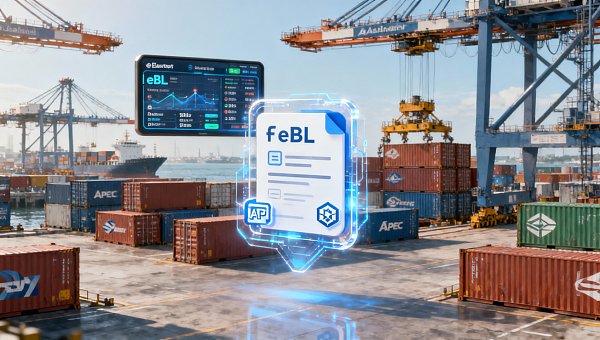
On May 27, 2026, the APEC Trade Ministers’ Meeting formally endorsed the Suzhou Declaration. The declaration sets out a common technical framework to enable interoperability among eBL systems used across APEC member economies. It affirms mutual recognition of legally valid electronic bills of lading and outlines baseline requirements for API-based integration between trade platforms, port systems, and customs environments.
Industries Affected
Direct Export/Import Trading Enterprises
These enterprises rely heavily on timely, error-free documentation for customs clearance and payment settlement. With eBL interoperability, manual re-entry and format conversion across jurisdictions will decrease — reducing delays and discrepancies in letter-of-credit processing and cargo release.
Freight Forwarding & Logistics Service Providers
Forwarders act as intermediaries between shippers, carriers, and ports. Standardized eBL interfaces mean reduced integration effort with multiple carrier or port systems. However, providers lacking API-ready infrastructure may face pressure to upgrade legacy platforms to remain competitive in APEC-aligned trade lanes.
Port Authorities & Terminal Operators
Ports handling significant APEC-origin or APEC-destination cargo will need to align their document acceptance protocols and system interfaces with the declared interoperability standards. This includes validating eBL signatures from foreign issuers and enabling seamless data exchange with national single-window systems.
Cross-Border Freight SaaS Providers
The declaration establishes de facto interoperability expectations for cloud-based trade platforms operating across APEC markets. Providers with modular, API-first architecture are better positioned to support customers in multi-jurisdictional workflows — while those relying on proprietary or siloed document formats may require engineering adjustments to maintain compliance.
What Stakeholders Should Monitor and Do Now
Track official implementation roadmaps from APEC working groups
The Suzhou Declaration sets principles and frameworks — not binding regulations. Stakeholders should monitor outputs from the APEC Electronic Commerce Steering Group (ECSG) and the APEC Sub-Committee on Customs Procedures (SCCP), where technical annexes and pilot timelines are expected to be published in late 2026.
Assess current eBL integration capabilities by trade lane
Not all APEC economies have equivalent legal frameworks for eBL validity. Companies should map which key export/import corridors (e.g., China–U.S., Japan–Vietnam, Australia–Malaysia) already support enforceable eBLs — and prioritize integration efforts accordingly, rather than assuming uniform readiness.
Distinguish policy signal from operational readiness
While the declaration is a high-level commitment, actual system-to-system interoperability requires bilateral or multilateral technical alignment. Businesses should avoid treating the declaration as an immediate go-live trigger; instead, treat it as a catalyst to initiate internal API compatibility reviews and vendor due diligence.
Prepare for documentation workflow redesign — not just software updates
eBL interoperability affects roles beyond IT: legal teams must verify jurisdictional enforceability; finance teams must adapt to near-real-time cargo release triggers; and operations teams must revise training for staff handling hybrid (paper + digital) transitions. Cross-functional alignment is essential before technical deployment.
Editorial Perspective / Industry Observation
Observably, the Suzhou Declaration functions primarily as a coordination signal — not an operational mandate. It reflects growing consensus among APEC economies on the necessity of interoperable digital trade infrastructure, but implementation remains decentralized and voluntary. Analysis shows that its real impact will unfold over 2–4 years, contingent on national regulatory adoption and bilateral testing outcomes. From an industry perspective, this is less about immediate compliance and more about strategic positioning: firms that treat interoperability as a design requirement — not an add-on feature — will gain scalability advantages in APEC-aligned digital trade corridors.
Concluding, the Suzhou Declaration marks a foundational step toward harmonized eBL use across APEC — yet it does not replace jurisdiction-specific legal validation or eliminate transitional friction. It is best understood not as a new standard already in force, but as a shared reference point guiding future technical and regulatory alignment. Stakeholders benefit most by treating it as a planning horizon marker — informing platform investment cycles, integration priorities, and cross-border documentation strategy — rather than an immediate operational deadline.
Source: Official APEC Trade Ministers’ Meeting communiqué, May 27, 2026. Note: Technical annexes, national implementation timelines, and pilot program details remain pending publication and are subject to ongoing APEC working group deliberation.
Get weekly intelligence in your inbox.
No noise. No sponsored content. Pure intelligence.
 Oct 24, 2026Tesla Q3 2026 Storage Deployments Rank Second Highest as Revenue Falls 16%Tesla Q3 2026 Storage Deployments Rank Second Highest as Revenue Falls 16%
 Oct 24, 2026Freight Forwarding Services Pricing: Comparing Quotes Beyond Base RatesFreight Forwarding Services Pricing: Comparing Quotes Beyond Base Rates
 Oct 23, 2026IndexBox Issues Off-Grid Solar Outlook to 2035, Forecasting 8.2% CAGRIndexBox Issues Off-Grid Solar Outlook to 2035, Forecasting 8.2% CAGR
 Oct 23, 2026NSF/ANSI 49 Biosafety Cabinets: Product Certification vs. Field TestingNSF/ANSI 49 Biosafety Cabinets: Product Certification vs. Field Testing
 Oct 22, 2026Mitsubishi Electric Develops Industry-First Humanoid Robot–CNC Machining SystemMitsubishi Electric Develops Industry-First Humanoid Robot–CNC Machining System
 Oct 22, 2026Aerospace Aluminum Machining: How to Control Distortion in Thin-Wall PartsAerospace Aluminum Machining: How to Control Distortion in Thin-Wall Parts
 Oct 21, 2026Genesis Energy commissions 200 MWh battery storage system at HuntlyGenesis Energy commissions 200 MWh battery storage system at Huntly
 Oct 21, 2026Buying AMI Smart Meters Wholesale: Compatibility Checks and Total CostsBuying AMI Smart Meters Wholesale: Compatibility Checks and Total Costs
 Oct 20, 2026Werner Enterprises Issues Q3 Earnings Warning as Costs RiseWerner Enterprises Issues Q3 Earnings Warning as Costs Rise
 Oct 20, 2026Are Digital Twins Viable for SMEs? Costs, Use Cases, and Data RequirementsAre Digital Twins Viable for SMEs? Costs, Use Cases, and Data Requirements
 Oct 19, 2026Choosing a Wholesale Servo Motor Exporter: Traceability and Warranty ChecksChoosing a Wholesale Servo Motor Exporter: Traceability and Warranty Checks
 Oct 18, 2026Syringe Manufacturing Equipment: Evaluating Throughput and Assembly AccuracySyringe Manufacturing Equipment: Evaluating Throughput and Assembly Accuracy
 Oct 17, 2026Air Freight Forwarding Services: How to Compare Quotes for Urgent ShipmentsAir Freight Forwarding Services: How to Compare Quotes for Urgent Shipments
 Oct 16, 2026Wholesale Solar Panels: How to Compare Bulk Quotes by Total Landed CostWholesale Solar Panels: How to Compare Bulk Quotes by Total Landed Cost
 Oct 15, 2026Supply Chain Intelligence for Sourcing: How to Vet New SuppliersSupply Chain Intelligence for Sourcing: How to Vet New Suppliers
 Oct 14, 2026How energy costs shape smart manufacturing investment in EuropeHow energy costs shape smart manufacturing investment in Europe
 Oct 14, 2026How skills shortages slow smart manufacturing in Southeast AsiaHow skills shortages slow smart manufacturing in Southeast Asia
 Oct 14, 2026How CNC wire-cut machining maintains tight tolerances in thick partsHow CNC wire-cut machining maintains tight tolerances in thick parts
 Oct 14, 2026Can automated feeding stabilize metal forming in smart factories?Can automated feeding stabilize metal forming in smart factories?
 Oct 14, 2026Can CT inspection detect internal defects in metal additive parts?Can CT inspection detect internal defects in metal additive parts?
 Oct 14, 2026When does additive manufacturing reduce lead time for spare parts?When does additive manufacturing reduce lead time for spare parts?
 Oct 14, 2026How production volume affects ROI on an automated painting lineHow production volume affects ROI on an automated painting line
 Oct 14, 2026What data does manufacturing bottleneck analysis consulting need?What data does manufacturing bottleneck analysis consulting need?
 Oct 14, 2026When should you hire a consultant for manufacturing bottlenecks?When should you hire a consultant for manufacturing bottlenecks?
 Oct 14, 2026What Are Electronics Exporters' Top Supply Chain Resilience Gaps in 2026?What Are Electronics Exporters' Top Supply Chain Resilience Gaps in 2026?
 Oct 14, 2026How Do You Measure AI Adoption Maturity in a Traditional Factory?How Do You Measure AI Adoption Maturity in a Traditional Factory?
 Oct 14, 2026Are Chinese AI-Assisted Surgical Devices Gaining Global Trust?Are Chinese AI-Assisted Surgical Devices Gaining Global Trust?