Deep Cycle Batteries Explained: AGM, Gel, and Lithium Compared
For technical evaluators, selecting deep cycle batteries is no longer a simple choice between cost and capacity.
AGM, Gel, and Lithium chemistries each deliver distinct advantages in cycle life, discharge performance, maintenance requirements, safety, and total cost of ownership.
As energy storage becomes critical across mobility, backup power, renewable systems, and industrial applications, understanding these differences is essential for reliable decisions.
This guide compares the core technologies behind deep cycle batteries to help teams assess performance trade-offs with greater confidence.
Why Deep Cycle Batteries Require Scenario-Based Evaluation
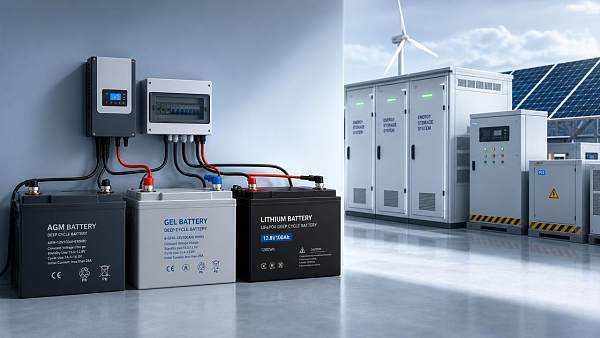
Deep cycle batteries are designed for repeated discharge and recharge, unlike starting batteries that deliver short bursts of high current.
That distinction matters in solar storage, marine power, floor cleaning equipment, telecom backup, mobility systems, and off-grid installations.
A battery that performs well in standby service may fail early under daily cycling, vibration, heat, or deep discharge stress.
For this reason, deep cycle batteries should be judged by operating profile, not only rated amp-hours or upfront price.
The right choice depends on depth of discharge, charge speed, ambient temperature, maintenance access, safety limits, and expected service life.
AGM Deep Cycle Batteries for Rugged, Low-Maintenance Use
AGM means Absorbent Glass Mat, a sealed lead-acid design using fiberglass separators to hold electrolyte close to the plates.
AGM deep cycle batteries are popular where spill resistance, vibration tolerance, and moderate cost are important decision factors.
They usually accept higher charge rates than Gel batteries and perform reliably in mobile or semi-mobile equipment.
Common scenarios include recreational vehicles, marine house banks, emergency lighting, UPS systems, and industrial carts with predictable duty cycles.
However, AGM deep cycle batteries remain sensitive to over-discharge, high heat, and chronic undercharging.
When repeatedly discharged below recommended limits, their cycle life can fall sharply, raising total replacement cost.
Best-fit scenarios for AGM
- Moderate cycling with reliable charging access.
- Applications requiring sealed, spill-resistant batteries.
- Systems exposed to vibration or movement.
- Projects needing lower upfront cost than Lithium.
Gel Deep Cycle Batteries for Stable, Controlled Discharge
Gel batteries use silica to immobilize electrolyte, creating a thick gel that reduces leakage and improves deep-discharge stability.
Gel deep cycle batteries are often chosen for sensitive systems requiring slow, steady power delivery.
They can tolerate deeper discharge better than many standard flooded lead-acid designs when properly charged.
Typical uses include medical mobility devices, remote monitoring equipment, marine electronics, and off-grid loads with limited maintenance access.
The key limitation is charging sensitivity. Gel batteries require accurate voltage control and compatible chargers.
Excessive charging voltage can create gas pockets inside the gel, permanently reducing capacity and service life.
Best-fit scenarios for Gel
- Low-to-moderate discharge rates over longer periods.
- Installations where leakage control is essential.
- Remote systems with stable charge settings.
- Applications avoiding high surge loads.
Lithium Deep Cycle Batteries for High Utilization and Fast Charging
Lithium deep cycle batteries, especially LiFePO4 types, have changed expectations for cycle life, usable capacity, and energy density.
They can often deliver thousands of cycles when operated within specified voltage and temperature ranges.
Unlike lead-acid batteries, Lithium models can usually use a much larger percentage of rated capacity.
This makes them attractive for solar storage, electric mobility, robotics, marine propulsion, portable power, and high-frequency industrial duty.
They also charge faster, weigh less, and maintain voltage more consistently during discharge.
The main concerns are higher initial cost, charger compatibility, battery management system quality, and low-temperature charging protection.
Best-fit scenarios for Lithium
- Daily cycling with high depth of discharge.
- Weight-sensitive vehicles, vessels, or mobile systems.
- Renewable energy systems needing high usable capacity.
- Operations where downtime and replacement labor are costly.
Application Scenarios That Change Battery Priorities
Different use cases place different stress on deep cycle batteries, even when nominal voltage and capacity appear similar.
A solar bank may need long cycle life, while a standby backup system may prioritize reliability after months of float charging.
Mobile equipment may value vibration resistance and weight savings, while telecom shelters may focus on thermal stability and service intervals.
Performance Differences That Affect Total Cost
The true cost of deep cycle batteries is not limited to purchase price.
Replacement frequency, usable capacity, downtime, shipping weight, installation labor, and charger upgrades all influence lifecycle economics.
AGM usually offers a strong balance when cycling demand is moderate and budget pressure is high.
Gel can be valuable where controlled charging and low leakage risk are more important than rapid recharge.
Lithium often wins when daily use, weight reduction, and long service life outweigh initial investment.
Scenario Adaptation Checklist for Deep Cycle Batteries
A structured checklist helps prevent specification gaps and mismatched battery selection.
Before comparing quotes, define the operating conditions that will determine real battery performance.
- Calculate average daily energy consumption in watt-hours.
- Confirm maximum discharge current and surge demand.
- Define acceptable depth of discharge for each chemistry.
- Check charger voltage profile and temperature compensation.
- Evaluate installation space, ventilation, vibration, and orientation.
- Compare lifecycle cost, not only purchase cost.
- Verify safety certifications, warranty terms, and technical documentation.
For deep cycle batteries in mission-critical systems, performance data should include cycle curves, temperature ratings, and recommended charging settings.
For Lithium products, battery management system specifications should be reviewed as closely as cell chemistry.
Common Misjudgments When Comparing AGM, Gel, and Lithium
One common mistake is treating rated capacity as fully usable capacity.
Many lead-acid deep cycle batteries should not be repeatedly discharged to very low levels.
Another error is replacing AGM or Gel with Lithium without checking charger compatibility.
Incorrect charging can reduce performance, trigger protection circuits, or create safety risks.
Temperature is also underestimated. Heat accelerates lead-acid aging, while freezing conditions affect Lithium charging behavior.
Weight calculations are sometimes ignored in mobile systems, even though battery mass affects payload, range, and structural design.
Finally, warranty length should not replace technical evaluation.
The warranty may exclude deep discharge, improper charging, high temperature exposure, or unsupported configurations.
How to Choose the Right Deep Cycle Batteries
Choose AGM when the project needs sealed construction, proven durability, moderate cycling, and reasonable initial investment.
Choose Gel when stable discharge, low leakage risk, and controlled charging environments matter more than fast recharge.
Choose Lithium when deep cycle batteries must support frequent cycling, high usable energy, lower weight, and longer replacement intervals.
In many industrial and green energy applications, the strongest choice is not the cheapest battery.
It is the option that matches duty cycle, installation constraints, charging infrastructure, and lifecycle budget.
Action Steps for Reliable Battery Decisions
Start with a load profile, then shortlist deep cycle batteries by chemistry, operating temperature, discharge rate, and expected cycle count.
Request datasheets showing test conditions, not only marketing capacity claims.
Validate charger compatibility before approving AGM, Gel, or Lithium substitutions.
Where downtime is expensive, calculate replacement labor and operational disruption as part of total ownership cost.
TradeNexus Pro supports data-driven evaluation across green energy, advanced manufacturing, smart electronics, healthcare technology, and supply chain SaaS.
For complex sourcing and technology comparisons, scenario-based intelligence helps turn battery selection into a measurable strategic decision.
Get weekly intelligence in your inbox.
No noise. No sponsored content. Pure intelligence.
 Oct 24, 2026Tesla Q3 2026 Storage Deployments Rank Second Highest as Revenue Falls 16%Tesla Q3 2026 Storage Deployments Rank Second Highest as Revenue Falls 16%
 Oct 24, 2026Freight Forwarding Services Pricing: Comparing Quotes Beyond Base RatesFreight Forwarding Services Pricing: Comparing Quotes Beyond Base Rates
 Oct 23, 2026IndexBox Issues Off-Grid Solar Outlook to 2035, Forecasting 8.2% CAGRIndexBox Issues Off-Grid Solar Outlook to 2035, Forecasting 8.2% CAGR
 Oct 23, 2026NSF/ANSI 49 Biosafety Cabinets: Product Certification vs. Field TestingNSF/ANSI 49 Biosafety Cabinets: Product Certification vs. Field Testing
 Oct 22, 2026Mitsubishi Electric Develops Industry-First Humanoid Robot–CNC Machining SystemMitsubishi Electric Develops Industry-First Humanoid Robot–CNC Machining System
 Oct 22, 2026Aerospace Aluminum Machining: How to Control Distortion in Thin-Wall PartsAerospace Aluminum Machining: How to Control Distortion in Thin-Wall Parts
 Oct 21, 2026Genesis Energy commissions 200 MWh battery storage system at HuntlyGenesis Energy commissions 200 MWh battery storage system at Huntly
 Oct 21, 2026Buying AMI Smart Meters Wholesale: Compatibility Checks and Total CostsBuying AMI Smart Meters Wholesale: Compatibility Checks and Total Costs
 Oct 20, 2026Werner Enterprises Issues Q3 Earnings Warning as Costs RiseWerner Enterprises Issues Q3 Earnings Warning as Costs Rise
 Oct 20, 2026Are Digital Twins Viable for SMEs? Costs, Use Cases, and Data RequirementsAre Digital Twins Viable for SMEs? Costs, Use Cases, and Data Requirements
 Oct 19, 2026Choosing a Wholesale Servo Motor Exporter: Traceability and Warranty ChecksChoosing a Wholesale Servo Motor Exporter: Traceability and Warranty Checks
 Oct 18, 2026Syringe Manufacturing Equipment: Evaluating Throughput and Assembly AccuracySyringe Manufacturing Equipment: Evaluating Throughput and Assembly Accuracy
 Oct 17, 2026Air Freight Forwarding Services: How to Compare Quotes for Urgent ShipmentsAir Freight Forwarding Services: How to Compare Quotes for Urgent Shipments
 Oct 16, 2026Wholesale Solar Panels: How to Compare Bulk Quotes by Total Landed CostWholesale Solar Panels: How to Compare Bulk Quotes by Total Landed Cost
 Oct 15, 2026Supply Chain Intelligence for Sourcing: How to Vet New SuppliersSupply Chain Intelligence for Sourcing: How to Vet New Suppliers
 Oct 14, 2026How energy costs shape smart manufacturing investment in EuropeHow energy costs shape smart manufacturing investment in Europe
 Oct 14, 2026How skills shortages slow smart manufacturing in Southeast AsiaHow skills shortages slow smart manufacturing in Southeast Asia
 Oct 14, 2026How CNC wire-cut machining maintains tight tolerances in thick partsHow CNC wire-cut machining maintains tight tolerances in thick parts
 Oct 14, 2026Can automated feeding stabilize metal forming in smart factories?Can automated feeding stabilize metal forming in smart factories?
 Oct 14, 2026Can CT inspection detect internal defects in metal additive parts?Can CT inspection detect internal defects in metal additive parts?
 Oct 14, 2026When does additive manufacturing reduce lead time for spare parts?When does additive manufacturing reduce lead time for spare parts?
 Oct 14, 2026How production volume affects ROI on an automated painting lineHow production volume affects ROI on an automated painting line
 Oct 14, 2026What data does manufacturing bottleneck analysis consulting need?What data does manufacturing bottleneck analysis consulting need?
 Oct 14, 2026When should you hire a consultant for manufacturing bottlenecks?When should you hire a consultant for manufacturing bottlenecks?
 Oct 14, 2026What Are Electronics Exporters' Top Supply Chain Resilience Gaps in 2026?What Are Electronics Exporters' Top Supply Chain Resilience Gaps in 2026?
 Oct 14, 2026How Do You Measure AI Adoption Maturity in a Traditional Factory?How Do You Measure AI Adoption Maturity in a Traditional Factory?
 Oct 14, 2026Are Chinese AI-Assisted Surgical Devices Gaining Global Trust?Are Chinese AI-Assisted Surgical Devices Gaining Global Trust?