Syringe Manufacturing Process Explained: Materials, Sterilization, and Quality Checks
Syringe manufacturing sits at the intersection of healthcare technology, advanced manufacturing, and regulatory control. A syringe looks simple, yet its production demands strict material selection, contamination control, validated sterilization, and repeatable inspection. In practice, small process deviations can affect dose accuracy, sterility assurance, plunger movement, and patient safety. That is why the syringe manufacturing process deserves close attention not only on the factory floor, but also across supplier qualification, traceability, and global healthcare supply planning.
Why syringe manufacturing now draws wider industry attention
Healthcare demand has grown more sensitive to product reliability, cleanroom discipline, and supply chain resilience. Syringe manufacturing is no longer viewed as a routine conversion process.
It is also shaped by broader industrial forces. Resin availability, stainless-steel quality, automation upgrades, and packaging material shortages can all influence output consistency.
This is where a cross-sector lens matters. Platforms such as TradeNexus Pro often track how manufacturing capability, healthcare compliance, and supply chain data increasingly connect.
For operations and compliance teams, the main question is straightforward: where are the highest risks, and how should they be controlled before a batch is released?
What the syringe manufacturing process includes
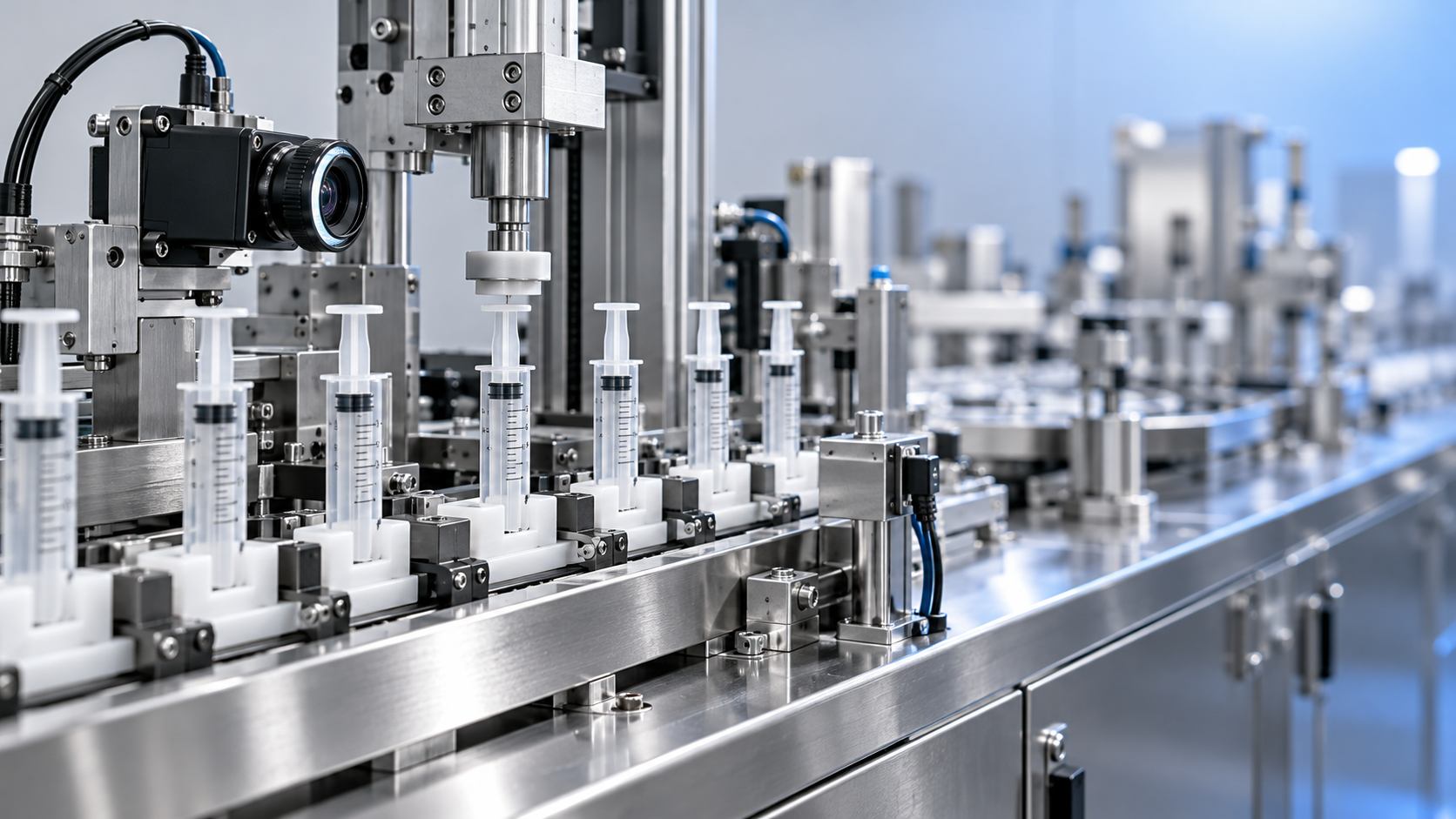
In most cases, syringe manufacturing covers component production, assembly, sterilization, packaging, inspection, and batch documentation. Each stage must support the intended clinical use.
A standard disposable syringe often includes a barrel, plunger, gasket, needle or needle hub, protective cap, and sterile barrier packaging.
Depending on the product format, syringe manufacturing may involve two-part or three-part syringes, safety syringes, prefilled systems, or specialty devices for precise dosing.
The process is not only about forming parts. It is about achieving dimensional control, biocompatibility, low particulate generation, and proven sterility assurance.
Materials define performance before molding begins
Material choice is one of the earliest quality gates in syringe manufacturing. Most disposable barrels and plungers use medical-grade polypropylene because it balances clarity, processability, and chemical resistance.
Elastomeric gaskets are selected for sealing performance and compatibility with drugs or fluids. Needle cannulas usually rely on stainless steel with controlled surface finish and corrosion resistance.
What matters is not only the material family, but also the grade, supplier controls, additive profile, and lot-to-lot consistency.
Common material review points include:
- Biocompatibility and regulatory declarations
- Extractables and leachables risk
- Sterilization compatibility
- Mechanical stability during storage and transport
- Dimensional behavior after molding or assembly
In syringe manufacturing, a poor resin specification can create brittleness, haze, flash, or inconsistent fit. A poor steel source can increase burr risk and needle defects.
Typical materials and related concerns
Molding, assembly, and contamination control
Once approved materials enter production, syringe manufacturing depends heavily on controlled molding conditions. Injection parameters influence wall thickness, transparency, short shots, flash, and warpage.
Tool maintenance is just as important. Worn molds can quietly increase particulate load or dimensional variation long before obvious defects appear.
Assembly usually takes place in controlled environments. Needle insertion, gasket fitting, lubrication, and cap placement all create opportunities for contamination or mechanical mismatch.
In syringe manufacturing, contamination control is broader than microbiology. Fibers, metal fragments, silicone imbalance, plastic dust, and packaging debris all matter.
Clean production points worth tracking
- Environmental monitoring trends, not just pass or fail results
- Operator gowning discipline and intervention frequency
- Lubricant application consistency
- Equipment cleaning validation and line clearance
- Segregation of raw, in-process, and released components
A capable plant treats these factors as process variables, not housekeeping details. That distinction often separates stable output from recurring deviations.
Sterilization is a validation exercise, not a finishing step
Sterilization in syringe manufacturing is sometimes misunderstood as the final kill step that fixes earlier weaknesses. In reality, it cannot compensate for poor assembly hygiene or damaged packaging.
Common methods include ethylene oxide, gamma irradiation, and in some cases electron beam. The right method depends on material tolerance, packaging design, and target shelf life.
Validation usually examines biological effectiveness, material compatibility, residuals, dose mapping, and packaging integrity after exposure.
A strong syringe manufacturing program connects sterilization data to upstream process knowledge. If polymer aging, seal weakness, or lubricant instability appears after sterilization, the issue began earlier.
What should be reviewed in sterilization records
- Validated cycle parameters and approved load configuration
- Evidence of consistent sterilant penetration
- Residual testing where relevant
- Requalification timing and deviation history
- Package seal performance after processing and aging
Quality checks that actually determine release confidence
Effective quality control in syringe manufacturing is layered. Incoming checks, in-process controls, finished product testing, and document review should support each other.
Visual inspection remains essential, but it should not be the only barrier. Many critical problems are functional or statistical rather than obvious to the eye.
High-value checks often include:
- Dimensional verification of barrel, tip, and plunger fit
- Leakage and pressure resistance testing
- Plunger movement force and glide performance
- Needle bonding strength and sharpness
- Sterile barrier seal integrity
- Particulate and cosmetic defect inspection
- Label, lot code, and traceability confirmation
In syringe manufacturing, trending matters as much as acceptance. Repeated borderline results often signal drift before a formal out-of-specification event occurs.
Where batch risk usually hides
Some of the highest risks are not dramatic failures. They are gradual shifts that seem minor when viewed one lot at a time.
Examples include subtle resin substitution, increased mold wear, unstable siliconization, packaging seal drift, and rising intervention rates in clean areas.
From a business perspective, these issues affect more than compliance. They influence complaint rates, recalls, line downtime, supplier trust, and export readiness.
This is one reason industry intelligence has practical value. TNP’s focus on deep sector analysis reflects a real operational need: technical quality signals often originate in supply chain changes.
How to evaluate a syringe manufacturing system more effectively
A useful review does not stop at certificates or end-product results. It connects material data, process capability, sterilization validation, and release records into one control story.
When assessing syringe manufacturing, it helps to verify:
- Whether approved materials are traceable to exact production lots
- Whether critical dimensions are monitored with trend analysis
- Whether sterilization is revalidated after packaging or material changes
- Whether deviations are investigated for root cause, not only disposition
- Whether complaint feedback loops influence process controls
That approach creates a more realistic picture of control maturity. It also supports better supplier comparison and stronger release confidence.
A practical next step
The best way to use this understanding is to map the full syringe manufacturing flow against actual risk points in materials, clean production, sterilization, and final inspection.
Then compare that map with current records, supplier controls, and deviation trends. Gaps usually become visible when process steps are reviewed as one connected system.
For teams watching both quality and market stability, it also makes sense to track broader healthcare manufacturing signals, especially where component sourcing and process reliability overlap.
In syringe manufacturing, consistency is rarely the result of one strong test. It is the result of disciplined control at every stage, long before a product reaches sterile packaging.
Get weekly intelligence in your inbox.
No noise. No sponsored content. Pure intelligence.
 Oct 24, 2026Tesla Q3 2026 Storage Deployments Rank Second Highest as Revenue Falls 16%Tesla Q3 2026 Storage Deployments Rank Second Highest as Revenue Falls 16%
 Oct 24, 2026Freight Forwarding Services Pricing: Comparing Quotes Beyond Base RatesFreight Forwarding Services Pricing: Comparing Quotes Beyond Base Rates
 Oct 23, 2026IndexBox Issues Off-Grid Solar Outlook to 2035, Forecasting 8.2% CAGRIndexBox Issues Off-Grid Solar Outlook to 2035, Forecasting 8.2% CAGR
 Oct 23, 2026NSF/ANSI 49 Biosafety Cabinets: Product Certification vs. Field TestingNSF/ANSI 49 Biosafety Cabinets: Product Certification vs. Field Testing
 Oct 22, 2026Mitsubishi Electric Develops Industry-First Humanoid Robot–CNC Machining SystemMitsubishi Electric Develops Industry-First Humanoid Robot–CNC Machining System
 Oct 22, 2026Aerospace Aluminum Machining: How to Control Distortion in Thin-Wall PartsAerospace Aluminum Machining: How to Control Distortion in Thin-Wall Parts
 Oct 21, 2026Genesis Energy commissions 200 MWh battery storage system at HuntlyGenesis Energy commissions 200 MWh battery storage system at Huntly
 Oct 21, 2026Buying AMI Smart Meters Wholesale: Compatibility Checks and Total CostsBuying AMI Smart Meters Wholesale: Compatibility Checks and Total Costs
 Oct 20, 2026Werner Enterprises Issues Q3 Earnings Warning as Costs RiseWerner Enterprises Issues Q3 Earnings Warning as Costs Rise
 Oct 20, 2026Are Digital Twins Viable for SMEs? Costs, Use Cases, and Data RequirementsAre Digital Twins Viable for SMEs? Costs, Use Cases, and Data Requirements
 Oct 19, 2026Choosing a Wholesale Servo Motor Exporter: Traceability and Warranty ChecksChoosing a Wholesale Servo Motor Exporter: Traceability and Warranty Checks
 Oct 18, 2026Syringe Manufacturing Equipment: Evaluating Throughput and Assembly AccuracySyringe Manufacturing Equipment: Evaluating Throughput and Assembly Accuracy
 Oct 17, 2026Air Freight Forwarding Services: How to Compare Quotes for Urgent ShipmentsAir Freight Forwarding Services: How to Compare Quotes for Urgent Shipments
 Oct 16, 2026Wholesale Solar Panels: How to Compare Bulk Quotes by Total Landed CostWholesale Solar Panels: How to Compare Bulk Quotes by Total Landed Cost
 Oct 15, 2026Supply Chain Intelligence for Sourcing: How to Vet New SuppliersSupply Chain Intelligence for Sourcing: How to Vet New Suppliers
 Oct 14, 2026How energy costs shape smart manufacturing investment in EuropeHow energy costs shape smart manufacturing investment in Europe
 Oct 14, 2026How skills shortages slow smart manufacturing in Southeast AsiaHow skills shortages slow smart manufacturing in Southeast Asia
 Oct 14, 2026How CNC wire-cut machining maintains tight tolerances in thick partsHow CNC wire-cut machining maintains tight tolerances in thick parts
 Oct 14, 2026Can automated feeding stabilize metal forming in smart factories?Can automated feeding stabilize metal forming in smart factories?
 Oct 14, 2026Can CT inspection detect internal defects in metal additive parts?Can CT inspection detect internal defects in metal additive parts?
 Oct 14, 2026When does additive manufacturing reduce lead time for spare parts?When does additive manufacturing reduce lead time for spare parts?
 Oct 14, 2026How production volume affects ROI on an automated painting lineHow production volume affects ROI on an automated painting line
 Oct 14, 2026What data does manufacturing bottleneck analysis consulting need?What data does manufacturing bottleneck analysis consulting need?
 Oct 14, 2026When should you hire a consultant for manufacturing bottlenecks?When should you hire a consultant for manufacturing bottlenecks?
 Oct 14, 2026What Are Electronics Exporters' Top Supply Chain Resilience Gaps in 2026?What Are Electronics Exporters' Top Supply Chain Resilience Gaps in 2026?
 Oct 14, 2026How Do You Measure AI Adoption Maturity in a Traditional Factory?How Do You Measure AI Adoption Maturity in a Traditional Factory?
 Oct 14, 2026Are Chinese AI-Assisted Surgical Devices Gaining Global Trust?Are Chinese AI-Assisted Surgical Devices Gaining Global Trust?