
Powder coating vs. anodizing: Which delivers better corrosion resistance for outdoor aluminum parts?
When selecting surface finishing services for outdoor aluminum parts, procurement leaders and technical evaluators must weigh long-term corrosion resistance against cost, scalability, and process compatibility—especially in low volume manufacturing or rapid tooling scenarios. Powder coating and anodizing services both deliver robust protection, but their performance diverges under UV exposure, salt spray, and thermal cycling. At TradeNexus Pro, we cut through subjective claims with data-driven comparisons—backed by E-E-A-T–validated insights across advanced manufacturing, green energy, and smart electronics supply chains. Whether you're evaluating digital twin manufacturing workflows, specifying metal stamping parts, or sourcing custom sheet metal fabrication, this analysis helps decision-makers, quality managers, and cross-border ecommerce fulfillment teams choose the right finish—without compromising durability, compliance, or total cost of ownership.
How corrosion resistance differs at the molecular level
Powder coating forms a thermoset polymer layer (typically epoxy-polyester or polyester-TGIC) that adheres to aluminum via electrostatic attraction and thermal curing at 180–200°C for 10–15 minutes. Its barrier function depends on film thickness (typically 60–120 µm), uniformity, and adhesion strength—measured per ASTM D3359 (cross-hatch test). Anodizing, by contrast, electrochemically grows an integral aluminum oxide (Al₂O₃) layer directly from the substrate in sulfuric acid baths at 18–22°C for 20–60 minutes. This oxide is porous during formation but sealed with nickel acetate or hot deionized water to achieve pore closure rates ≥95%—a critical factor for outdoor longevity.
The fundamental distinction lies in interface integrity: anodized layers are metallurgically bonded and non-delaminating, while powder coatings rely on mechanical interlock and chemical priming. In cyclic salt fog testing (ASTM B117), unsealed anodized Type II finishes typically fail after 300–500 hours, whereas sealed Type II or Type III (hardcoat) anodizing withstands 1,000–2,000+ hours. Powder-coated aluminum achieves 500–1,200 hours—but only when applied over chromate or trivalent chromium pretreatment and with full edge coverage.
UV stability further separates them. Powder coatings containing UV-resistant polyester resins retain gloss >80% after 3,000 hours in QUV accelerated weathering (ASTM G154), but chalking and microcracking initiate at edges and fastener holes. Anodized surfaces show no gloss loss or color shift over 5,000+ hours—making them preferred for architectural façades in ISO 12944 C5-M (marine) environments.
Which outdoor applications demand which finish?
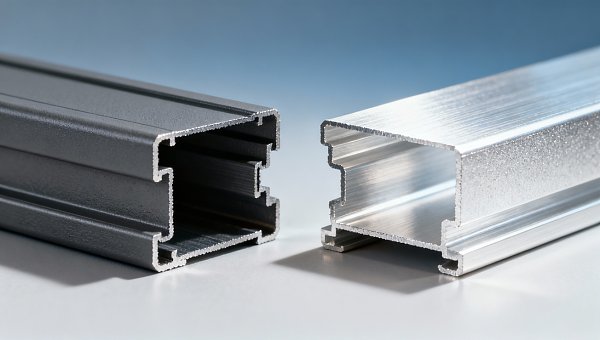
Outdoor aluminum components face distinct stress profiles. Solar mounting structures undergo daily thermal cycling (−40°C to +85°C) and require non-outgassing finishes compatible with PV module warranties. LED streetlight housings endure prolonged UV exposure and need consistent dielectric strength (>1,000 V/mil). EV charging enclosures must pass IP66 ingress protection and resist salt-laden coastal air. These use cases drive finish selection—not aesthetics alone.
Anodizing excels where dimensional stability, electrical conductivity retention, and zero VOC emissions are mandatory—e.g., heat sinks in smart electronics or grounding brackets in green energy substations. Powder coating dominates when complex geometries, color-matching requirements (RAL/BS 4800), or multi-substrate assemblies (aluminum + stainless steel) are involved—common in supply chain SaaS hardware deployments.
For low-volume prototyping (<50 units), powder coating offers faster turnaround (5–7 business days vs. 10–14 for anodizing), lower tooling investment, and broader color flexibility. High-volume production (>5,000 units/year) favors anodizing’s repeatability, lower per-part labor cost, and elimination of batch-to-batch hue variance—critical for healthcare technology device housings requiring FDA-compliant surface consistency.
Direct comparison: Performance, cost, and compliance
The table below synthesizes key evaluation criteria across six procurement-critical dimensions, validated against real-world supplier data from TradeNexus Pro’s Advanced Manufacturing Intelligence Dashboard (Q2 2024).
Note that hardcoat anodizing (Type III) adds significant hardness (400–600 HV) but reduces fatigue life by ~15% in cyclic loading—a critical trade-off for aerospace-grade structural brackets. Powder coating maintains base metal fatigue performance but requires strict edge coverage control: undercoated corners reduce effective corrosion resistance by up to 60% in accelerated testing.
Procurement checklist: What to verify before sourcing
Global procurement directors must validate five technical and operational parameters before issuing RFQs:
- Sealing method verification: Request certified test reports for pore sealing efficiency (per MIL-A-8625 or ISO 7583), not just “sealed” claims.
- Pretreatment audit: Confirm whether powder coaters use chromate conversion (RoHS-restricted) or compliant trivalent chromium (TCP) per ISO 1456.
- Edge coverage documentation: Require macrophotographs of cross-sections at radii ≤0.5 mm for powder-coated parts exposed to marine environments.
- Batch traceability: Ensure lot-specific salt spray and adhesion test records accompany every shipment—mandatory for green energy infrastructure projects.
- Thermal expansion coefficient alignment: Verify CTE match between coating and substrate for parts operating beyond ±30°C cycles (e.g., solar trackers).
TradeNexus Pro’s Verified Supplier Network includes 37 anodizing and powder coating providers pre-qualified across all five target sectors. Each undergoes biannual audits covering equipment calibration (e.g., bath temperature sensors ±0.5°C), process parameter logging (voltage, time, concentration), and third-party lab validation of corrosion performance.
Why partner with TradeNexus Pro for finish specification
Selecting between powder coating and anodizing isn’t about choosing one technology—it’s about aligning surface performance with your product lifecycle, regulatory obligations, and supply chain resilience. TradeNexus Pro delivers more than comparative data: our platform integrates real-time supplier capacity dashboards, material compliance tracking (REACH, RoHS, Prop 65), and digital twin-compatible finish specifications for CAD/CAM handoff.
We support procurement teams with actionable next steps: request a finish suitability assessment for your specific part geometry and environmental class; obtain certified quotations with guaranteed lead times and batch-level test reporting; or benchmark your current supplier’s corrosion performance against sector-wide benchmarks (updated quarterly).
Contact our Advanced Manufacturing Intelligence Team to receive a free corrosion resistance scoring report—including recommended finish type, minimum sealing specification, and tolerance-critical zones—for your next outdoor aluminum component. Specify part drawings, intended deployment region, and compliance requirements (e.g., ISO 12944, AAMA 2604) for immediate prioritization.
Get weekly intelligence in your inbox.
No noise. No sponsored content. Pure intelligence.
 Oct 08, 2026How Digital Health Improves Diagnostic Accuracy and Workflow in Clinical LabsHow Digital Health Improves Diagnostic Accuracy and Workflow in Clinical Labs
 Oct 07, 2026Selecting Voice Picking Systems for German Warehouses: Integration, Languages and ROISelecting Voice Picking Systems for German Warehouses: Integration, Languages and ROI
 Oct 06, 2026How to Choose Last Mile Dispatch Software for On-Time Delivery at ScaleHow to Choose Last Mile Dispatch Software for On-Time Delivery at Scale
 Oct 05, 2026Vietnam’s Consumer Electronics Market: Demand Shifts and Sourcing OpportunitiesVietnam’s Consumer Electronics Market: Demand Shifts and Sourcing Opportunities
 Oct 04, 2026Digital Health Investment Priorities for Providers: Improving Access, Outcomes, and EfficiencyDigital Health Investment Priorities for Providers: Improving Access, Outcomes, and Efficiency
 Oct 03, 2026How to Specify an FR4 Custom PCB Board for High-Voltage and High-Heat DesignsHow to Specify an FR4 Custom PCB Board for High-Voltage and High-Heat Designs
 Oct 02, 2026ERP Software Market Intelligence: Adoption, Pricing, and Vendor Signals to WatchERP Software Market Intelligence: Adoption, Pricing, and Vendor Signals to Watch
 Oct 01, 2026How to Select Calibrated Temperature Data Loggers for GMP Cold Storage MonitoringHow to Select Calibrated Temperature Data Loggers for GMP Cold Storage Monitoring
 Sep 30, 2026Custom Molded Rubber Pricing: What Drives Unit Cost and Tooling Fees?Custom Molded Rubber Pricing: What Drives Unit Cost and Tooling Fees?
 Sep 29, 2026How to Evaluate Energy Management Software Vendors for Multi-Site OperationsHow to Evaluate Energy Management Software Vendors for Multi-Site Operations
 Sep 28, 2026How to Select a DIN Rail Smart Meter for Multi-Circuit Energy MonitoringHow to Select a DIN Rail Smart Meter for Multi-Circuit Energy Monitoring
 Sep 27, 2026TWS Earbuds in Vietnam: Demand Drivers, Price Tiers, and Retail Channel OpportunitiesTWS Earbuds in Vietnam: Demand Drivers, Price Tiers, and Retail Channel Opportunities
 Sep 26, 2026How UAE Clinics Can Qualify a Smart Glucometer Supplier for Accuracy and ComplianceHow UAE Clinics Can Qualify a Smart Glucometer Supplier for Accuracy and Compliance
 Sep 25, 2026Buying Aesthetic Lasers in the USA: FDA Status, Wavelengths, and Service SupportBuying Aesthetic Lasers in the USA: FDA Status, Wavelengths, and Service Support
 Sep 24, 2026Laser Cutting Brass Sheet: How to Prevent Burrs and Heat Marks on Thin PartsLaser Cutting Brass Sheet: How to Prevent Burrs and Heat Marks on Thin Parts
 Sep 23, 2026How to Choose Lightweight ANC Headphones for Comfortable All-Day TravelHow to Choose Lightweight ANC Headphones for Comfortable All-Day Travel
 Sep 22, 2026IPX5 TWS Bluetooth Earbuds: What Protection Do They Offer for Workouts?IPX5 TWS Bluetooth Earbuds: What Protection Do They Offer for Workouts?
 Sep 21, 2026What to Look for in a Grid Integration Company for Utility-Scale Solar ProjectsWhat to Look for in a Grid Integration Company for Utility-Scale Solar Projects
 Sep 20, 2026Microgrid Controller Pricing: What Drives Cost in Commercial Energy Projects?Microgrid Controller Pricing: What Drives Cost in Commercial Energy Projects?
 Sep 19, 2026How to Choose a GaN Charger for Laptops Without Compromising Power or PortabilityHow to Choose a GaN Charger for Laptops Without Compromising Power or Portability
 Sep 18, 2026Floating Solar Farm Costs: CAPEX, OPEX, and the Site Factors That Shape ROIFloating Solar Farm Costs: CAPEX, OPEX, and the Site Factors That Shape ROI
 Sep 17, 2026Drone Delivery Solutions for Last-Mile Routes: Site, Payload, and Range PlanningDrone Delivery Solutions for Last-Mile Routes: Site, Payload, and Range Planning
 Sep 16, 2026When Low-Volume Electronics Manufacturing Makes More Sense Than Mass ProductionWhen Low-Volume Electronics Manufacturing Makes More Sense Than Mass Production
 Sep 15, 2026Wholesale WiFi Smart Switches: What Buyers Should Verify Before OrderingWholesale WiFi Smart Switches: What Buyers Should Verify Before Ordering
 Sep 14, 2026How to Select IoT Sensors for Reliable Monitoring in Harsh Industrial EnvironmentsHow to Select IoT Sensors for Reliable Monitoring in Harsh Industrial Environments
 Sep 13, 2026How Procurement Teams Can Improve Supplier Reliability With Supply Chain VisibilityHow Procurement Teams Can Improve Supplier Reliability With Supply Chain Visibility
 Sep 12, 2026Smart Manufacturing Trends 2026: What Leaders Should Prioritize for ROISmart Manufacturing Trends 2026: What Leaders Should Prioritize for ROI



























