
Battery Technology Comparison: LFP vs NMC vs Solid-State for Energy Storage Projects
Battery Technology Comparison: LFP vs NMC vs Solid-State for Energy Storage Projects
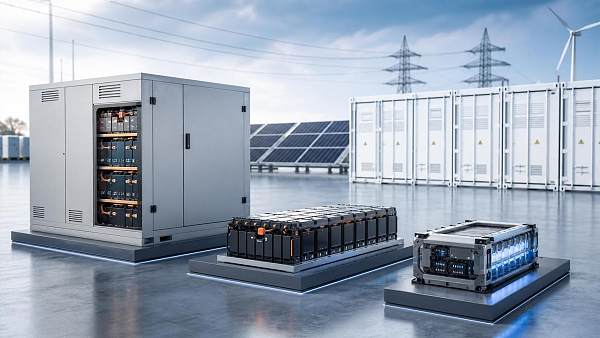
Choosing the right battery technology can shape project economics for years. In energy storage, that choice affects uptime, safety planning, footprint, and financing confidence.
A practical battery technology review usually starts with three names: LFP, NMC, and solid-state. Each option brings a different balance of maturity, performance, and project risk.
For grid-scale and commercial storage, the best answer is rarely about headline specs alone. It comes from matching battery technology to use case, duty cycle, thermal conditions, and budget constraints.
From a project planning perspective, the decision also influences insurance requirements, fire protection design, replacement assumptions, and procurement timing. That makes early comparison essential.
This article compares LFP vs NMC vs solid-state for energy storage projects, focusing on real selection criteria rather than lab-only claims.
Why Battery Technology Selection Matters More Than Ever
Recent market changes have made battery technology selection more strategic. Price volatility, safety scrutiny, local regulations, and supply chain shifts now affect project viability earlier than before.
That also means a battery technology comparison should go beyond cell chemistry. Teams need to evaluate system integration, bankability, service support, and long-term operating assumptions.
In actual deployment, a technically strong chemistry can still become a weak project choice. Limited supplier depth, uncertain certification paths, or complex thermal controls may reduce its appeal.
So the right question is not simply which battery technology is best. The better question is which one best fits the project profile with acceptable risk.
LFP Battery Technology: Stable, Proven, and Cost-Oriented
LFP, or lithium iron phosphate, has become the default battery technology for many stationary storage projects. Its rise comes from safety, cycle life, and increasingly competitive system pricing.
The biggest strength of LFP is thermal stability. Compared with higher-energy chemistries, it generally presents a lower thermal runaway risk and simpler safety management.
LFP also performs well in applications with frequent cycling. For daily charge-discharge patterns, its long cycle life often improves total cost of ownership over the project horizon.
That said, LFP has lower energy density than NMC. If space is tight, more containers or a larger installation area may be required to reach the same capacity target.
LFP is usually a strong fit for:
- Utility-scale energy shifting
- Commercial and industrial peak shaving
- Solar-plus-storage projects
- Sites with strict safety expectations
- Projects targeting lower lifecycle replacement risk
For many buyers, LFP battery technology wins because it is predictable. In project delivery, predictability often matters more than peak performance.
NMC Battery Technology: Higher Energy Density, Higher Complexity
NMC, or nickel manganese cobalt, remains an important battery technology where energy density is a primary concern. It stores more energy in a smaller footprint than LFP.
This matters in locations where land is expensive or limited. Urban commercial projects, transport-adjacent sites, and space-constrained facilities may favor NMC for that reason.
However, NMC introduces more demanding thermal management and safety considerations. That can increase engineering complexity, protection requirements, and ongoing operational oversight.
Its material profile also raises supply chain and cost questions. Nickel and cobalt exposure can affect pricing stability, sustainability discussions, and sourcing strategy.
In a battery technology comparison, NMC should not be dismissed. It still works well when compact design, weight efficiency, or specific performance requirements dominate the selection model.
NMC is often considered for:
- Space-limited storage installations
- Projects needing higher energy density
- Applications with strong cooling and monitoring systems
- Portfolios already aligned with NMC suppliers
Solid-State Battery Technology: Promising, but Not Yet Mainstream
Solid-state battery technology attracts attention because it promises higher energy density, better safety potential, and future performance gains. On paper, it looks like a major step forward.
The issue is project readiness. Most solid-state solutions remain in development, pilot phases, or early commercialization rather than broad stationary deployment.
That creates several decision challenges. Warranty structures may be limited, supply volumes may be uncertain, and long-term field data may not yet support conservative infrastructure planning.
For innovation-driven portfolios, solid-state battery technology can be worth tracking now. For near-term projects with financing pressure, it is usually a watchlist option rather than a default choice.
A realistic view matters here. Emerging battery technology may shape the next decade, but project teams still need bankable systems today.
Side-by-Side Battery Technology Comparison
A direct comparison helps translate chemistry differences into project language. The table below summarizes how each battery technology typically performs in energy storage selection.
Key Decision Criteria for Energy Storage Projects
When comparing battery technology, start with operating profile. Daily cycling, partial cycling, backup use, and fast-response services place different demands on the system.
Next, review site conditions. Ambient temperature, available land, ventilation design, and emergency access can quickly change which chemistry is most practical.
Financial structure matters too. If project returns depend on long service life and low maintenance surprises, LFP often offers a stronger planning base.
If footprint reduction is critical, NMC may justify the added complexity. If the project is meant to test future platforms, solid-state may deserve limited pilot evaluation.
A practical selection checklist includes:
- Define required duration, throughput, and cycle expectations.
- Model degradation under actual operating temperature ranges.
- Compare safety design implications across technologies.
- Check certification status and insurer acceptance.
- Review supplier bankability and service capacity.
- Stress-test replacement and warranty assumptions.
Common Selection Mistakes in Battery Technology Planning
One frequent mistake is prioritizing energy density when the site has enough space. In those cases, safer and longer-life battery technology may create better lifecycle value.
Another mistake is assuming all commercial battery technology options are equally mature. Laboratory promise does not always translate into predictable procurement and operation.
Teams also sometimes compare cell-level prices without modeling system-level cost. Cooling, fire suppression, controls, and replacement schedules can shift the real decision.
A stronger process links battery technology evaluation to EPC design, O&M planning, local code review, and long-term commercial assumptions from the start.
Which Battery Technology Fits Which Project?
For most stationary energy storage deployments today, LFP is the most balanced battery technology choice. It offers mature supply, strong safety performance, and dependable lifecycle economics.
NMC remains relevant where compact design is decisive and the project team can manage tighter thermal and safety requirements. It is a targeted answer, not a universal one.
Solid-state battery technology belongs in strategic monitoring and pilot discussions. It may become more important, but widespread project selection still requires more proof.
In practical terms, the best battery technology decision comes from matching chemistry to project objectives, not chasing the newest narrative in the market.
For organizations evaluating global supply options, technical positioning should be reviewed alongside supplier credibility, sector insight, and decision-grade market intelligence. That is where a focused platform such as TradeNexus Pro can add real value to the selection process.
Get weekly intelligence in your inbox.
No noise. No sponsored content. Pure intelligence.
 Oct 08, 2026How Digital Health Improves Diagnostic Accuracy and Workflow in Clinical LabsHow Digital Health Improves Diagnostic Accuracy and Workflow in Clinical Labs
 Oct 07, 2026Selecting Voice Picking Systems for German Warehouses: Integration, Languages and ROISelecting Voice Picking Systems for German Warehouses: Integration, Languages and ROI
 Oct 06, 2026How to Choose Last Mile Dispatch Software for On-Time Delivery at ScaleHow to Choose Last Mile Dispatch Software for On-Time Delivery at Scale
 Oct 05, 2026Vietnam’s Consumer Electronics Market: Demand Shifts and Sourcing OpportunitiesVietnam’s Consumer Electronics Market: Demand Shifts and Sourcing Opportunities
 Oct 04, 2026Digital Health Investment Priorities for Providers: Improving Access, Outcomes, and EfficiencyDigital Health Investment Priorities for Providers: Improving Access, Outcomes, and Efficiency
 Oct 03, 2026How to Specify an FR4 Custom PCB Board for High-Voltage and High-Heat DesignsHow to Specify an FR4 Custom PCB Board for High-Voltage and High-Heat Designs
 Oct 02, 2026ERP Software Market Intelligence: Adoption, Pricing, and Vendor Signals to WatchERP Software Market Intelligence: Adoption, Pricing, and Vendor Signals to Watch
 Oct 01, 2026How to Select Calibrated Temperature Data Loggers for GMP Cold Storage MonitoringHow to Select Calibrated Temperature Data Loggers for GMP Cold Storage Monitoring
 Sep 30, 2026Custom Molded Rubber Pricing: What Drives Unit Cost and Tooling Fees?Custom Molded Rubber Pricing: What Drives Unit Cost and Tooling Fees?
 Sep 29, 2026How to Evaluate Energy Management Software Vendors for Multi-Site OperationsHow to Evaluate Energy Management Software Vendors for Multi-Site Operations
 Sep 28, 2026How to Select a DIN Rail Smart Meter for Multi-Circuit Energy MonitoringHow to Select a DIN Rail Smart Meter for Multi-Circuit Energy Monitoring
 Sep 27, 2026TWS Earbuds in Vietnam: Demand Drivers, Price Tiers, and Retail Channel OpportunitiesTWS Earbuds in Vietnam: Demand Drivers, Price Tiers, and Retail Channel Opportunities
 Sep 26, 2026How UAE Clinics Can Qualify a Smart Glucometer Supplier for Accuracy and ComplianceHow UAE Clinics Can Qualify a Smart Glucometer Supplier for Accuracy and Compliance
 Sep 25, 2026Buying Aesthetic Lasers in the USA: FDA Status, Wavelengths, and Service SupportBuying Aesthetic Lasers in the USA: FDA Status, Wavelengths, and Service Support
 Sep 24, 2026Laser Cutting Brass Sheet: How to Prevent Burrs and Heat Marks on Thin PartsLaser Cutting Brass Sheet: How to Prevent Burrs and Heat Marks on Thin Parts
 Sep 23, 2026How to Choose Lightweight ANC Headphones for Comfortable All-Day TravelHow to Choose Lightweight ANC Headphones for Comfortable All-Day Travel
 Sep 22, 2026IPX5 TWS Bluetooth Earbuds: What Protection Do They Offer for Workouts?IPX5 TWS Bluetooth Earbuds: What Protection Do They Offer for Workouts?
 Sep 21, 2026What to Look for in a Grid Integration Company for Utility-Scale Solar ProjectsWhat to Look for in a Grid Integration Company for Utility-Scale Solar Projects
 Sep 20, 2026Microgrid Controller Pricing: What Drives Cost in Commercial Energy Projects?Microgrid Controller Pricing: What Drives Cost in Commercial Energy Projects?
 Sep 19, 2026How to Choose a GaN Charger for Laptops Without Compromising Power or PortabilityHow to Choose a GaN Charger for Laptops Without Compromising Power or Portability
 Sep 18, 2026Floating Solar Farm Costs: CAPEX, OPEX, and the Site Factors That Shape ROIFloating Solar Farm Costs: CAPEX, OPEX, and the Site Factors That Shape ROI
 Sep 17, 2026Drone Delivery Solutions for Last-Mile Routes: Site, Payload, and Range PlanningDrone Delivery Solutions for Last-Mile Routes: Site, Payload, and Range Planning
 Sep 16, 2026When Low-Volume Electronics Manufacturing Makes More Sense Than Mass ProductionWhen Low-Volume Electronics Manufacturing Makes More Sense Than Mass Production
 Sep 15, 2026Wholesale WiFi Smart Switches: What Buyers Should Verify Before OrderingWholesale WiFi Smart Switches: What Buyers Should Verify Before Ordering
 Sep 14, 2026How to Select IoT Sensors for Reliable Monitoring in Harsh Industrial EnvironmentsHow to Select IoT Sensors for Reliable Monitoring in Harsh Industrial Environments
 Sep 13, 2026How Procurement Teams Can Improve Supplier Reliability With Supply Chain VisibilityHow Procurement Teams Can Improve Supplier Reliability With Supply Chain Visibility
 Sep 12, 2026Smart Manufacturing Trends 2026: What Leaders Should Prioritize for ROISmart Manufacturing Trends 2026: What Leaders Should Prioritize for ROI



























