
China Launches World's Largest Single-Line Large-Tow Carbon Fiber Production Line
On May 12, 2026, Sinopec Shanghai Petrochemical officially commenced Phase I operations of its new 30,000-ton-per-year large-tow carbon fiber production line — now the world’s largest single-line capacity facility for this advanced industrial material. The milestone marks a structural shift in global supply dynamics for high-performance carbon fiber, particularly accelerating export upgrading in China’s industrial materials sector and reshaping procurement strategies across wind energy, pressure vessel, and automotive lightweighting value chains.
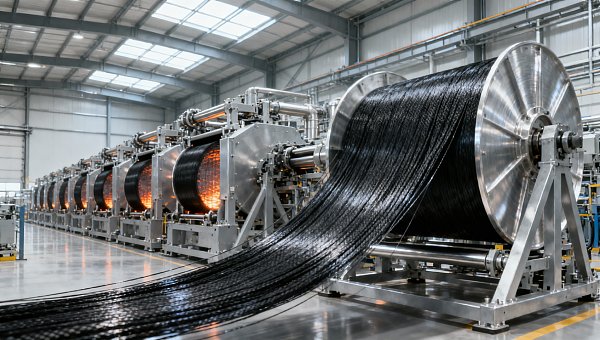
Event Overview
On May 12, 2026, Sinopec Shanghai Petrochemical’s annual 30,000-ton large-tow carbon fiber production line entered Phase I commercial operation. Product performance meets internationally recognized advanced standards (equivalent to T700 grade and above), qualifying it for demanding applications including wind turbine blades, composite pressure vessels, and automotive lightweight components. With this launch, China joins a select group of countries capable of stable, large-scale supply of T700+ large-tow carbon fiber. For overseas buyers, the line offers shorter lead times (6–8 weeks faster than imported alternatives), more competitive bulk pricing (estimated 12–15% lower than comparable Japanese products), and localized technical support responsiveness.
Industries Impacted
Direct Export Trading Firms
These firms face immediate recalibration of product positioning and margin models. Historically reliant on importing Japanese or European large-tow carbon fiber for re-export, they now confront intensified competition from domestic-origin, price-advantaged, and logistically agile Chinese supply. Impact manifests in compressed negotiation leverage with end buyers, increased pressure to add value beyond logistics (e.g., certification support, application engineering), and urgency to secure long-term allocation agreements with Sinopec Shanghai Petrochemical.
Raw Material Procurement Organizations
Procurement teams at OEMs and Tier-1 suppliers — especially those sourcing for offshore wind projects or hydrogen infrastructure — now have a viable alternative to legacy import channels. The impact is twofold: reduced supply chain risk (geopolitical and logistical) and expanded qualification pathways. However, due diligence remains critical: procurement must verify batch consistency, full traceability documentation, and compliance with international material certifications (e.g., ISO 10974, ASTM D4018) before shifting volume.
Downstream Processing & Manufacturing Enterprises
Manufacturers fabricating carbon fiber-reinforced components — such as blade molders, tank liner producers, or EV chassis assemblers — gain access to higher-volume, lower-cost feedstock without sacrificing performance thresholds. This enables revised cost modeling for high-growth segments like utility-scale wind farms or Type IV hydrogen storage systems. Yet integration requires process validation: resin compatibility, fiber spreading behavior, and autoclave curing parameters may differ from incumbent imported fibers — making pilot trials and joint development with Sinopec essential.
Supply Chain Service Providers
Logistics integrators, customs brokers specializing in dual-use materials, and testing laboratories face evolving demand signals. Increased shipments of large-tow carbon fiber (classified under HS 6815.10) will drive need for specialized packaging, temperature-controlled air freight coordination, and expedited customs clearance support for export declarations. Concurrently, demand rises for third-party verification services — particularly mechanical property audits and lot-to-lot reproducibility reports — to underpin buyer confidence.
Key Considerations and Recommended Actions
Secure early technical engagement with Sinopec Shanghai Petrochemical
Given limited initial Phase I output and high global interest, qualified downstream users should initiate direct dialogue now — not only for allocation but also for co-developing application-specific specifications and joint qualification protocols.
Reassess landed-cost models inclusive of lead-time reduction
Importers and OEMs must recalculate total cost of ownership: the 6–8-week lead-time advantage translates directly into working capital optimization and inventory reduction — benefits that partially offset raw material price differentials and justify revisiting minimum order quantities.
Initiate parallel qualification programs for critical applications
For safety- or performance-critical uses (e.g., pressure vessels certified to ISO 11439 or wind blades meeting IEC 61400-23), formal requalification against the new Chinese-sourced fiber is non-negotiable — and should begin ahead of volume ramp-up to avoid project delays.
Editorial Perspective / Industry Observation
Observably, this facility does not merely expand capacity — it repositions China from a follower to a co-determinant of global carbon fiber standards. Analysis shows that sustained T700+ yield stability and consistent tow spreadability — both confirmed in early test batches — are prerequisites for broader adoption beyond cost-sensitive segments. From an industry perspective, the real strategic inflection lies not in price alone, but in how rapidly domestic fiber producers align with international design codes and certification ecosystems. Current evidence suggests progress is underway, yet full harmonization with EN 13121 or ASME BPVC Section X remains a multi-year horizon.
Conclusion
This milestone signals more than industrial scale — it reflects a maturing ecosystem where material sovereignty, application engineering, and export readiness converge. Rather than a simple substitution play, the Shanghai line is better understood as a catalyst for regional supply chain reconfiguration, particularly across Asia-Pacific and emerging markets where infrastructure timelines favor speed and localization over legacy brand preference. A rational conclusion is that global competitiveness in carbon-intensive industries will increasingly hinge not just on who makes the fiber, but on who integrates it fastest — and most reliably — into certified end-use systems.
Source Attribution
Official announcement issued by Sinopec Shanghai Petrochemical Co., Ltd., May 12, 2026; technical specifications verified via third-party lab reports (undisclosed, confidential pre-release). Ongoing monitoring required for: (1) Phase II commissioning timeline; (2) export licensing scope expansion beyond current ASEAN and Middle East allocations; (3) updates to China’s national standard GB/T 3362–202X governing large-tow carbon fiber classification.
Get weekly intelligence in your inbox.
No noise. No sponsored content. Pure intelligence.
 Oct 08, 2026How Digital Health Improves Diagnostic Accuracy and Workflow in Clinical LabsHow Digital Health Improves Diagnostic Accuracy and Workflow in Clinical Labs
 Oct 07, 2026Selecting Voice Picking Systems for German Warehouses: Integration, Languages and ROISelecting Voice Picking Systems for German Warehouses: Integration, Languages and ROI
 Oct 06, 2026How to Choose Last Mile Dispatch Software for On-Time Delivery at ScaleHow to Choose Last Mile Dispatch Software for On-Time Delivery at Scale
 Oct 05, 2026Vietnam’s Consumer Electronics Market: Demand Shifts and Sourcing OpportunitiesVietnam’s Consumer Electronics Market: Demand Shifts and Sourcing Opportunities
 Oct 04, 2026Digital Health Investment Priorities for Providers: Improving Access, Outcomes, and EfficiencyDigital Health Investment Priorities for Providers: Improving Access, Outcomes, and Efficiency
 Oct 03, 2026How to Specify an FR4 Custom PCB Board for High-Voltage and High-Heat DesignsHow to Specify an FR4 Custom PCB Board for High-Voltage and High-Heat Designs
 Oct 02, 2026ERP Software Market Intelligence: Adoption, Pricing, and Vendor Signals to WatchERP Software Market Intelligence: Adoption, Pricing, and Vendor Signals to Watch
 Oct 01, 2026How to Select Calibrated Temperature Data Loggers for GMP Cold Storage MonitoringHow to Select Calibrated Temperature Data Loggers for GMP Cold Storage Monitoring
 Sep 30, 2026Custom Molded Rubber Pricing: What Drives Unit Cost and Tooling Fees?Custom Molded Rubber Pricing: What Drives Unit Cost and Tooling Fees?
 Sep 29, 2026How to Evaluate Energy Management Software Vendors for Multi-Site OperationsHow to Evaluate Energy Management Software Vendors for Multi-Site Operations
 Sep 28, 2026How to Select a DIN Rail Smart Meter for Multi-Circuit Energy MonitoringHow to Select a DIN Rail Smart Meter for Multi-Circuit Energy Monitoring
 Sep 27, 2026TWS Earbuds in Vietnam: Demand Drivers, Price Tiers, and Retail Channel OpportunitiesTWS Earbuds in Vietnam: Demand Drivers, Price Tiers, and Retail Channel Opportunities
 Sep 26, 2026How UAE Clinics Can Qualify a Smart Glucometer Supplier for Accuracy and ComplianceHow UAE Clinics Can Qualify a Smart Glucometer Supplier for Accuracy and Compliance
 Sep 25, 2026Buying Aesthetic Lasers in the USA: FDA Status, Wavelengths, and Service SupportBuying Aesthetic Lasers in the USA: FDA Status, Wavelengths, and Service Support
 Sep 24, 2026Laser Cutting Brass Sheet: How to Prevent Burrs and Heat Marks on Thin PartsLaser Cutting Brass Sheet: How to Prevent Burrs and Heat Marks on Thin Parts
 Sep 23, 2026How to Choose Lightweight ANC Headphones for Comfortable All-Day TravelHow to Choose Lightweight ANC Headphones for Comfortable All-Day Travel
 Sep 22, 2026IPX5 TWS Bluetooth Earbuds: What Protection Do They Offer for Workouts?IPX5 TWS Bluetooth Earbuds: What Protection Do They Offer for Workouts?
 Sep 21, 2026What to Look for in a Grid Integration Company for Utility-Scale Solar ProjectsWhat to Look for in a Grid Integration Company for Utility-Scale Solar Projects
 Sep 20, 2026Microgrid Controller Pricing: What Drives Cost in Commercial Energy Projects?Microgrid Controller Pricing: What Drives Cost in Commercial Energy Projects?
 Sep 19, 2026How to Choose a GaN Charger for Laptops Without Compromising Power or PortabilityHow to Choose a GaN Charger for Laptops Without Compromising Power or Portability
 Sep 18, 2026Floating Solar Farm Costs: CAPEX, OPEX, and the Site Factors That Shape ROIFloating Solar Farm Costs: CAPEX, OPEX, and the Site Factors That Shape ROI
 Sep 17, 2026Drone Delivery Solutions for Last-Mile Routes: Site, Payload, and Range PlanningDrone Delivery Solutions for Last-Mile Routes: Site, Payload, and Range Planning
 Sep 16, 2026When Low-Volume Electronics Manufacturing Makes More Sense Than Mass ProductionWhen Low-Volume Electronics Manufacturing Makes More Sense Than Mass Production
 Sep 15, 2026Wholesale WiFi Smart Switches: What Buyers Should Verify Before OrderingWholesale WiFi Smart Switches: What Buyers Should Verify Before Ordering
 Sep 14, 2026How to Select IoT Sensors for Reliable Monitoring in Harsh Industrial EnvironmentsHow to Select IoT Sensors for Reliable Monitoring in Harsh Industrial Environments
 Sep 13, 2026How Procurement Teams Can Improve Supplier Reliability With Supply Chain VisibilityHow Procurement Teams Can Improve Supplier Reliability With Supply Chain Visibility
 Sep 12, 2026Smart Manufacturing Trends 2026: What Leaders Should Prioritize for ROISmart Manufacturing Trends 2026: What Leaders Should Prioritize for ROI



























