China’s Green Smart Ship Tech Norms Accelerate BMS & Shore Power Export
On April 20, 2026, China’s Ministry of Transport’s Maritime Safety Administration issued the Action Plan for Accelerating the Construction of Green and Intelligent Ship Technical Standards System (2026–2030), introducing mandatory technical requirements for domestic lithium-ion battery BMS thermal runaway multi-level interlock, smart shore power plug-and-play interfaces, and onboard AI energy efficiency management systems — prompting renewed attention from shipbuilders, marine EV infrastructure suppliers, and international classification societies.
Event Overview
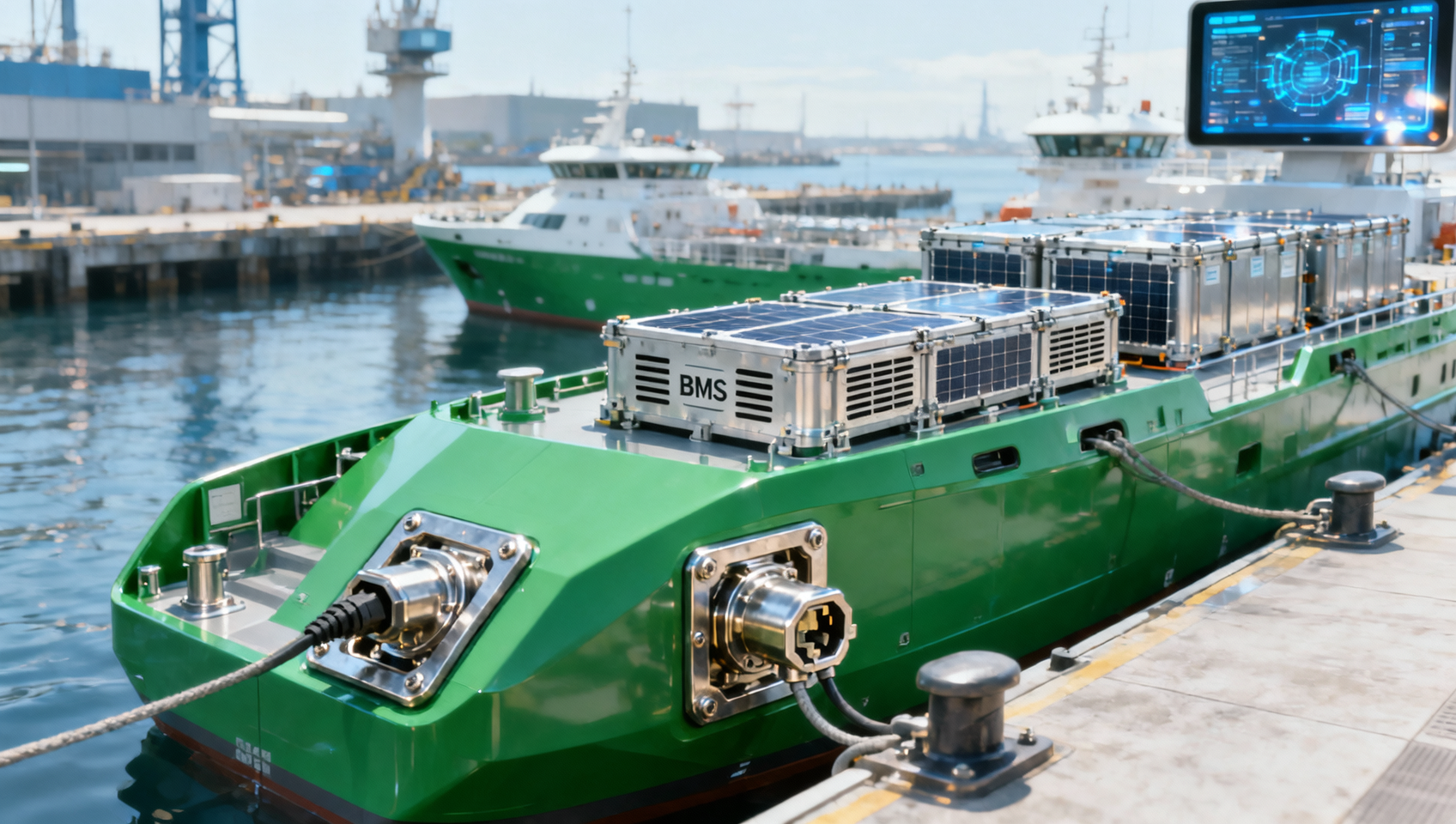
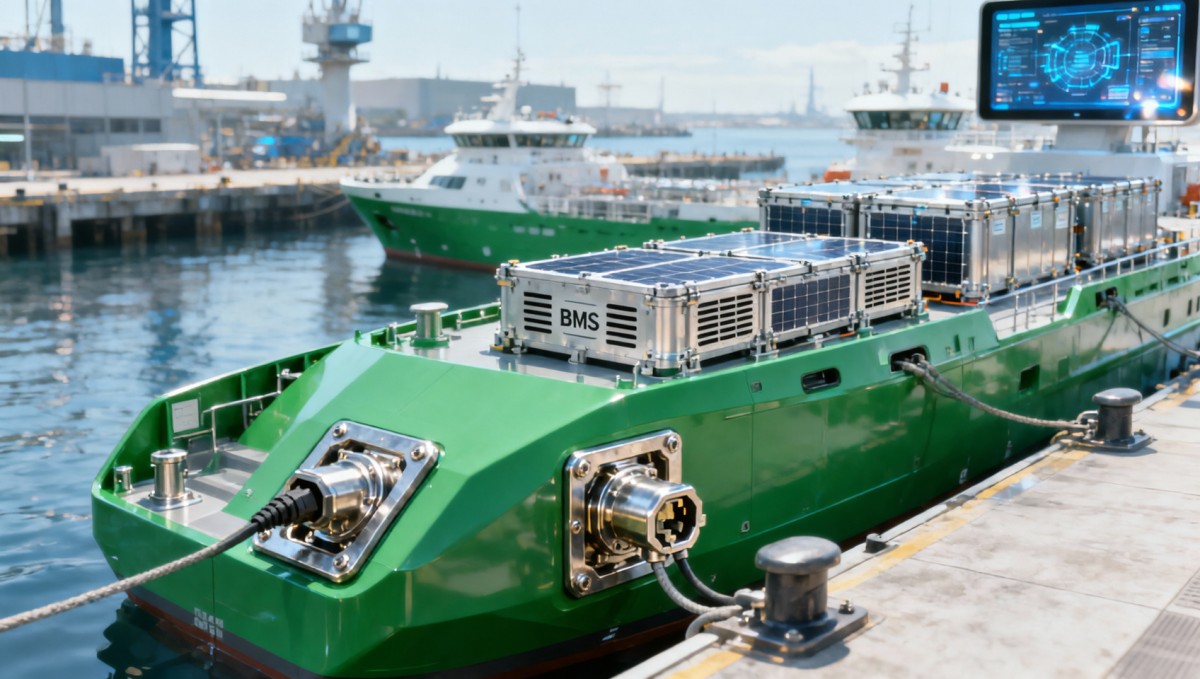
On April 20, 2026, the Maritime Safety Administration under China’s Ministry of Transport issued the Action Plan for Accelerating the Construction of Green and Intelligent Ship Technical Standards System (2026–2030). The document formally incorporates three technologies as mandatory technical clauses: (1) lithium-ion battery Battery Management Systems (BMS) with multi-level thermal runaway interlock functionality; (2) intelligent shore power interfaces supporting plug-and-play operation; and (3) shipboard AI-based energy efficiency management systems. The standard is currently being adopted by international classification societies including DNV (Norway) and KR (South Korea), facilitating accelerated international certification for Chinese marine battery storage and electric vessel infrastructure suppliers.
Industries Affected
Direct Exporters of Marine BMS and Shore Power Equipment
These enterprises face immediate alignment requirements with newly mandated technical specifications. Impact manifests in product design validation cycles, third-party testing scope, and documentation needed for overseas classification society submissions — especially where DNV or KR certification is a prerequisite for vessel integration or flag-state approval.
Marine EV Infrastructure Manufacturers (e.g., Onboard Chargers, DC Distribution Units)
As the plan mandates interoperability via standardized shore power interfaces, manufacturers must verify conformance to defined electrical, mechanical, and communication protocols. Non-compliant legacy designs may require re-engineering before entering tenders for green ferry or inland waterway projects in Europe or Asia.
Classification Society-Accredited Testing and Certification Service Providers
With DNV and KR actively referencing the new Chinese standards, accredited labs and conformity assessment bodies are seeing increased demand for test reports covering thermal runaway cascade mitigation, real-time shore power handshake verification, and AI model traceability per IMO MSC.1/Circ.1647 guidance. Capacity planning and staff upskilling in these domains are becoming urgent.
Ship Designers and Naval Architects (Especially for Inland/Short-Sea Vessels)
The inclusion of AI-driven energy efficiency management as mandatory implies new integration obligations during concept and detailed design phases. Architects must now coordinate early with BMS and shore power system vendors to ensure data interface compatibility, cybersecurity architecture alignment, and onboard computing resource allocation — all before preliminary class approval submission.
What Enterprises and Practitioners Should Monitor and Act On
Track official implementation timelines and interpretation documents
The Action Plan sets a 2026–2030 horizon, but phased enforcement dates — particularly for newbuilds vs. retrofits — remain unspecified. Stakeholders should monitor updates from the Maritime Safety Administration and affiliated institutes (e.g., China Classification Society) for technical circulars clarifying compliance thresholds and transitional arrangements.
Verify which export markets are adopting the standard via mutual recognition
While DNV and KR have begun referencing the standard, formal mutual recognition agreements (MRAs) with China’s national accreditation body (CNAS) are not yet confirmed. Exporters should confirm whether target-flag administrations (e.g., Norway, South Korea, Singapore) accept test reports issued under this framework without duplication — especially for vessels flagged under open registries.
Distinguish between regulatory signal and enforceable requirement
The Action Plan establishes mandatory clauses *within China’s domestic regulatory framework*. Its adoption by foreign classification societies reflects technical influence, not legal obligation outside Chinese jurisdiction. Enterprises should avoid assuming automatic global compliance — instead treating each international certification as a separate process requiring local validation.
Prepare technical documentation packages aligned with classification society expectations
DNV GL-IV-1-1 (Marine Battery Systems) and KR Rules Part F Chapter 8 (Electric Propulsion and Energy Storage) already reference functional safety and cyber-resilience. Suppliers should consolidate failure mode analyses, software verification records, and interface protocol specifications now — rather than waiting for formal audit requests.
Editorial Perspective / Industry Observation
From an industry perspective, this development is best understood as a coordinated policy signal — not yet a fully operationalized global standard. It reflects China’s strategic intent to shape technical baselines for green maritime mobility, particularly in segments where domestic supply chains hold competitive advantage (e.g., lithium battery systems, medium-voltage shore power hardware). Analysis来看, its near-term impact lies less in direct enforcement abroad and more in accelerating convergence between Chinese design practices and internationally accepted safety and interoperability expectations. Observation来看, the speed at which DNV and KR are referencing the standard suggests growing technical credibility — but sustained adoption will depend on transparent test methodology publication and independent validation outcomes. Current relevance is strongest for firms actively engaged in EU Green Corridor tenders, Korean inland ferry upgrades, or ASEAN port electrification pilots.
In summary, the issuance of China’s green and intelligent ship technical standards marks a formal step toward harmonizing domestic innovation with international maritime safety and sustainability frameworks. It does not replace existing IEC, ISO, or IMO-aligned requirements, but adds a layer of nationally specified performance criteria that increasingly informs global procurement and certification decisions. For stakeholders, it is more accurately interpreted as an evolving benchmark — one requiring active monitoring, selective alignment, and context-specific implementation — rather than a universally binding mandate.
Source: Ministry of Transport of the People’s Republic of China, Maritime Safety Administration — Action Plan for Accelerating the Construction of Green and Intelligent Ship Technical Standards System (2026–2030), issued April 20, 2026. Status of mutual recognition agreements with DNV and KR remains under observation and has not been formally confirmed in publicly available documents as of publication.
Get weekly intelligence in your inbox.
No noise. No sponsored content. Pure intelligence.
 Apr 23, 2026Taobao Factory Spark 3.0 Launches AI Workbench for SME Export FactoriesTaobao Factory Spark 3.0 Launches AI Workbench for SME Export Factories
 Apr 23, 2026TENENG Group Inspects IoT Safety Compliance at Jiangnan ChemicalTENENG Group Inspects IoT Safety Compliance at Jiangnan Chemical
 Apr 23, 2026China Launches First Embodied AI Open Data CommunityChina Launches First Embodied AI Open Data Community
 Apr 23, 2026PV Glass Prices Flat for 9 Weeks Amid Rising Integrated ProcurementPV Glass Prices Flat for 9 Weeks Amid Rising Integrated Procurement
 Apr 23, 20262984 NQI One-Stop Platforms Launched Nationwide2984 NQI One-Stop Platforms Launched Nationwide
 Apr 23, 2026China’s Green Smart Ship Tech Norms Accelerate BMS & Shore Power ExportChina’s Green Smart Ship Tech Norms Accelerate BMS & Shore Power Export
 Apr 23, 2026China Builds World's Largest Agri-Meteorological IoT NetworkChina Builds World's Largest Agri-Meteorological IoT Network
 Apr 23, 2026EU CBAM Carbon Tariff Enters Enforcement on April 1, 2026EU CBAM Carbon Tariff Enters Enforcement on April 1, 2026
 Apr 23, 2026Five Ministries Issue Zero-Carbon Factory Guidance for Export IndustriesFive Ministries Issue Zero-Carbon Factory Guidance for Export Industries
 Apr 23, 2026ISO Releases First Zero-Carbon City Standard — China’s Practices IncludedISO Releases First Zero-Carbon City Standard — China’s Practices Included
 Apr 22, 2026China Leads Global Offshore Wind Installations for 5th YearChina Leads Global Offshore Wind Installations for 5th Year
 Apr 22, 2026China Launches National Mine Safety IoT Monitoring NetworkChina Launches National Mine Safety IoT Monitoring Network
 Apr 22, 2026Yinchuan Boiler Pure Water Solution Certified for Middle East ProjectsYinchuan Boiler Pure Water Solution Certified for Middle East Projects
 Apr 22, 2026China to Enforce Mandatory EV Battery Recycling Standards by 2026China to Enforce Mandatory EV Battery Recycling Standards by 2026
 Apr 22, 2026Vietnam Launches Anti-Circumvention Probe on Electronic ComponentsVietnam Launches Anti-Circumvention Probe on Electronic Components
 Apr 22, 20262026 Shanghai Fastener Show: Robotic Fasteners Drive Overseas Procurement2026 Shanghai Fastener Show: Robotic Fasteners Drive Overseas Procurement
 Apr 22, 2026US BIS Adds EV On-Board Charger Crypto Modules to EAR Appendix 7US BIS Adds EV On-Board Charger Crypto Modules to EAR Appendix 7
 Apr 22, 2026TÜV Rheinland Updates BESS Certification: Propagation Blocking Now MandatoryTÜV Rheinland Updates BESS Certification: Propagation Blocking Now Mandatory
 Apr 22, 2026Red Sea Crisis Escalates: Suez AI Speed Limits & Slot Review from Apr 19Red Sea Crisis Escalates: Suez AI Speed Limits & Slot Review from Apr 19
 Apr 22, 2026EU CBAM Carbon Tariff Takes Effect April 1, 2026EU CBAM Carbon Tariff Takes Effect April 1, 2026
 Apr 21, 2026When to Replace CT Scanner Parts Before Downtime StartsWhen to Replace CT Scanner Parts Before Downtime Starts
 Apr 21, 2026How to Cut Costs in Lathe Turning Without ReworkHow to Cut Costs in Lathe Turning Without Rework
 Apr 21, 2026Lathe Turning Tolerances: What Can You Expect?Lathe Turning Tolerances: What Can You Expect?
 Apr 21, 2026How to Avoid Risks in Solar Panels WholesaleHow to Avoid Risks in Solar Panels Wholesale
 Apr 21, 2026Solar Panels Wholesale: How to Compare SuppliersSolar Panels Wholesale: How to Compare Suppliers
 Apr 21, 2026Solar Mounting Cost Factors You Should KnowSolar Mounting Cost Factors You Should Know
 Apr 21, 2026Solar Mounting Options: Which One Fits Your Project?Solar Mounting Options: Which One Fits Your Project?