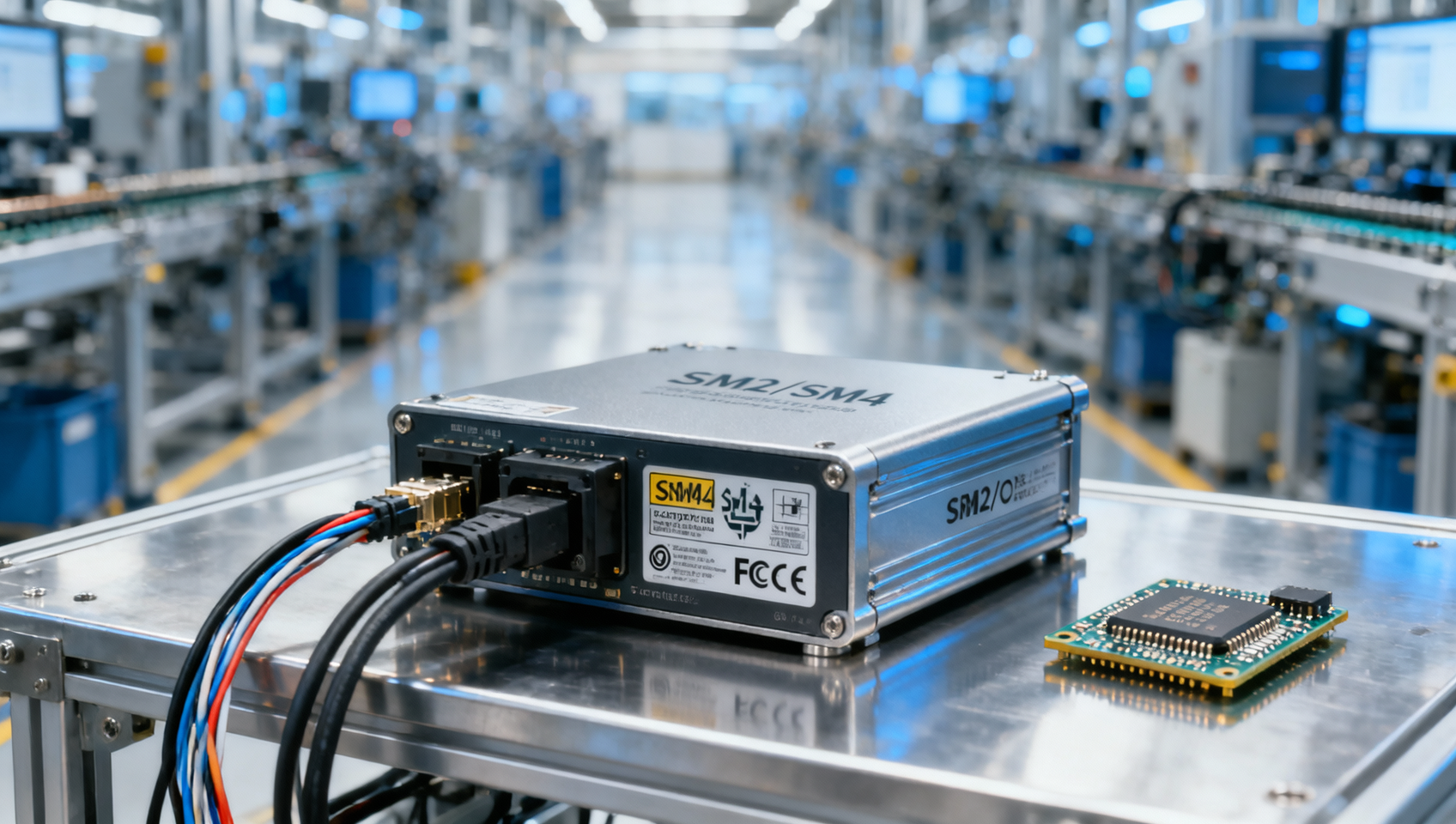
China Launches National Mine Safety IoT Monitoring Network
On April 17, 2026, China completed the foundational deployment of its national mine safety risk monitoring and early-warning network — dubbed the 'One Integrated Network' — covering all normally operating coal mines and 84% of non-coal underground mines. This development signals material implications for global suppliers of mining IoT equipment, certification bodies, export compliance teams, and international mining operators evaluating Chinese hardware interoperability and data governance capabilities.
Event Overview
The national mine safety risk monitoring and early-warning 'One Integrated Network' was officially declared largely built on April 17, 2026. It covers all normally operating coal mines and 84% of non-coal underground mines nationwide. The platform adopts a unified IoT protocol stack and edge computing architecture. Its rollout has accelerated domestic adaptation of mine-specific IoT devices — including intrinsically safe sensors, explosion-proof gateways, and positioning terminals — to standards such as GB/T 38651. Internationally, overseas mining clients are now using 'connectivity to China’s One Integrated Network' as a key indicator to assess the communication reliability and data sovereignty assurance capability of Chinese IoT equipment.
Industries Affected by This Development
Export-Oriented Mining IoT Equipment Manufacturers
These companies face intensified technical alignment requirements: devices intended for both domestic deployment and export must now support the unified protocol stack mandated by the national network. Non-compliance may hinder domestic market access and weaken credibility in overseas tenders where 'China Network compatibility' is increasingly referenced as a de facto reliability benchmark.
Certification & Compliance Service Providers
Testing labs and conformity assessment bodies are seeing rising demand for validation against GB/T 38651 and related edge-interoperability criteria. The national network’s architecture implies new test scenarios — especially for time-sensitive edge processing, secure over-the-air (OTA) updates, and deterministic low-latency telemetry — beyond traditional ATEX/IECEx or CCC scope.
International Mining Operators & EPC Contractors
Operators managing assets in multiple jurisdictions — particularly those with procurement pipelines linked to Chinese suppliers — are beginning to treat 'One Integrated Network compatibility' as an operational due diligence factor. It informs not only equipment selection but also long-term data integration strategy, especially where hybrid cloud-edge architectures are deployed across borders.
Supply Chain Integrators & System OEMs
Firms assembling full-stack mine monitoring solutions (e.g., combining third-party sensors, gateways, and analytics software) must verify end-to-end protocol coherence. Fragmented vendor implementations — even if individually certified — risk interoperability gaps under the national network’s standardized edge orchestration layer.
What Relevant Enterprises or Practitioners Should Monitor and Do Now
Track official implementation timelines for mandatory network connectivity
While 84% coverage is reported, the timeline for full mandatory connectivity — especially for remaining non-coal underground mines and legacy systems — remains unannounced. Regulatory enforcement cadence will directly affect upgrade cycles and retrofit demand.
Verify device-level conformance with GB/T 38651 and associated edge computing specifications
Compatibility is no longer limited to physical safety certifications. Firms should prioritize verification of message formatting, topic naming conventions, secure boot, and firmware signing — elements critical to network-wide trust but often outside traditional testing scopes.
Distinguish between policy signaling and actual procurement impact
Overseas clients referencing 'China Network compatibility' are currently using it as a proxy for maturity — not necessarily requiring direct cross-border data routing. Exporters should clarify whether the expectation relates to architectural alignment, protocol support, or live data federation before committing to engineering changes.
Prepare documentation packages demonstrating design traceability to national network requirements
For B2G or large-scale B2B tenders, having auditable evidence — e.g., protocol stack version logs, edge firmware attestations, and edge-to-cloud handoff test reports — is becoming a differentiator, even where formal certification is not yet required.
Editorial Observation / Industry Perspective
From an industry perspective, this milestone is best understood not as a finished regulatory regime, but as a strong signal of infrastructure-led standardization. Analysis shows that China is leveraging centralized monitoring not just for safety oversight, but as a mechanism to consolidate technical baselines across fragmented domestic suppliers — thereby raising the bar for both domestic competitiveness and international perception of reliability. Observation suggests that 'One Integrated Network' compatibility is evolving from a domestic compliance checkpoint into an informal global trust marker — particularly in emerging-market mining projects where Chinese equipment plays a growing role. Current momentum reflects institutional prioritization, but actual export impact will depend on how consistently the framework is applied, audited, and communicated internationally.
This is not yet a binding export requirement, nor does it replace existing regional certifications. Rather, it functions as a convergent reference point — one that aligns technical expectations across safety, interoperability, and data control dimensions.
Conclusion
The completion of China’s national mine safety monitoring 'One Integrated Network' marks a structural shift in how mining IoT infrastructure is governed and evaluated — domestically and, increasingly, abroad. Its significance lies less in immediate regulatory enforcement and more in its role as a coordination mechanism that reshapes technical benchmarks and buyer expectations. For stakeholders, the current phase calls for measured attention: verifying alignment with published standards, preparing interoperability documentation, and distinguishing between symbolic adoption and operational mandate. It is more accurately interpreted as an accelerating convergence point than a standalone compliance event.
Source Attribution
Main source: Official announcement released on April 17, 2026, regarding the foundational completion of the national mine safety risk monitoring and early-warning 'One Integrated Network'.
Areas requiring ongoing observation: Full mandatory rollout schedule for non-coal underground mines; formal recognition of 'One Integrated Network compatibility' in international procurement clauses; technical evolution of the unified IoT protocol stack beyond GB/T 38651.

Get weekly intelligence in your inbox.
No noise. No sponsored content. Pure intelligence.
 Apr 22, 2026China Leads Global Offshore Wind Installations for 5th YearChina Leads Global Offshore Wind Installations for 5th Year
 Apr 22, 2026China Launches National Mine Safety IoT Monitoring NetworkChina Launches National Mine Safety IoT Monitoring Network
 Apr 22, 2026Yinchuan Boiler Pure Water Solution Certified for Middle East ProjectsYinchuan Boiler Pure Water Solution Certified for Middle East Projects
 Apr 22, 2026China to Enforce Mandatory EV Battery Recycling Standards by 2026China to Enforce Mandatory EV Battery Recycling Standards by 2026
 Apr 22, 2026Vietnam Launches Anti-Circumvention Probe on Electronic ComponentsVietnam Launches Anti-Circumvention Probe on Electronic Components
 Apr 22, 20262026 Shanghai Fastener Show: Robotic Fasteners Drive Overseas Procurement2026 Shanghai Fastener Show: Robotic Fasteners Drive Overseas Procurement
 Apr 22, 2026US BIS Adds EV On-Board Charger Crypto Modules to EAR Appendix 7US BIS Adds EV On-Board Charger Crypto Modules to EAR Appendix 7
 Apr 22, 2026TÜV Rheinland Updates BESS Certification: Propagation Blocking Now MandatoryTÜV Rheinland Updates BESS Certification: Propagation Blocking Now Mandatory
 Apr 22, 2026Red Sea Crisis Escalates: Suez AI Speed Limits & Slot Review from Apr 19Red Sea Crisis Escalates: Suez AI Speed Limits & Slot Review from Apr 19
 Apr 22, 2026EU CBAM Carbon Tariff Takes Effect April 1, 2026EU CBAM Carbon Tariff Takes Effect April 1, 2026
 Apr 21, 2026When to Replace CT Scanner Parts Before Downtime StartsWhen to Replace CT Scanner Parts Before Downtime Starts
 Apr 21, 2026How to Cut Costs in Lathe Turning Without ReworkHow to Cut Costs in Lathe Turning Without Rework
 Apr 21, 2026Lathe Turning Tolerances: What Can You Expect?Lathe Turning Tolerances: What Can You Expect?
 Apr 21, 2026How to Avoid Risks in Solar Panels WholesaleHow to Avoid Risks in Solar Panels Wholesale
 Apr 21, 2026Solar Panels Wholesale: How to Compare SuppliersSolar Panels Wholesale: How to Compare Suppliers
 Apr 21, 2026Solar Mounting Cost Factors You Should KnowSolar Mounting Cost Factors You Should Know
 Apr 21, 2026Solar Mounting Options: Which One Fits Your Project?Solar Mounting Options: Which One Fits Your Project?
 Apr 21, 2026How to Pick USB C Docking Stations for Dual DisplaysHow to Pick USB C Docking Stations for Dual Displays
 Apr 21, 2026USB C Docking Stations: What Ports Do You Need?USB C Docking Stations: What Ports Do You Need?
 Apr 21, 2026What Affects Dental Milling Machine ROI in 2026?What Affects Dental Milling Machine ROI in 2026?
 Apr 21, 2026Dental Milling Machines: Wet or Dry for Your Lab?Dental Milling Machines: Wet or Dry for Your Lab?
 Apr 21, 2026How to Avoid Common Medical Refrigerator MistakesHow to Avoid Common Medical Refrigerator Mistakes
 Apr 21, 2026Medical Refrigerators: What Specs Matter Most?Medical Refrigerators: What Specs Matter Most?
 Apr 21, 2026Portable or Cart Vet Ultrasound: Which to Buy?Portable or Cart Vet Ultrasound: Which to Buy?
 Apr 21, 2026Vet Ultrasound Buying Guide for Small ClinicsVet Ultrasound Buying Guide for Small Clinics
 Apr 21, 2026Yard Management Systems: Key Features to CompareYard Management Systems: Key Features to Compare
 Apr 21, 2026How Yard Management Systems Improve Dock FlowHow Yard Management Systems Improve Dock Flow