Swiss Holographic Volumetric 3D Printing Boosts CNC Prototyping Speed 70×
On May 22, 2026, a breakthrough in holographic volumetric 3D printing developed by ETH Zurich was announced, enabling second-scale fabrication of millimeter-scale complex geometries—70 times faster than conventional SLA. Its integration into three Chinese precision CNC machining service providers is accelerating rapid prototyping and low-volume production for high-precision components used in European and U.S. medical devices and optical communications equipment.
Confirmed Technical Deployment
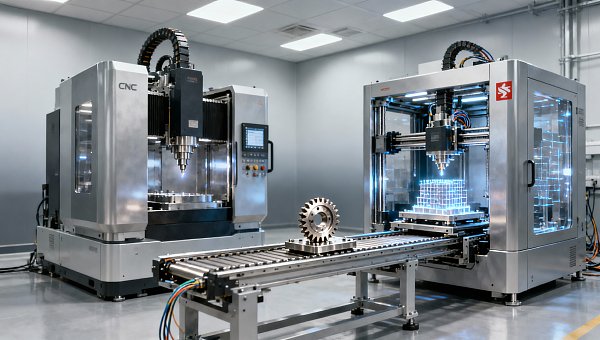
On May 22, 2026, ETH Zurich publicly introduced a novel holographic volumetric 3D printing method capable of fabricating intricate millimeter-scale structures within seconds—achieving a 70-fold speed increase over standard stereolithography (SLA). The technology has been licensed to three China-based CNC machining service providers for production-line integration. As a result, lead times for high-precision, low-volume orders—including titanium alloy micro-gears and fiber-optic coupling brackets—have been reduced from three weeks to 72 hours. This advancement directly strengthens end-to-end responsiveness across the ‘prototype–iteration–production’ cycle for clients in the medical device and optical communications sectors based in Europe and North America.
Impact Across Supply Chain Roles
Direct Exporters and Trading Firms
These firms face tighter delivery windows for technical samples and pre-production batches. With compressed turnaround times, their quoting, order confirmation, and logistics coordination must now align with sub-72-hour manufacturing capacity—requiring real-time visibility into supplier readiness and revised contractual SLAs on sample delivery timelines.
Raw Material and Component Sourcing Enterprises
Supply chains for specialty alloys (e.g., Ti-6Al-4V) and optical-grade substrates must adapt to more frequent, smaller-batch procurement cycles. Just-in-time replenishment protocols and material traceability documentation (e.g., mill test reports, heat lot tracking) gain heightened importance to support accelerated qualification and release.
Precision Manufacturing and Contract Machining Providers
Integrating holographic volumetric printing into hybrid workflows demands updated process validation, dimensional inspection protocols (e.g., CT scanning for internal feature verification), and operator training on multi-modal machine operation. Capabilities previously reserved for high-volume CNC are now being extended to ultra-fast, low-volume technical parts—reshaping capacity planning and quoting models.
Supply Chain Integration and Engineering Service Providers
These entities play a growing role in bridging design intent with hybrid manufacturing feasibility. They must now assess part geometry not only for CNC machinability but also for volumetric print compatibility—evaluating trade-offs between surface finish, resolution, residual stress, and post-processing requirements before recommending the optimal fabrication path.
Strategic Priorities for Enterprises
Validate Hybrid Process Compliance for Regulated Sectors
Medical device and telecom component manufacturers must confirm whether holographic-printed inserts or tooling meet applicable regulatory expectations—for instance, ISO 13485 process validation requirements or IEC 61215 mechanical integrity criteria—especially when integrated into certified assemblies.
Reassess Material Qualification and Traceability Protocols
For titanium micro-components, revalidation of tensile strength, fatigue resistance, and biocompatibility may be required if feedstock sourcing, sintering parameters, or post-processing steps deviate from legacy CNC routes—even when final geometry and dimensions remain identical.
Update Technical Tender Alignment Procedures
Bid documents for EU MDR-compliant devices or GR-1221-certified telecom hardware increasingly specify additive-manufactured part acceptance criteria. Suppliers must proactively align their technical submissions—including build orientation rationale, layerless defect analysis, and metrology reports—with evolving customer engineering standards.
Optimize Low-Volume Procurement Planning
Procurement teams should revise minimum order quantities (MOQs) and safety stock policies for precision micro-parts, shifting from batch-driven inventory models toward demand-triggered, digitally enabled short-run execution—leveraging the new 72-hour response window without compromising quality assurance rigor.
Industry Observation: Beyond Speed, a Shift in Responsiveness Logic
Analysis shows this development signals more than a throughput improvement—it redefines the operational logic of technical responsiveness in global B2B manufacturing. From an industry perspective, the shrinking gap between digital design iteration and physical prototype delivery compresses the traditional ‘design–quote–tool–produce’ sequence into a single synchronized loop. What deserves closer attention is how this reshapes supplier qualification: capability is no longer measured solely by annual volume capacity, but by validated agility across design fidelity, material compliance, and time-bound delivery under regulated conditions. Observably, certification bodies and notified bodies may begin incorporating hybrid manufacturing process audits into scope assessments for ISO 13485 or AS9100 certifications.
Toward Agile, Verified, and Interoperable Manufacturing
This milestone reflects a broader industry inflection: precision manufacturing is transitioning from scale-optimized to speed-verified. The ability to deliver certified, functionally validated micro-components in under three days does not replace CNC—but elevates its strategic role within a responsive, multi-process ecosystem. Sustainable advantage will accrue to enterprises that treat speed, compliance, and interoperability—not as separate KPIs—but as co-dependent system properties.
Source Attribution and Monitoring Guidance
This article was generated exclusively from the user-provided title, event date (May 22, 2026), and summary. Specific official source links were not provided in the input and should be verified continuously. Stakeholders are advised to monitor upcoming updates from Swiss regulatory authorities on volumetric printing standards, potential revisions to EN ISO/ASTM 52900 terminology, evolving tender language in EU Horizon and U.S. NIH SBIR solicitations, and early feedback from notified bodies on hybrid process audit readiness.
Get weekly intelligence in your inbox.
No noise. No sponsored content. Pure intelligence.
 Oct 12, 2026How Predictive Maintenance AI Detects Machine Failures Before Unplanned DowntimeHow Predictive Maintenance AI Detects Machine Failures Before Unplanned Downtime
 Oct 10, 2026How to Scope Packaging Automation for High-Mix Lines Without Creating BottlenecksHow to Scope Packaging Automation for High-Mix Lines Without Creating Bottlenecks
 Oct 08, 2026How Digital Health Improves Diagnostic Accuracy and Workflow in Clinical LabsHow Digital Health Improves Diagnostic Accuracy and Workflow in Clinical Labs
 Oct 07, 2026Selecting Voice Picking Systems for German Warehouses: Integration, Languages and ROISelecting Voice Picking Systems for German Warehouses: Integration, Languages and ROI
 Oct 06, 2026How to Choose Last Mile Dispatch Software for On-Time Delivery at ScaleHow to Choose Last Mile Dispatch Software for On-Time Delivery at Scale
 Oct 05, 2026Vietnam’s Consumer Electronics Market: Demand Shifts and Sourcing OpportunitiesVietnam’s Consumer Electronics Market: Demand Shifts and Sourcing Opportunities
 Oct 04, 2026Digital Health Investment Priorities for Providers: Improving Access, Outcomes, and EfficiencyDigital Health Investment Priorities for Providers: Improving Access, Outcomes, and Efficiency
 Oct 03, 2026How to Specify an FR4 Custom PCB Board for High-Voltage and High-Heat DesignsHow to Specify an FR4 Custom PCB Board for High-Voltage and High-Heat Designs
 Oct 02, 2026ERP Software Market Intelligence: Adoption, Pricing, and Vendor Signals to WatchERP Software Market Intelligence: Adoption, Pricing, and Vendor Signals to Watch
 Oct 01, 2026How to Select Calibrated Temperature Data Loggers for GMP Cold Storage MonitoringHow to Select Calibrated Temperature Data Loggers for GMP Cold Storage Monitoring
 Sep 30, 2026Custom Molded Rubber Pricing: What Drives Unit Cost and Tooling Fees?Custom Molded Rubber Pricing: What Drives Unit Cost and Tooling Fees?
 Sep 29, 2026How to Evaluate Energy Management Software Vendors for Multi-Site OperationsHow to Evaluate Energy Management Software Vendors for Multi-Site Operations
 Sep 28, 2026How to Select a DIN Rail Smart Meter for Multi-Circuit Energy MonitoringHow to Select a DIN Rail Smart Meter for Multi-Circuit Energy Monitoring
 Sep 27, 2026TWS Earbuds in Vietnam: Demand Drivers, Price Tiers, and Retail Channel OpportunitiesTWS Earbuds in Vietnam: Demand Drivers, Price Tiers, and Retail Channel Opportunities
 Sep 26, 2026How UAE Clinics Can Qualify a Smart Glucometer Supplier for Accuracy and ComplianceHow UAE Clinics Can Qualify a Smart Glucometer Supplier for Accuracy and Compliance
 Sep 25, 2026Buying Aesthetic Lasers in the USA: FDA Status, Wavelengths, and Service SupportBuying Aesthetic Lasers in the USA: FDA Status, Wavelengths, and Service Support
 Sep 24, 2026Laser Cutting Brass Sheet: How to Prevent Burrs and Heat Marks on Thin PartsLaser Cutting Brass Sheet: How to Prevent Burrs and Heat Marks on Thin Parts
 Sep 23, 2026How to Choose Lightweight ANC Headphones for Comfortable All-Day TravelHow to Choose Lightweight ANC Headphones for Comfortable All-Day Travel
 Sep 22, 2026IPX5 TWS Bluetooth Earbuds: What Protection Do They Offer for Workouts?IPX5 TWS Bluetooth Earbuds: What Protection Do They Offer for Workouts?
 Sep 21, 2026What to Look for in a Grid Integration Company for Utility-Scale Solar ProjectsWhat to Look for in a Grid Integration Company for Utility-Scale Solar Projects
 Sep 20, 2026Microgrid Controller Pricing: What Drives Cost in Commercial Energy Projects?Microgrid Controller Pricing: What Drives Cost in Commercial Energy Projects?
 Sep 19, 2026How to Choose a GaN Charger for Laptops Without Compromising Power or PortabilityHow to Choose a GaN Charger for Laptops Without Compromising Power or Portability
 Sep 18, 2026Floating Solar Farm Costs: CAPEX, OPEX, and the Site Factors That Shape ROIFloating Solar Farm Costs: CAPEX, OPEX, and the Site Factors That Shape ROI
 Sep 17, 2026Drone Delivery Solutions for Last-Mile Routes: Site, Payload, and Range PlanningDrone Delivery Solutions for Last-Mile Routes: Site, Payload, and Range Planning
 Sep 16, 2026When Low-Volume Electronics Manufacturing Makes More Sense Than Mass ProductionWhen Low-Volume Electronics Manufacturing Makes More Sense Than Mass Production
 Sep 15, 2026Wholesale WiFi Smart Switches: What Buyers Should Verify Before OrderingWholesale WiFi Smart Switches: What Buyers Should Verify Before Ordering
 Sep 14, 2026How to Select IoT Sensors for Reliable Monitoring in Harsh Industrial EnvironmentsHow to Select IoT Sensors for Reliable Monitoring in Harsh Industrial Environments