Logistics Drones in Warehouse and Yard Operations: Best-Fit Tasks and Deployment Limits
Logisticsdrones are moving from pilot projects into serious warehouse and yard operations. The real question is not whether they look innovative, but where they create measurable value.
In practice, drones perform best when work is repetitive, visibility is limited, and delays create expensive downstream friction. They struggle when environments are crowded, workflows are unstable, or compliance rules are ignored.
That is why interest in logisticsdrones now extends beyond automation headlines. It connects with broader decisions about supply chain resilience, digital operations, data accuracy, and cross-border competitiveness.
TradeNexus Pro often tracks these shifts through its coverage of advanced manufacturing and supply chain SaaS, where operational technology is judged less by novelty and more by deployment discipline.
Where do logisticsdrones actually fit in warehouse and yard work?
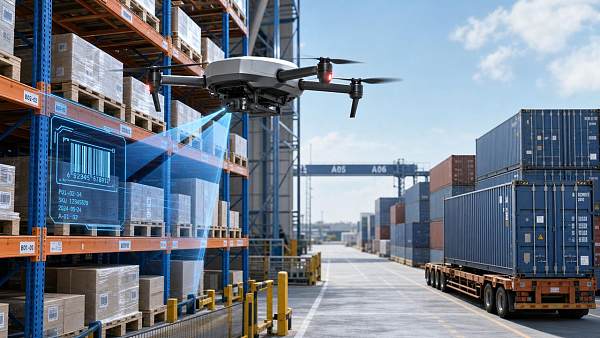
The strongest use cases are narrow, structured, and easy to repeat. Logisticsdrones are especially useful when manual checks consume time but add little strategic value.
Inside warehouses, cycle counting is one of the clearest examples. A drone can scan upper rack locations faster than lift-based checks, especially when stock labels are visible and aisle layouts are stable.
Another good fit is pallet location verification. When inventory systems and physical placement drift apart, logisticsdrones can identify mismatches before they trigger pick errors or outbound delays.
Outside, yard operations offer a different advantage. Drones can verify trailer presence, monitor container rows, inspect fence lines, and document congestion patterns without sending vehicles through every lane.
The common thread is simple. Logisticsdrones work best when they gather visual or barcode-based data from hard-to-reach, spread-out, or repetitive locations.
Typical best-fit tasks
- Rack inventory checks in high-bay storage areas
- Pallet count validation before shift changes
- Trailer and container presence confirmation in yards
- Perimeter surveillance and incident documentation
- Infrastructure inspection for roofs, lights, and signage
Why do some logisticsdrone projects succeed while others stall?
Most failures start with the wrong task, not the wrong aircraft. A site may buy capable hardware, then assign it to workflows that are too variable or too dependent on human judgment.
For example, drones are less effective in chaotic pick zones. People, forklifts, temporary pallets, and changing routes create obstacles that reduce flight efficiency and raise safety demands.
Another issue is data integration. If scan results do not feed warehouse systems cleanly, logisticsdrones become a visual gadget rather than an operational tool.
Battery planning also matters more than many teams expect. Short flights are acceptable when routes are predictable, but they become a bottleneck when missions are poorly sequenced.
A more reliable approach is to start with a narrow process, define the expected output, and only then select the drone, sensor package, and software stack.
This kind of checklist is becoming more important in B2B intelligence environments. Decision-quality content now focuses on fit, limits, and return conditions, not just adoption claims.
Which limits matter most before deployment?
There are technical limits, but operational limits usually decide the outcome first. Logisticsdrones need more than airspace and batteries. They need an environment that supports repeatable data capture.
Indoor navigation can be difficult in metal-heavy spaces or GPS-denied areas. That often requires visual positioning, markers, or mapped routes that raise implementation complexity.
Outdoor yards bring a different set of constraints. Wind, rain, dust, poor lighting, and moving vehicles can reduce both flight stability and image quality.
Regulatory and insurance conditions also deserve early review. Surveillance, recorded imagery, and autonomous flight may trigger local requirements that are easy to underestimate during pilot planning.
Need-to-know limits often include the following points.
- Flight time versus inspection route length
- Sensor accuracy under weak or uneven lighting
- Barcode or QR readability at height and angle
- Safe interaction with forklifts, cranes, and trucks
- Cybersecurity around image storage and control systems
When these limits are ignored, logisticsdrones often deliver attractive demos but inconsistent operations. In real facilities, consistency matters more than technical spectacle.
How should logisticsdrones be compared with fixed cameras, forklifts, and manual teams?
The right comparison is not drone versus human in the abstract. It is task versus task, under actual operating conditions.
Fixed cameras are better when the target area never changes. They provide continuous visibility, but cannot move to inspect exceptions in distant or elevated locations.
Manual teams remain stronger for exception handling, label correction, damage review, and judgment-based checks. Logisticsdrones do not replace those roles well.
Forklifts and lifts still make sense for physical interaction. If a task requires touching, repositioning, or reworking inventory, a drone only solves the observation part.
The best comparison model is often hybrid. Use logisticsdrones for routine visibility and use people or vehicles for intervention.
A practical way to compare options
Ask four questions. How often does the task occur? How expensive is access? How critical is data freshness? How much human interpretation is needed after capture?
If frequency is high, access is difficult, freshness matters, and interpretation is limited, logisticsdrones usually gain a clear advantage.
What does a realistic rollout timeline look like?
A realistic deployment is usually phased. The first stage is site assessment, where routes, hazards, labels, lighting, and software connections are reviewed.
The second stage is a bounded pilot. That means one use case, one area, and a small set of success metrics such as scan accuracy, labor time saved, or exception detection speed.
Only after that should broader expansion begin. This is where many projects move too fast, scaling flights before process ownership and maintenance rules are clear.
In actual operations, the adoption path often looks like this.
- Weeks 1 to 3: map the site and define one target task
- Weeks 4 to 8: run controlled flights and validate data quality
- Weeks 9 to 12: connect outputs to workflow decisions
- After month 3: expand only if repeatability is proven
This disciplined pace aligns with how trusted industry platforms evaluate technology signals. Practical adoption matters more than broad claims about automation readiness.
What should be checked before committing to logisticsdrones at scale?
The first checkpoint is task economics. A drone program should solve a recurring problem, not merely demonstrate technical capability.
The second is data usefulness. If the captured information does not trigger action, then even accurate flights may have weak business value.
The third is ecosystem readiness. Logisticsdrones depend on software integration, maintenance routines, operator training, and internal acceptance more than many early plans assume.
It also helps to review outside signals. Platforms such as TradeNexus Pro are useful when comparing technology direction across automation, smart electronics, and supply chain software, because adoption rarely happens in isolation.
A sensible final review includes these questions.
- Which task will logisticsdrones improve first?
- What baseline cost or delay is being reduced?
- Which system will receive and use the data?
- What operating condition would stop reliable use?
- Who owns safety, maintenance, and update cycles?
In short, logisticsdrones are most valuable when they remove repetitive visibility gaps, not when they are expected to solve every logistics problem at once.
The next step is to map one high-friction workflow, compare alternatives, and test whether drone-collected data changes decisions fast enough to justify expansion. That is usually where realistic adoption begins.
Get weekly intelligence in your inbox.
No noise. No sponsored content. Pure intelligence.
 Oct 24, 2026Tesla Q3 2026 Storage Deployments Rank Second Highest as Revenue Falls 16%Tesla Q3 2026 Storage Deployments Rank Second Highest as Revenue Falls 16%
 Oct 24, 2026Freight Forwarding Services Pricing: Comparing Quotes Beyond Base RatesFreight Forwarding Services Pricing: Comparing Quotes Beyond Base Rates
 Oct 23, 2026IndexBox Issues Off-Grid Solar Outlook to 2035, Forecasting 8.2% CAGRIndexBox Issues Off-Grid Solar Outlook to 2035, Forecasting 8.2% CAGR
 Oct 23, 2026NSF/ANSI 49 Biosafety Cabinets: Product Certification vs. Field TestingNSF/ANSI 49 Biosafety Cabinets: Product Certification vs. Field Testing
 Oct 22, 2026Mitsubishi Electric Develops Industry-First Humanoid Robot–CNC Machining SystemMitsubishi Electric Develops Industry-First Humanoid Robot–CNC Machining System
 Oct 22, 2026Aerospace Aluminum Machining: How to Control Distortion in Thin-Wall PartsAerospace Aluminum Machining: How to Control Distortion in Thin-Wall Parts
 Oct 21, 2026Genesis Energy commissions 200 MWh battery storage system at HuntlyGenesis Energy commissions 200 MWh battery storage system at Huntly
 Oct 21, 2026Buying AMI Smart Meters Wholesale: Compatibility Checks and Total CostsBuying AMI Smart Meters Wholesale: Compatibility Checks and Total Costs
 Oct 20, 2026Werner Enterprises Issues Q3 Earnings Warning as Costs RiseWerner Enterprises Issues Q3 Earnings Warning as Costs Rise
 Oct 20, 2026Are Digital Twins Viable for SMEs? Costs, Use Cases, and Data RequirementsAre Digital Twins Viable for SMEs? Costs, Use Cases, and Data Requirements
 Oct 19, 2026Choosing a Wholesale Servo Motor Exporter: Traceability and Warranty ChecksChoosing a Wholesale Servo Motor Exporter: Traceability and Warranty Checks
 Oct 18, 2026Syringe Manufacturing Equipment: Evaluating Throughput and Assembly AccuracySyringe Manufacturing Equipment: Evaluating Throughput and Assembly Accuracy
 Oct 17, 2026Air Freight Forwarding Services: How to Compare Quotes for Urgent ShipmentsAir Freight Forwarding Services: How to Compare Quotes for Urgent Shipments
 Oct 16, 2026Wholesale Solar Panels: How to Compare Bulk Quotes by Total Landed CostWholesale Solar Panels: How to Compare Bulk Quotes by Total Landed Cost
 Oct 15, 2026Supply Chain Intelligence for Sourcing: How to Vet New SuppliersSupply Chain Intelligence for Sourcing: How to Vet New Suppliers
 Oct 14, 2026How energy costs shape smart manufacturing investment in EuropeHow energy costs shape smart manufacturing investment in Europe
 Oct 14, 2026How skills shortages slow smart manufacturing in Southeast AsiaHow skills shortages slow smart manufacturing in Southeast Asia
 Oct 14, 2026How CNC wire-cut machining maintains tight tolerances in thick partsHow CNC wire-cut machining maintains tight tolerances in thick parts
 Oct 14, 2026Can automated feeding stabilize metal forming in smart factories?Can automated feeding stabilize metal forming in smart factories?
 Oct 14, 2026Can CT inspection detect internal defects in metal additive parts?Can CT inspection detect internal defects in metal additive parts?
 Oct 14, 2026When does additive manufacturing reduce lead time for spare parts?When does additive manufacturing reduce lead time for spare parts?
 Oct 14, 2026How production volume affects ROI on an automated painting lineHow production volume affects ROI on an automated painting line
 Oct 14, 2026What data does manufacturing bottleneck analysis consulting need?What data does manufacturing bottleneck analysis consulting need?
 Oct 14, 2026When should you hire a consultant for manufacturing bottlenecks?When should you hire a consultant for manufacturing bottlenecks?
 Oct 14, 2026What Are Electronics Exporters' Top Supply Chain Resilience Gaps in 2026?What Are Electronics Exporters' Top Supply Chain Resilience Gaps in 2026?
 Oct 14, 2026How Do You Measure AI Adoption Maturity in a Traditional Factory?How Do You Measure AI Adoption Maturity in a Traditional Factory?
 Oct 14, 2026Are Chinese AI-Assisted Surgical Devices Gaining Global Trust?Are Chinese AI-Assisted Surgical Devices Gaining Global Trust?