Vietnam Enforces Bilingual Safety Labels for Imported Electronic Components from Apr 22, 2026
Starting April 22, 2026, Vietnam’s Ministry of Industry and Trade (MOIT) will enforce mandatory bilingual safety labeling — Vietnamese plus English or Vietnamese plus Chinese — on packaging and instruction manuals of all imported electronic components (including PCBs, connectors, sensors, etc.). This regulation directly affects exporters, OEMs, distributors, and logistics providers serving the Vietnamese market — particularly those in electronics manufacturing, component trading, and cross-border supply chains.
Event Overview
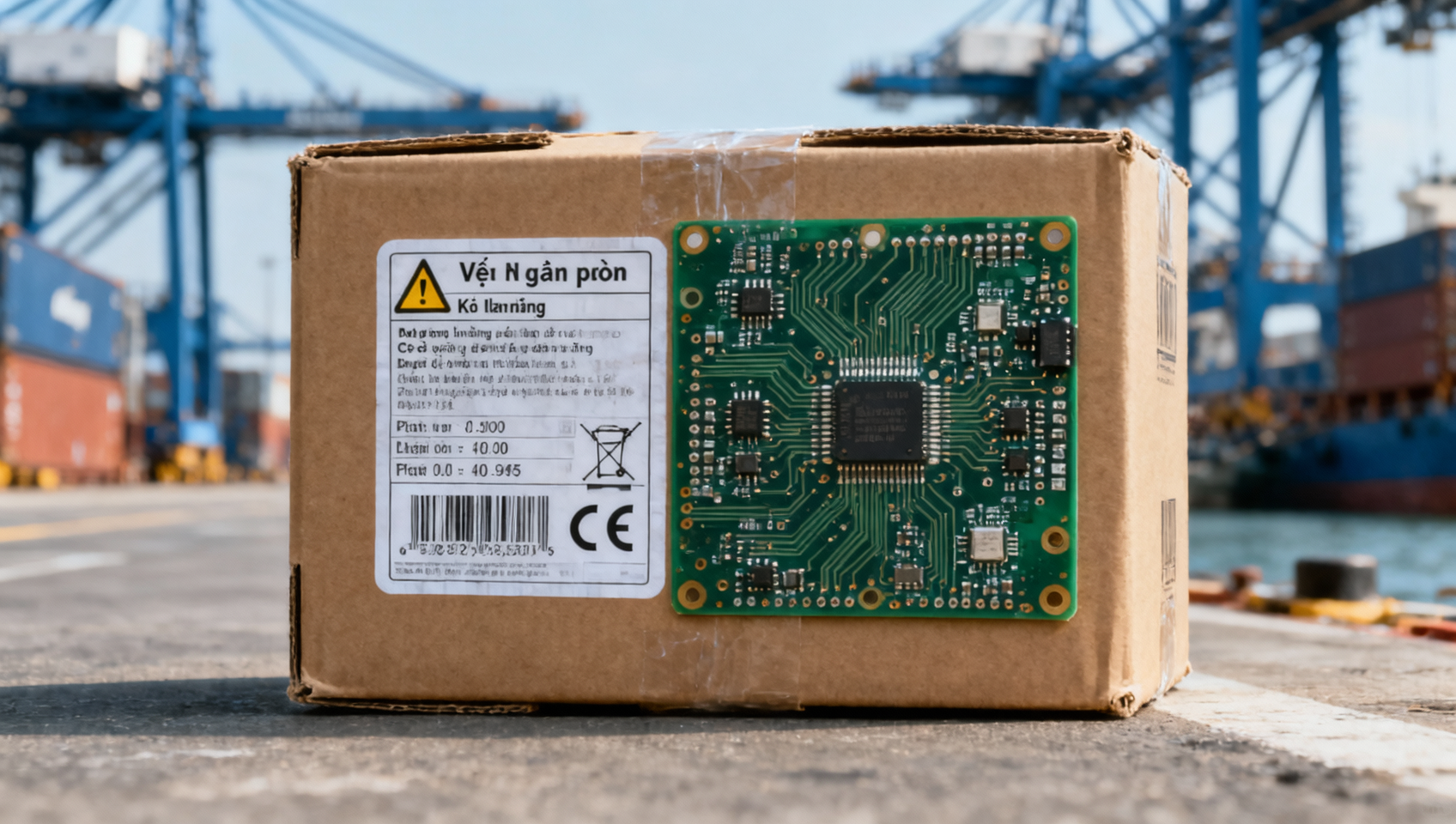
Vietnam’s MOIT Circular No. 12/2026/TT-BCT takes effect on April 22, 2026. It requires that safety warnings, rated parameters, and CE/UKCA certification markings on imported electronic components be labeled in Vietnamese paired with either English or Chinese on both outer packaging and accompanying documentation. Products failing to comply will be detained by Ho Chi Minh City Customs and subject to a fine equal to 20% of the goods’ declared value.
Which Sub-Sectors Are Affected
Direct Exporters & Trading Companies: Entities shipping electronic components from China, South Korea, Taiwan, Malaysia, or other origins into Vietnam must now adapt labeling at origin or during pre-clearance staging. Non-compliant labels trigger detention — not just rejection — increasing demurrage, rework, and customs clearance time.
Contract Manufacturers & EMS Providers: Firms assembling devices containing imported components (e.g., PCB assemblies with foreign-sourced sensors or connectors) may face downstream compliance pressure if their suppliers do not provide compliant labeling. This adds verification steps to incoming goods inspection protocols.
Distribution & Channel Partners: Local distributors handling multi-origin component inventories must audit existing stock and incoming shipments for label conformity. Mixed-language labeling (e.g., Vietnamese + Chinese for Chinese-made goods; Vietnamese + English for EU/US-sourced items) introduces SKU-level complexity in warehouse management and documentation handover.
Supply Chain & Compliance Service Providers: Customs brokers, labeling vendors, and regulatory consultants will see increased demand for bilingual label design, printing, and MOIT-aligned documentation review — especially for clients managing dual-market (e.g., China-Vietnam and EU-Vietnam) supply flows.
What Relevant Enterprises or Practitioners Should Focus On — And How to Respond Now
Confirm labeling language pairing per origin country
Analysis shows MOIT allows Vietnamese + English or Vietnamese + Chinese — but does not permit Vietnamese-only or English-only labeling. Exporters should align language choice with product origin: Chinese-sourced goods are more practically labeled in Vietnamese + Chinese; EU/UK/US-sourced goods, in Vietnamese + English. Mixing pairings within one shipment may require segregation.
Verify CE/UKCA marking placement and legibility
The circular explicitly includes CE and UKCA certification identifiers as mandatory bilingual elements — meaning not only safety text but also these logos and associated declarations must appear in both languages. This goes beyond typical multilingual warning text and affects label layout, font sizing, and print resolution requirements.
Update pre-shipment documentation workflows
Since detention occurs at Ho Chi Minh City Customs — Vietnam’s largest import gateway — shippers should integrate bilingual label verification into final QA before container loading. Including a signed declaration of label compliance in commercial invoices or packing lists may reduce on-site scrutiny, though MOIT has not formalized this as a requirement.
Monitor MOIT’s implementation guidance for exceptions
Current text does not clarify whether small-batch consignments, R&D samples, or repair parts qualify for exemptions. From industry angle, enterprises should track MOIT’s upcoming FAQs or circular amendments — expected in Q2 2026 — rather than assume de facto leniency.
Editorial Perspective / Industry Observation
This regulation is better understood as an enforcement signal than an isolated compliance update. Observation suggests it reflects Vietnam’s broader move toward harmonizing import controls with regional traceability standards — similar to ASEAN’s evolving product safety frameworks. While the rule targets labeling, its linkage to CE/UKCA marks implies growing alignment with international conformity assessment expectations. Analysis indicates it is less about restricting trade and more about strengthening post-import accountability — especially for fast-moving, low-value electronic parts where documentation gaps have historically been high.
That said, the 20% penalty and detention mechanism make it operationally consequential — not merely symbolic. Current more relevant interpretation is that MOIT is testing enforcement capacity ahead of anticipated updates to Vietnam’s Technical Regulations on Electrical Equipment (QCVN 04:2025/BKHCN), expected later in 2026.
Conclusion
This measure signals a tightening of documentation rigor for electronic components entering Vietnam — not a shift in market access policy. Its immediate impact lies in operational execution: labeling adaptation, customs coordination, and supplier communication. It is best understood not as a barrier, but as a procedural checkpoint reflecting Vietnam’s maturing regulatory infrastructure for electronics imports.
Information Source
Main source: Vietnam Ministry of Industry and Trade (MOIT), Circular No. 12/2026/TT-BCT, effective April 22, 2026.
Points requiring ongoing observation: MOIT’s official guidance on exemptions (e.g., samples, low-volume shipments), and any supplementary notices regarding label format specifications (font size, contrast ratio, placement).
Get weekly intelligence in your inbox.
No noise. No sponsored content. Pure intelligence.
 Apr 24, 2026India BIS Mandates IS 13252:2025 for PLCs & HMIs by Oct 2026India BIS Mandates IS 13252:2025 for PLCs & HMIs by Oct 2026
 Apr 24, 2026SASO EV Charger Regulation: Sand-Resistant Grid Compatibility Testing RequiredSASO EV Charger Regulation: Sand-Resistant Grid Compatibility Testing Required
 Apr 24, 2026Japan Updates JIS for Rehab Devices: IEC 62366-1:2024 Usability Compliance RequiredJapan Updates JIS for Rehab Devices: IEC 62366-1:2024 Usability Compliance Required
 Apr 24, 2026China Customs Launches RCEP Origin Smart Pre-Review SystemChina Customs Launches RCEP Origin Smart Pre-Review System
 Apr 24, 2026ANATEL Mandates Localized Voice Assistants for Smart Home Devices in BrazilANATEL Mandates Localized Voice Assistants for Smart Home Devices in Brazil
 Apr 24, 2026TÜV Rheinland Updates IoT EMC Standard with AI Edge抗扰度 RequirementTÜV Rheinland Updates IoT EMC Standard with AI Edge抗扰度 Requirement
 Apr 24, 20262M Alliance Shortens Ningbo–Rotterdam Route to 18 Days Amid 35% Slot Premium2M Alliance Shortens Ningbo–Rotterdam Route to 18 Days Amid 35% Slot Premium
 Apr 24, 2026Vietnam Enforces Bilingual Safety Labels for Imported Electronic Components from Apr 22, 2026Vietnam Enforces Bilingual Safety Labels for Imported Electronic Components from Apr 22, 2026
 Apr 24, 2026USTR Launches Sunset Review on China Solar PV AD/CVD DutiesUSTR Launches Sunset Review on China Solar PV AD/CVD Duties
 Apr 24, 2026EU New Battery Regulation Fully Effective Apr 24, 2026EU New Battery Regulation Fully Effective Apr 24, 2026
 Apr 23, 2026Taobao Factory Spark 3.0 Launches AI Workbench for SME Export FactoriesTaobao Factory Spark 3.0 Launches AI Workbench for SME Export Factories
 Apr 23, 2026TENENG Group Inspects IoT Safety Compliance at Jiangnan ChemicalTENENG Group Inspects IoT Safety Compliance at Jiangnan Chemical
 Apr 23, 2026China Launches First Embodied AI Open Data CommunityChina Launches First Embodied AI Open Data Community
 Apr 23, 2026PV Glass Prices Flat for 9 Weeks Amid Rising Integrated ProcurementPV Glass Prices Flat for 9 Weeks Amid Rising Integrated Procurement
 Apr 23, 20262984 NQI One-Stop Platforms Launched Nationwide2984 NQI One-Stop Platforms Launched Nationwide
 Apr 23, 2026China’s Green Smart Ship Tech Norms Accelerate BMS & Shore Power ExportChina’s Green Smart Ship Tech Norms Accelerate BMS & Shore Power Export
 Apr 23, 2026China Builds World's Largest Agri-Meteorological IoT NetworkChina Builds World's Largest Agri-Meteorological IoT Network
 Apr 23, 2026EU CBAM Carbon Tariff Enters Enforcement on April 1, 2026EU CBAM Carbon Tariff Enters Enforcement on April 1, 2026
 Apr 23, 2026Five Ministries Issue Zero-Carbon Factory Guidance for Export IndustriesFive Ministries Issue Zero-Carbon Factory Guidance for Export Industries
 Apr 23, 2026ISO Releases First Zero-Carbon City Standard — China’s Practices IncludedISO Releases First Zero-Carbon City Standard — China’s Practices Included
 Apr 22, 2026China Leads Global Offshore Wind Installations for 5th YearChina Leads Global Offshore Wind Installations for 5th Year
 Apr 22, 2026China Launches National Mine Safety IoT Monitoring NetworkChina Launches National Mine Safety IoT Monitoring Network
 Apr 22, 2026Yinchuan Boiler Pure Water Solution Certified for Middle East ProjectsYinchuan Boiler Pure Water Solution Certified for Middle East Projects
 Apr 22, 2026China to Enforce Mandatory EV Battery Recycling Standards by 2026China to Enforce Mandatory EV Battery Recycling Standards by 2026
 Apr 22, 2026Vietnam Launches Anti-Circumvention Probe on Electronic ComponentsVietnam Launches Anti-Circumvention Probe on Electronic Components
 Apr 22, 20262026 Shanghai Fastener Show: Robotic Fasteners Drive Overseas Procurement2026 Shanghai Fastener Show: Robotic Fasteners Drive Overseas Procurement
 Apr 22, 2026US BIS Adds EV On-Board Charger Crypto Modules to EAR Appendix 7US BIS Adds EV On-Board Charger Crypto Modules to EAR Appendix 7