2026 Shanghai Fastener Show: 1,423 Exhibitors, Robot-Specialized Fasteners in Focus
The 16th Shanghai International Fastener Exhibition (June 24–26, 2026) has confirmed 1,423 exhibitors — a new record — with rising demand for high-performance fasteners used in industrial and collaborative robotics drawing attention from procurement teams across automation, precision manufacturing, and cross-border OEM supply chains. This shift signals evolving technical requirements at the intersection of mechanical reliability and system-level integration.
Event Overview
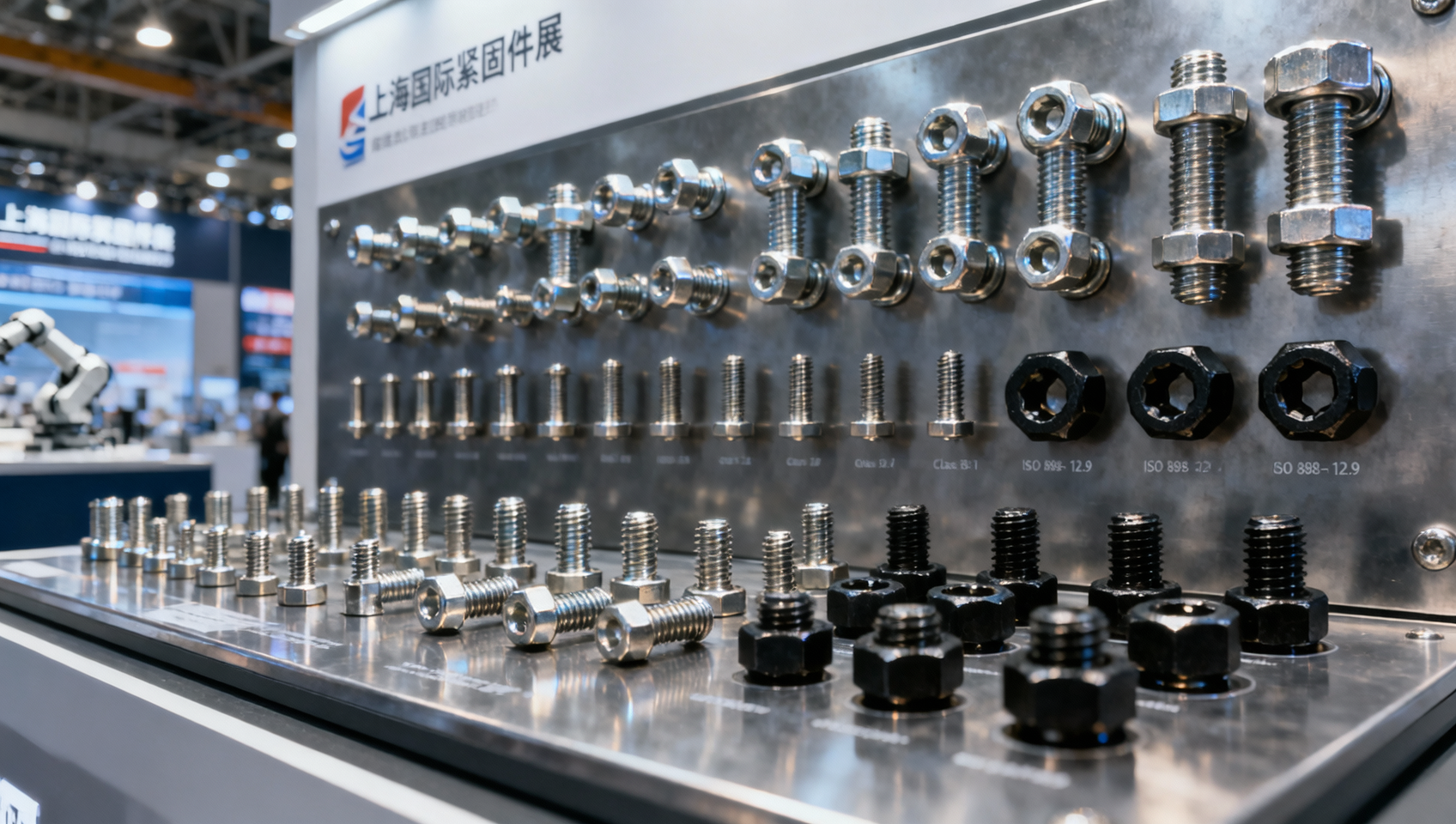
The 16th Shanghai Fastener Professional Exhibition is scheduled for June 24–26, 2026. Organizers have announced that the number of confirmed exhibitors stands at 1,423. Among them, 37% specialize in high-grade fasteners meeting ISO 898-1 Class 12.9 or higher specifications, corrosion-resistant coated variants, or lightweight titanium alloy solutions. Concurrently, the event will debut the Technical White Paper on Fasteners for Collaborative Robot Joint Modules, developed to address overseas robot integrators’ growing need for connection solutions with verified long-term reliability.
Industries Affected by This Development
Direct Trading Enterprises (e.g., Export-Oriented Distributors)
These firms face tightening technical qualification requirements when quoting to international robot integrators. The rise in Class 12.9+ and corrosion-resistant fastener suppliers indicates shifting buyer expectations — not just on price or lead time, but on traceability, material certification, and application-specific validation data.
Raw Material Procurement Enterprises
Procurement teams sourcing base materials (e.g., high-tensile steel billets, titanium wire, specialty coating agents) may observe increased volume inquiries for grades compliant with aerospace- or medical-grade processing standards. Demand signals are emerging not from broad market growth, but from concentrated adoption in joint module subassemblies.
Component Manufacturing Enterprises (e.g., Forging, Heat-Treating, Surface Finishing)
Manufacturers performing secondary processes must contend with tighter tolerances and stricter process controls — especially for fasteners destined for robotic joints where micro-movement fatigue and thermal cycling performance are critical. Certification readiness (e.g., ISO/IEC 17025 lab accreditation for mechanical testing) becomes more operationally relevant.
Supply Chain Service Providers (e.g., Logistics, Technical Documentation, Compliance Support)
Providers supporting export compliance — including EN 10204 3.1/3.2 documentation, REACH/ROHS declarations, and application-specific test reports — are likely to see elevated request volumes. The white paper’s release suggests standardization efforts are underway, potentially increasing reliance on third-party verification services ahead of formal harmonization.
What Relevant Enterprises or Practitioners Should Focus On Now
Monitor official publication timing and scope of the white paper
The Technical White Paper on Fasteners for Collaborative Robot Joint Modules is set for launch at the show. Current more suitable than treating it as an immediate specification is tracking its intended audience (e.g., whether aimed at end users, integrators, or component suppliers), and whether it references existing standards (e.g., ISO/TS 16949, ISO 13849) or introduces new performance benchmarks.
Assess exposure to Class 12.9+ and titanium fastener supply chains
Analysis来看, the 37% share of exhibitors focused on ultra-high-strength, corrosion-resistant, or lightweight fasteners reflects a structural shift — not cyclical demand. Companies involved in procurement or engineering should audit current supplier capabilities against these three technical vectors, particularly where joint modules or motion-control subassemblies are involved.
Distinguish between procurement interest and certified application readiness
Observation shows that while interest in robot-grade fasteners is rising, few Chinese suppliers currently hold publicly verifiable certifications for use in safety-rated robotic joints (e.g., PL e / SIL 3 compliant connections). It is therefore more accurate to view this as an early-stage alignment signal — not yet evidence of widespread qualification or deployment.
Prepare technical documentation workflows for higher-grade product lines
From industry perspective, enterprises supplying into robotics-related applications should begin aligning internal documentation practices with common requirements: lot traceability to heat treatment batch, tensile test reports per batch, surface coating thickness & adhesion verification, and dimensional inspection records. These are increasingly requested pre-qualification — not post-order.
Editorial Perspective / Industry Observation
This announcement is best understood as a coordination signal rather than a fully formed market outcome. The 1,423-exhibitor figure confirms scale and sectoral consolidation; the 37% specialization rate reflects targeted investment — but actual adoption by Tier-1 robot integrators remains unconfirmed in public data. The white paper’s release is a notable step toward technical convergence, yet its influence depends on uptake beyond the exhibition floor. From industry angle, what matters most now is not whether demand exists, but whether domestic suppliers can meet the *evidence-based* reliability thresholds required in functional safety contexts — a domain where documentation rigor often outweighs raw performance metrics.
Conclusion
The 2026 Shanghai Fastener Show’s exhibitor profile underscores a maturing interface between fastener engineering and advanced automation systems. Rather than indicating immediate market transformation, it highlights an ongoing realignment: technical specifications are becoming more application-defined, procurement criteria more verification-heavy, and supply chain readiness more documentation-intensive. Currently, this is better interpreted as a directional marker for capability development — not a trigger for wholesale strategic pivots.
Source Attribution
Main source: Official announcement from organizers of the 16th Shanghai Fastener Professional Exhibition (2026 edition). Note: The content and scope of the Technical White Paper on Fasteners for Collaborative Robot Joint Modules remain pending full public release and are subject to ongoing observation.
Get weekly intelligence in your inbox.
No noise. No sponsored content. Pure intelligence.
 Apr 21, 2026China Builds National Mine Safety Risk Monitoring 'Single Network'China Builds National Mine Safety Risk Monitoring 'Single Network'
 Apr 21, 2026MIIT Releases First List of AI+Manufacturing IncubatorsMIIT Releases First List of AI+Manufacturing Incubators
 Apr 21, 20262026 Shanghai Fastener Show: 1,423 Exhibitors, Robot-Specialized Fasteners in Focus2026 Shanghai Fastener Show: 1,423 Exhibitors, Robot-Specialized Fasteners in Focus
 Apr 21, 2026Vietnam Launches Anti-Circumvention Probe on Chinese-Assembled Electronic ComponentsVietnam Launches Anti-Circumvention Probe on Chinese-Assembled Electronic Components
 Apr 21, 2026China Academy Releases 2026 Digital Passport White PaperChina Academy Releases 2026 Digital Passport White Paper
 Apr 21, 2026Suez Canal AI Speed & Stowage Control Starts Apr 19, 2026Suez Canal AI Speed & Stowage Control Starts Apr 19, 2026
 Apr 21, 2026US BIS Adds EV Onboard Chargers with AES-256+ Encryption to Export ControlsUS BIS Adds EV Onboard Chargers with AES-256+ Encryption to Export Controls
 Apr 21, 2026TÜV Rheinland Updates BESS Certification: Thermal Cascade Protection Now MandatoryTÜV Rheinland Updates BESS Certification: Thermal Cascade Protection Now Mandatory
 Apr 21, 2026Shanghai Port Launches Green Clearance Channel for New Energy EquipmentShanghai Port Launches Green Clearance Channel for New Energy Equipment
 Apr 21, 2026IEC 63275:2026 Released: Global EMC Immunity Testing Standard for Warehouse RobotsIEC 63275:2026 Released: Global EMC Immunity Testing Standard for Warehouse Robots
 Apr 20, 2026Solar Street Lights: When Do They Really Pay Off?Solar Street Lights: When Do They Really Pay Off?
 Apr 20, 2026What Makes an Ultrasound Machine Worth the Cost?What Makes an Ultrasound Machine Worth the Cost?
 Apr 20, 2026Ultrasound Machines: New vs Refurbished in 2026Ultrasound Machines: New vs Refurbished in 2026
 Apr 20, 2026How to Evaluate Clean Energy ROI in 2026How to Evaluate Clean Energy ROI in 2026
 Apr 20, 2026Clean Energy Projects: Where Savings Really Come FromClean Energy Projects: Where Savings Really Come From
 Apr 20, 2026Air Quality Monitors: What to Check Before BuyingAir Quality Monitors: What to Check Before Buying
 Apr 20, 2026How Accurate Are Air Quality Monitors Indoors?How Accurate Are Air Quality Monitors Indoors?
 Apr 20, 2026AR Glasses for Field Work: Worth It or Not?AR Glasses for Field Work: Worth It or Not?
 Apr 20, 2026Which AED Defibrillators Are Easiest to Use?Which AED Defibrillators Are Easiest to Use?
 Apr 20, 2026AED Defibrillators: What Buyers Often MissAED Defibrillators: What Buyers Often Miss
 Apr 20, 2026How to Compare 3PL Logistics Providers for GrowthHow to Compare 3PL Logistics Providers for Growth
 Apr 20, 20263PL Logistics Costs Explained Before You Outsource3PL Logistics Costs Explained Before You Outsource
 Apr 20, 2026WMS vs ERP: What Matters on the Warehouse Floor?WMS vs ERP: What Matters on the Warehouse Floor?
 Apr 20, 2026How to Choose a Warehouse Management System in 2026How to Choose a Warehouse Management System in 2026
 Apr 20, 2026TENS Units: When Do They Help and When Don’t They?TENS Units: When Do They Help and When Don’t They?
 Apr 20, 2026Why Electronic Health Records Software Projects Go Over BudgetWhy Electronic Health Records Software Projects Go Over Budget
 Apr 20, 2026Electronic Health Records Software: What Should You Compare First?Electronic Health Records Software: What Should You Compare First?