When laser cutting services beat stamping on total cost
When buyers compare laser cutting services with stamping, the cheapest unit price is not always the lowest total cost. In many real sourcing scenarios, laser cutting wins when annual volumes are low to mid-range, part designs change frequently, launch timing is tight, or tooling risk is hard to justify. For procurement teams, engineers, finance approvers, and project managers, the real decision is not “Which process is cheaper on paper?” but “Which process reduces total landed cost, execution risk, and delay across the full project lifecycle?”
This matters even more when custom sheet metal fabrication is being evaluated alongside other precision manufacturing options such as micro machining, cnc turning centers, and additive manufacturing services. The right choice depends on volume, geometry, tolerance needs, lead time pressure, and how expensive a design mistake would be. Below is a practical framework to determine when laser cutting services beat stamping on total cost—and when they do not.
Why laser cutting can be the lower total-cost option
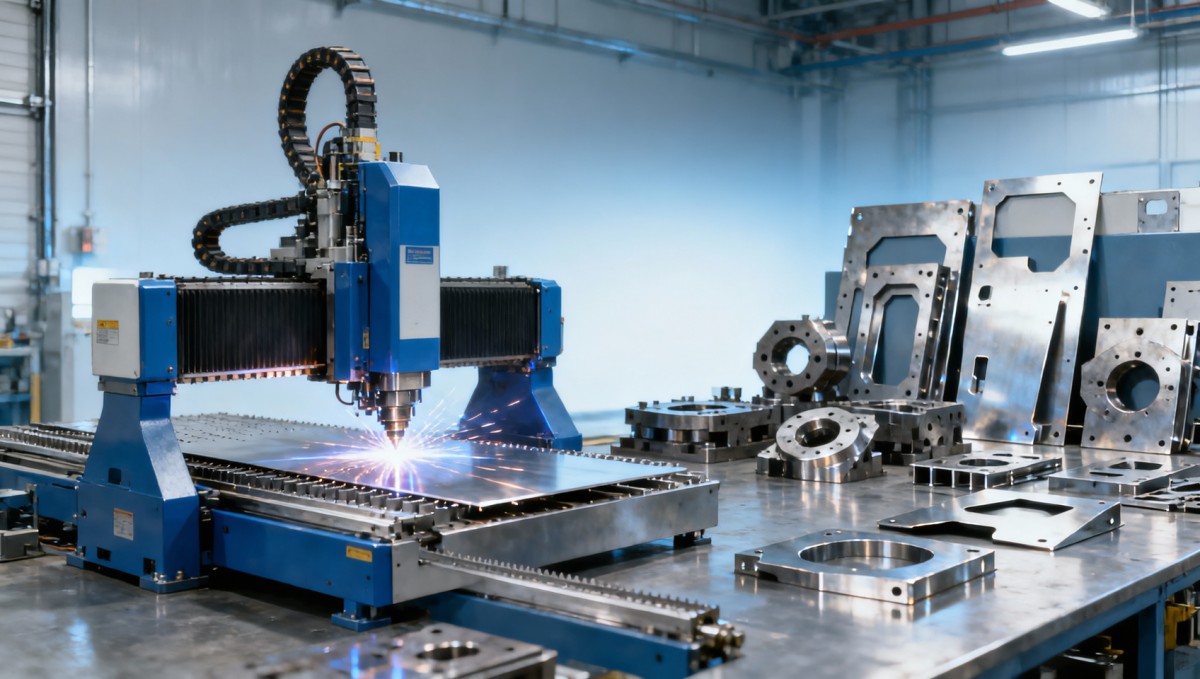
The biggest mistake in process selection is focusing only on piece-part price. Stamping often delivers a lower per-part cost at high volume, but total cost includes far more than cycle time. It also includes tooling investment, engineering revisions, setup risk, scrap exposure, inventory carrying cost, supplier responsiveness, and quality-related disruption.
Laser cutting services usually outperform stamping on total cost in these conditions:
- Low-to-medium production volumes
- Prototype, pilot, bridge, or launch-stage programs
- Frequent design revisions or uncertain demand forecasts
- Multiple SKUs with similar material but different profiles
- Projects where speed to qualification matters
- Programs that cannot justify dedicated tooling upfront
Stamping requires tooling, and tooling changes cost money and time. Laser cutting does not. That difference alone can shift the economics significantly, especially for buyers managing volatile demand or engineering-driven updates.
What buyers should include in a true total cost comparison
Technical teams may start with manufacturability, while finance teams look at quoted piece price and capitalized tooling. Both views are incomplete unless they include the full operating impact.
A realistic total cost model should include:
- Tooling cost: die design, die build, testing, maintenance, and revision cost
- Lead time cost: delay to first article, production launch, or customer delivery
- Engineering change cost: expense of modifying or replacing tooling after design updates
- Inventory burden: stock built to justify stamping economics, plus storage and obsolescence risk
- Quality cost: scrap, rework, dimensional variation, and inspection burden
- Procurement complexity: supplier coordination, MOQ pressure, and schedule inflexibility
- Cash flow impact: upfront tooling payment versus pay-as-you-order production
For many organizations, the commercial value of avoiding a tooling decision too early is substantial. If demand is not stable, laser cutting preserves optionality and reduces the cost of being wrong.
When stamping still looks cheaper—but actually is not
Stamping can appear cost-effective in quoting spreadsheets because the unit cost declines sharply once tooling is amortized over high volumes. But this logic breaks down when the forecast is uncertain or the program changes after launch.
Common situations where stamping appears cheaper but becomes more expensive include:
- Forecasted volumes do not materialize. The tooling cost is then spread over fewer parts than planned.
- Design changes occur after tooling approval. Even small geometry updates can trigger expensive die modifications.
- Product variants increase. Each variant may require dedicated tooling or compromise production efficiency.
- Market windows are short. Delayed tooling can cause lost revenue or delayed customer approval.
- MOQ-driven buying inflates inventory. The “cheap part” becomes expensive once storage, working capital, and excess stock are included.
This is especially relevant for sectors covered by TradeNexus Pro, such as advanced manufacturing, green energy equipment, smart electronics enclosures, and healthcare technology components, where products evolve quickly and specification stability cannot always be assumed early in the program.
Volume is the tipping point—but not the only one
Yes, volume matters. In general, stamping becomes more economical when part geometry is stable, annual volume is high, and the tooling can be fully utilized over a long production run. But no single volume threshold applies to every project.
The crossover point depends on:
- Material type and thickness
- Part complexity and number of features
- Tolerance requirements
- Nesting efficiency for laser cutting
- Number of revisions expected over the product lifecycle
- How many part numbers share the same production resources
- Cost of delayed market entry
For straightforward geometries at very high volume, stamping often wins. For mixed-demand portfolios, custom parts, or products still moving through design optimization, laser cutting services often provide the better economic result even when per-part price is nominally higher.
How laser cutting reduces risk for engineering and procurement teams
Laser cutting offers more than flexibility. It reduces decision risk across multiple departments.
For engineering teams:
- Fast implementation of design changes
- No tooling lock-in during product refinement
- Faster prototype-to-production transition
For procurement teams:
- Lower upfront spend
- Easier supplier switching if needed
- Reduced dependence on long tooling timelines
For finance approvers:
- Less capital tied up in uncertain programs
- Better cash flow management
- Lower exposure to stranded tooling assets
For quality and operations teams:
- More consistent execution on short runs and mixed batches
- Reduced risk of using outdated tooling revisions
- Simpler control during early production phases
In practical sourcing terms, laser cutting helps organizations keep options open until demand, design, and downstream assembly requirements are truly stable.
Where laser cutting fits versus micro machining, CNC turning, and additive manufacturing
Buyers evaluating sheet metal fabrication may also compare other precision processes. Each has a different cost logic.
- Laser cutting services: best for flat sheet profiles, fast changes, short-to-mid runs, and low tooling risk
- Micro machining: suitable for very small, high-precision features, usually at a higher cost structure
- CNC turning centers: ideal for rotational parts, shafts, and cylindrical geometries rather than sheet profiles
- Additive manufacturing services: valuable for complex shapes and prototyping, but often less cost-efficient for many sheet metal production applications
If the component is fundamentally a sheet metal part, comparing laser cutting directly against stamping is usually the most relevant evaluation. Other processes may serve niche design or prototyping needs, but they often do not replace either method efficiently at scale.
Questions to ask before choosing laser cutting or stamping
To avoid sourcing mistakes, teams should evaluate the project with a short decision checklist:
- What is the realistic annual volume, not just the optimistic forecast?
- How likely is a design revision in the next 6 to 12 months?
- What is the cost of delaying production while tooling is built or corrected?
- How much inventory will be required to make stamping economical?
- What happens if demand drops or product variants expand?
- How expensive would obsolete tooling become?
- Does the supplier have proven quality control for the chosen process?
If several of these answers point to uncertainty, laser cutting services usually deserve stronger consideration than a basic per-part comparison would suggest.
Best-fit scenarios for laser cutting services
Laser cutting is often the smarter sourcing choice in the following situations:
- New product introduction
- Bridge production before volume ramps
- Custom industrial enclosures and brackets
- Multi-variant product families
- Buyer-driven cost control without heavy tooling commitment
- Programs requiring short lead times and agile replenishment
It is particularly effective for organizations that want to reduce total supply chain friction, not just manufacturing cost in isolation.
Conclusion: choose the process that lowers system-wide cost, not just quoted price
When do laser cutting services beat stamping on total cost? Most often when volumes are not yet high enough to absorb tooling efficiently, when design changes are likely, when lead time matters, and when inventory or obsolescence risk is significant. In those cases, laser cutting can deliver a better overall financial outcome even if the nominal unit price is higher.
Stamping remains powerful for mature, stable, high-volume programs. But for many real-world sourcing decisions, especially in fast-moving B2B sectors, laser cutting offers the better balance of cost, speed, flexibility, and risk control. Buyers who evaluate total lifecycle cost—not just piece price—will make better manufacturing decisions and protect margin more effectively.
Get weekly intelligence in your inbox.
No noise. No sponsored content. Pure intelligence.
 Apr 19, 20262026 Dongguan Whole-House Customization List Released2026 Dongguan Whole-House Customization List Released
 Apr 19, 2026Global Shipping Alliances Launch Green Slot Priority for Asia-Europe RoutesGlobal Shipping Alliances Launch Green Slot Priority for Asia-Europe Routes
 Apr 19, 2026Vietnam Imposes AD Duties on Chinese Electronic ComponentsVietnam Imposes AD Duties on Chinese Electronic Components
 Apr 19, 2026Dongguan Victor Tops Local Full-Home Customization ListDongguan Victor Tops Local Full-Home Customization List
 Apr 19, 2026Guosheng Zhike Launches High-Precision Mold Machine Project in TaizhouGuosheng Zhike Launches High-Precision Mold Machine Project in Taizhou
 Apr 19, 2026CRRC Changchun Wins Jiaxing Urban Rail EMU ProjectCRRC Changchun Wins Jiaxing Urban Rail EMU Project
 Apr 19, 2026China Releases Green Design Guidelines 2026 for Industrial ProductsChina Releases Green Design Guidelines 2026 for Industrial Products
 Apr 19, 2026CATL Establishes $3B Era Resources Group for Global Mineral ControlCATL Establishes $3B Era Resources Group for Global Mineral Control
 Apr 19, 2026Shanghai Electric Gas Turbine Backlog Extends to 2028Shanghai Electric Gas Turbine Backlog Extends to 2028
 Apr 19, 2026Hormuz Strait Reopens, China Fertilizer Export Quota Easing ExpectedHormuz Strait Reopens, China Fertilizer Export Quota Easing Expected
 Apr 18, 2026TradeNexus Pro Launches Global Compliance RadarTradeNexus Pro Launches Global Compliance Radar
 Apr 18, 2026JIS T 2304:2026 Takes Effect June 1, 2026 for IVD SoftwareJIS T 2304:2026 Takes Effect June 1, 2026 for IVD Software
 Pathway for Rehab Devices with AI Modules") Apr 18, 2026FDA Updates 510(k) Pathway for Rehab Devices with AI ModulesFDA Updates 510(k) Pathway for Rehab Devices with AI Modules
Apr 18, 2026FDA Updates 510(k) Pathway for Rehab Devices with AI ModulesFDA Updates 510(k) Pathway for Rehab Devices with AI Modules Apr 18, 2026India BIS Approves 3 Chinese IoT Labs for IS 16444:2026 CertificationIndia BIS Approves 3 Chinese IoT Labs for IS 16444:2026 Certification
 Apr 18, 2026THE Alliance Launches Green Slot Priority for China PortsTHE Alliance Launches Green Slot Priority for China Ports
 Apr 18, 2026TÜV Rheinland Releases Dual-Standard ESS Certification Guide for ChinaTÜV Rheinland Releases Dual-Standard ESS Certification Guide for China
 Apr 18, 2026Vietnam Imposes AD Duties on Chinese Electronic ComponentsVietnam Imposes AD Duties on Chinese Electronic Components
 Apr 18, 2026SASO Launches PV Carbon Footprint Labeling from July 2026SASO Launches PV Carbon Footprint Labeling from July 2026
 Apr 18, 2026U.S. Adds 17 Smart Warehouse Robot Components to Export Control ListU.S. Adds 17 Smart Warehouse Robot Components to Export Control List
 Apr 18, 2026EU Enforces EN IEC 62443-4-2:2026 for Industrial Control Devices from 18 Apr 2026EU Enforces EN IEC 62443-4-2:2026 for Industrial Control Devices from 18 Apr 2026
 Apr 17, 2026How to Avoid Common Smart Thermostat Installation MistakesHow to Avoid Common Smart Thermostat Installation Mistakes
 Apr 17, 2026Smart Thermostats: Which Features Actually Cut Energy Bills?Smart Thermostats: Which Features Actually Cut Energy Bills?
 Apr 17, 2026Are Portable Monitors Worth It for Field Work in 2026?Are Portable Monitors Worth It for Field Work in 2026?
 Apr 17, 2026Portable Monitors: What Should You Check Before Buying?Portable Monitors: What Should You Check Before Buying?
 Apr 17, 2026How to Compare Lithium Ion Battery Costs Without MistakesHow to Compare Lithium Ion Battery Costs Without Mistakes
 Apr 17, 2026Lithium Ion Batteries: Which Specs Matter Most in Use?Lithium Ion Batteries: Which Specs Matter Most in Use?
 Apr 17, 2026Why Industry Veterans question impressive but vague specsWhy Industry Veterans question impressive but vague specs