JIS T 2304:2026 Takes Effect June 1, 2026 for IVD Software
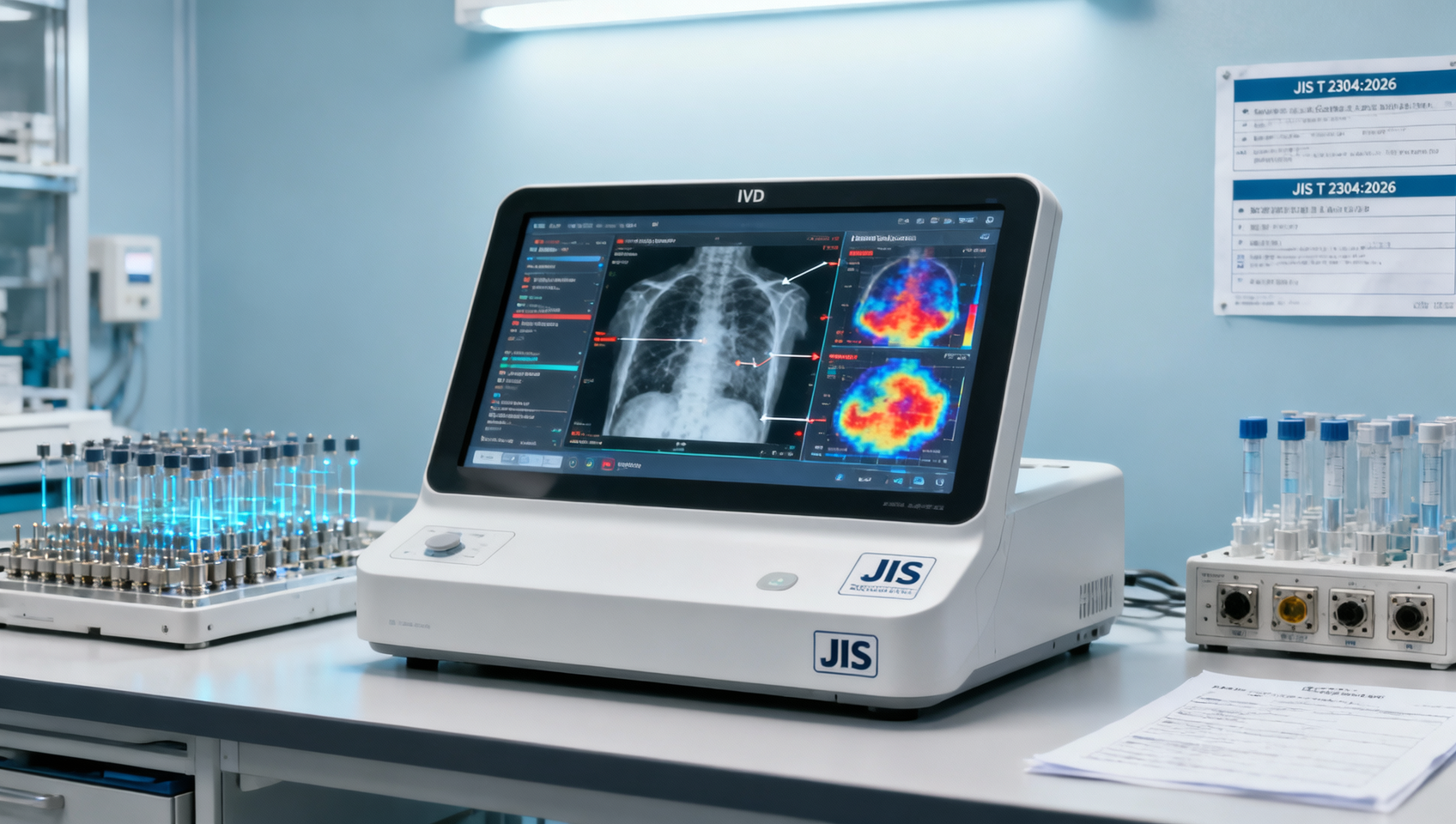
Japan’s Ministry of Economy, Trade and Industry (METI) has confirmed the mandatory implementation of JIS T 2304:2026 — Software Safety Requirements for In Vitro Diagnostic Medical Devices — effective June 1, 2026. The standard introduces new requirements for AI-assisted interpretation modules in diagnostic software, particularly concerning traceability, training data transparency, and explainability of black-box algorithms. Exporters of in vitro diagnostic equipment from China must update verification and validation (V&V) documentation and user manuals by the deadline to maintain eligibility for registration with Japan’s Pharmaceuticals and Medical Devices Agency (PMDA). This development directly affects manufacturers, exporters, and regulatory affairs professionals engaged in the Japanese IVD market.
Event Overview
On April 16, 2026, METI held an online briefing confirming that JIS T 2304:2026 will become mandatory on June 1, 2026. The standard revises the prior version to include specific provisions for AI-enabled diagnostic software used in in vitro diagnostics, focusing on three key areas: (1) full traceability of AI-assisted decision-making processes; (2) transparency of training data sources and composition; and (3) requirements for explaining outputs generated by opaque (‘black-box’) algorithms. Chinese diagnostic equipment suppliers exporting to Japan must revise their software V&V documentation and user manuals accordingly before June 1, 2026, or risk non-acceptance of PMDA registration submissions.
Industries Affected by the Change
Direct Exporters of IVD Equipment
Companies exporting in vitro diagnostic devices incorporating embedded software — especially those with AI-based image analysis, result interpretation, or risk-scoring functions — are directly subject to the new standard. Non-compliance may result in rejection of PMDA registration applications, delaying or blocking market access. Impact manifests in revised technical documentation, internal software validation protocols, and potential re-testing cycles.
Software Development & Integration Providers
Firms responsible for developing, integrating, or maintaining diagnostic software components (e.g., algorithm libraries, UI layers, reporting engines) must align code-level design, logging mechanisms, and documentation practices with the new traceability and explainability clauses. This includes updating audit trails for model inference steps and enabling human-readable rationale generation where feasible.
Regulatory Affairs & Quality Assurance Teams
Personnel managing compliance, ISO 13485 quality systems, or PMDA submission dossiers face increased documentation burdens. Specifically, they must now verify and record evidence of training data provenance, algorithm decision pathways, and user-facing explanations — all of which require cross-functional coordination between engineering, clinical, and regulatory units.
What Relevant Enterprises or Practitioners Should Focus On — And How to Respond
Monitor official METI and PMDA guidance updates closely
While the standard is published, implementation clarifications — such as acceptable formats for training data summaries or minimum thresholds for explanation depth — may be issued via METI notices or PMDA Q&A documents. Current more suitable approach is to track these channels weekly rather than assuming the published text is fully self-explanatory.
Prioritize review of products with AI-assisted interpretation features
Not all IVD software falls equally under the new requirements. Analysis来看, devices using rule-based logic or static lookup tables are less likely to trigger the AI-specific clauses than those deploying deep learning models for pattern recognition or probabilistic diagnosis. Firms should conduct a feature-level inventory to identify high-priority candidates for documentation revision.
Distinguish between policy signal and operational readiness
The June 1, 2026 date marks formal enforcement, but PMDA has not yet published revised review timelines or acceptance criteria for newly submitted dossiers. From industry perspective, this means firms should treat the deadline as a hard cutoff for documentation completeness — not necessarily for final approval. Pre-submission consultations with PMDA are recommended where feasible.
Initiate internal alignment across R&D, QA, and regulatory teams now
Updating V&V documentation and user manuals requires coordinated input from software developers (for traceability logs), clinical specialists (for explanation validity), and technical writers (for user-facing clarity). Observation来看, delays most commonly arise from misaligned definitions of ‘explanation’ across departments — e.g., developer-defined confidence scores versus clinician-expected clinical rationale. Starting cross-functional workshops by May 2026 is advisable.
Editorial Perspective / Industry Observation
This update is better understood as a regulatory signal reflecting Japan’s broader shift toward algorithmic accountability in health technology — rather than merely a technical revision. It signals increasing convergence between medical device regulation and AI governance frameworks, especially regarding transparency obligations for clinically consequential software. Analysis来看, METI’s emphasis on traceability and explainability suggests future extensions may cover model versioning, bias assessment, or real-world performance monitoring. However, as of April 2026, no such expansions have been announced. Current more appropriate interpretation is that JIS T 2304:2026 establishes a foundational compliance baseline — one that demands structured documentation discipline, not necessarily full AI auditing infrastructure.
Conclusion
JIS T 2304:2026 does not introduce new product categories or prohibit existing technologies, but it does raise the bar for evidentiary rigor in software-related claims for IVD devices entering Japan. Its significance lies not in novelty of concept, but in its binding nature and narrow implementation window. For affected stakeholders, the standard is best interpreted as a near-term documentation and process alignment requirement — one that reflects evolving global expectations for trustworthy AI in healthcare, but remains operationally focused on verifiable, human-reviewable artifacts.
Source Attribution
Main source: Japan Ministry of Economy, Trade and Industry (METI), online briefing held on April 16, 2026.
Points requiring ongoing observation: Official PMDA implementation guidance, including interpretation of ‘explanation’, acceptable data transparency formats, and transitional arrangements for pending registrations.
Get weekly intelligence in your inbox.
No noise. No sponsored content. Pure intelligence.
 Apr 18, 2026TradeNexus Pro Launches Global Compliance RadarTradeNexus Pro Launches Global Compliance Radar
 Apr 18, 2026JIS T 2304:2026 Takes Effect June 1, 2026 for IVD SoftwareJIS T 2304:2026 Takes Effect June 1, 2026 for IVD Software
 Pathway for Rehab Devices with AI Modules") Apr 18, 2026FDA Updates 510(k) Pathway for Rehab Devices with AI ModulesFDA Updates 510(k) Pathway for Rehab Devices with AI Modules
Apr 18, 2026FDA Updates 510(k) Pathway for Rehab Devices with AI ModulesFDA Updates 510(k) Pathway for Rehab Devices with AI Modules Apr 18, 2026India BIS Approves 3 Chinese IoT Labs for IS 16444:2026 CertificationIndia BIS Approves 3 Chinese IoT Labs for IS 16444:2026 Certification
 Apr 18, 2026THE Alliance Launches Green Slot Priority for China PortsTHE Alliance Launches Green Slot Priority for China Ports
 Apr 18, 2026TÜV Rheinland Releases Dual-Standard ESS Certification Guide for ChinaTÜV Rheinland Releases Dual-Standard ESS Certification Guide for China
 Apr 18, 2026Vietnam Imposes AD Duties on Chinese Electronic ComponentsVietnam Imposes AD Duties on Chinese Electronic Components
 Apr 18, 2026SASO Launches PV Carbon Footprint Labeling from July 2026SASO Launches PV Carbon Footprint Labeling from July 2026
 Apr 18, 2026U.S. Adds 17 Smart Warehouse Robot Components to Export Control ListU.S. Adds 17 Smart Warehouse Robot Components to Export Control List
 Apr 18, 2026EU Enforces EN IEC 62443-4-2:2026 for Industrial Control Devices from 18 Apr 2026EU Enforces EN IEC 62443-4-2:2026 for Industrial Control Devices from 18 Apr 2026
 Apr 17, 2026Temperature data loggers drift unpredictably inside lithium-ion battery storage enclosuresTemperature data loggers drift unpredictably inside lithium-ion battery storage enclosures
 Apr 17, 2026Are solar microinverters really worth the extra cost?Are solar microinverters really worth the extra cost?
 Apr 17, 2026Bifacial solar panels: How much more energy can they generate?Bifacial solar panels: How much more energy can they generate?
 Apr 17, 2026Gear manufacturing: How to optimize production for high precision?Gear manufacturing: How to optimize production for high precision?
 Apr 17, 2026Why power transmission components fail earlier than expectedWhy power transmission components fail earlier than expected
 Apr 17, 2026Linear motion systems: belt drive or ball screw for speed?Linear motion systems: belt drive or ball screw for speed?
 Apr 17, 2026Industrial bearing suppliers: what signals reliable quality?Industrial bearing suppliers: what signals reliable quality?
 Apr 17, 2026When pneumatic valves wholesale gets expensive laterWhen pneumatic valves wholesale gets expensive later
 Apr 17, 2026Hydraulic cylinder fabrication mistakes that cause oil leaksHydraulic cylinder fabrication mistakes that cause oil leaks
 Apr 17, 2026Heavy equipment manufacturing delays often start hereHeavy equipment manufacturing delays often start here
 Apr 17, 2026Custom heatsinks: when a larger size solves nothingCustom heatsinks: when a larger size solves nothing
 Apr 17, 2026Electronic enclosure fabrication: steel or aluminum?Electronic enclosure fabrication: steel or aluminum?
 Apr 17, 2026Automotive parts machining tolerances that drive up scrapAutomotive parts machining tolerances that drive up scrap
 Apr 17, 2026Medical device manufacturing changes under tighter traceabilityMedical device manufacturing changes under tighter traceability
 Apr 17, 2026How to Choose Solid State Batteries in 2026How to Choose Solid State Batteries in 2026
 Apr 17, 2026Are Solid State Batteries Worth the Cost Yet?Are Solid State Batteries Worth the Cost Yet?
 Apr 17, 2026Commercial Energy Storage Sizing: What Matters Most?Commercial Energy Storage Sizing: What Matters Most?