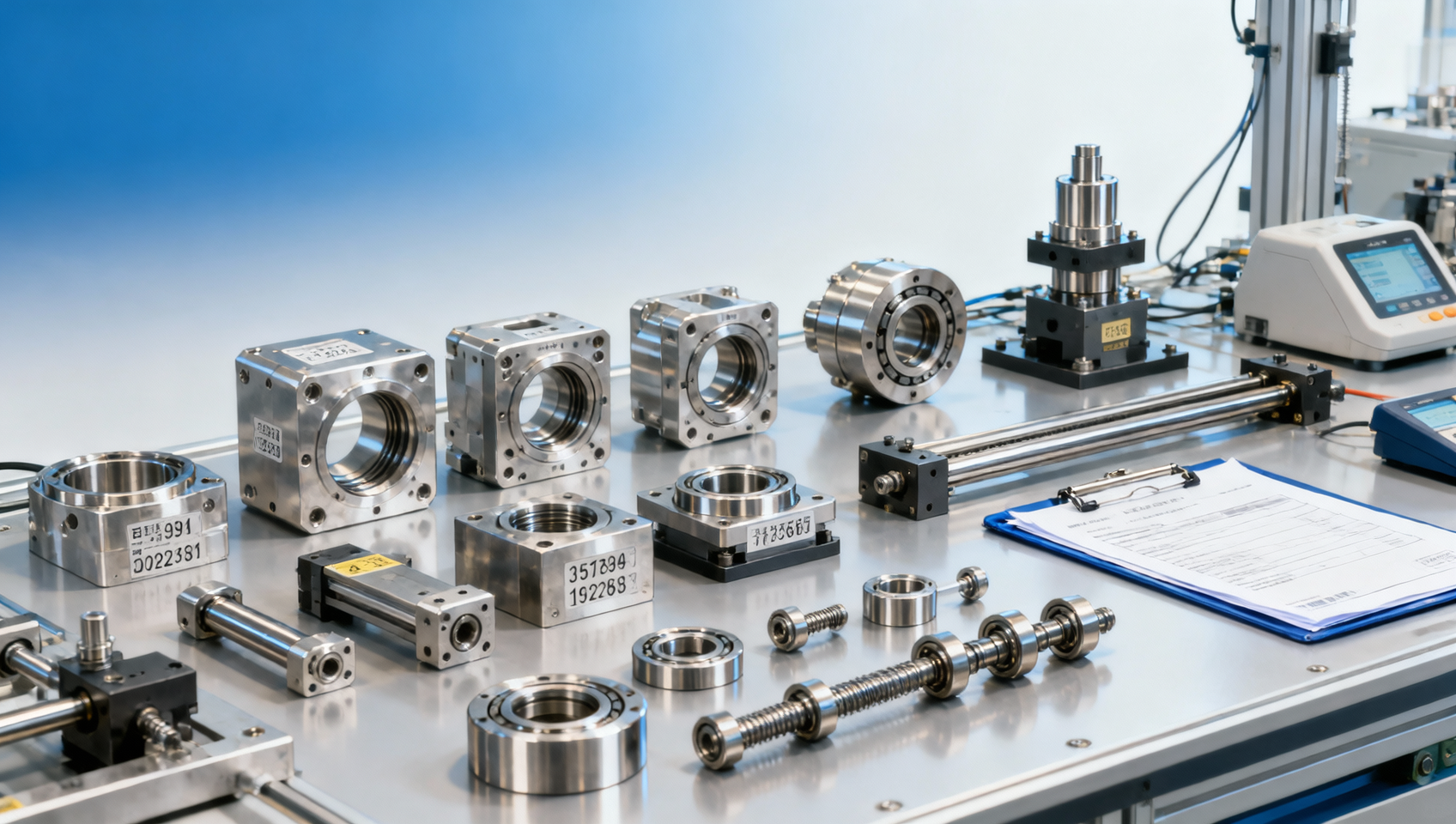
When pneumatic valves wholesale gets expensive later
What looks like a bargain in pneumatic valves wholesale can become a hidden cost driver when quality drift, lead-time volatility, and maintenance failures hit operations later. For buyers comparing power transmission components, linear motion systems, hydraulic cylinder fabrication, and industrial bearing suppliers, the real question is not unit price alone, but total lifecycle value, sourcing risk, and long-term supply chain resilience.
This issue matters across manufacturing, automation, energy systems, medical equipment assemblies, and material handling lines where pneumatic valves are not isolated parts. They affect response time, pressure stability, uptime, safety performance, and spare-parts planning. A valve that saves 8% on purchase cost can trigger 20% to 30% more maintenance events if seal quality, machining tolerance, or contamination control is inconsistent.
For procurement teams, technical evaluators, quality managers, project leaders, distributors, and finance approvers, the practical challenge is to separate low initial pricing from low total ownership cost. In many B2B buying cycles, the cost difference only becomes visible after 6 to 18 months, when warranty claims, air leakage, delayed deliveries, and line stoppages begin to accumulate.
Why low-cost pneumatic valves wholesale often becomes expensive later

In wholesale sourcing, price competition often compresses attention toward unit cost, MOQ, and freight terms. Yet pneumatic valves operate in duty cycles that may exceed 500,000 to 2 million actuations depending on the application. If material consistency, spool finishing, coil stability, or seal compatibility is weak, failure rates rise long before the procurement spreadsheet shows the true cost.
A common sourcing mistake is treating valves as interchangeable catalog items. In reality, application conditions differ sharply: compressed air cleanliness may range from basic filtered shop air to higher-purity lines in electronics or healthcare equipment; ambient temperatures may swing from 5°C to 45°C; and pressure may run at 4 bar, 6 bar, or 8 bar with fluctuating load profiles. Cheap sourcing that ignores these variables usually shifts cost into maintenance, scrap, or downtime.
Lead-time instability is another hidden cost layer. A supplier offering a lower quotation may require 10 to 12 weeks when demand spikes, while a more disciplined manufacturer may hold standard configurations with a 2 to 4 week replenishment window. For project managers and distributors, late delivery can delay machine builds, FAT schedules, and customer acceptance milestones.
There is also the commercial impact of quality drift. Initial pilot samples may perform acceptably, but batch-to-batch variation in anodizing, spring force, coil winding, or thread accuracy can create inconsistent field results. That inconsistency increases incoming inspection work, raises the need for 100% lot checks, and complicates replacement planning across multiple sites.
The four cost layers buyers tend to underestimate
- Direct maintenance cost: more frequent replacement of seals, coils, connectors, and pilot components after 3 to 9 months instead of expected service intervals.
- Downtime cost: even a 20-minute stoppage on a packaging or assembly line can outweigh the savings from a full pallet of discounted valves.
- Quality assurance cost: additional inspection, documentation, and quarantine procedures increase labor load for QC and safety teams.
- Planning cost: uncertain lead times force higher safety stock, tying up cash and warehouse space for 60 to 90 days.
The table below shows how a lower quote can translate into a higher lifecycle burden when viewed from a cross-functional B2B perspective.
The key takeaway is simple: savings at purchase order stage must be tested against 4 downstream realities—uptime, consistency, replenishment speed, and maintenance exposure. Wholesale decisions that ignore these factors often create budget pressure later for operations, engineering, and finance at the same time.
How to evaluate pneumatic valve sourcing beyond unit price
A disciplined sourcing process should evaluate pneumatic valves as performance-critical components, not just commodities. Whether the application supports automated assembly, conveyor gating, battery manufacturing, compact medical devices, or industrial packaging, a useful evaluation model needs at least 5 dimensions: technical fit, quality control, lead-time reliability, service support, and total cost over 12 to 24 months.
Technical teams should confirm pressure range, flow requirements, response time, port size, duty cycle, operating temperature, media compatibility, and mounting constraints. A valve selected only on nominal size may later underperform because Cv, coil power, manual override design, or ingress protection level does not match the operating environment.
Commercial teams should check MOQ, pricing validity, spare-part availability, packaging standards, and forecast flexibility. If a supplier only supports large batch builds and cannot handle 20% to 30% monthly demand swings, distributors and OEM buyers may face excess inventory during slow cycles and shortages during ramp-up periods.
Quality and safety personnel should require lot traceability, inspection methods, and defect handling procedures. Even when no application-specific certification is required, suppliers should be able to explain leak testing practice, coil verification, thread inspection, and packaging protection against moisture or particulate contamination.
Core evaluation checklist for procurement and engineering
- Define operating conditions: pressure, temperature, media quality, switching frequency, and contamination risk.
- Verify production capability: standard lead time, peak-season extension, and capacity for emergency orders within 7 to 10 days.
- Review quality controls: leak testing approach, dimensional inspection, coil verification, and lot traceability.
- Assess service support: replacement parts, engineering response time, and root-cause analysis process.
- Model total cost: purchase, maintenance, downtime risk, inventory carrying cost, and replacement cycles.
Typical technical and commercial criteria
The matrix below can be used by sourcing managers, project engineers, and finance reviewers when comparing wholesale offers from multiple vendors.
When buyers use this kind of cross-functional matrix, procurement becomes less vulnerable to misleadingly low quotations. It also creates a shared decision language among engineering, quality, operations, and finance, reducing friction in approval cycles.
Application-specific risks across advanced manufacturing and industrial supply chains
Not all pneumatic valve failures carry the same consequence. In advanced manufacturing, a sticking directional valve may slow a robotic fixture and reduce output by a few percentage points. In electronics assembly, inconsistent air control can affect micro-positioning stability. In healthcare technology equipment, pressure instability may compromise repeatability in compact pneumatic subassemblies. The true cost depends on where the valve sits in the process.
This is why wholesale selection should be linked to application criticality. A low-risk utility line may tolerate a broader component range. A high-cycle automated station running 16 to 20 hours per day requires tighter control over seal wear, thermal behavior, and contamination resilience. Buyers who standardize without considering these distinctions often overpay in one area and underprotect another.
Supply chain teams also need to think in system terms. Pneumatic valves interact with cylinders, air preparation units, manifolds, tubing, sensors, and PLC logic. If the sourcing strategy for valves is disconnected from the rest of the motion or automation architecture, maintenance teams can face incompatible interfaces, excess spare SKUs, and longer troubleshooting windows.
For distributors and integrators, the risk extends to reputation. If replacement claims rise above even 2% to 3% of delivered volume, the administrative load and customer dissatisfaction can erode margin quickly. That is especially true when technical support must travel across time zones and replacement inventory is not localized.
Where hidden costs show up by application type
The table below maps common use environments to the sourcing risks most likely to become expensive later.
The lesson is not that buyers should always choose the highest-priced option. It is that sourcing should match risk exposure. In lower-criticality circuits, commercial optimization may dominate. In higher-criticality processes, reliability and replenishment discipline usually carry more financial weight than small price gaps.
Three practical risk filters before approving a supplier
- Criticality filter: identify whether failure causes inconvenience, measurable output loss, or safety-related disruption.
- Variability filter: review how much demand, environment, and duty cycle change over a quarter or full year.
- Recovery filter: estimate whether replacement can happen in hours, days, or several weeks depending on stocking and sourcing model.
A better procurement model: total cost, vendor resilience, and implementation control
The most effective way to avoid expensive surprises in pneumatic valves wholesale is to build a decision framework that combines cost analysis with supplier resilience. Instead of awarding business on quoted price alone, buyers should score vendors across 6 to 8 weighted criteria. Typical weightings may include 25% technical fit, 20% quality consistency, 20% delivery reliability, 15% service responsiveness, 10% commercial flexibility, and 10% cost competitiveness.
This approach works especially well for enterprise decision-makers and finance approvers because it converts engineering concerns into measurable commercial logic. A supplier that is 7% cheaper but scores 30% lower in delivery stability and support may not be the lower-cost option once inventory buffers, expediting, and service disruptions are included.
Implementation control matters as much as supplier selection. New sources should be introduced in stages: sample validation, pilot batch, and production ramp. A 3-step release model can reduce exposure to mass replacement or field complaints. It also allows technical teams to compare leakage, switching consistency, and installation fit across real operating conditions rather than laboratory assumptions alone.
For organizations managing international sourcing, market intelligence is part of the strategy. Buyers need visibility into sector demand, regional capacity shifts, freight volatility, and substitute component risk. In a supply chain environment where manufacturing, green energy systems, smart electronics, healthcare technology, and software-driven planning intersect, informed procurement becomes a competitive advantage rather than a back-office function.
Recommended rollout process for new wholesale sources
- Specification alignment: lock key parameters, interfaces, and quality expectations before quotation comparison.
- Sample and pilot review: test 20 to 50 units under realistic duty cycles, contamination levels, and pressure ranges.
- Supplier audit discussion: confirm process controls, traceability, contingency planning, and escalation contacts.
- Controlled ramp-up: release partial volume first, monitor field performance for one or two replenishment cycles.
- Quarterly review: track delivery adherence, defect trends, replacement rate, and service response time.
FAQ for procurement, engineering, and channel partners
Below are common questions that arise when buyers compare wholesale offers and try to balance price with operational security.
How long should a typical evaluation cycle take?
For standard industrial applications, 2 to 6 weeks is common, depending on sample availability and test complexity. High-cycle or regulated equipment environments may take longer because teams need more validation points, including fit, leakage stability, and performance consistency across several operating conditions.
What is a reasonable lead-time benchmark for standard pneumatic valves?
Many standard configurations fall in the 2 to 4 week range under stable market conditions, while customized manifolds or special coil options may extend to 6 to 10 weeks. Buyers should ask not only for quoted lead time, but also for on-time performance during peak demand periods.
Which indicators best predict future hidden costs?
The most useful signals are batch consistency, field replacement rate, lead-time variation, engineering response speed, and spare-part support. These indicators often predict downstream cost better than unit price alone, particularly in multi-site or distributor-led supply chains.
Can a lower-cost source still be a good choice?
Yes, if the application is low criticality, the supplier has stable process control, and replenishment risk is acceptable. The right question is not whether the price is low, but whether the supplier can support the required reliability, consistency, and service level over the full operating cycle.
When pneumatic valves wholesale gets expensive later, the root cause is usually not price itself, but poor alignment between component sourcing and operational reality. Buyers who examine lifecycle cost, batch consistency, lead-time resilience, and application criticality make better decisions than those who compare quotations in isolation.
For organizations navigating supplier selection across advanced manufacturing, green energy, smart electronics, healthcare technology, and digitalized supply chains, informed market intelligence can shorten decision cycles and reduce procurement risk. TradeNexus Pro helps global B2B teams evaluate sourcing options with deeper industry context, practical analysis, and stronger decision support. Contact us to explore tailored insights, compare sourcing strategies, and get a more resilient path to long-term value.
Get weekly intelligence in your inbox.
No noise. No sponsored content. Pure intelligence.
 Apr 17, 2026Temperature data loggers drift unpredictably inside lithium-ion battery storage enclosuresTemperature data loggers drift unpredictably inside lithium-ion battery storage enclosures
 Apr 17, 2026Are solar microinverters really worth the extra cost?Are solar microinverters really worth the extra cost?
 Apr 17, 2026Bifacial solar panels: How much more energy can they generate?Bifacial solar panels: How much more energy can they generate?
 Apr 17, 2026Gear manufacturing: How to optimize production for high precision?Gear manufacturing: How to optimize production for high precision?
 Apr 17, 2026Why power transmission components fail earlier than expectedWhy power transmission components fail earlier than expected
 Apr 17, 2026Linear motion systems: belt drive or ball screw for speed?Linear motion systems: belt drive or ball screw for speed?
 Apr 17, 2026Industrial bearing suppliers: what signals reliable quality?Industrial bearing suppliers: what signals reliable quality?
 Apr 17, 2026When pneumatic valves wholesale gets expensive laterWhen pneumatic valves wholesale gets expensive later
 Apr 17, 2026Hydraulic cylinder fabrication mistakes that cause oil leaksHydraulic cylinder fabrication mistakes that cause oil leaks
 Apr 17, 2026Heavy equipment manufacturing delays often start hereHeavy equipment manufacturing delays often start here
 Apr 17, 2026Custom heatsinks: when a larger size solves nothingCustom heatsinks: when a larger size solves nothing
 Apr 17, 2026Electronic enclosure fabrication: steel or aluminum?Electronic enclosure fabrication: steel or aluminum?
 Apr 17, 2026Automotive parts machining tolerances that drive up scrapAutomotive parts machining tolerances that drive up scrap
 Apr 17, 2026Medical device manufacturing changes under tighter traceabilityMedical device manufacturing changes under tighter traceability
 Apr 17, 2026How to Choose Solid State Batteries in 2026How to Choose Solid State Batteries in 2026
 Apr 17, 2026Are Solid State Batteries Worth the Cost Yet?Are Solid State Batteries Worth the Cost Yet?
 Apr 17, 2026Commercial Energy Storage Sizing: What Matters Most?Commercial Energy Storage Sizing: What Matters Most?
 Apr 17, 2026Commercial Energy Storage ROI: How to Assess ItCommercial Energy Storage ROI: How to Assess It
 Apr 17, 2026Off Grid Solar Systems: What to Avoid FirstOff Grid Solar Systems: What to Avoid First
 Apr 17, 2026Who Should Use Off Grid Solar Systems?Who Should Use Off Grid Solar Systems?
 Apr 17, 2026Solar Microinverters vs String Inverters: Which Fits?Solar Microinverters vs String Inverters: Which Fits?
 Apr 17, 2026When Do Solar Microinverters Make More Sense?When Do Solar Microinverters Make More Sense?
 Apr 17, 2026How digital freight matching for international shipping cuts transit time by up to 22% in 2026How digital freight matching for international shipping cuts transit time by up to 22% in 2026
 Apr 17, 2026Why port automation tech for smart logistics reduces container handling errors by 37% at Tier-1 terminalsWhy port automation tech for smart logistics reduces container handling errors by 37% at Tier-1 terminals
 Apr 17, 2026What yard management systems for port operations actually deliver in real-world deploymentsWhat yard management systems for port operations actually deliver in real-world deployments
 Apr 17, 2026Can digital customs clearance for sea freight reduce D/O processing from 48 hours to under 90 minutesCan digital customs clearance for sea freight reduce D/O processing from 48 hours to under 90 minutes
 Apr 17, 2026How returnable transport packaging for automotive parts lowers TCO by 18–25% over 3 yearsHow returnable transport packaging for automotive parts lowers TCO by 18–25% over 3 years