ASRS Systems Payback: Where ROI Estimates Often Go Wrong
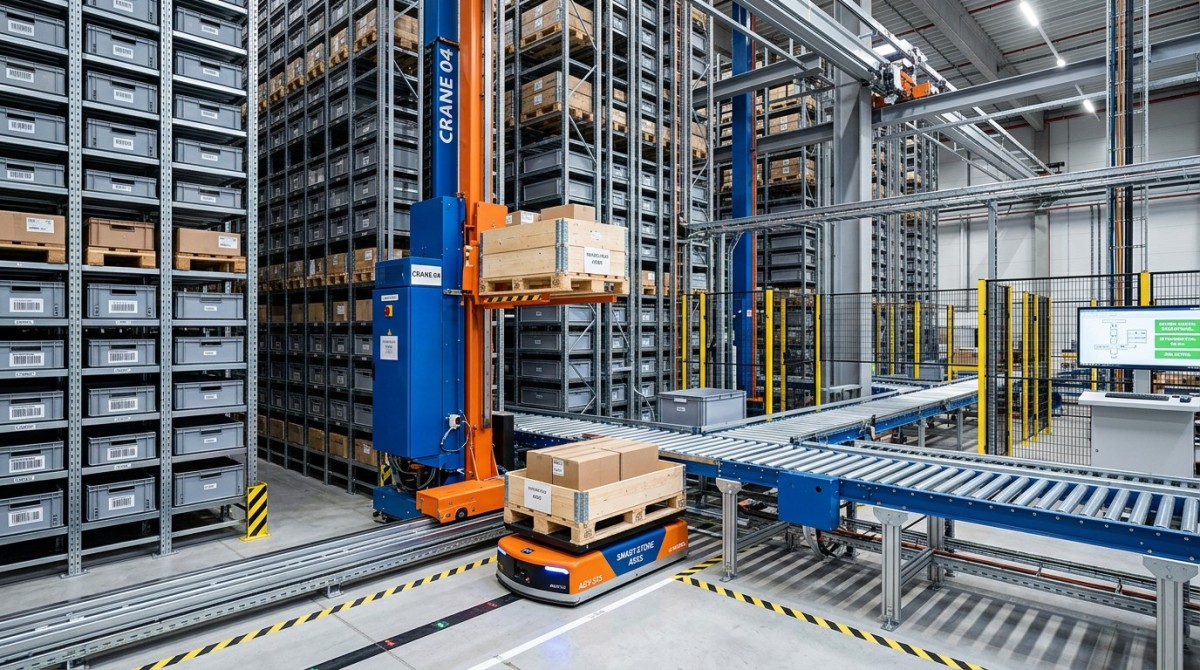
ASRS systems can deliver real value, but the payback period is often overstated because many ROI models rely on simplified assumptions. In practice, the biggest mistakes usually come from underestimating integration complexity, overestimating labor savings, ignoring ramp-up losses, and failing to account for software, maintenance, energy, and change-management costs. For procurement teams, operations leaders, finance approvers, and project owners, the real question is not whether automated storage and retrieval can work, but whether the business case reflects actual operating conditions. A credible ROI model should connect warehouse automation, AGV robots, WMS and TMS software alignment, service requirements, throughput reality, and operational risk into one decision framework.
Why ASRS payback estimates so often miss the mark
The core search intent behind this topic is highly practical: readers want to know why projected ASRS systems ROI often looks attractive in vendor proposals but becomes less convincing during implementation or after go-live. They are not looking for a generic definition of automated storage and retrieval. They want to understand where financial assumptions fail, what hidden costs are commonly missed, and how to judge whether an ASRS investment case is realistic.
That concern is especially relevant for mixed audiences such as warehouse users, procurement specialists, enterprise decision-makers, finance reviewers, safety managers, quality personnel, project leaders, and channel partners. Each group sees the payback question differently, but all of them care about one issue: can the proposed system achieve measurable business gains without creating unexpected operational or financial drag?
In most cases, ASRS payback estimates go wrong for one of three reasons. First, the model is too narrow and focuses only on labor reduction. Second, the planning team assumes ideal operating conditions from day one. Third, the investment case ignores the surrounding digital and process ecosystem needed to make warehouse automation perform as promised.
The most common ROI mistake: reducing the business case to labor savings alone
One of the biggest weaknesses in ASRS ROI calculations is the assumption that labor reduction is the main value driver. Labor savings matter, but a realistic business case should be broader. In many facilities, labor may not disappear at the rate projected in early estimates. Roles often shift instead of being eliminated. Operators may move into exception handling, replenishment supervision, maintenance coordination, quality checks, inventory validation, or system support.
This matters because many financial models are built around aggressive headcount reduction assumptions that are difficult to achieve in real operating environments. If a warehouse still needs people for inbound verification, damaged goods handling, cycle counting, returns management, compliance checks, and safety oversight, then the labor line in the ROI spreadsheet can be misleading.
A better approach is to divide value into separate buckets:
- Direct labor productivity gains
- Improved storage density and reduced building expansion pressure
- Higher throughput consistency during peak periods
- Lower picking error rates and better inventory accuracy
- Reduced product damage and traceability improvements
- Service-level benefits such as faster order turnaround
- Lower dependence on hard-to-hire warehouse labor
For finance approvers, this is a crucial distinction. A weak model says, “the system pays back because labor goes down.” A credible model says, “the system pays back because it changes cost, capacity, service reliability, space utilization, and operating resilience in ways we can quantify.”
Integration costs are usually underestimated, especially across software and material flow
Another major source of payback distortion is underestimating integration. An ASRS system rarely operates as a standalone asset. It must exchange data and execution logic with warehouse management systems, ERP, conveyors, sortation equipment, scanners, labeling systems, AGV robots, and sometimes TMS software when outbound scheduling and dock coordination affect warehouse flow.
Companies often approve projects based on equipment pricing and basic installation cost, then discover that software alignment is more difficult than expected. Material flow logic, inventory mapping, order prioritization rules, exception management, and interface testing can consume significant time and budget. Even when the hardware performs well, the full warehouse automation stack may not.
Typical overlooked items include:
- Middleware or warehouse control software licensing
- Custom interface development between ASRS, WMS, ERP, and TMS software
- Data cleansing before migration
- Testing cycles for exception scenarios
- Cybersecurity hardening and network upgrades
- Third-party systems integration and validation
- Post-go-live software tuning
For project managers and engineering leaders, this is where ROI credibility is often won or lost. If software dependencies are treated as minor details rather than core project elements, the actual payback timeline can move substantially to the right.
Ramp-up losses and operational disruption are often ignored in early models
Many ROI estimates assume that warehouse performance improves almost immediately after commissioning. In reality, most ASRS systems need a ramp-up period before they reach target throughput, storage accuracy, and labor efficiency. During that phase, output can temporarily drop, overtime may rise, and manual backup processes may continue longer than planned.
This is especially true in facilities with SKU variability, seasonal volume swings, high order complexity, or strict quality and compliance requirements. Even with strong vendor support, operations teams need time to adapt slotting logic, replenishment rules, preventive maintenance routines, and exception workflows.
Decision-makers should build these transition realities into the model:
- Training time for operators, supervisors, and maintenance personnel
- Productivity loss during commissioning and stabilization
- Temporary parallel running of manual and automated processes
- Inventory correction work after system cutover
- Initial software rule adjustments after live operations begin
- Customer service impact if throughput targets are missed in early weeks
For enterprises operating under tight service-level commitments, these transition costs can materially affect first-year returns. An ASRS project may still be the right investment, but its payback calculation should reflect the real path to steady-state performance, not an idealized one.
Energy, maintenance, and lifecycle costs are frequently treated too lightly
ASRS systems are often justified on efficiency grounds, yet some models overlook how ongoing operating costs evolve over time. Energy use, maintenance planning, spare parts strategy, system uptime support, and component replacement schedules can all influence actual ROI.
This is becoming more important as companies expand energy monitoring and sustainability reporting. High-density automated storage can improve building efficiency per unit handled, but energy consumption is still a real line item, especially when refrigeration, climate control, charging systems, lifts, shuttles, conveyors, or AGV robots are involved. If the business case assumes only labor benefits and ignores power demand, charging infrastructure, peak-load effects, and service contracts, the payback estimate may be incomplete.
Important cost categories to evaluate include:
- Preventive and corrective maintenance contracts
- Spare parts inventory and critical component lead times
- Energy consumption under normal and peak throughput conditions
- Battery management or charging costs for AGV robots if integrated
- Downtime risk and the cost of lost throughput
- Upgrade costs for controls and software over the asset lifecycle
For finance and procurement teams, the right question is not only “what is the initial capex?” but “what is the real total cost of ownership over five to ten years?” Without that view, short payback claims can be misleading.
Throughput assumptions are often too optimistic for real warehouse conditions
Vendors and internal champions may model high throughput under stable, engineered conditions. But actual warehouses face congestion, SKU profile changes, variable order waves, damaged loads, replenishment conflicts, carrier cut-off pressure, and unplanned downtime. These real-world conditions can erode the performance level assumed in ROI projections.
Throughput assumptions should therefore be tested against operational variability rather than best-case scenarios. A strong business case asks:
- What happens during seasonal peaks?
- How sensitive is the system to SKU growth and order profile changes?
- What is the impact of exceptions, short picks, returns, and damaged goods?
- Can upstream and downstream processes keep pace with ASRS speed?
- Do dock scheduling and TMS software constraints limit outbound gains?
This last point is often missed. A faster storage and retrieval engine does not automatically create end-to-end efficiency if transport planning, dock assignment, trailer availability, packing stations, or order release logic remain bottlenecks. ASRS ROI should be modeled as part of a full warehouse and logistics flow, not as an isolated machine calculation.
Safety, quality, and compliance value are real, but they should be quantified carefully
Quality managers, safety officers, and executive sponsors often recognize that warehouse automation can reduce manual handling, improve traceability, and create more controlled inventory environments. These are legitimate benefits. However, problems arise when soft benefits are inserted into the ROI model without a defensible method.
A stronger approach is to convert these factors into measurable business outcomes where possible. For example:
- Reduced forklift traffic may lower incident rates and insurance exposure
- Better inventory traceability may reduce recall risk or compliance failures
- Improved stock accuracy may reduce write-offs and emergency replenishment
- More controlled storage conditions may lower product damage rates
These benefits should not be exaggerated, but they should not be ignored either. In regulated sectors and high-value inventory environments, risk reduction and compliance improvement can be meaningful contributors to project value, even if they do not always appear in narrow payback spreadsheets.
How to build a more credible ASRS ROI model before approval
If decision-makers want a more realistic payback estimate, they need a model grounded in process reality rather than presentation logic. That means combining financial analysis with operational validation.
A practical review framework includes the following steps:
- Separate one-time and recurring costs clearly. Include equipment, software, commissioning, training, integration, maintenance, energy, and upgrade costs.
- Model multiple scenarios. Compare best case, expected case, and stress case instead of relying on a single payback figure.
- Validate labor assumptions by task. Identify which activities disappear, which remain, and which new technical roles are created.
- Test throughput against real order and SKU data. Use actual warehouse profiles, not abstract averages.
- Include ramp-up timing. Build in stabilization periods, temporary inefficiencies, and dual-process operation if needed.
- Assess system dependencies. Check whether WMS, ERP, AGV robots, conveyors, and TMS software can support the projected gains.
- Quantify downtime sensitivity. Understand the cost of service interruption and what fallback process exists.
- Review total cost of ownership. Payback matters, but so does long-term cost stability and scalability.
This method helps procurement teams challenge weak assumptions, gives project leaders a more practical implementation roadmap, and allows finance teams to compare automation options on a stronger basis.
When ASRS investment cases are usually strongest
Not every warehouse needs an ASRS. The strongest cases typically appear where several conditions exist at the same time: labor pressure is persistent, land or building expansion is expensive, inventory accuracy matters, throughput must be more predictable, and the operation has enough volume and process discipline to benefit from automation.
ASRS investment tends to be more compelling when businesses face:
- High storage density requirements
- Expensive warehouse space or limited expansion options
- Repeated labor shortages or high labor turnover
- Demand for higher order accuracy and traceability
- Stable enough volume to support automation utilization
- Clear digital infrastructure strategy for warehouse automation
By contrast, ROI is harder to justify when product profiles change constantly, volume is too low, process discipline is weak, or supporting systems are fragmented. In such environments, the issue is not that ASRS technology lacks value, but that the organization may not yet be ready to capture it fully.
Final takeaway: a realistic payback model is a strategic decision tool, not a sales number
ASRS systems can absolutely produce strong returns, but only when the ROI estimate reflects real warehouse conditions, full system dependencies, and total lifecycle cost. The most common errors come from overly simple labor assumptions, underestimated integration work, ignored ramp-up disruption, incomplete maintenance and energy planning, and unrealistic throughput expectations.
For business leaders, procurement teams, finance approvers, and project owners, the best path is to treat payback analysis as a cross-functional exercise. When operations, engineering, IT, safety, quality, and finance all test the model together, the result is usually less optimistic on paper but far more useful in practice. That is what turns an ASRS proposal from a persuasive presentation into a defensible investment decision.
Get weekly intelligence in your inbox.
No noise. No sponsored content. Pure intelligence.
 Apr 23, 2026Taobao Factory Spark 3.0 Launches AI Workbench for SME Export FactoriesTaobao Factory Spark 3.0 Launches AI Workbench for SME Export Factories
 Apr 23, 2026TENENG Group Inspects IoT Safety Compliance at Jiangnan ChemicalTENENG Group Inspects IoT Safety Compliance at Jiangnan Chemical
 Apr 23, 2026China Launches First Embodied AI Open Data CommunityChina Launches First Embodied AI Open Data Community
 Apr 23, 2026PV Glass Prices Flat for 9 Weeks Amid Rising Integrated ProcurementPV Glass Prices Flat for 9 Weeks Amid Rising Integrated Procurement
 Apr 23, 20262984 NQI One-Stop Platforms Launched Nationwide2984 NQI One-Stop Platforms Launched Nationwide
 Apr 23, 2026China’s Green Smart Ship Tech Norms Accelerate BMS & Shore Power ExportChina’s Green Smart Ship Tech Norms Accelerate BMS & Shore Power Export
 Apr 23, 2026China Builds World's Largest Agri-Meteorological IoT NetworkChina Builds World's Largest Agri-Meteorological IoT Network
 Apr 23, 2026EU CBAM Carbon Tariff Enters Enforcement on April 1, 2026EU CBAM Carbon Tariff Enters Enforcement on April 1, 2026
 Apr 23, 2026Five Ministries Issue Zero-Carbon Factory Guidance for Export IndustriesFive Ministries Issue Zero-Carbon Factory Guidance for Export Industries
 Apr 23, 2026ISO Releases First Zero-Carbon City Standard — China’s Practices IncludedISO Releases First Zero-Carbon City Standard — China’s Practices Included
 Apr 22, 2026China Leads Global Offshore Wind Installations for 5th YearChina Leads Global Offshore Wind Installations for 5th Year
 Apr 22, 2026China Launches National Mine Safety IoT Monitoring NetworkChina Launches National Mine Safety IoT Monitoring Network
 Apr 22, 2026Yinchuan Boiler Pure Water Solution Certified for Middle East ProjectsYinchuan Boiler Pure Water Solution Certified for Middle East Projects
 Apr 22, 2026China to Enforce Mandatory EV Battery Recycling Standards by 2026China to Enforce Mandatory EV Battery Recycling Standards by 2026
 Apr 22, 2026Vietnam Launches Anti-Circumvention Probe on Electronic ComponentsVietnam Launches Anti-Circumvention Probe on Electronic Components
 Apr 22, 20262026 Shanghai Fastener Show: Robotic Fasteners Drive Overseas Procurement2026 Shanghai Fastener Show: Robotic Fasteners Drive Overseas Procurement
 Apr 22, 2026US BIS Adds EV On-Board Charger Crypto Modules to EAR Appendix 7US BIS Adds EV On-Board Charger Crypto Modules to EAR Appendix 7
 Apr 22, 2026TÜV Rheinland Updates BESS Certification: Propagation Blocking Now MandatoryTÜV Rheinland Updates BESS Certification: Propagation Blocking Now Mandatory
 Apr 22, 2026Red Sea Crisis Escalates: Suez AI Speed Limits & Slot Review from Apr 19Red Sea Crisis Escalates: Suez AI Speed Limits & Slot Review from Apr 19
 Apr 22, 2026EU CBAM Carbon Tariff Takes Effect April 1, 2026EU CBAM Carbon Tariff Takes Effect April 1, 2026
 Apr 21, 2026When to Replace CT Scanner Parts Before Downtime StartsWhen to Replace CT Scanner Parts Before Downtime Starts
 Apr 21, 2026How to Cut Costs in Lathe Turning Without ReworkHow to Cut Costs in Lathe Turning Without Rework
 Apr 21, 2026Lathe Turning Tolerances: What Can You Expect?Lathe Turning Tolerances: What Can You Expect?
 Apr 21, 2026How to Avoid Risks in Solar Panels WholesaleHow to Avoid Risks in Solar Panels Wholesale
 Apr 21, 2026Solar Panels Wholesale: How to Compare SuppliersSolar Panels Wholesale: How to Compare Suppliers
 Apr 21, 2026Solar Mounting Cost Factors You Should KnowSolar Mounting Cost Factors You Should Know
 Apr 21, 2026Solar Mounting Options: Which One Fits Your Project?Solar Mounting Options: Which One Fits Your Project?