When AGV Robots Become a Bottleneck on the Shop Floor
AGV robots can improve material flow, but they become a bottleneck when traffic logic, charging strategy, layout design, and software orchestration are weaker than the operation they are supposed to support. In practice, the problem is rarely “the robot” alone. It is usually a system-level mismatch between throughput targets, route density, battery management, warehouse control logic, and exception handling. For teams investing in warehouse automation, asrs systems, and automated storage and retrieval, the real question is not whether AGVs are useful, but when they stop scaling efficiently and what to do before performance, safety, and ROI start to slide.
Why do AGV robots become a bottleneck instead of a productivity gain?
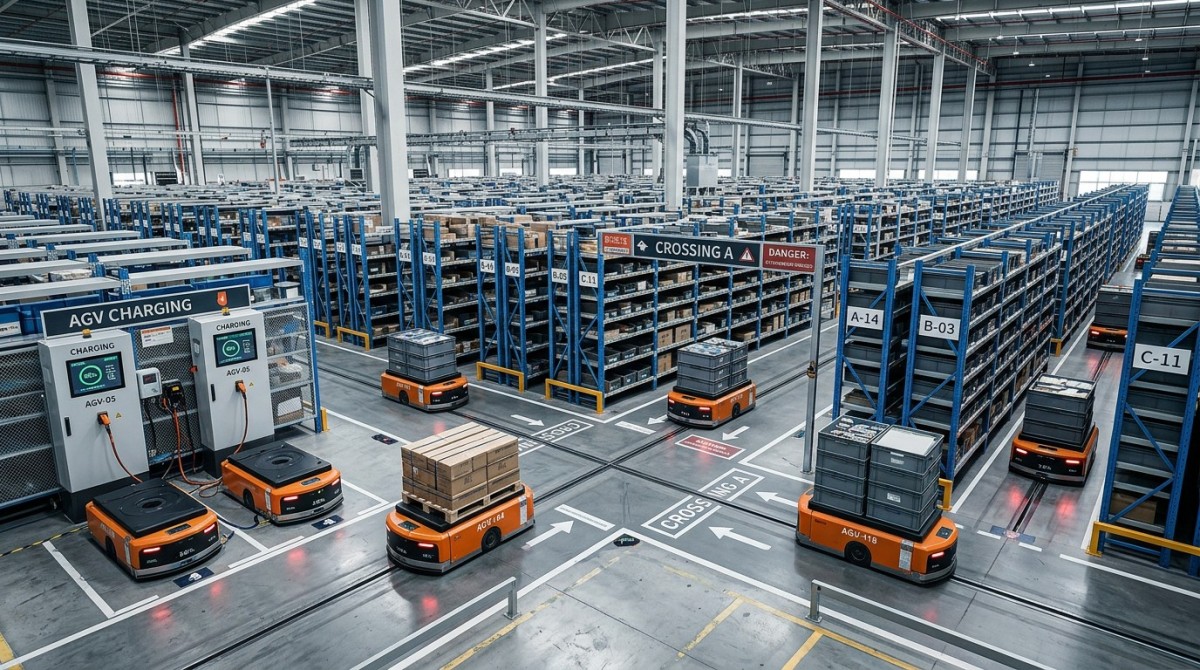
The short answer is simple: AGVs become a bottleneck when transport demand grows faster than system coordination.
Many facilities adopt AGV robots to reduce manual transport, stabilize repetitive movement, and support leaner operations. Early results are often positive. Travel becomes more predictable, labor pressure eases, and internal logistics looks more controlled. But once order volume rises, SKU diversity expands, or production timing becomes less predictable, AGV performance can flatten or even decline.
This happens because AGVs operate inside a tightly connected environment. Their real performance depends on:
- Route design and aisle availability
- Fleet management software quality
- Charging schedules and battery health
- Dispatching logic and task prioritization
- Integration with WMS, MES, ERP, or asrs systems
- Human intervention during exceptions
- Safety rules that affect speed, stopping distance, and right-of-way
If any of these factors lag behind operational demand, AGVs no longer accelerate flow. They queue, wait, reroute, stop for charging at the wrong time, or create congestion at transfer points. At that stage, the facility may look automated on paper while still losing throughput in reality.
What are the earliest warning signs that an AGV fleet is limiting throughput?
For operators, project managers, and decision-makers, the biggest mistake is waiting for a visible breakdown. AGV bottlenecks usually appear first as small inefficiencies that compound over time.
Common early warning signs include:
- Increasing wait time at pickup and drop-off stations
- Frequent AGV queuing at intersections or narrow aisles
- Missed production replenishment windows
- Charging-related downtime during peak operating hours
- Growing manual overrides by supervisors or floor staff
- Underutilized upstream or downstream equipment due to transport delays
- Lower-than-expected gains from automated storage and retrieval investments
- Rising safety interventions caused by mixed traffic with forklifts or personnel
For finance approvers and procurement teams, these symptoms matter because they directly affect return on investment. A fleet can appear fully deployed while still underperforming against planned capacity. If labor is still required to constantly recover stalled flows, the promised cost advantage of warehouse automation becomes weaker.
Which root causes create AGV bottlenecks most often on the shop floor?
Most AGV bottlenecks come from a handful of recurring design and management issues.
1. Poor traffic planning
When multiple AGVs share too few high-demand corridors, congestion becomes inevitable. This is especially common near inbound staging, work cells, pallet transfer stations, elevators, and asrs interfaces. Even a technically capable fleet will struggle if too many missions depend on the same route segments.
2. Charging strategy that conflicts with operations
Battery charging is often underestimated during planning. If too many robots need charging in the same window, available transport capacity drops exactly when demand spikes. Opportunity charging can help, but only if the software intelligently balances mission urgency with battery preservation.
3. Weak orchestration with WMS, MES, or ASRS
AGVs do not work in isolation. If task release logic from the warehouse management system or manufacturing execution system is poorly timed, robots may receive low-priority missions while urgent replenishment waits. In facilities using automated storage and retrieval, bad synchronization between storage equipment and mobile robots can create idle zones and blocked transfer points.
4. Too much dependence on fixed assumptions
Many AGV projects are designed around stable flow patterns. But real operations change. Product mix shifts, order peaks become less predictable, and temporary floor obstructions are common. If the fleet control logic is not flexible enough, system performance drops quickly under variable demand.
5. Inadequate exception handling
Every shop floor has exceptions: blocked aisles, damaged pallets, delayed handoffs, missing barcodes, and urgent manual tasks. When AGV robots cannot recover gracefully or escalate exceptions fast enough, one small issue can create a chain reaction across multiple zones.
6. Safety rules reducing practical speed
In mixed environments, AGVs often slow down far below their rated travel speed. Safety scanners, pedestrian interactions, blind corners, and forklift crossings all reduce effective throughput. Buyers often evaluate nominal specifications, while real performance is determined by actual floor conditions.
How do AGV bottlenecks affect ROI, labor efficiency, and service levels?
This is the section many enterprise stakeholders care about most: bottlenecks are not just technical annoyances. They change the economics of automation.
When AGV robots become a constraint, the impact typically appears in five business areas:
- Throughput loss: material arrives later, workstations starve, and outbound preparation slows down.
- Hidden labor cost: staff must step in to clear routes, manually move urgent loads, or supervise recovery.
- Asset underutilization: expensive systems such as asrs systems, conveyors, or packing lines wait for transport availability.
- Lower service reliability: internal delays can affect on-time production and shipment commitments.
- Expansion risk: a fleet that works at current volume may fail when the site adds shifts, SKUs, or higher order density.
For financial approvers, this means AGV evaluation should not stop at headcount reduction or hardware cost. It must include system resilience, dispatch quality, integration maturity, and scale behavior under peak conditions.
How can buyers and project teams tell whether AGVs are the right fit or the wrong automation layer?
Not every internal transport problem should be solved with AGVs. In some facilities, autonomous mobile robots, conveyors, tugger systems, or hybrid automation architecture may produce better results.
AGVs are generally a stronger fit when:
- Routes are repetitive and reasonably structured
- Traffic rules can be controlled consistently
- Payload movement is standardized
- Handover points are clearly defined
- Demand variability is moderate rather than chaotic
AGVs may be a weaker fit when:
- Flow paths change constantly
- Too many shared zones create unavoidable traffic conflict
- Manual interference is frequent
- Urgent transport priorities shift minute by minute
- The facility lacks software readiness for orchestration
For procurement teams, this is important because buying more robots does not always solve a capacity issue. If the core problem is layout, logic, or integration, adding units may only increase congestion.
What should decision-makers evaluate before expanding an AGV fleet?
Before approving expansion, stakeholders should ask whether the current bottleneck is caused by fleet size or by system design. A disciplined evaluation usually includes the following questions:
- What is the actual mission completion time during peak hours, not average hours?
- Where do queues form most often?
- How much downtime is linked to charging, waiting, rerouting, or operator intervention?
- Which transfer stations create repeated congestion?
- How well does the AGV software prioritize critical tasks?
- Are ASRS, warehouse automation, and production systems synchronized in real time?
- What happens to performance if order volume rises by 20% to 40%?
- How many delays are caused by physical layout rather than robot availability?
For project leaders and engineering teams, simulation is often one of the most practical tools. A good digital model can reveal route conflicts, charging shortfalls, and transfer-point saturation before additional capital is committed.
How can operators and managers reduce AGV bottlenecks without rebuilding the whole system?
Not every problem requires replacing the fleet. In many cases, measurable improvement can come from operational and software-level adjustments.
Improve route zoning
Separate high-frequency traffic from lower-priority movement where possible. Dedicated lanes, one-way logic, or revised pickup/drop-off positions can reduce conflict significantly.
Refine dispatch priorities
Task sequencing should reflect business value, not just first-in-first-out logic. Critical replenishment and production-feeding tasks may need priority over less urgent internal moves.
Optimize charging behavior
Review whether charging windows are creating avoidable capacity loss. Smarter opportunity charging and battery-health monitoring can stabilize fleet availability.
Reduce transfer-point friction
Many AGV delays occur not while driving, but while waiting to hand off a load. Better station design, sensor reliability, and interface timing can improve flow faster than adding more vehicles.
Strengthen exception management
Give operators clear escalation rules and faster recovery tools. The shorter the time to resolve blocked routes or failed missions, the lower the chance of network-wide delays.
Align KPIs to real bottlenecks
Do not rely only on fleet utilization or total trips. Focus on metrics like delay per mission, peak-hour queue time, on-time delivery to workstations, and manual intervention frequency.
What does a more resilient AGV strategy look like in modern warehouse automation?
A resilient AGV strategy is not built around robot count alone. It combines mobile automation with software visibility, scalable traffic logic, clear safety governance, and realistic growth planning.
In stronger deployments, companies treat AGV robots as part of a broader material-flow architecture that may include:
- Automated storage and retrieval integration
- Dynamic warehouse management rules
- Production-aware mission scheduling
- Traffic heatmap analysis
- Battery and charging analytics
- Fallback procedures for manual recovery
- Periodic layout reassessment as volume changes
This matters across industries because the cost of a transport bottleneck is rarely confined to logistics alone. It affects production continuity, safety performance, inventory accuracy, and customer service reliability.
AGV robots become a bottleneck when the surrounding system cannot support the speed, density, and variability of real operations. For users, managers, procurement teams, and financial stakeholders, the smartest approach is to evaluate AGV performance as part of the whole warehouse automation and automated storage and retrieval environment. If routes are congested, charging is poorly timed, or software coordination is weak, adding more robots may deepen the problem rather than solve it. The better path is to diagnose the true constraint, measure peak-hour behavior, and build an automation strategy that protects throughput, safety, and long-term ROI.
Get weekly intelligence in your inbox.
No noise. No sponsored content. Pure intelligence.
 Apr 23, 2026Taobao Factory Spark 3.0 Launches AI Workbench for SME Export FactoriesTaobao Factory Spark 3.0 Launches AI Workbench for SME Export Factories
 Apr 23, 2026TENENG Group Inspects IoT Safety Compliance at Jiangnan ChemicalTENENG Group Inspects IoT Safety Compliance at Jiangnan Chemical
 Apr 23, 2026China Launches First Embodied AI Open Data CommunityChina Launches First Embodied AI Open Data Community
 Apr 23, 2026PV Glass Prices Flat for 9 Weeks Amid Rising Integrated ProcurementPV Glass Prices Flat for 9 Weeks Amid Rising Integrated Procurement
 Apr 23, 20262984 NQI One-Stop Platforms Launched Nationwide2984 NQI One-Stop Platforms Launched Nationwide
 Apr 23, 2026China’s Green Smart Ship Tech Norms Accelerate BMS & Shore Power ExportChina’s Green Smart Ship Tech Norms Accelerate BMS & Shore Power Export
 Apr 23, 2026China Builds World's Largest Agri-Meteorological IoT NetworkChina Builds World's Largest Agri-Meteorological IoT Network
 Apr 23, 2026EU CBAM Carbon Tariff Enters Enforcement on April 1, 2026EU CBAM Carbon Tariff Enters Enforcement on April 1, 2026
 Apr 23, 2026Five Ministries Issue Zero-Carbon Factory Guidance for Export IndustriesFive Ministries Issue Zero-Carbon Factory Guidance for Export Industries
 Apr 23, 2026ISO Releases First Zero-Carbon City Standard — China’s Practices IncludedISO Releases First Zero-Carbon City Standard — China’s Practices Included
 Apr 22, 2026China Leads Global Offshore Wind Installations for 5th YearChina Leads Global Offshore Wind Installations for 5th Year
 Apr 22, 2026China Launches National Mine Safety IoT Monitoring NetworkChina Launches National Mine Safety IoT Monitoring Network
 Apr 22, 2026Yinchuan Boiler Pure Water Solution Certified for Middle East ProjectsYinchuan Boiler Pure Water Solution Certified for Middle East Projects
 Apr 22, 2026China to Enforce Mandatory EV Battery Recycling Standards by 2026China to Enforce Mandatory EV Battery Recycling Standards by 2026
 Apr 22, 2026Vietnam Launches Anti-Circumvention Probe on Electronic ComponentsVietnam Launches Anti-Circumvention Probe on Electronic Components
 Apr 22, 20262026 Shanghai Fastener Show: Robotic Fasteners Drive Overseas Procurement2026 Shanghai Fastener Show: Robotic Fasteners Drive Overseas Procurement
 Apr 22, 2026US BIS Adds EV On-Board Charger Crypto Modules to EAR Appendix 7US BIS Adds EV On-Board Charger Crypto Modules to EAR Appendix 7
 Apr 22, 2026TÜV Rheinland Updates BESS Certification: Propagation Blocking Now MandatoryTÜV Rheinland Updates BESS Certification: Propagation Blocking Now Mandatory
 Apr 22, 2026Red Sea Crisis Escalates: Suez AI Speed Limits & Slot Review from Apr 19Red Sea Crisis Escalates: Suez AI Speed Limits & Slot Review from Apr 19
 Apr 22, 2026EU CBAM Carbon Tariff Takes Effect April 1, 2026EU CBAM Carbon Tariff Takes Effect April 1, 2026
 Apr 21, 2026When to Replace CT Scanner Parts Before Downtime StartsWhen to Replace CT Scanner Parts Before Downtime Starts
 Apr 21, 2026How to Cut Costs in Lathe Turning Without ReworkHow to Cut Costs in Lathe Turning Without Rework
 Apr 21, 2026Lathe Turning Tolerances: What Can You Expect?Lathe Turning Tolerances: What Can You Expect?
 Apr 21, 2026How to Avoid Risks in Solar Panels WholesaleHow to Avoid Risks in Solar Panels Wholesale
 Apr 21, 2026Solar Panels Wholesale: How to Compare SuppliersSolar Panels Wholesale: How to Compare Suppliers
 Apr 21, 2026Solar Mounting Cost Factors You Should KnowSolar Mounting Cost Factors You Should Know
 Apr 21, 2026Solar Mounting Options: Which One Fits Your Project?Solar Mounting Options: Which One Fits Your Project?