Why Automated Storage and Retrieval Fails in Tight Layouts
Automated storage and retrieval systems can deliver major gains in throughput, labor efficiency, and inventory accuracy—but only when the layout supports them. In tight facilities, failure usually does not come from the automation itself. It comes from a mismatch between system design and real operating constraints: narrow travel paths, poor cube utilization, weak slotting logic, bottlenecks at pick faces, and incomplete integration with AGV robots, WMS, and warehouse automation controls. For buyers and project leaders, the key question is not “Is ASRS good?” but “Will this specific ASRS design still perform in our space, with our SKU mix, order profile, and growth plan?”
For operators, procurement teams, financial approvers, and engineering managers, that distinction matters. A system that looks efficient in a vendor demo can become slow, expensive, and difficult to maintain once installed inside a constrained footprint. This article explains why automated storage and retrieval fails in tight layouts, the warning signs to catch early, and the practical criteria to use before approving an investment.
Why ASRS underperforms when warehouse space is too tight
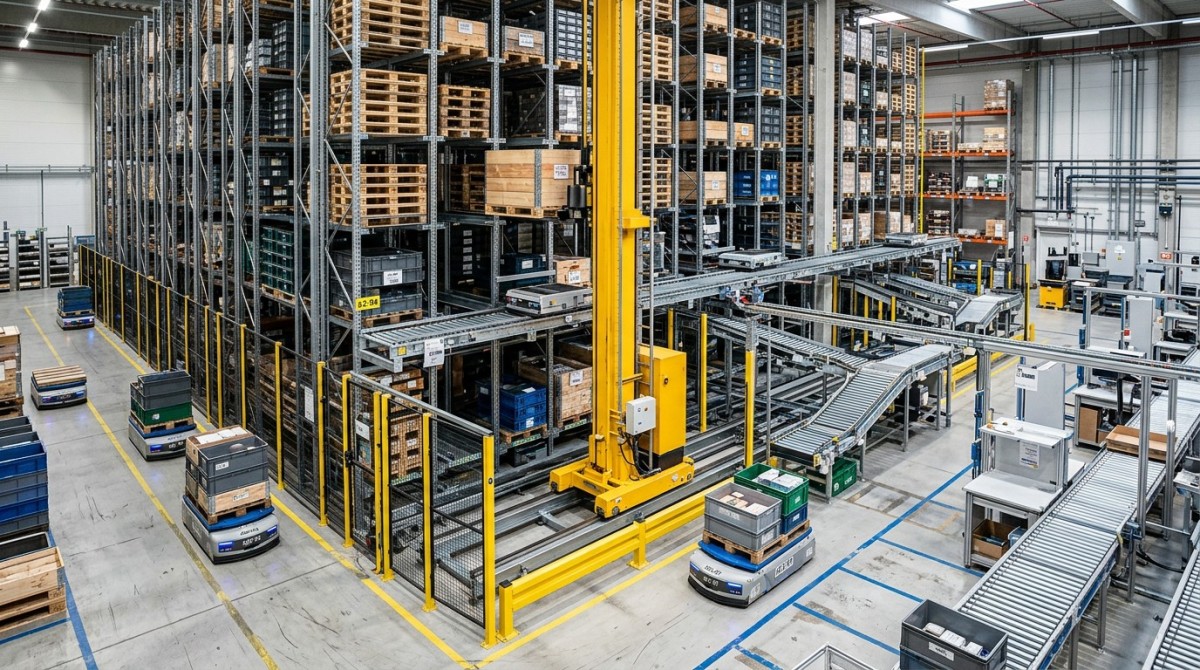
The core problem is simple: automated storage and retrieval depends on predictable movement, buffering capacity, and clean system coordination. Tight layouts reduce all three.
In a confined warehouse, every meter matters. If aisle width, transfer zones, maintenance access, inbound staging, and outbound sequencing areas are all compressed, the result is not just less storage space—it is less operating flexibility. This creates several common failure points:
- Restricted equipment movement: cranes, shuttles, lifts, conveyors, and AGV robots have less room for safe acceleration, turning, parking, and handoff.
- Insufficient buffer zones: goods cannot queue efficiently before storage or dispatch, causing micro-stoppages that reduce system flow.
- More congestion at touchpoints: even highly automated systems still need human access for exceptions, replenishment, maintenance, and quality checks.
- Poor slotting outcomes: when layout limitations force inventory into non-ideal locations, travel time and retrieval logic become inefficient.
- Harder integration: software can optimize routes, but it cannot fully solve physical choke points built into the site.
This is why a high-density solution can still fail operationally. Storage density alone is not the same as usable throughput.
What buyers and operators are actually worried about
Search intent around this topic is usually practical and risk-driven. Most readers are not asking for a textbook definition of warehouse automation. They want to know whether an ASRS project will create hidden costs, workflow problems, or implementation failure in a constrained building.
The most common concerns include:
- Will the system hit promised throughput?
- Will installation force us into expensive building modifications?
- Can the ASRS handle our SKU variety, order peaks, and replenishment patterns?
- Will AGV robots, conveyors, WMS, and ERP actually work together without delays?
- What happens when there is a jam, maintenance stop, or manual intervention?
- Will the payback period still make sense after change orders and downtime risks?
For financial approvers, the real issue is capital efficiency. For operators, it is day-to-day reliability. For safety and quality teams, it is controlled movement, traceability, and safe exception handling. For project managers, it is whether the design is robust enough to survive real-life complexity, not just simulation assumptions.
The most common reasons automated storage and retrieval fails in tight layouts
When automated storage and retrieval projects struggle in compact sites, the causes are usually structural rather than accidental. The following issues appear repeatedly across industries.
1. Throughput was modeled from ideal conditions, not real constraints
Many projects are sized using average order profiles, clean equipment availability assumptions, and optimized replenishment patterns. But tight layouts amplify peaks, interruptions, and access conflicts. If the model does not account for surge periods, mixed pallet/carton flows, operator crossings, and exception handling, the system may miss service targets from day one.
2. High density was prioritized over flow design
It is tempting to maximize storage positions in a small footprint. But if retrieval paths, decanting areas, staging lanes, or pick interfaces become too compressed, the warehouse gains density while losing responsiveness. This is especially damaging in fast-moving operations where order release speed matters more than static capacity.
3. Slotting strategy does not match SKU behavior
ASRS performance in small spaces depends heavily on smart slotting. Fast-moving, bulky, fragile, or temperature-sensitive items should not be assigned purely by available slot. In constrained systems, poor slotting quickly increases travel cycles, retrieval delays, and rehandling. Businesses with volatile demand patterns are especially exposed.
4. AGV robot integration adds complexity without resolving bottlenecks
AGV robots can improve internal transport, but in a tight layout they can also multiply traffic conflicts if charging zones, pickup/drop-off points, and crossing logic are poorly planned. If the ASRS, AGV fleet manager, and warehouse control system are not synchronized, one automated layer can end up waiting on another.
5. Maintenance access was underestimated
Compact automation often leaves too little room for safe service access. That means longer downtime when a shuttle, lift, conveyor section, or sensor array needs attention. A technically elegant design may become operationally fragile if technicians cannot reach critical components quickly and safely.
6. Exception handling was treated as a minor issue
Every automated facility has exceptions: damaged loads, unreadable labels, pallet quality defects, urgent orders, software misroutes, or inventory discrepancies. In a tight warehouse, there is less room to isolate and resolve these issues without disrupting normal flow. If exception handling is not designed in from the start, disruptions spread fast.
How to tell whether your layout is too tight for the proposed system
Not every small warehouse is a bad candidate for ASRS. The issue is whether the layout can support the required performance with acceptable risk. The best evaluation starts with operational fit, not automation ambition.
Ask these questions before approving any concept:
- What is the true required throughput at peak, not average?
- How much space is reserved for staging, buffering, maintenance, charging, and exception handling?
- What percentage of SKUs are fast movers, irregularly shaped, fragile, or difficult to handle?
- How often will people need to enter automated zones?
- Can inbound, storage, picking, and outbound operate simultaneously without contention?
- What happens if one subsystem stops for 30 minutes?
- Can the system scale if SKU count, order frequency, or service requirements increase?
If a vendor proposal depends on minimal buffers, very high equipment utilization, or highly disciplined inventory behavior to achieve ROI, that is a sign the design may be too tight for resilient operation.
What procurement and finance teams should evaluate before investing
For procurement leaders and financial approvers, the decision should not be based only on equipment price or storage gain. The stronger framework is total operational economics.
Key evaluation areas include:
Total installed cost
Include civil works, fire protection changes, rack reinforcement, software integration, commissioning, training, safety systems, and downtime during changeover. Tight sites often trigger more retrofit cost than expected.
Productivity realism
Request throughput validation using peak-period data, not just annual averages. Ask for assumptions around replenishment overlap, exception rates, and system recovery after stoppages.
Serviceability and spare parts
Compact systems can be more sensitive to minor failures. Confirm response times, local service capability, spare parts availability, and mean time to repair.
Integration ownership
Clarify who is responsible for WMS, warehouse control system, PLCs, AGV software, and ERP connectivity. Many underperforming warehouse automation projects fail at the interfaces, not at the machinery level.
Payback sensitivity
Model best case, expected case, and disrupted case. A system with attractive ROI under ideal flow but weak resilience under real-world variability may not be financially sound.
How project leaders can reduce failure risk in confined facilities
If the facility footprint is fixed, risk reduction depends on design discipline and phased validation. Several actions make a significant difference:
- Start with flow mapping: understand movement interactions before selecting equipment.
- Design for exceptions: include reject lanes, manual recovery paths, and overflow logic.
- Protect buffer capacity: do not sacrifice all transitional space to maximize rack count.
- Use SKU segmentation: separate fast, slow, fragile, and special-handling items logically.
- Test software orchestration early: verify handshakes among ASRS, AGV robots, WMS, and ERP before go-live.
- Plan maintenance access as a core requirement: not as an afterthought.
- Run scenario-based simulations: include peak demand, labor intervention, and equipment downtime.
In many cases, a hybrid design performs better than a fully maximized automated one. Combining selective automation with well-designed manual support areas can produce stronger resilience and lower lifecycle risk in a limited footprint.
When ASRS still makes sense in a tight layout
Automated storage and retrieval is not automatically the wrong choice for compact warehouses. It can still work well when several conditions are true:
- The SKU profile is relatively stable and well understood.
- Load dimensions and packaging quality are consistent.
- Throughput requirements are moderate relative to storage density goals.
- System interfaces are simplified and well governed.
- Enough space exists for buffering, maintenance, and safe intervention.
- The business values accuracy, traceability, and labor reduction over maximum flexibility.
For sectors such as healthcare technology, smart electronics, and advanced manufacturing, these conditions may be achievable if the project is engineered around operational discipline rather than headline automation claims.
Conclusion: the issue is not automation, but fit
Why does automated storage and retrieval fail in tight layouts? Usually because the system was expected to overcome physical and operational constraints that were never fully addressed in the design. In restricted spaces, even advanced warehouse automation can underdeliver when movement paths are compressed, slotting is weak, buffers are missing, and AGV or software integration is not robust.
The right decision is not whether to automate in principle. It is whether the proposed ASRS matches your actual building, SKU behavior, throughput peaks, maintenance reality, and business goals. For operators, that means fewer disruptions. For procurement, it means better vendor scrutiny. For enterprise decision-makers and finance teams, it means investing in a system that creates sustainable performance—not just impressive specifications.
If a proposed design looks efficient only on paper, treat that as a warning. In tight layouts, resilience is often more valuable than maximum density.
Get weekly intelligence in your inbox.
No noise. No sponsored content. Pure intelligence.
 Apr 23, 2026Taobao Factory Spark 3.0 Launches AI Workbench for SME Export FactoriesTaobao Factory Spark 3.0 Launches AI Workbench for SME Export Factories
 Apr 23, 2026TENENG Group Inspects IoT Safety Compliance at Jiangnan ChemicalTENENG Group Inspects IoT Safety Compliance at Jiangnan Chemical
 Apr 23, 2026China Launches First Embodied AI Open Data CommunityChina Launches First Embodied AI Open Data Community
 Apr 23, 2026PV Glass Prices Flat for 9 Weeks Amid Rising Integrated ProcurementPV Glass Prices Flat for 9 Weeks Amid Rising Integrated Procurement
 Apr 23, 20262984 NQI One-Stop Platforms Launched Nationwide2984 NQI One-Stop Platforms Launched Nationwide
 Apr 23, 2026China’s Green Smart Ship Tech Norms Accelerate BMS & Shore Power ExportChina’s Green Smart Ship Tech Norms Accelerate BMS & Shore Power Export
 Apr 23, 2026China Builds World's Largest Agri-Meteorological IoT NetworkChina Builds World's Largest Agri-Meteorological IoT Network
 Apr 23, 2026EU CBAM Carbon Tariff Enters Enforcement on April 1, 2026EU CBAM Carbon Tariff Enters Enforcement on April 1, 2026
 Apr 23, 2026Five Ministries Issue Zero-Carbon Factory Guidance for Export IndustriesFive Ministries Issue Zero-Carbon Factory Guidance for Export Industries
 Apr 23, 2026ISO Releases First Zero-Carbon City Standard — China’s Practices IncludedISO Releases First Zero-Carbon City Standard — China’s Practices Included
 Apr 22, 2026China Leads Global Offshore Wind Installations for 5th YearChina Leads Global Offshore Wind Installations for 5th Year
 Apr 22, 2026China Launches National Mine Safety IoT Monitoring NetworkChina Launches National Mine Safety IoT Monitoring Network
 Apr 22, 2026Yinchuan Boiler Pure Water Solution Certified for Middle East ProjectsYinchuan Boiler Pure Water Solution Certified for Middle East Projects
 Apr 22, 2026China to Enforce Mandatory EV Battery Recycling Standards by 2026China to Enforce Mandatory EV Battery Recycling Standards by 2026
 Apr 22, 2026Vietnam Launches Anti-Circumvention Probe on Electronic ComponentsVietnam Launches Anti-Circumvention Probe on Electronic Components
 Apr 22, 20262026 Shanghai Fastener Show: Robotic Fasteners Drive Overseas Procurement2026 Shanghai Fastener Show: Robotic Fasteners Drive Overseas Procurement
 Apr 22, 2026US BIS Adds EV On-Board Charger Crypto Modules to EAR Appendix 7US BIS Adds EV On-Board Charger Crypto Modules to EAR Appendix 7
 Apr 22, 2026TÜV Rheinland Updates BESS Certification: Propagation Blocking Now MandatoryTÜV Rheinland Updates BESS Certification: Propagation Blocking Now Mandatory
 Apr 22, 2026Red Sea Crisis Escalates: Suez AI Speed Limits & Slot Review from Apr 19Red Sea Crisis Escalates: Suez AI Speed Limits & Slot Review from Apr 19
 Apr 22, 2026EU CBAM Carbon Tariff Takes Effect April 1, 2026EU CBAM Carbon Tariff Takes Effect April 1, 2026
 Apr 21, 2026When to Replace CT Scanner Parts Before Downtime StartsWhen to Replace CT Scanner Parts Before Downtime Starts
 Apr 21, 2026How to Cut Costs in Lathe Turning Without ReworkHow to Cut Costs in Lathe Turning Without Rework
 Apr 21, 2026Lathe Turning Tolerances: What Can You Expect?Lathe Turning Tolerances: What Can You Expect?
 Apr 21, 2026How to Avoid Risks in Solar Panels WholesaleHow to Avoid Risks in Solar Panels Wholesale
 Apr 21, 2026Solar Panels Wholesale: How to Compare SuppliersSolar Panels Wholesale: How to Compare Suppliers
 Apr 21, 2026Solar Mounting Cost Factors You Should KnowSolar Mounting Cost Factors You Should Know
 Apr 21, 2026Solar Mounting Options: Which One Fits Your Project?Solar Mounting Options: Which One Fits Your Project?