
China Customs Adds 'Restriction Identification Code' to Export Declarations
Starting 1 May 2026, China Customs will require exporters to include a new ‘Restriction Identification Code’ and related ‘Restriction Declaration Elements’ on export customs declarations. This change directly affects electronics component manufacturers, diagnostic equipment suppliers, and IoT module producers—especially those whose products incorporate AI computing capabilities, RF functions, or encryption features. The update signals heightened regulatory scrutiny for dual-use items destined for markets including the US, EU, and Russia.
Event Overview
Effective 1 May 2026, the General Administration of Customs of the People’s Republic of China (GACC) mandates the addition of a ‘Restriction Identification Code’ and associated ‘Restriction Declaration Elements’ to export customs declarations. Exporters of electronic components, diagnostic devices, and IoT modules with AI-related processing, radio-frequency, or encryption functionality must proactively declare dual-use attributes. Failure to provide accurate information may result in increased customs inspection rates and clearance delays, potentially disrupting delivery commitments to key overseas markets.
Industries Affected by Segment
Direct Exporting Enterprises
These enterprises file export declarations and bear primary compliance responsibility. They are affected because the new requirement shifts declaration obligations from general commodity classification to specific dual-use attribute identification. Impact includes increased pre-filing workload, higher risk of classification errors, and potential penalties or delays if misdeclared.
Electronics Component Manufacturers
Manufacturers supplying processors, RF transceivers, secure microcontrollers, or AI-accelerated modules are directly impacted. Their products fall under the scope due to inherent technical features—not end-use alone. Impact manifests in revised internal product tagging, updated technical documentation, and closer coordination with customs brokers to ensure correct attribute mapping.
IoT Module and Diagnostic Equipment Producers
Producers integrating connectivity, edge AI, or encrypted data transmission into medical or industrial devices must now assess whether their modules meet dual-use criteria. Impact includes expanded internal compliance reviews, possible re-evaluation of export control classifications (e.g., against China’s Dual-Use Items Export Control List), and adjustments to technical datasheets shared with distributors.
Supply Chain and Logistics Service Providers
Third-party customs brokers, freight forwarders, and logistics platforms supporting electronics exports face increased verification responsibilities. They must now validate dual-use declarations before submission—not just HS code accuracy. Impact includes tighter documentation requirements from clients, extended processing timelines, and potential liability exposure if declarations are incomplete or inconsistent.
Key Focus Areas and Recommended Actions
Monitor Official Guidance and Implementation Clarifications
Analysis shows GACC has not yet published the full list of codes, detailed declaration logic, or technical thresholds (e.g., minimum encryption key length or AI inference latency) that trigger dual-use classification. Companies should track subsequent notices from GACC and local customs offices for operational clarity.
Identify and Flag High-Risk Product Lines by Functionality
Current more relevant than broad category labeling is functional assessment: products containing embedded encryption (even software-based), configurable RF output above specified power/frequency ranges, or AI inference engines with quantifiable throughput metrics may require declaration. Prioritize internal review of such items ahead of the 1 May 2026 deadline.
Distinguish Between Policy Signal and Operational Requirement
Observably, this measure reflects an enforcement tightening—not a new export ban. It enhances traceability rather than restricting trade outright. Companies should avoid overreacting (e.g., halting shipments) but instead treat it as a procedural upgrade requiring updated internal workflows and staff training.
Update Documentation, Training, and Broker Coordination Protocols
Practical preparation includes revising product technical specifications to highlight controlled functionalities, training export operations staff on dual-use terminology and declaration triggers, and aligning data exchange formats with customs brokers to ensure consistent code assignment across shipments.
Editorial Perspective / Industry Observation
This requirement is better understood as a regulatory signal than an immediate operational constraint. Analysis shows it aligns with broader global trends toward granular dual-use tracking, particularly for technologies with cross-border AI and connectivity applications. From an industry perspective, it does not yet indicate expanded control lists—but rather a structural shift in how existing controls are enforced at the declaration level. Continued attention is warranted, especially as GACC may issue supplementary guidance on code assignment methodology or audit protocols in Q2 2026.
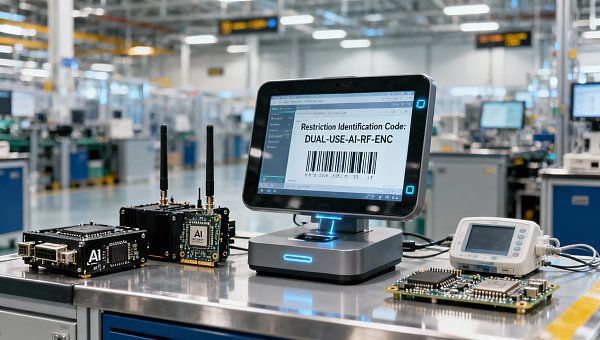
In summary, the introduction of the ‘Restriction Identification Code’ marks a procedural evolution in China’s export control implementation—not a substantive policy shift. Its significance lies in raising the baseline for compliance diligence among exporters of technology-enabled hardware. For affected companies, the most appropriate interpretation is that this is a mandatory process upgrade demanding functional product assessment, documentation alignment, and proactive inter-agency coordination—not a barrier to market access, but a new checkpoint in the export workflow.
Source: General Administration of Customs of the People’s Republic of China (GACC) — official announcement effective 1 May 2026.
Note: Specific technical thresholds, code definitions, and implementation FAQs remain pending publication and are subject to ongoing observation.
Get weekly intelligence in your inbox.
No noise. No sponsored content. Pure intelligence.
 Oct 08, 2026How Digital Health Improves Diagnostic Accuracy and Workflow in Clinical LabsHow Digital Health Improves Diagnostic Accuracy and Workflow in Clinical Labs
 Oct 07, 2026Selecting Voice Picking Systems for German Warehouses: Integration, Languages and ROISelecting Voice Picking Systems for German Warehouses: Integration, Languages and ROI
 Oct 06, 2026How to Choose Last Mile Dispatch Software for On-Time Delivery at ScaleHow to Choose Last Mile Dispatch Software for On-Time Delivery at Scale
 Oct 05, 2026Vietnam’s Consumer Electronics Market: Demand Shifts and Sourcing OpportunitiesVietnam’s Consumer Electronics Market: Demand Shifts and Sourcing Opportunities
 Oct 04, 2026Digital Health Investment Priorities for Providers: Improving Access, Outcomes, and EfficiencyDigital Health Investment Priorities for Providers: Improving Access, Outcomes, and Efficiency
 Oct 03, 2026How to Specify an FR4 Custom PCB Board for High-Voltage and High-Heat DesignsHow to Specify an FR4 Custom PCB Board for High-Voltage and High-Heat Designs
 Oct 02, 2026ERP Software Market Intelligence: Adoption, Pricing, and Vendor Signals to WatchERP Software Market Intelligence: Adoption, Pricing, and Vendor Signals to Watch
 Oct 01, 2026How to Select Calibrated Temperature Data Loggers for GMP Cold Storage MonitoringHow to Select Calibrated Temperature Data Loggers for GMP Cold Storage Monitoring
 Sep 30, 2026Custom Molded Rubber Pricing: What Drives Unit Cost and Tooling Fees?Custom Molded Rubber Pricing: What Drives Unit Cost and Tooling Fees?
 Sep 29, 2026How to Evaluate Energy Management Software Vendors for Multi-Site OperationsHow to Evaluate Energy Management Software Vendors for Multi-Site Operations
 Sep 28, 2026How to Select a DIN Rail Smart Meter for Multi-Circuit Energy MonitoringHow to Select a DIN Rail Smart Meter for Multi-Circuit Energy Monitoring
 Sep 27, 2026TWS Earbuds in Vietnam: Demand Drivers, Price Tiers, and Retail Channel OpportunitiesTWS Earbuds in Vietnam: Demand Drivers, Price Tiers, and Retail Channel Opportunities
 Sep 26, 2026How UAE Clinics Can Qualify a Smart Glucometer Supplier for Accuracy and ComplianceHow UAE Clinics Can Qualify a Smart Glucometer Supplier for Accuracy and Compliance
 Sep 25, 2026Buying Aesthetic Lasers in the USA: FDA Status, Wavelengths, and Service SupportBuying Aesthetic Lasers in the USA: FDA Status, Wavelengths, and Service Support
 Sep 24, 2026Laser Cutting Brass Sheet: How to Prevent Burrs and Heat Marks on Thin PartsLaser Cutting Brass Sheet: How to Prevent Burrs and Heat Marks on Thin Parts
 Sep 23, 2026How to Choose Lightweight ANC Headphones for Comfortable All-Day TravelHow to Choose Lightweight ANC Headphones for Comfortable All-Day Travel
 Sep 22, 2026IPX5 TWS Bluetooth Earbuds: What Protection Do They Offer for Workouts?IPX5 TWS Bluetooth Earbuds: What Protection Do They Offer for Workouts?
 Sep 21, 2026What to Look for in a Grid Integration Company for Utility-Scale Solar ProjectsWhat to Look for in a Grid Integration Company for Utility-Scale Solar Projects
 Sep 20, 2026Microgrid Controller Pricing: What Drives Cost in Commercial Energy Projects?Microgrid Controller Pricing: What Drives Cost in Commercial Energy Projects?
 Sep 19, 2026How to Choose a GaN Charger for Laptops Without Compromising Power or PortabilityHow to Choose a GaN Charger for Laptops Without Compromising Power or Portability
 Sep 18, 2026Floating Solar Farm Costs: CAPEX, OPEX, and the Site Factors That Shape ROIFloating Solar Farm Costs: CAPEX, OPEX, and the Site Factors That Shape ROI
 Sep 17, 2026Drone Delivery Solutions for Last-Mile Routes: Site, Payload, and Range PlanningDrone Delivery Solutions for Last-Mile Routes: Site, Payload, and Range Planning
 Sep 16, 2026When Low-Volume Electronics Manufacturing Makes More Sense Than Mass ProductionWhen Low-Volume Electronics Manufacturing Makes More Sense Than Mass Production
 Sep 15, 2026Wholesale WiFi Smart Switches: What Buyers Should Verify Before OrderingWholesale WiFi Smart Switches: What Buyers Should Verify Before Ordering
 Sep 14, 2026How to Select IoT Sensors for Reliable Monitoring in Harsh Industrial EnvironmentsHow to Select IoT Sensors for Reliable Monitoring in Harsh Industrial Environments
 Sep 13, 2026How Procurement Teams Can Improve Supplier Reliability With Supply Chain VisibilityHow Procurement Teams Can Improve Supplier Reliability With Supply Chain Visibility
 Sep 12, 2026Smart Manufacturing Trends 2026: What Leaders Should Prioritize for ROISmart Manufacturing Trends 2026: What Leaders Should Prioritize for ROI



























