Aesthetic Lasers Explained: How to Compare Wavelength, Spot Size, and Downtime
Aesthetic Lasers Explained: How to Compare Wavelength, Spot Size, and Downtime
Choosing among aesthetic lasers is not just a clinical question—it is a strategic one for buyers, clinic operators, and healthcare technology decision-makers.
To compare systems well, you need to look beyond marketing language and headline treatment lists.
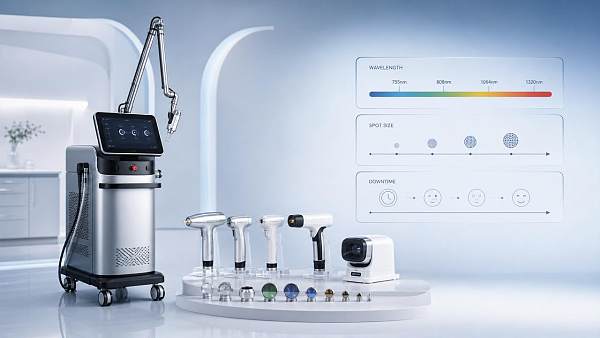
Wavelength, spot size, and downtime directly affect treatment scope, patient satisfaction, workflow, utilization, and long-term return.
That is why aesthetic lasers should be assessed as both medical technology and operational assets.
This guide explains the core comparison points in plain language so evaluation teams can make clearer, lower-risk decisions.
Why aesthetic lasers require a structured comparison
Many aesthetic lasers appear similar in brochures, yet their real-world fit can vary sharply.
A platform that works well for pigment may not perform equally well for vascular concerns or hair reduction.
In practical business terms, this means the wrong choice can limit case volume and reduce payback speed.
A better evaluation starts with three questions.
- What tissue target does the wavelength address best?
- How does spot size influence speed, penetration, and comfort?
- What level of downtime is acceptable for the intended patient mix?
Once those answers are clear, comparing aesthetic lasers becomes much more objective.
Wavelength: the foundation of treatment fit
Wavelength determines how laser energy interacts with melanin, hemoglobin, or water in the skin.
This is the starting point for any serious aesthetic lasers comparison.
Common wavelength categories
- 755 nm: Often used for pigment and hair removal, with strong melanin absorption.
- 808 nm: Common in diode systems, balancing efficacy and treatment comfort.
- 1064 nm: Reaches deeper tissue and is often favored for darker skin types.
- 532 nm: Frequently applied for superficial vascular and pigmented lesions.
- 2940 nm or 10,600 nm: Used in resurfacing, where water absorption is central.
The best wavelength is not the one with the broadest claims.
It is the one that matches the treatment menu, local demand profile, and operator skill level.
What buyers should ask
- Which indications generate the highest revenue potential?
- Which skin types are most common in the target market?
- Does the platform support one key wavelength or multiple proven wavelengths?
- Are clinical outcomes supported by credible case data?
From a selection standpoint, wavelength is where clinical relevance and commercial logic first meet.
Spot size: the hidden driver of efficiency
Spot size is often under-discussed, yet it has a major effect on treatment practicality.
In aesthetic lasers, spot size influences coverage speed, energy delivery, and how comfortably operators can work.
How spot size changes performance
- Larger spot sizes usually improve speed for bigger areas like legs or back.
- Smaller spot sizes offer more precision for narrow or delicate treatment zones.
- Bigger spots can also support deeper penetration in some applications.
- Poor spot size flexibility may reduce scheduling efficiency and treatment versatility.
This matters more than it may seem.
If treatment sessions run too long, room turnover slows and labor costs become harder to absorb.
Aesthetic lasers with adaptable spot sizes can support both throughput and range.
Operational evaluation points
When reviewing aesthetic lasers, ask whether spot size options align with high-frequency procedures.
Also check handpiece ergonomics, cooling integration, and actual treatment time per session.
Those details affect daily capacity more than spec sheets usually suggest.
Downtime: where patient experience meets business reality
Downtime is not just a recovery issue.
For aesthetic lasers, downtime shapes booking conversion, repeat treatment willingness, and brand positioning.
Low-downtime systems may appeal to busy patients who want visible improvement with limited disruption.
Higher-downtime treatments may still be attractive if outcomes are stronger for resurfacing or correction.
Why downtime matters in selection
- It influences how easily sales teams can explain treatment expectations.
- It affects cancellation risk and post-treatment support requirements.
- It shapes patient reviews, referrals, and perceived convenience.
- It can change whether a device fits a premium, corrective, or high-volume model.
In other words, downtime should be matched to the commercial strategy, not viewed in isolation.
How to compare aesthetic lasers across business scenarios
Different business models need different priorities.
That is why aesthetic lasers should be compared against real operating scenarios, not generic feature lists.
This kind of matrix helps teams compare aesthetic lasers with more discipline and less bias.
Questions that reveal true device value
Aesthetic lasers should never be judged on technical parameters alone.
A smarter review combines device fit, supplier reliability, and lifecycle economics.
Use this shortlist during evaluation
- What are the strongest indications, and where is performance only average?
- How much operator training is needed for safe, consistent results?
- What consumables, maintenance intervals, or handpiece replacement costs apply?
- How dependable is service coverage across the target market?
- Can the supplier provide clinical data, installed base evidence, and user references?
- Will the device still fit demand if treatment trends shift over the next three years?
In actual procurement work, these questions often separate attractive demos from durable investments.
Common comparison mistakes to avoid
The aesthetic lasers market is crowded, and mistakes usually come from oversimplified comparisons.
- Choosing only by price, without modeling treatment volume and service cost.
- Assuming more indications always mean better commercial performance.
- Ignoring downtime, even though it affects conversion and experience.
- Overlooking spot size, despite its impact on throughput.
- Relying on broad claims instead of verified outcomes by skin type and use case.
More informed selection usually comes from narrowing the use case first, then matching the technology.
A practical decision framework for aesthetic lasers
If the goal is a better decision, keep the process simple and evidence-based.
- Define the top three treatment categories that matter commercially.
- Match those categories to the most relevant wavelengths.
- Check whether spot size supports expected session speed and case mix.
- Assess downtime against the intended brand and patient profile.
- Validate service, training, and support before final comparison.
- Review total ownership cost, not only acquisition cost.
This approach makes aesthetic lasers easier to compare in a way that supports both treatment quality and commercial resilience.
The strongest choice is rarely the most advertised system.
It is the platform that aligns wavelength, spot size, and downtime with real demand, real workflows, and real growth plans.
Before making a final commitment, compare aesthetic lasers through live use cases, supplier evidence, and long-term operating assumptions. That is where smarter investments usually begin.
Get weekly intelligence in your inbox.
No noise. No sponsored content. Pure intelligence.
 Sep 15, 2026Wholesale WiFi Smart Switches: What Buyers Should Verify Before OrderingWholesale WiFi Smart Switches: What Buyers Should Verify Before Ordering
 Sep 14, 2026How to Select IoT Sensors for Reliable Monitoring in Harsh Industrial EnvironmentsHow to Select IoT Sensors for Reliable Monitoring in Harsh Industrial Environments
 Sep 13, 2026How Procurement Teams Can Improve Supplier Reliability With Supply Chain VisibilityHow Procurement Teams Can Improve Supplier Reliability With Supply Chain Visibility
 Sep 12, 2026Smart Manufacturing Trends 2026: What Leaders Should Prioritize for ROISmart Manufacturing Trends 2026: What Leaders Should Prioritize for ROI
 Sep 11, 2026B2B Market Analysis: How Buyers Evaluate Suppliers, Pricing, and Delivery RiskB2B Market Analysis: How Buyers Evaluate Suppliers, Pricing, and Delivery Risk
 Sep 10, 2026Residential Solar Kits in Canada: How to Size a System for Your Home and ClimateResidential Solar Kits in Canada: How to Size a System for Your Home and Climate
 Sep 09, 2026How to Specify a Syringe Assembly Line for High-Volume Sterile ProductionHow to Specify a Syringe Assembly Line for High-Volume Sterile Production
 Sep 08, 2026How to Evaluate Warehouse Robotics System Suppliers for Reliable Multi-Site DeploymentHow to Evaluate Warehouse Robotics System Suppliers for Reliable Multi-Site Deployment
 Sep 07, 2026Renewable Geothermal Energy Explained: How It Works for Heating and PowerRenewable Geothermal Energy Explained: How It Works for Heating and Power
 Sep 07, 2026How to Choose an Industrial Packaging Robot Manufacturer for Your Production LineHow to Choose an Industrial Packaging Robot Manufacturer for Your Production Line
 Sep 05, 2026How to Evaluate a Turnkey Hydro Turbine Generator Supplier for Remote Power ProjectsHow to Evaluate a Turnkey Hydro Turbine Generator Supplier for Remote Power Projects
 Sep 04, 2026Automated Ultrasonic Welding for Thermoplastic Assemblies: Process Controls That MatterAutomated Ultrasonic Welding for Thermoplastic Assemblies: Process Controls That Matter
 Sep 03, 2026Energy Forecasting for Grid Planning: Sizing Solar and Storage CapacityEnergy Forecasting for Grid Planning: Sizing Solar and Storage Capacity
 Sep 02, 2026Which Metrics Should an Energy Analytics Dashboard Track for Factory Energy Management?Which Metrics Should an Energy Analytics Dashboard Track for Factory Energy Management?
 Sep 01, 2026How Warehouse Voice Picking Improves Accuracy and Throughput in Order FulfillmentHow Warehouse Voice Picking Improves Accuracy and Throughput in Order Fulfillment
 Aug 31, 2026How to Automate Dropshipping Order Processing Without Overselling StockHow to Automate Dropshipping Order Processing Without Overselling Stock
 Aug 30, 2026How to Evaluate a Smart Lighting Supplier for Multi-Site Commercial ProjectsHow to Evaluate a Smart Lighting Supplier for Multi-Site Commercial Projects
 Aug 29, 2026Recent Advances in Smart Manufacturing and Materials Reshaping Factory InvestmentRecent Advances in Smart Manufacturing and Materials Reshaping Factory Investment
 Aug 29, 2026Selecting Lightweight Aluminum Extrusions for Strength-Critical Industrial DesignsSelecting Lightweight Aluminum Extrusions for Strength-Critical Industrial Designs
 Aug 29, 2026Vertical Powder Anodizing Explained: Process Controls for Uniform Coating QualityVertical Powder Anodizing Explained: Process Controls for Uniform Coating Quality
 Aug 29, 2026PV Module Product Due Diligence: What Buyers Should Verify Before ContractingPV Module Product Due Diligence: What Buyers Should Verify Before Contracting
 Aug 29, 2026Solar Design for Challenging Terrain: Managing Slope, Soil, and Shading RisksSolar Design for Challenging Terrain: Managing Slope, Soil, and Shading Risks
 Aug 29, 2026IS 16444 Smart Meter Requirements: Key Functions, Tests, and ComplianceIS 16444 Smart Meter Requirements: Key Functions, Tests, and Compliance
 Aug 29, 2026Rehabilitation Equipment Market Outlook: Demand Drivers and Growth SegmentsRehabilitation Equipment Market Outlook: Demand Drivers and Growth Segments
 Aug 29, 2026When Does Container Handling Automation Deliver ROI in Port Yard Operations?When Does Container Handling Automation Deliver ROI in Port Yard Operations?
 Aug 29, 2026Customs API Integration: A Practical Checklist for Automated Trade ComplianceCustoms API Integration: A Practical Checklist for Automated Trade Compliance
 Aug 29, 2026Returnable Packaging for Automotive: How to Cut Damage and Reverse Logistics CostsReturnable Packaging for Automotive: How to Cut Damage and Reverse Logistics Costs