Bulk Order Guide for Ergonomic Gaming Mice: MOQ, Customization, and Supplier Checks
Bulk Order Guide for Ergonomic Gaming Mice: MOQ, Customization, and Supplier Checks
Planning an ergonomic gaming mice bulk order involves more than comparing unit prices. Procurement teams must evaluate MOQ terms, customization options, quality control standards, and supplier credibility to reduce risk and secure long-term value. This guide outlines the key checkpoints buyers should review before placing volume orders, helping sourcing professionals make faster, more informed purchasing decisions.
If you buy gaming peripherals often, you already know where orders go wrong: not in the quote, but in the assumptions behind it. An ergonomic gaming mouse looks simple on paper. In practice, it combines tooling, firmware, sensor selection, switch consistency, shell fit, packaging decisions, and after-sales risk. For procurement, the real job is to separate factories that can ship repeatable product from traders that can only promise attractive pricing.
This checklist is built for that stage. It is less about theory and more about what to confirm before you lock MOQ, approve samples, and commit cash.
Start with the purchase model, not the mouse spec
Before asking for a unit price, define what kind of order you are actually placing. That sounds obvious, but many RFQs mix three different buying models into one conversation: stock product purchase, semi-custom private label, and full custom development.
- Stock model: fastest route, lower risk, usually lower MOQ. Best when timing matters more than product exclusivity.
- Private label or light customization: logo, packaging, colorway, maybe bundled accessories. This is common for distributors and e-commerce brands.
- Full custom ergonomic gaming mouse program: new shell, tuned grip geometry, unique firmware, or market-specific design. This changes tooling cost, lead time, and supplier dependence immediately.
If your internal team has not agreed on which model fits the business case, MOQ discussions will be misleading from the start. A supplier may quote a low entry MOQ for the base mouse, while the branded packaging, custom shell texture, or software adjustments quietly trigger a much higher commitment.
Treat MOQ as a structure, not a single number
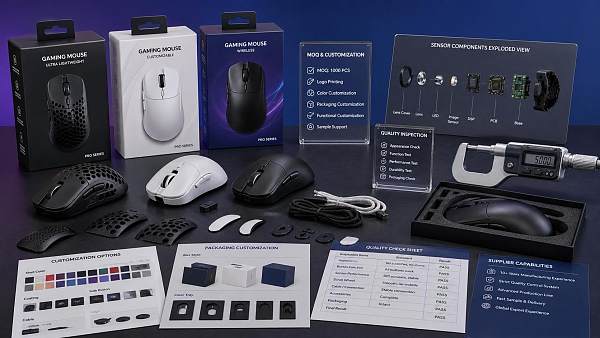
One of the most common mistakes in an ergonomic gaming mice bulk order is accepting MOQ as one headline figure. In real sourcing, MOQ often sits in layers.
Ask suppliers to break out MOQ by component and customization item. If they resist that level of detail, assume you will discover hidden minimums later, usually after sample approval when switching cost is higher.
A useful question here is simple: “What can I change without changing MOQ?” Good factories answer that clearly. Weak suppliers answer with generalities.
Do not discuss ergonomics in vague terms
“Ergonomic” is one of those words that gets used too loosely in peripheral sourcing. For a procurement team, it needs to be translated into measurable or reviewable details.
Check the shell dimensions, weight range, grip style fit, button reach, thumb rest geometry, and surface finish. If the target market is esports retail, office-gaming crossover, or promotional distribution, the preferred hand feel may differ quite a bit. A shape that works for palm grip users may underperform in a market leaning toward claw or fingertip grip.
This is where samples matter more than presentations. Ask for at least two physical checks: one engineering sample to assess structure and one pre-production sample with actual finishing, coating, and branding. Surface coating can materially change the feel of the same shell. That matters if your return rates are sensitive to user comfort claims.
The sensor and switch stack usually explains the price gap
When two suppliers offer similar-looking mice with noticeably different quotes, the answer is often inside the BOM. Sensor model, MCU, switch brand, encoder choice, battery cell specification for wireless models, and cable type can all shift cost and field performance.
You do not need to over-engineer the RFQ, but you do need component transparency. Ask for the exact sensor series, switch brand or approved equivalent, polling rate support, connection mode, and battery capacity where relevant. If a supplier only says “gaming chip” or “high-end switch,” that is not enough for comparison.
Also check substitution rights. Some factories reserve the right to replace non-critical parts with equivalents during production. That clause may look harmless until consistency problems show up across batches.
Customization is where margins disappear if you price it badly
Customization is usually what makes a bulk order commercially worthwhile, but it is also where buyers underestimate total landed cost. In this category, custom work may include logo placement, RGB lighting behavior, software interface language, side-button mapping, shell color, texture coating, gift box design, inserts, and bundled accessories.
Ask suppliers to separate one-time charges from recurring charges:
- Tooling or mold modification fees
- Printing plate or packaging setup costs
- Firmware adjustment fees 【待核实 if claimed as “free” but custom work is substantial】
- Per-unit uplift for coating, cable upgrade, or premium components
- Reorder pricing once the initial setup is complete
A practical checkpoint: ask whether your packaging assets and firmware files remain usable if production moves to another facility later. Some suppliers become difficult once they know your brand depends on their custom file set.
Quality control needs to match the actual failure modes
For gaming mice, generic “100% tested before shipment” language is not very useful. Ask what they test and at what stage.
The more relevant checks usually include click consistency, scroll wheel feel, DPI or tracking verification, wireless pairing stability where applicable, charging behavior, RGB function, button mapping, cosmetic finish, and carton drop condition for retail packaging. If the supplier has an AQL standard, ask which level they use for outgoing inspection. If they cannot explain their inspection flow, assume quality is reactive rather than controlled.
Returns in this category often come from issues that were not “major defects” in factory language but are still commercial failures in your channel: rattle, uneven buttons, cheap-feeling wheel tension, surface scratches, or inconsistent skates. Put those into your approval criteria early.
Compliance and market access should be confirmed before artwork approval
Requirements depend on whether the mouse is wired or wireless, and on the destination market. For example, wireless products typically involve additional regulatory considerations compared with wired versions. Exact requirements vary by market and product configuration, so do not rely on old reports or verbal confirmation alone.
Ask for current compliance documents relevant to your destination market and verify that the documents match the actual model, not a similar one. Labeling, user manual content, packaging marks, battery transport details, and importer information may also need review depending on where the goods will be sold. If a supplier sends certificates with mismatched model references, missing dates, or unclear issuing bodies, stop and verify before production.
This is one area where procurement teams sometimes move too quickly because artwork deadlines feel urgent. Packaging can always be revised. Non-compliant goods at customs are harder to fix.
Supplier credibility is not the same as being responsive on chat
A smooth sales conversation is useful, but it is not supplier validation. For this category, credibility checks should focus on manufacturing control, export experience, and consistency.
- Confirm whether the company is a factory, trading company, or mixed model.
- Ask which parts are made in-house and which are outsourced.
- Review sample quality against quote level, not in isolation.
- Check whether they can support repeat orders with stable BOM control.
- Ask how they manage engineering changes and version records.
If possible, request a production walkthrough by video or third-party audit. Even a short review can reveal whether the supplier understands process control or is mainly coordinating external workshops. For buyers working through platforms like TradeNexus Pro - Global B2B Intelligence, this kind of source validation matters because discoverability alone is not proof of execution capability.
Lead time should be broken into stages
A single lead-time number is rarely enough for purchasing decisions. Break it down into sample lead time, packaging confirmation, material preparation, assembly, testing, and shipping release. That helps you spot where delay risk actually sits.
For customized orders, packaging often becomes the bottleneck rather than assembly. For wireless models, battery supply can also affect timing. Ask what components are long-lead items and whether the supplier books them before deposit or only after final artwork approval.
If your launch depends on a campaign date, build in time for rework. The first approved sample does not guarantee the first bulk run will be clean.
Do the landed cost math before negotiating the last cent
Procurement teams sometimes spend too much energy squeezing ex-works pricing while ignoring cost leakage elsewhere. In an ergonomic gaming mice bulk order, total cost can move because of packaging size, carton efficiency, defect replacement rate, accessory bundling, and freight mode.
Ask for packed dimensions, gross weight per carton, carton quantity, spare ratio policy, and warranty support terms. A cheaper mouse with bulky retail packaging can become more expensive once freight and storage are included. A supplier with a slightly higher unit price but lower defect exposure can easily be the better buy.
What to lock before you issue the PO
Before purchase order release, make sure these points are written, not implied: exact model and BOM version, approved sample reference, customization files, packaging specification, inspection standard, delivery term, payment term, defect handling, and any agreed component substitution limits.
If the order is strategic, add one more safeguard: define what happens if the supplied mouse differs from the approved sample in coating, switch feel, sensor version, or packaging finish. That discussion is much easier before deposit than after shipment booking.
The best bulk orders in this category are usually not the ones with the lowest opening quote. They are the ones where MOQ is transparent, customization is priced honestly, quality checkpoints match real failure risk, and the supplier can explain the product in operational detail. That is what keeps a sourcing project from turning into a returns problem six weeks later.
Get weekly intelligence in your inbox.
No noise. No sponsored content. Pure intelligence.
 Oct 24, 2026Tesla Q3 2026 Storage Deployments Rank Second Highest as Revenue Falls 16%Tesla Q3 2026 Storage Deployments Rank Second Highest as Revenue Falls 16%
 Oct 24, 2026Freight Forwarding Services Pricing: Comparing Quotes Beyond Base RatesFreight Forwarding Services Pricing: Comparing Quotes Beyond Base Rates
 Oct 23, 2026IndexBox Issues Off-Grid Solar Outlook to 2035, Forecasting 8.2% CAGRIndexBox Issues Off-Grid Solar Outlook to 2035, Forecasting 8.2% CAGR
 Oct 23, 2026NSF/ANSI 49 Biosafety Cabinets: Product Certification vs. Field TestingNSF/ANSI 49 Biosafety Cabinets: Product Certification vs. Field Testing
 Oct 22, 2026Mitsubishi Electric Develops Industry-First Humanoid Robot–CNC Machining SystemMitsubishi Electric Develops Industry-First Humanoid Robot–CNC Machining System
 Oct 22, 2026Aerospace Aluminum Machining: How to Control Distortion in Thin-Wall PartsAerospace Aluminum Machining: How to Control Distortion in Thin-Wall Parts
 Oct 21, 2026Genesis Energy commissions 200 MWh battery storage system at HuntlyGenesis Energy commissions 200 MWh battery storage system at Huntly
 Oct 21, 2026Buying AMI Smart Meters Wholesale: Compatibility Checks and Total CostsBuying AMI Smart Meters Wholesale: Compatibility Checks and Total Costs
 Oct 20, 2026Werner Enterprises Issues Q3 Earnings Warning as Costs RiseWerner Enterprises Issues Q3 Earnings Warning as Costs Rise
 Oct 20, 2026Are Digital Twins Viable for SMEs? Costs, Use Cases, and Data RequirementsAre Digital Twins Viable for SMEs? Costs, Use Cases, and Data Requirements
 Oct 19, 2026Choosing a Wholesale Servo Motor Exporter: Traceability and Warranty ChecksChoosing a Wholesale Servo Motor Exporter: Traceability and Warranty Checks
 Oct 18, 2026Syringe Manufacturing Equipment: Evaluating Throughput and Assembly AccuracySyringe Manufacturing Equipment: Evaluating Throughput and Assembly Accuracy
 Oct 17, 2026Air Freight Forwarding Services: How to Compare Quotes for Urgent ShipmentsAir Freight Forwarding Services: How to Compare Quotes for Urgent Shipments
 Oct 16, 2026Wholesale Solar Panels: How to Compare Bulk Quotes by Total Landed CostWholesale Solar Panels: How to Compare Bulk Quotes by Total Landed Cost
 Oct 15, 2026Supply Chain Intelligence for Sourcing: How to Vet New SuppliersSupply Chain Intelligence for Sourcing: How to Vet New Suppliers
 Oct 14, 2026How energy costs shape smart manufacturing investment in EuropeHow energy costs shape smart manufacturing investment in Europe
 Oct 14, 2026How skills shortages slow smart manufacturing in Southeast AsiaHow skills shortages slow smart manufacturing in Southeast Asia
 Oct 14, 2026How CNC wire-cut machining maintains tight tolerances in thick partsHow CNC wire-cut machining maintains tight tolerances in thick parts
 Oct 14, 2026Can automated feeding stabilize metal forming in smart factories?Can automated feeding stabilize metal forming in smart factories?
 Oct 14, 2026Can CT inspection detect internal defects in metal additive parts?Can CT inspection detect internal defects in metal additive parts?
 Oct 14, 2026When does additive manufacturing reduce lead time for spare parts?When does additive manufacturing reduce lead time for spare parts?
 Oct 14, 2026How production volume affects ROI on an automated painting lineHow production volume affects ROI on an automated painting line
 Oct 14, 2026What data does manufacturing bottleneck analysis consulting need?What data does manufacturing bottleneck analysis consulting need?
 Oct 14, 2026When should you hire a consultant for manufacturing bottlenecks?When should you hire a consultant for manufacturing bottlenecks?
 Oct 14, 2026What Are Electronics Exporters' Top Supply Chain Resilience Gaps in 2026?What Are Electronics Exporters' Top Supply Chain Resilience Gaps in 2026?
 Oct 14, 2026How Do You Measure AI Adoption Maturity in a Traditional Factory?How Do You Measure AI Adoption Maturity in a Traditional Factory?
 Oct 14, 2026Are Chinese AI-Assisted Surgical Devices Gaining Global Trust?Are Chinese AI-Assisted Surgical Devices Gaining Global Trust?