NSF/ANSI 49 Biosafety Cabinets: Product Certification vs. Field Testing
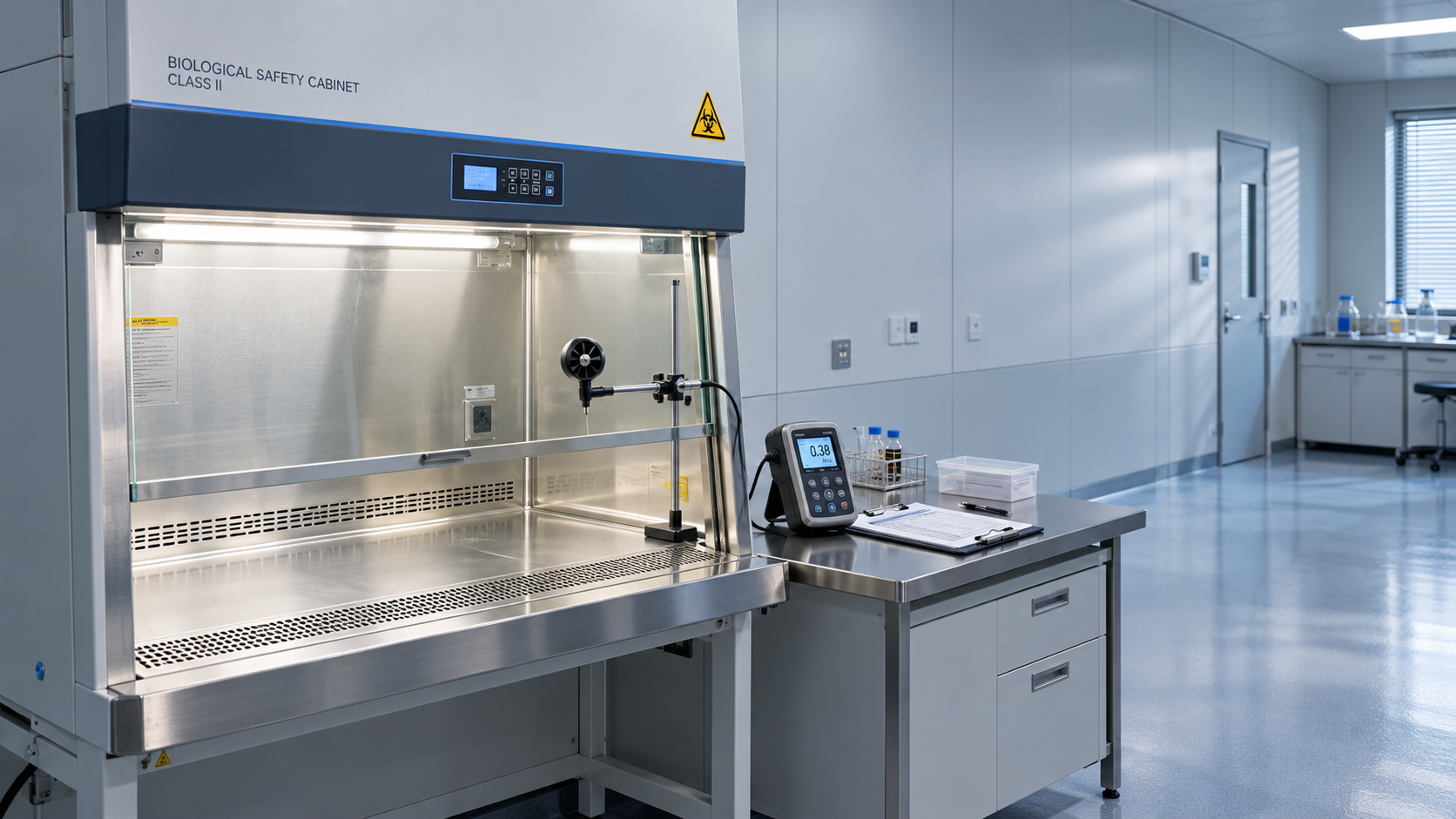
When comparing NSF biosafety cabinets, treat product certification and field testing as two separate acceptance requirements. Product certification establishes that a listed Class II biological safety cabinet model meets applicable NSF/ANSI 49 requirements within its certified configuration. Field testing establishes whether an individual cabinet performs acceptably after installation in a particular location. A certification mark cannot establish how a cabinet performs beside a busy doorway or when connected to a building exhaust system.
This distinction belongs in the purchase specification, installation plan, and release-to-use process. A cabinet can arrive with valid product certification and still require installation corrections before use. Conversely, a satisfactory field test does not establish that an unlisted model has undergone product certification.
What NSF/ANSI 49 product certification establishes
NSF/ANSI 49 addresses Class II biosafety cabinet design, construction, and performance. These cabinets use controlled airflow and high-efficiency particulate air filtration to support personnel, product, and environmental protection when correctly selected, installed, maintained, and operated.
Product certification evaluates a model against applicable requirements through a certification program. Its scope extends beyond the measurements normally taken during an on-site service visit. Design and construction features, containment performance, and other applicable characteristics are assessed under defined evaluation conditions. Certification also involves ongoing oversight under the certification program.
For procurement purposes, the decisive evidence is the certification listing for the specific model and configuration being supplied. A manufacturer’s statement that a cabinet is “designed to NSF/ANSI 49” does not establish the same status as independent product certification. Neither does a general brochure displaying a certification mark beside an entire product range.
Check that the offered model designation, cabinet type, size, and relevant options correspond to the listing. Accessories or modifications that affect airflow, the work opening, or exhaust arrangements deserve particular attention because their compatibility cannot be inferred from the base cabinet’s certification.
Product certification also has a practical boundary: it evaluates the cabinet within specified conditions. It does not establish that every room, exhaust connection, or laboratory workflow will preserve those conditions.
What field testing establishes—and what it cannot establish
Field testing evaluates an individual cabinet in its installed condition. The cabinet’s location, airflow settings, sash position, filters, and applicable exhaust connections become part of the assessment.
The purpose is to identify whether installation conditions, transport damage, component condition, or adjustments have affected performance. A cabinet that performed correctly before shipment may behave differently after relocation, connection to exhaust ductwork, or changes to room ventilation.
The expression “field certification” is commonly used for this process. However, the resulting label and report should be understood as evidence of the installed unit’s performance at the time of testing. They do not create an NSF product listing or extend an existing listing to an altered cabinet.
Both forms of evidence are needed when the specification calls for a certified product and verified installed performance. Neither document closes the other’s evidence gap.
Read the field test report beyond the pass label
A service sticker is useful for identifying test status, but the report provides the information needed to judge acceptance. It should identify the cabinet by model and serial number, record its location, describe the applicable test basis, and show the results supporting the conclusion.
The applicable procedures depend on the cabinet type and installation. Several checks are especially relevant when reviewing the scope.
Airflow measurements and smoke patterns
Inflow testing assesses air entering the front opening. Downflow testing assesses the filtered airflow moving through the work area. Results need to be evaluated against the applicable criteria for the cabinet and test method; a single generic velocity target is not a sound acceptance rule for every Class II cabinet.
Smoke pattern observations help reveal airflow behavior that an average velocity measurement cannot explain. They can expose undesirable movement near the opening, disrupted flow, or other patterns requiring investigation. Smoke visualization supports the assessment, but it does not replace quantitative airflow testing.
HEPA filter integrity
Installed filter integrity testing looks for leakage through the filter system, including relevant seals and mounting interfaces. This differs from checking that a filter carries an efficiency rating. A high-efficiency filter can still leak around an installation defect.
A satisfactory filter test also does not establish adequate front-opening containment by itself. Filtration and airflow control perform different functions, so both need appropriate assessment.
Installation-dependent checks
Depending on the cabinet and its exhaust arrangement, testing may also address alarms, interlocks, exhaust performance, and other applicable installation requirements. Building exhaust deserves particular attention where cabinet operation depends on it.
The report should make exclusions visible. If a required check could not be completed because an exhaust system was unavailable or an alarm remained disconnected, the omission should not disappear behind an overall “pass” entry.
Measurement traceability matters as well. Instrument identification and calibration status help establish that the reported values have a defensible basis. Records of adjustments and repairs explain what changed before the final results were obtained.
Why cabinet type and room conditions change acceptance
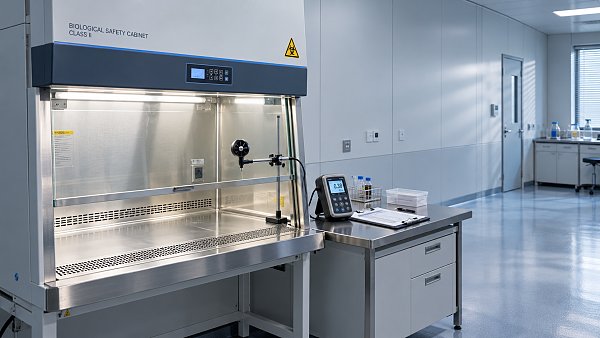
“Class II” does not describe one interchangeable installation arrangement. Cabinet types differ in airflow recirculation, exhaust handling, and their relationship with building ventilation. Those differences affect selection, installation requirements, and field-test scope.
A Type A2 cabinet, for example, may discharge filtered exhaust into the room or use an appropriate canopy connection where permitted by its design and intended application. A Type B2 cabinet depends on an external exhaust arrangement and places different demands on the facility. Procurement should resolve those dependencies before choosing a model.
HEPA filters capture particles; they do not provide general removal of chemical vapors. Product certification therefore does not make every certified cabinet suitable for work involving volatile toxic chemicals. Suitability depends on the substances, quantities, procedures, cabinet type, and exhaust configuration.
Room placement creates another boundary. Supply-air diffusers, doors, pedestrian traffic, and nearby equipment can disturb airflow at the front opening. A cabinet with acceptable internal components may still require relocation or ventilation changes to achieve an acceptable installation.
Consider a typical installation scenario: a certified cabinet is positioned near a doorway because that location simplifies equipment delivery. Airflow observations during acceptance testing reveal disturbance when the door operates. Increasing blower speed without a documented basis may upset other performance conditions. The appropriate response is to investigate the placement and ventilation interaction, correct the cause, and repeat the affected tests.
Field testing should therefore take place with the cabinet in its intended operating location and with relevant building systems functioning in the intended configuration. Testing before an exhaust connection is complete leaves a material part of acceptance unresolved.
Specify the evidence before placing the order
A purchase order that asks only for an “NSF-certified cabinet” can leave responsibility for installation testing unclear. A stronger specification separates product status, installation requirements, and release criteria.
- Product identification: Require the proposed model, cabinet type, configuration, and evidence of the applicable certification listing.
- Installation information: Obtain site requirements covering placement, utilities, exhaust connections, and relevant accessories before delivery.
- Field-test scope: Define the applicable standard edition, manufacturer procedures, required tests, and acceptance criteria.
- Service competence: Specify personnel qualified for the cabinet type and test methods. Where NSF-accredited field certifiers are required, state that explicitly.
- Acceptance records: Require a complete report identifying the installed unit, measured results, deficiencies, corrective work, and final status.
- Handover responsibility: Assign responsibility for installation corrections, retesting, and authorization to place the cabinet into service.
Accreditation of a field certifier and certification of a cabinet are separate credentials. One concerns the individual’s demonstrated competence within a defined program; the other concerns the listed product. A service provider’s credentials should never be used as evidence that the cabinet model itself is certified.
For cross-border purchases, also identify the standard and conformity evidence required by the destination facility. Certification against another biosafety cabinet standard may be relevant evidence, but it does not automatically satisfy a specification requiring NSF/ANSI 49 product certification.
When installed performance needs to be tested again
Initial field testing should occur after installation and before the cabinet is released for work requiring containment. Verification then continues through the cabinet’s service life.
Annual field certification is a common baseline in biosafety programs. The facility’s schedule should reflect applicable requirements, the manufacturer’s instructions, and the work performed. A calendar interval alone is insufficient because important changes can occur between scheduled visits.
Relocation is a clear trigger for reassessment. Moving a cabinet can affect its physical condition, and the new position changes its relationship with room airflow. A short move within the same laboratory can still alter exposure to doors or ventilation outlets.
HEPA filter replacement, blower work, and other maintenance affecting containment or airflow also require appropriate testing before return to service. Changes to building exhaust or room ventilation may create a similar need even when nobody has worked directly on the cabinet.
The necessary retest scope follows the change and the applicable procedures. It should be established by qualified personnel rather than assumed from the apparent size of the repair.
Turn the two assessments into one acceptance decision
Technical acceptance is strongest when three records align: the product listing identifies the supplied configuration, the installation meets the cabinet’s requirements, and the field report demonstrates acceptable performance for that specific unit.
If the listing does not match the delivered model, resolve the product-status issue. If the field report records a failure, correct the installation or equipment problem and obtain satisfactory retest results. If the report omits an applicable test, close that gap before treating acceptance as complete.
Retain the initial report as a baseline for subsequent service. Later changes in airflow readings, adjustments, or recurring faults can help identify developing problems, although comparisons must account for test methods and operating conditions.
The practical purchasing rule is straightforward: require certification evidence for the product you order and performance evidence for the cabinet you will actually use. Release it for service only when both records support that decision.
Get weekly intelligence in your inbox.
No noise. No sponsored content. Pure intelligence.
 Oct 24, 2026Tesla Q3 2026 Storage Deployments Rank Second Highest as Revenue Falls 16%Tesla Q3 2026 Storage Deployments Rank Second Highest as Revenue Falls 16%
 Oct 24, 2026Freight Forwarding Services Pricing: Comparing Quotes Beyond Base RatesFreight Forwarding Services Pricing: Comparing Quotes Beyond Base Rates
 Oct 23, 2026IndexBox Issues Off-Grid Solar Outlook to 2035, Forecasting 8.2% CAGRIndexBox Issues Off-Grid Solar Outlook to 2035, Forecasting 8.2% CAGR
 Oct 23, 2026NSF/ANSI 49 Biosafety Cabinets: Product Certification vs. Field TestingNSF/ANSI 49 Biosafety Cabinets: Product Certification vs. Field Testing
 Oct 22, 2026Mitsubishi Electric Develops Industry-First Humanoid Robot–CNC Machining SystemMitsubishi Electric Develops Industry-First Humanoid Robot–CNC Machining System
 Oct 22, 2026Aerospace Aluminum Machining: How to Control Distortion in Thin-Wall PartsAerospace Aluminum Machining: How to Control Distortion in Thin-Wall Parts
 Oct 21, 2026Genesis Energy commissions 200 MWh battery storage system at HuntlyGenesis Energy commissions 200 MWh battery storage system at Huntly
 Oct 21, 2026Buying AMI Smart Meters Wholesale: Compatibility Checks and Total CostsBuying AMI Smart Meters Wholesale: Compatibility Checks and Total Costs
 Oct 20, 2026Werner Enterprises Issues Q3 Earnings Warning as Costs RiseWerner Enterprises Issues Q3 Earnings Warning as Costs Rise
 Oct 20, 2026Are Digital Twins Viable for SMEs? Costs, Use Cases, and Data RequirementsAre Digital Twins Viable for SMEs? Costs, Use Cases, and Data Requirements
 Oct 19, 2026Choosing a Wholesale Servo Motor Exporter: Traceability and Warranty ChecksChoosing a Wholesale Servo Motor Exporter: Traceability and Warranty Checks
 Oct 18, 2026Syringe Manufacturing Equipment: Evaluating Throughput and Assembly AccuracySyringe Manufacturing Equipment: Evaluating Throughput and Assembly Accuracy
 Oct 17, 2026Air Freight Forwarding Services: How to Compare Quotes for Urgent ShipmentsAir Freight Forwarding Services: How to Compare Quotes for Urgent Shipments
 Oct 16, 2026Wholesale Solar Panels: How to Compare Bulk Quotes by Total Landed CostWholesale Solar Panels: How to Compare Bulk Quotes by Total Landed Cost
 Oct 15, 2026Supply Chain Intelligence for Sourcing: How to Vet New SuppliersSupply Chain Intelligence for Sourcing: How to Vet New Suppliers
 Oct 14, 2026How energy costs shape smart manufacturing investment in EuropeHow energy costs shape smart manufacturing investment in Europe
 Oct 14, 2026How skills shortages slow smart manufacturing in Southeast AsiaHow skills shortages slow smart manufacturing in Southeast Asia
 Oct 14, 2026How CNC wire-cut machining maintains tight tolerances in thick partsHow CNC wire-cut machining maintains tight tolerances in thick parts
 Oct 14, 2026Can automated feeding stabilize metal forming in smart factories?Can automated feeding stabilize metal forming in smart factories?
 Oct 14, 2026Can CT inspection detect internal defects in metal additive parts?Can CT inspection detect internal defects in metal additive parts?
 Oct 14, 2026When does additive manufacturing reduce lead time for spare parts?When does additive manufacturing reduce lead time for spare parts?
 Oct 14, 2026How production volume affects ROI on an automated painting lineHow production volume affects ROI on an automated painting line
 Oct 14, 2026What data does manufacturing bottleneck analysis consulting need?What data does manufacturing bottleneck analysis consulting need?
 Oct 14, 2026When should you hire a consultant for manufacturing bottlenecks?When should you hire a consultant for manufacturing bottlenecks?
 Oct 14, 2026What Are Electronics Exporters' Top Supply Chain Resilience Gaps in 2026?What Are Electronics Exporters' Top Supply Chain Resilience Gaps in 2026?
 Oct 14, 2026How Do You Measure AI Adoption Maturity in a Traditional Factory?How Do You Measure AI Adoption Maturity in a Traditional Factory?
 Oct 14, 2026Are Chinese AI-Assisted Surgical Devices Gaining Global Trust?Are Chinese AI-Assisted Surgical Devices Gaining Global Trust?