When does additive manufacturing reduce lead time for spare parts?
Additive manufacturing reduces spare-part lead time when it removes a longer delay from tooling, supplier queues, or unavailable inventory, while leaving a manageable path through finishing and acceptance. The strongest candidates have a usable digital definition, a suitable material and process, accessible production capacity, and clearly defined installation requirements. A short print cycle provides little advantage if the part then waits for heat treatment, machining, inspection, or approval.
The comparison should end at the same point: a released part that is ready to install. For an obsolete cover or an irregular duct, printing can remove substantial sourcing work. For a precision shaft available from stock or readily machined from standard bar, conventional sourcing often remains faster. Geometry, operating conditions, and the maturity of the manufacturing route determine which conclusion holds.
Measure the interval from request to installation readiness
A quoted build time describes only one stage of additive manufacturing lead time. The full interval includes confirming the design, preparing the build, waiting for machine capacity, printing, cooling, removing supports or loose powder, finishing, inspection, release, and delivery. Metal parts can also require stress relief, other heat treatment, or machining of critical surfaces.
Conventional production needs an equally complete comparison. A machining quote might exclude material procurement; a casting quote might assume that usable tooling already exists. Conversely, an additive quotation might start its delivery clock only after approval of the build file. Comparing those dates without aligning their starting conditions creates an artificial advantage.
Elapsed time follows the workflow’s critical path. Some activities overlap: inspection planning can proceed during build preparation, and shipping can be arranged before final release. Other stages are sequential because machining cannot begin until the required thermal processing is complete. Adding every activity duration therefore overstates the schedule when work overlaps, while quoting print time alone understates it.
A useful comparison records the earliest credible installation-ready date for each route, together with the unresolved assumptions behind it. Confirmed machine availability, reserved finishing capacity, and an agreed acceptance plan make that date more dependable than a headline turnaround estimate.
Where printing removes the dominant delay
Additive manufacturing is most attractive when the conventional route carries a substantial setup burden relative to the quantity required. A replacement casting without usable patterns, a molded component requiring new tooling, or a complex part dependent on a distant specialist creates opportunities. Printing avoids dedicated forming tools, although it still requires build preparation and sometimes finishing fixtures.
Part consolidation deserves particular scrutiny. Combining several pieces into one printed component can remove assembly operations, but it also changes the replacement design. Mounting access, serviceability, load paths, and inspection access must remain acceptable. For an urgent repair, reproducing an established geometry can reach release sooner than a redesign that promises a shorter manufacturing cycle.
A printable model is not necessarily a production definition
Digital readiness is often the decisive difference between a rapid repeat order and a slow first replacement. A surface mesh suitable for printing may omit tolerances, material requirements, mating dimensions, or the intended manufacturing allowances. Those omissions become consequential when a bearing seat, sealing face, or threaded connection must fit an existing assembly.
Reverse engineering from a worn spare introduces another problem: the measured shape may contain service damage. Scanning a distorted housing or eroded impeller reproduces its current condition unless the original geometry is reconstructed. Mating parts, historical drawings, and functional requirements help distinguish design intent from wear. That engineering effort belongs in the lead-time estimate.
Material substitution also requires more than matching a material name or a room-temperature strength value. A printed polymer exposed to sustained heat can creep or lose dimensional stability. A metal replacement subjected to cyclic loading needs consideration of surface condition, internal defects, orientation, and heat treatment. Chemical exposure, electrical behavior, and sealing requirements can similarly determine whether a proposed material is suitable.
A first article therefore carries a different schedule from a repeat spare. Once the geometry, material, process route, and acceptance evidence are established, later orders can avoid much of the initial work. A digital spare-part library delivers its strongest time advantage when it stores that manufacturing definition alongside the model.
The finishing route can outweigh the build cycle
Process selection should follow the functional surfaces and service conditions of the spare. Material extrusion can suit certain covers, guides, and fixtures when temperature, loading, and dimensional requirements permit. Polymer powder-bed processes can produce complex shapes without attached support structures, but cooling, depowdering, and any required surface treatment remain part of the schedule.
Metal powder-bed fusion introduces a different sequence. Depending on the material and application, the route can include stress relief, separation from the build plate, support removal, further heat treatment, and machining. A nearby printer does not guarantee a short delivery interval if these operations depend on separate facilities with their own queues.
Other additive routes have their own scheduling constraints. Metal binder jetting requires debinding and sintering, with dimensional control linked to shrinkage. Directed energy deposition can be suitable for certain repairs or larger features, but deposited material commonly needs machining to achieve the final geometry. Comparing these routes solely by deposition speed misses the work required afterward.
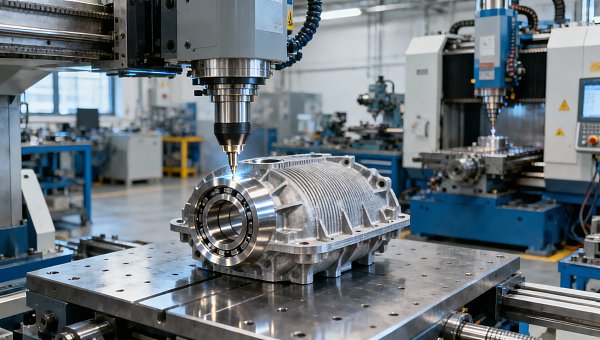
Orientation connects print duration with downstream work. A faster orientation can place supports on a critical surface or produce an unfavorable surface finish. A different orientation can reduce support removal while increasing build height and machine occupancy. The useful comparison evaluates the complete route, including how the part will be held during machining and how its datums will be established.
For a replacement housing, the outside shape might emerge close to its final form while sealing lands, bearing bores, and threaded holes still require finishing. Machining allowance must be included before printing. If it is missing, the result can be an uncorrectable undersized feature and a repeat build. Accessible powder-removal paths matter just as much for internal channels: trapped material can prevent release even when external dimensions pass inspection.
Qualification determines whether the first part arrives sooner
A geometrically acceptable spare is not automatically suitable for service. Acceptance requirements should be tied to the part’s function before production begins. A lightly loaded protective cover and a pressure-containing component require different evidence, even if their print times are similar.
Dimensional inspection establishes fit, but it does not establish fatigue resistance, leak tightness, cleanliness, or behavior at operating temperature. Where these properties matter, the schedule must include the agreed examinations or functional tests. Destructive testing also requires a defined approach because the spare itself cannot both be consumed in testing and installed.
Test coupons provide useful evidence within an appropriate qualification plan, but their results do not automatically represent every region of a complex component. Geometry, orientation, thermal history, and finishing affect the relationship between coupon properties and part performance. Unresolved questions about that relationship can extend release beyond the manufacturing completion date.
The additive route is strongest when required evidence already exists and the planned production conditions fall within its accepted scope. Where substitution needs engineering approval or formal qualification, that work can dominate the first order. A temporary spare also needs defined operating limits and acceptance; urgency alone does not establish suitability.
Capacity claims need to cover the whole production chain
“Local production” reduces transport distance only if the required manufacturing and finishing capabilities are actually local. A printed metal spare sent elsewhere for thermal processing and precision machining may retain much of the original logistics delay. The relevant location is the location of each operation on the critical path.
Machine availability must also match the proposed material and process. An open machine is of limited value if material changeover, cleaning, or setup consumes the available window. Suitable feedstock must be available in an acceptable condition, with the traceability required for release. Build batching can improve production efficiency while postponing the start of a single urgent spare.
Inspection capacity is easy to overlook. A dimensional scan, nondestructive examination, or leak test may depend on equipment that is booked separately from the printer. An accelerated build with an unreserved inspection slot merely moves the queue downstream.
A credible quotation therefore identifies the completion milestones for printing, finishing, inspection, and dispatch. It should also state whether the schedule assumes a successful first build. Rework exposure differs between a familiar, repeatable spare and a new geometry with difficult supports, thin walls, or distortion-sensitive features.
Choose against the fastest credible alternative
The correct baseline is the fastest technically acceptable conventional route. Comparing printing with a lengthy original-equipment replacement schedule can be misleading if a local machining route can deliver the same accepted spare sooner. Conversely, a simple-looking component may favor printing when conventional production requires unavailable tooling or specialist material procurement.
A useful decision record keeps each route’s promised date separate from its open dependencies. An additive option with a prepared file and a reserved printer still has an uncertain release date if heat treatment capacity or acceptance criteria remain unresolved. A conventional option with confirmed stock material and machining capacity may offer a more reliable arrival, even when its nominal production cycle is longer.
For recurring shortages, engineering work completed before the next failure changes the comparison. A validated build file, defined finishing allowances, agreed inspection requirements, and an established release route remove delays that an emergency print request cannot bypass. Additive manufacturing then becomes a practical way to replenish suitable spares on demand, with delivery governed by a known production workflow.
Get weekly intelligence in your inbox.
No noise. No sponsored content. Pure intelligence.
 Oct 22, 2026Mitsubishi Electric Develops Industry-First Humanoid Robot–CNC Machining SystemMitsubishi Electric Develops Industry-First Humanoid Robot–CNC Machining System
 Oct 22, 2026Aerospace Aluminum Machining: How to Control Distortion in Thin-Wall PartsAerospace Aluminum Machining: How to Control Distortion in Thin-Wall Parts
 Oct 21, 2026Genesis Energy commissions 200 MWh battery storage system at HuntlyGenesis Energy commissions 200 MWh battery storage system at Huntly
 Oct 21, 2026Buying AMI Smart Meters Wholesale: Compatibility Checks and Total CostsBuying AMI Smart Meters Wholesale: Compatibility Checks and Total Costs
 Oct 20, 2026Werner Enterprises Issues Q3 Earnings Warning as Costs RiseWerner Enterprises Issues Q3 Earnings Warning as Costs Rise
 Oct 20, 2026Are Digital Twins Viable for SMEs? Costs, Use Cases, and Data RequirementsAre Digital Twins Viable for SMEs? Costs, Use Cases, and Data Requirements
 Oct 19, 2026Choosing a Wholesale Servo Motor Exporter: Traceability and Warranty ChecksChoosing a Wholesale Servo Motor Exporter: Traceability and Warranty Checks
 Oct 18, 2026Syringe Manufacturing Equipment: Evaluating Throughput and Assembly AccuracySyringe Manufacturing Equipment: Evaluating Throughput and Assembly Accuracy
 Oct 17, 2026Air Freight Forwarding Services: How to Compare Quotes for Urgent ShipmentsAir Freight Forwarding Services: How to Compare Quotes for Urgent Shipments
 Oct 16, 2026Wholesale Solar Panels: How to Compare Bulk Quotes by Total Landed CostWholesale Solar Panels: How to Compare Bulk Quotes by Total Landed Cost
 Oct 15, 2026Supply Chain Intelligence for Sourcing: How to Vet New SuppliersSupply Chain Intelligence for Sourcing: How to Vet New Suppliers
 Oct 14, 2026How skills shortages slow smart manufacturing in Southeast AsiaHow skills shortages slow smart manufacturing in Southeast Asia
 Oct 14, 2026How CNC wire-cut machining maintains tight tolerances in thick partsHow CNC wire-cut machining maintains tight tolerances in thick parts
 Oct 14, 2026Can automated feeding stabilize metal forming in smart factories?Can automated feeding stabilize metal forming in smart factories?
 Oct 14, 2026Can CT inspection detect internal defects in metal additive parts?Can CT inspection detect internal defects in metal additive parts?
 Oct 14, 2026When does additive manufacturing reduce lead time for spare parts?When does additive manufacturing reduce lead time for spare parts?
 Oct 14, 2026How production volume affects ROI on an automated painting lineHow production volume affects ROI on an automated painting line
 Oct 14, 2026What data does manufacturing bottleneck analysis consulting need?What data does manufacturing bottleneck analysis consulting need?
 Oct 14, 2026When should you hire a consultant for manufacturing bottlenecks?When should you hire a consultant for manufacturing bottlenecks?
 Oct 14, 2026How Do You Measure AI Adoption Maturity in a Traditional Factory?How Do You Measure AI Adoption Maturity in a Traditional Factory?
 Oct 14, 2026Are Chinese AI-Assisted Surgical Devices Gaining Global Trust?Are Chinese AI-Assisted Surgical Devices Gaining Global Trust?
 Oct 14, 2026What Happens When Warehouse Robots Need Software Updates Mid-Operation?What Happens When Warehouse Robots Need Software Updates Mid-Operation?
 Oct 14, 2026How Do Plants Calculate Real Savings from Energy-Efficient Equipment?How Do Plants Calculate Real Savings from Energy-Efficient Equipment?
 Oct 14, 2026Are Digital Twins Only for Large Enterprises, or Can SMEs Use Them?Are Digital Twins Only for Large Enterprises, or Can SMEs Use Them?
 Oct 14, 2026What Are the Common Failure Modes in Legacy Industrial Control Systems?What Are the Common Failure Modes in Legacy Industrial Control Systems?
 Oct 14, 2026Do Electronic Component Distributors Add Value or Just Markup?Do Electronic Component Distributors Add Value or Just Markup?
 Oct 14, 2026What ESG Requirements Apply to Solar PV Exporters Selling to Europe?What ESG Requirements Apply to Solar PV Exporters Selling to Europe?