Can automated feeding stabilize metal forming in smart factories?
Automated feeding can stabilize metal forming when inconsistent material delivery is a significant source of process variation. It can improve feed positioning, synchronize stock movement with the press, and reduce interruptions caused by poorly controlled handling. It cannot compensate for an unstable die, unsuitable lubrication, or material properties outside the forming process window. The decisive question is whether the feeding system controls the disturbances that actually limit production.
For smart factory metal forming automation, the strongest evidence is not a feeder’s advertised positioning accuracy. It is repeatable performance across the intended materials, tooling, speeds, and operating conditions. A feeder that performs well during an unloaded demonstration may still lose accuracy when pulling heavy strip, managing coil tension, or working within a short press feed window.
Identify which instability feeding can actually remove
“Unstable forming” can describe several different problems: inconsistent part dimensions, misfeeds, strip buckling, surface marks, press stoppages, or variable scrap. These symptoms do not share a single cause. Before selecting automation, separate material-positioning errors from variation generated inside the forming operation.
In progressive stamping, incorrect feed pitch can place features out of position before the die pilots engage. Variable strip tension can disturb registration or prevent the strip from settling correctly. Automated feeding can address these mechanisms through controlled motion, suitable roll pressure, synchronized release, and coordinated upstream handling.
By contrast, cracking caused by insufficient material ductility or wrinkling caused by inappropriate blank-holder force requires changes to the forming process. Feeding may influence how consistently material enters the tool, but precise positioning alone does not resolve those defects. Springback variation associated with material strength also remains a separate concern.
A useful baseline therefore links each reject and stop category to an observable cause. Record feed-related alarms, actual strip-position errors, material condition, press speed, and tooling state alongside quality results. If feeder faults account for little of the production loss, replacing the feeder may offer limited stabilization even when its technical specifications are better.
The controlled system extends from coil to die
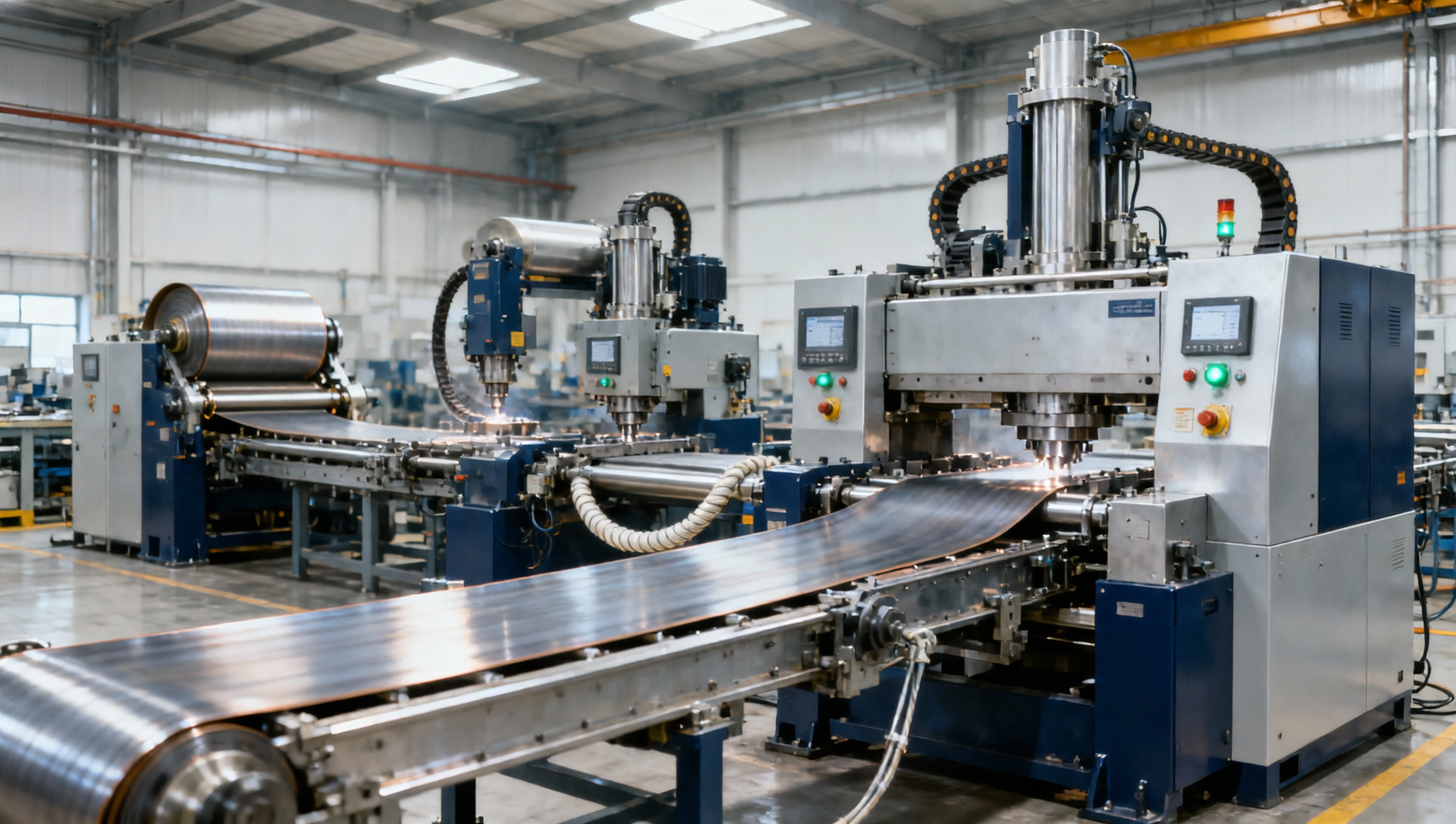
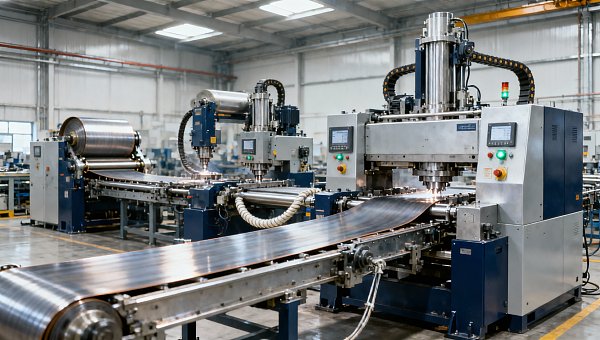
For coil-fed forming, the feeder is only one part of the material path. The decoiler, straightener, loop or accumulator, feeder, guides, and die entry must operate together. Their arrangement depends on the material and available space, but the underlying requirement is consistent: deliver stock without transmitting uncontrolled upstream disturbances into the feed stroke.
A suitably managed loop separates intermittent feeding from coil payout. If the loop becomes too small, the feeder may pull against upstream resistance. If it becomes excessive or poorly guided, strip can contact surrounding equipment, twist, or buckle. Loop sensing and payout control therefore affect feeding stability even when the feeder’s position controller operates correctly.
Straightening presents another boundary. Residual coil set can make strip difficult to guide into the die, while unsuitable settings can mark surfaces or alter strip shape. A feeder cannot reliably solve these problems by applying more roll pressure. Excessive pressure may improve traction while creating a new surface-quality problem.
Coil diameter changes the payout system’s inertia and torque requirements. Thickness, width, strength, lubrication, and surface finish affect straightening load and available traction. The operating envelope must cover these variables in combination—not simply list a maximum thickness and maximum width that cannot be processed together.
For blank-fed forming, the equivalent concerns are separation, orientation, transfer position, and timing. Double-blank detection and reliable placement matter more than coil-loop control. This distinction prevents a coil-feeding specification from being applied to a robotic or gantry-fed press cell with different failure mechanisms.
Choose the feeding principle around the process constraint
Servo roll feeders offer programmable pitch and motion profiles, making them useful when a line handles different feed lengths or tooling recipes. Their suitability still depends on traction, roll geometry, drive capacity, and synchronization. A servo motor’s encoder can confirm roll rotation without proving that the strip moved by exactly the same amount.
Mechanically synchronized roll feeders can provide a direct relationship to press motion where feed requirements remain relatively fixed. Their adjustment range and changeover method deserve close attention when evaluating a mixed-product line. Limited flexibility is not automatically a disadvantage if the application is stable and the mechanism satisfies its operating envelope.
Gripper feeders move stock through a clamping and transfer cycle. They can be appropriate where roll feeding is unsuitable or where the required stock control favors gripping. Selection must account for clamp marks, reciprocating motion, stroke limits, and the available cycle time. No feeding principle is inherently the most accurate under every production condition.
For discrete blanks, robots and gantries introduce a different trade-off. Reach, payload, blank separation, end-effector compliance, and placement repeatability must be considered alongside the press cycle. A flexible robot can simplify handling across part families, but flexibility does not guarantee that it can complete loading and withdrawal within the required timing window.
The comparison should therefore start with the difficult operating conditions: sensitive surfaces, slippery stock, short feed windows, long pitches, or frequent changes. These constraints determine which mechanism deserves a production trial.
Accuracy must be defined at the material, not just the drive
Advertised feed accuracy is incomplete unless the supplier states where it is measured, under what load, and over which operating conditions. Motor position, roll displacement, strip displacement at the feeder exit, and registration at the die are related but not interchangeable measurements.
Roll slip, mechanical compliance, backlash, strip stretch, and guide friction can separate commanded movement from actual material movement. Independent strip-position measurement can help detect that difference, provided the sensing method remains reliable with the relevant surface finish, lubricant, and stock geometry.
Progressive dies add another consideration: pilot registration. Where the tooling requires the feeder to release stock so pilots can locate it, release timing must match the die sequence. Release that is too late can make the feeder resist correction; re-clamping too early can disturb registration. Release too early or for too long may leave the stock insufficiently controlled.
A feeder should consequently be evaluated against the complete positioning requirement: initial advance, settling, pilot engagement where applicable, release, and re-clamping. A tight feed-length specification does not replace validation of this sequence.
The press feed window determines usable speed
Maximum feeder speed and maximum press speed do not establish the capacity of the combined line. Material must advance during the portion of the press cycle when movement is permitted, then settle before tooling engagement. That window may be much shorter than the full cycle.
A longer pitch or shorter window demands greater acceleration and deceleration. The resulting forces can increase slip, strip vibration, and demand on the drive. A motion profile that achieves the target pitch at low speed may therefore become unreliable as press speed increases, even before the motor reaches its nominal speed limit.
Ask for a demonstrated operating envelope that relates feed length, press rate, material load, and allowable motion window. Include settling time and synchronization margins rather than accepting a calculation based only on average strip velocity. Where press motion is programmable, coordination may create a more suitable window, but any change must remain compatible with forming requirements and tooling clearance.
Retrofits require particular care. The existing press must supply a usable position reference and support the required interlocks. Encoder signals, controller latency, drive response, and stop behavior all influence whether the feeder can remain coordinated during acceleration, deceleration, and fault recovery—not merely during steady production.
Smart connectivity is useful only when it closes a control gap
A connected feeder can expose commanded pitch, actual position, motor torque, loop level, alarms, and recipe history. These signals support diagnosis when they are time-aligned with press position and quality records. Without that relationship, a dashboard may show that a fault occurred without explaining why.
For example, elevated drive torque combined with a shrinking loop may indicate upstream resistance. A discrepancy between roll-based position and independently measured strip travel may indicate slip. These are diagnostic clues, not automatic proof: interpretation depends on sensor quality and the machine’s operating state.
Machine synchronization should remain within the appropriate local control architecture. Production databases and factory networks can support traceability and analysis, but should not be relied on to deliver time-critical feed commands. Loss of higher-level connectivity should have a defined effect that does not compromise safe operation.
Recipe management also needs clear limits. A recipe may store pitch, acceleration, release timing, and selected setup values, but recalling it does not verify roll pressure, guide alignment, straightener settings, or the installed die. Automatic checks and documented setup confirmation should cover the parameters that cannot be established through software alone.
Require trials that expose variation, not just ideal operation
A meaningful acceptance trial uses representative tooling and material across the proposed operating envelope. Testing only a convenient coil at a moderate speed establishes little about performance with thin slippery strip, wider high-strength stock, or the longest required feed pitch.
Factory testing can establish basic capability before shipment. Site testing must then verify the actual press interface, upstream equipment, utilities, guarding, and production tooling. Where factory tests cannot reproduce site conditions, the remaining acceptance obligations should be explicit rather than assumed.
Agree on what constitutes success before testing begins:
- Positioning: measure actual stock displacement or registration using a method with sufficient resolution for the specified tolerance.
- Quality: assess relevant part dimensions and surface defects, distinguishing feed-related effects from tooling or material effects.
- Reliability: classify misfeeds, nuisance alarms, handling interruptions, and recovery time rather than reporting throughput alone.
- Operating coverage: include intended speed limits, material combinations, coil conditions, and changeovers.
- Recovery: verify restart after interruptions and controlled responses to credible faults through an approved, safe test procedure.
The trial duration should be sufficient to include meaningful changes in material handling conditions, not just a short burst of successful strokes. Comparing results with the existing process also requires equivalent tooling condition, material specification, lubrication, and inspection methods. Otherwise, an apparent improvement may reflect changes outside the feeder.
Safety validation remains separate from production acceptance. Guarding, access control, emergency stops, stored-energy management, and safety-related interlocks must be assessed for the integrated line under applicable requirements. Faster fault detection is not a substitute for a validated protective system.
Make the decision on the integrated operating envelope
Automated feeding is a strong candidate when measured losses originate in inconsistent stock movement, poor timing, or unstable material handling—and when the proposed system demonstrably controls those causes. Its value is less certain when defects remain dominated by die condition, material variation, or forming parameters that the feeder does not control.
The purchase specification should state accepted material combinations, tooling interfaces, timing requirements, measurement methods, and sustained production criteria. It should also define responsibility for integration and access to diagnostic data. This makes the supplier accountable for performance at the die, rather than for an isolated feeder specification.
The practical decision is not whether automated feeding is “smart,” but whether it delivers correctly positioned material, within the permitted press window, across the required production range. That is the evidence needed to distinguish genuine process stabilization from automation that merely moves stock faster.
Get weekly intelligence in your inbox.
No noise. No sponsored content. Pure intelligence.
 Oct 22, 2026Mitsubishi Electric Develops Industry-First Humanoid Robot–CNC Machining SystemMitsubishi Electric Develops Industry-First Humanoid Robot–CNC Machining System
 Oct 22, 2026Aerospace Aluminum Machining: How to Control Distortion in Thin-Wall PartsAerospace Aluminum Machining: How to Control Distortion in Thin-Wall Parts
 Oct 21, 2026Genesis Energy commissions 200 MWh battery storage system at HuntlyGenesis Energy commissions 200 MWh battery storage system at Huntly
 Oct 21, 2026Buying AMI Smart Meters Wholesale: Compatibility Checks and Total CostsBuying AMI Smart Meters Wholesale: Compatibility Checks and Total Costs
 Oct 20, 2026Werner Enterprises Issues Q3 Earnings Warning as Costs RiseWerner Enterprises Issues Q3 Earnings Warning as Costs Rise
 Oct 20, 2026Are Digital Twins Viable for SMEs? Costs, Use Cases, and Data RequirementsAre Digital Twins Viable for SMEs? Costs, Use Cases, and Data Requirements
 Oct 19, 2026Choosing a Wholesale Servo Motor Exporter: Traceability and Warranty ChecksChoosing a Wholesale Servo Motor Exporter: Traceability and Warranty Checks
 Oct 18, 2026Syringe Manufacturing Equipment: Evaluating Throughput and Assembly AccuracySyringe Manufacturing Equipment: Evaluating Throughput and Assembly Accuracy
 Oct 17, 2026Air Freight Forwarding Services: How to Compare Quotes for Urgent ShipmentsAir Freight Forwarding Services: How to Compare Quotes for Urgent Shipments
 Oct 16, 2026Wholesale Solar Panels: How to Compare Bulk Quotes by Total Landed CostWholesale Solar Panels: How to Compare Bulk Quotes by Total Landed Cost
 Oct 15, 2026Supply Chain Intelligence for Sourcing: How to Vet New SuppliersSupply Chain Intelligence for Sourcing: How to Vet New Suppliers
 Oct 14, 2026How skills shortages slow smart manufacturing in Southeast AsiaHow skills shortages slow smart manufacturing in Southeast Asia
 Oct 14, 2026How CNC wire-cut machining maintains tight tolerances in thick partsHow CNC wire-cut machining maintains tight tolerances in thick parts
 Oct 14, 2026Can automated feeding stabilize metal forming in smart factories?Can automated feeding stabilize metal forming in smart factories?
 Oct 14, 2026Can CT inspection detect internal defects in metal additive parts?Can CT inspection detect internal defects in metal additive parts?
 Oct 14, 2026When does additive manufacturing reduce lead time for spare parts?When does additive manufacturing reduce lead time for spare parts?
 Oct 14, 2026How production volume affects ROI on an automated painting lineHow production volume affects ROI on an automated painting line
 Oct 14, 2026What data does manufacturing bottleneck analysis consulting need?What data does manufacturing bottleneck analysis consulting need?
 Oct 14, 2026When should you hire a consultant for manufacturing bottlenecks?When should you hire a consultant for manufacturing bottlenecks?
 Oct 14, 2026How Do You Measure AI Adoption Maturity in a Traditional Factory?How Do You Measure AI Adoption Maturity in a Traditional Factory?
 Oct 14, 2026Are Chinese AI-Assisted Surgical Devices Gaining Global Trust?Are Chinese AI-Assisted Surgical Devices Gaining Global Trust?
 Oct 14, 2026What Happens When Warehouse Robots Need Software Updates Mid-Operation?What Happens When Warehouse Robots Need Software Updates Mid-Operation?
 Oct 14, 2026How Do Plants Calculate Real Savings from Energy-Efficient Equipment?How Do Plants Calculate Real Savings from Energy-Efficient Equipment?
 Oct 14, 2026Are Digital Twins Only for Large Enterprises, or Can SMEs Use Them?Are Digital Twins Only for Large Enterprises, or Can SMEs Use Them?
 Oct 14, 2026What Are the Common Failure Modes in Legacy Industrial Control Systems?What Are the Common Failure Modes in Legacy Industrial Control Systems?
 Oct 14, 2026Do Electronic Component Distributors Add Value or Just Markup?Do Electronic Component Distributors Add Value or Just Markup?
 Oct 14, 2026What ESG Requirements Apply to Solar PV Exporters Selling to Europe?What ESG Requirements Apply to Solar PV Exporters Selling to Europe?