
Global Construction Equipment Top 50 Sales Up 5.52%; Chinese Firms Localize Assembly in Mexico
Global construction equipment sales among the Top 50 manufacturers rose 5.52% year-on-year in 2025, with three Chinese firms increasing overseas revenue share to 41%. This development signals shifting supply chain strategies — particularly for CNC machining providers, industrial materials suppliers, and North American distribution partners — as Chinese OEMs accelerate nearshoring in Mexico to serve the U.S. and Canadian markets.
Event Overview
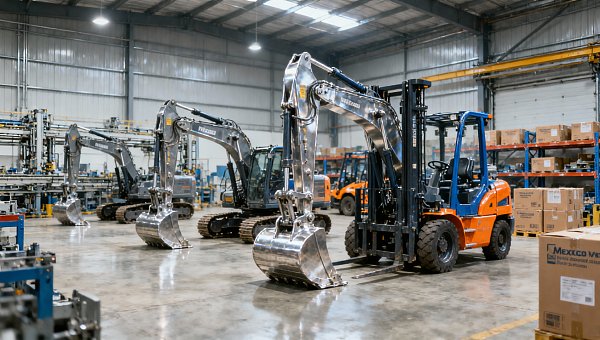
In 2025, the combined sales of the Global Construction Equipment Top 50 companies increased by 5.52% year-on-year. Among them, three Chinese manufacturers ranked in the list saw their overseas revenue share rise to 41%. Sany Heavy Industry and XCMG have initiated construction of a ‘nearshore manufacturing center’ in Monterrey, Mexico, scheduled for commissioning in Q3 2026. The facility will assemble small- and medium-sized hydraulic excavators and electric forklifts, targeting the mid-tier North American market. This move aims to avoid the 25% U.S. additional tariffs and comply with USMCA rules of origin.
Industries Affected
Direct Trade Enterprises
These enterprises — especially those exporting construction equipment or components from China to the U.S. — face recalibration of tariff exposure and compliance requirements. With localization in Mexico, direct export volumes from China may decline for targeted product categories, while demand for cross-border logistics coordination (e.g., China-to-Mexico component shipments) rises.
Raw Material Procurement Firms
Firms supplying base metals, structural steel, or battery-grade lithium compounds may see revised regional demand patterns. While final assembly shifts to Mexico, upstream material sourcing remains globally distributed; however, local content requirements under USMCA could gradually increase pressure to source more regionally — especially for Tier-2 and Tier-3 suppliers engaged with the new Mexican facilities.
Machining & Contract Manufacturing Providers
CNC machining service providers — particularly those certified for ISO 9001/TS 16949 and experienced in precision hydraulic or electric powertrain components — are positioned to benefit. The Monterrey facility’s focus on hydraulic excavators and electric forklifts implies demand for high-tolerance housings, valve blocks, motor casings, and battery enclosures. Localized assembly does not eliminate need for precision-machined parts — it changes geography and specification alignment priorities.
Supply Chain & Logistics Service Providers
Third-party logistics (3PL) and customs brokerage firms supporting China–Mexico–U.S. triangular trade must adapt to new documentation flows, USMCA certification protocols, and just-in-time delivery expectations for assembly lines. Increased scrutiny on origin tracing and duty drawback eligibility makes real-time compliance tracking more critical.
What Relevant Companies or Practitioners Should Monitor and Do
Track official USMCA implementation updates and Mexican IMMEX program adjustments
The Monterrey facility’s success hinges on stable access to IMMEX benefits (duty deferral for imported inputs) and consistent USMCA certification pathways. Stakeholders should monitor regulatory bulletins from Mexico’s Ministry of Economy and U.S. Customs and Border Protection — especially revisions affecting ‘regional value content’ thresholds for assembled equipment.
Assess exposure to hydraulic excavator and electric forklift component categories
Suppliers of castings, machined booms, hydraulic pumps, lithium-ion battery modules, and AC motor assemblies should review current customer roadmaps against the stated product scope. Early engagement with Sany or XCMG procurement teams — particularly regarding technical specifications aligned to North American safety and emissions standards — is advisable.
Distinguish between policy intent and operational readiness
While Q3 2026 is the announced投产 date, ramp-up timelines for full capacity, local supplier onboarding, and quality system certifications (e.g., ISO/TS audits in Mexico) remain subject to execution risk. Companies should treat announcements as strategic signals — not immediate volume triggers — and verify production milestones through official channel disclosures before adjusting capacity plans.
Prepare for dual-sourcing and documentation harmonization
Suppliers serving both legacy China-based exports and future Mexico-assembled units may need parallel documentation systems: one compliant with Chinese export controls and another aligned with USMCA origin declarations. Preemptive alignment with freight forwarders on certificate-of-origin templates and traceability data formats reduces future friction.
Editorial Perspective / Industry Observation
Observably, this development reflects a structural recalibration — not merely a tariff-arbitrage tactic. The decision by two Top 50 OEMs to invest in dedicated Mexican assembly infrastructure signals long-term commitment to North American market access under evolving trade frameworks. Analysis shows that such moves tend to precede broader supplier ecosystem development, but actual spillover into local Tier-2/Tier-3 capacity takes 18–36 months post-ramp-up. From an industry perspective, this is currently a signal — not yet a result — and its significance lies less in immediate sales impact and more in how it reshapes sourcing expectations across the machinery supply chain.
Concluding, this shift underscores growing complexity in global construction equipment trade governance — where commercial decisions increasingly intersect with regional content rules, environmental standards, and geopolitical risk mitigation. It is better understood not as a discrete market opportunity, but as an inflection point requiring calibrated, evidence-based adaptation across procurement, compliance, and partnership strategies.
Source: Publicly reported 2025 Global Construction Equipment Top 50 sales data; corporate announcements from Sany Heavy Industry and XCMG regarding Monterrey facility timeline and scope. Note: USMCA compliance verification outcomes, final product mix details, and Tier-1 supplier selection processes remain under observation and are not yet publicly confirmed.
Get weekly intelligence in your inbox.
No noise. No sponsored content. Pure intelligence.
 Oct 08, 2026How Digital Health Improves Diagnostic Accuracy and Workflow in Clinical LabsHow Digital Health Improves Diagnostic Accuracy and Workflow in Clinical Labs
 Oct 07, 2026Selecting Voice Picking Systems for German Warehouses: Integration, Languages and ROISelecting Voice Picking Systems for German Warehouses: Integration, Languages and ROI
 Oct 06, 2026How to Choose Last Mile Dispatch Software for On-Time Delivery at ScaleHow to Choose Last Mile Dispatch Software for On-Time Delivery at Scale
 Oct 05, 2026Vietnam’s Consumer Electronics Market: Demand Shifts and Sourcing OpportunitiesVietnam’s Consumer Electronics Market: Demand Shifts and Sourcing Opportunities
 Oct 04, 2026Digital Health Investment Priorities for Providers: Improving Access, Outcomes, and EfficiencyDigital Health Investment Priorities for Providers: Improving Access, Outcomes, and Efficiency
 Oct 03, 2026How to Specify an FR4 Custom PCB Board for High-Voltage and High-Heat DesignsHow to Specify an FR4 Custom PCB Board for High-Voltage and High-Heat Designs
 Oct 02, 2026ERP Software Market Intelligence: Adoption, Pricing, and Vendor Signals to WatchERP Software Market Intelligence: Adoption, Pricing, and Vendor Signals to Watch
 Oct 01, 2026How to Select Calibrated Temperature Data Loggers for GMP Cold Storage MonitoringHow to Select Calibrated Temperature Data Loggers for GMP Cold Storage Monitoring
 Sep 30, 2026Custom Molded Rubber Pricing: What Drives Unit Cost and Tooling Fees?Custom Molded Rubber Pricing: What Drives Unit Cost and Tooling Fees?
 Sep 29, 2026How to Evaluate Energy Management Software Vendors for Multi-Site OperationsHow to Evaluate Energy Management Software Vendors for Multi-Site Operations
 Sep 28, 2026How to Select a DIN Rail Smart Meter for Multi-Circuit Energy MonitoringHow to Select a DIN Rail Smart Meter for Multi-Circuit Energy Monitoring
 Sep 27, 2026TWS Earbuds in Vietnam: Demand Drivers, Price Tiers, and Retail Channel OpportunitiesTWS Earbuds in Vietnam: Demand Drivers, Price Tiers, and Retail Channel Opportunities
 Sep 26, 2026How UAE Clinics Can Qualify a Smart Glucometer Supplier for Accuracy and ComplianceHow UAE Clinics Can Qualify a Smart Glucometer Supplier for Accuracy and Compliance
 Sep 25, 2026Buying Aesthetic Lasers in the USA: FDA Status, Wavelengths, and Service SupportBuying Aesthetic Lasers in the USA: FDA Status, Wavelengths, and Service Support
 Sep 24, 2026Laser Cutting Brass Sheet: How to Prevent Burrs and Heat Marks on Thin PartsLaser Cutting Brass Sheet: How to Prevent Burrs and Heat Marks on Thin Parts
 Sep 23, 2026How to Choose Lightweight ANC Headphones for Comfortable All-Day TravelHow to Choose Lightweight ANC Headphones for Comfortable All-Day Travel
 Sep 22, 2026IPX5 TWS Bluetooth Earbuds: What Protection Do They Offer for Workouts?IPX5 TWS Bluetooth Earbuds: What Protection Do They Offer for Workouts?
 Sep 21, 2026What to Look for in a Grid Integration Company for Utility-Scale Solar ProjectsWhat to Look for in a Grid Integration Company for Utility-Scale Solar Projects
 Sep 20, 2026Microgrid Controller Pricing: What Drives Cost in Commercial Energy Projects?Microgrid Controller Pricing: What Drives Cost in Commercial Energy Projects?
 Sep 19, 2026How to Choose a GaN Charger for Laptops Without Compromising Power or PortabilityHow to Choose a GaN Charger for Laptops Without Compromising Power or Portability
 Sep 18, 2026Floating Solar Farm Costs: CAPEX, OPEX, and the Site Factors That Shape ROIFloating Solar Farm Costs: CAPEX, OPEX, and the Site Factors That Shape ROI
 Sep 17, 2026Drone Delivery Solutions for Last-Mile Routes: Site, Payload, and Range PlanningDrone Delivery Solutions for Last-Mile Routes: Site, Payload, and Range Planning
 Sep 16, 2026When Low-Volume Electronics Manufacturing Makes More Sense Than Mass ProductionWhen Low-Volume Electronics Manufacturing Makes More Sense Than Mass Production
 Sep 15, 2026Wholesale WiFi Smart Switches: What Buyers Should Verify Before OrderingWholesale WiFi Smart Switches: What Buyers Should Verify Before Ordering
 Sep 14, 2026How to Select IoT Sensors for Reliable Monitoring in Harsh Industrial EnvironmentsHow to Select IoT Sensors for Reliable Monitoring in Harsh Industrial Environments
 Sep 13, 2026How Procurement Teams Can Improve Supplier Reliability With Supply Chain VisibilityHow Procurement Teams Can Improve Supplier Reliability With Supply Chain Visibility
 Sep 12, 2026Smart Manufacturing Trends 2026: What Leaders Should Prioritize for ROISmart Manufacturing Trends 2026: What Leaders Should Prioritize for ROI



























