
Why sheet metal bending for aerospace demands tighter checks
In aerospace production, even minor forming deviations can compromise fit, fatigue life, and certification outcomes. That is why sheet metal bending for aerospace requires tighter checks than standard industrial applications. For operators and production teams, understanding these controls is essential to reducing rework, meeting strict tolerances, and ensuring every formed part performs reliably under demanding flight conditions.
For most operators, the core question is simple: why are aerospace bending inspections stricter, and what must be controlled on the shop floor to pass them consistently?
The short answer is that aerospace parts are rarely forgiving. A small angle error, surface crack, wrong bend radius, or uncontrolled springback can affect assembly accuracy, structural performance, and traceable compliance.
That makes inspection more than a final checkpoint. In real production, tighter checks support process stability, material consistency, tooling accuracy, and repeatable results across batches, machines, and qualified work instructions.
Why tighter checks matter so much in aerospace bending
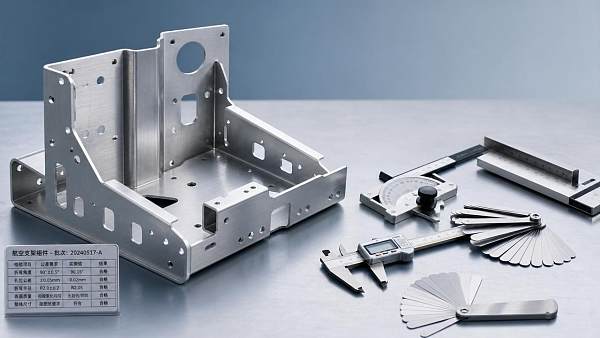
In general fabrication, some bend variation can be adjusted later during fitting or assembly. In aerospace, that margin is much smaller because parts often interface with tightly controlled structures.
Brackets, covers, clips, channels, skins, and support components may all look simple, yet they often sit inside assemblies where hole alignment, edge distance, and load paths are critical.
If a bent part is slightly off, the problem does not stay isolated. It can create stress concentration, interfere with nearby components, or force unapproved manual correction during downstream assembly.
This is one key reason sheet metal bending for aerospace demands tighter checks than automotive, consumer, or general industrial work. The consequences of variation are broader and harder to absorb.
Aerospace production also operates under strict documentation requirements. It is not enough for a part to look acceptable. Teams must often prove that process settings, material condition, and inspection records meet approved standards.
For operators, that means the bending task is tied directly to compliance. Good workmanship matters, but repeatability, traceability, and measurable conformance matter just as much.
What operators and production teams are really trying to prevent
On the shop floor, tighter checks are designed to prevent a small set of expensive failures. The first is dimensional nonconformance, especially bend angle, flange length, hole position shift, and overall profile distortion.
The second is material damage. Aerospace alloys can be sensitive to cracking, galling, marking, or thinning if bending is done with the wrong radius, poor tooling condition, or unstable forming parameters.
The third is inconsistency between supposedly identical parts. One part may pass, while the next from the same run fails because of springback variation, grain direction effects, or minor setup drift.
The fourth is undocumented process deviation. Even if a part appears usable, using the wrong tool set, incorrect tonnage approach, or outdated revision can trigger rejection during audit or customer review.
These are not theoretical issues. In aerospace environments, a rejected bend can delay assembly schedules, consume expensive material, and create extra burden for quality, engineering, and planning teams.
Which checks are usually tighter than in standard sheet metal work
Many of the same inspection categories exist in all fabrication sectors, but aerospace applies them with narrower limits and stronger discipline. Bend angle verification is one obvious example.
Operators may need to confirm first-off angle more carefully, then monitor drift through the run rather than relying only on initial setup. Springback behavior often requires active compensation and frequent validation.
Bend radius is another critical point. If the inside radius falls outside the approved range, the part may see excessive strain, reduced fatigue resistance, or mismatch against design intent.
Surface condition also receives more scrutiny. Minor scratches, tool marks, pressure lines, or coating damage that might be tolerated elsewhere can become rejection causes in aerospace applications.
Flange length and profile form are equally important. A correct angle does not guarantee a usable part if the leg length shifts due to material thickness variation or tooling setup inconsistency.
Teams also check flatness, twist, and distortion around holes or cutouts near the bend line. Features close to the bend are especially vulnerable to movement and local deformation.
Finally, documentation checks are tighter. Material certification, revision control, operator instructions, tooling identification, and inspection records are often part of the total acceptance picture.
Why aerospace materials make bending control more difficult
One major reason for tighter checks is that aerospace materials often behave less predictably than mild steel used in general fabrication. Aluminum aerospace grades can spring back noticeably and mark easily.
Stainless alloys may require more forming force and can introduce stronger elastic recovery. Titanium presents even greater sensitivity, with narrower process windows and a higher risk of cracking if mishandled.
Heat-treated or high-strength materials also limit how much forming abuse they can tolerate. The operator cannot simply force the part into shape and expect it to remain structurally acceptable.
Material lot variation matters too. Even when the nominal grade is unchanged, slight differences in temper, thickness, or surface condition can shift bending response enough to affect repeatability.
That is why experienced teams do not treat bend programs as universally fixed. They validate setup against the actual material being run and adjust based on approved process rules.
Grain direction is another practical factor. Depending on the alloy and part geometry, bending across or with the grain can influence crack risk and bend consistency.
For operators, this means tighter checks are not only about quality department requirements. They are a direct response to real material behavior that can change part performance.
How tighter checks reduce rework instead of just adding inspection burden
Operators sometimes view added checks as a slowdown. In aerospace, the opposite is often true. Early verification reduces the far greater cost of late-stage rejection and rework.
If a first-off part is confirmed thoroughly, the team catches problems before an entire batch is formed incorrectly. That protects machine time, material yield, and downstream assembly flow.
In-process checks also reveal drift before it becomes a pattern. A worn punch, slight backgauge shift, or temperature-related variation may not be obvious until several parts have already failed.
Tighter control improves communication between production and quality as well. When checks are clearly defined, operators know what matters most and inspectors evaluate against the same criteria.
This shared understanding reduces avoidable conflict. Instead of debating whether a part is “close enough,” the team works from documented tolerances, approved setups, and consistent acceptance standards.
For shops handling certified aerospace work, this discipline supports customer confidence too. Reliable control history is often as valuable as a low defect rate when demonstrating capability.
What a good aerospace bending control routine looks like on the floor
For execution teams, the best control routine starts before the first bend. Confirm the drawing revision, traveler, material identity, thickness, grain direction requirement, and any special process notes.
Next, verify tooling condition and setup. Punch radius, die opening, alignment, cleanliness, and machine calibration all influence whether the bend result will match the approved process window.
Then run a controlled first article or first-off sample. Do not only check the angle. Confirm flange dimensions, profile stability, surface condition, and any critical features affected by the bend.
If the part includes holes, slots, or edge-sensitive geometry near the bend, inspect those areas closely for pull, distortion, or crack initiation. These issues are easy to miss when checking only overall shape.
During production, use defined in-process inspection intervals. The exact frequency depends on part criticality, material behavior, lot size, and historical stability, but random checking is not enough.
Record adjustments properly. If springback compensation, tonnage approach, or gauging method is changed, the change should align with approved work instructions and quality requirements.
At completion, protect parts from handling damage. A conforming aerospace bend can still be rejected later if stacking, contact points, or packaging create scratches and edge deformation.
Where operators most often lose control of bend quality
One common mistake is relying too heavily on program memory from previous jobs. Even similar parts can respond differently if thickness, alloy temper, or bend orientation changes.
Another is focusing only on angle correction while ignoring radius and leg length. A part may appear visually correct but still fail dimensional or structural requirements after full inspection.
Tool wear is another hidden source of variation. Small changes in tool surface condition can affect marking, friction, and bend consistency long before the tooling looks obviously damaged.
Poor handling between operations also creates avoidable nonconformance. Aerospace parts with cosmetic or protective surface requirements can fail because of scratches, dents, or contamination after bending.
Measurement technique matters as well. If operators and inspectors use inconsistent reference points or gauging methods, good parts may be rejected and bad parts may pass.
Finally, rushing first-off approval is a costly habit. Many repeat failures begin with an incomplete setup verification that seemed acceptable only because production needed to move quickly.
How teams can improve consistency in sheet metal bending for aerospace
Improvement usually comes less from one dramatic change and more from tighter control across several basic practices. Standardized setup sheets are one of the strongest starting points.
When the operator has clear guidance on tooling, orientation, bend sequence, inspection points, and allowable adjustment logic, process repeatability improves significantly from shift to shift.
Training should also focus on material behavior, not just machine operation. Operators who understand why a specific alloy cracks, springs back, or marks easily make better decisions under pressure.
Cross-functional review between engineering, production, and quality is equally useful. If a part regularly causes bend issues, the team should identify whether the root cause is tooling, design, material, or method.
Measurement systems deserve attention too. Simple, repeatable gauging methods often outperform complicated routines if they are stable, documented, and understood by everyone involved.
Historical process data can also help. Tracking which combinations of alloy, thickness, radius, and tool set produce drift allows teams to anticipate risk before problems recur.
In this sense, sheet metal bending for aerospace is not only a forming task. It is a controlled process that combines machine discipline, material knowledge, and inspection reliability.
What tighter checks ultimately mean for operators
For operators, stricter aerospace checks should not be seen as extra paperwork attached to ordinary bending work. They reflect the real performance demands placed on flight-related components.
When checks are done well, they protect more than quality metrics. They protect assembly fit, structural reliability, certification confidence, and the credibility of the production team itself.
The practical takeaway is clear: tighter inspection in aerospace bending exists because the process has less room for hidden variation, cosmetic compromise, or undocumented correction than standard fabrication.
Teams that understand this usually perform better. They catch issues earlier, produce fewer disputed parts, and build a more stable process around materials and geometries that demand precision.
In the end, the reason sheet metal bending for aerospace demands tighter checks is simple. Aerospace parts must do more, tolerate less, and prove compliance more clearly than ordinary formed components.
For production personnel, that means success comes from disciplined setup, verified first-offs, controlled in-process checks, and careful handling throughout the job. Tight checks are not the obstacle. They are the method.
Get weekly intelligence in your inbox.
No noise. No sponsored content. Pure intelligence.
 Oct 08, 2026How Digital Health Improves Diagnostic Accuracy and Workflow in Clinical LabsHow Digital Health Improves Diagnostic Accuracy and Workflow in Clinical Labs
 Oct 07, 2026Selecting Voice Picking Systems for German Warehouses: Integration, Languages and ROISelecting Voice Picking Systems for German Warehouses: Integration, Languages and ROI
 Oct 06, 2026How to Choose Last Mile Dispatch Software for On-Time Delivery at ScaleHow to Choose Last Mile Dispatch Software for On-Time Delivery at Scale
 Oct 05, 2026Vietnam’s Consumer Electronics Market: Demand Shifts and Sourcing OpportunitiesVietnam’s Consumer Electronics Market: Demand Shifts and Sourcing Opportunities
 Oct 04, 2026Digital Health Investment Priorities for Providers: Improving Access, Outcomes, and EfficiencyDigital Health Investment Priorities for Providers: Improving Access, Outcomes, and Efficiency
 Oct 03, 2026How to Specify an FR4 Custom PCB Board for High-Voltage and High-Heat DesignsHow to Specify an FR4 Custom PCB Board for High-Voltage and High-Heat Designs
 Oct 02, 2026ERP Software Market Intelligence: Adoption, Pricing, and Vendor Signals to WatchERP Software Market Intelligence: Adoption, Pricing, and Vendor Signals to Watch
 Oct 01, 2026How to Select Calibrated Temperature Data Loggers for GMP Cold Storage MonitoringHow to Select Calibrated Temperature Data Loggers for GMP Cold Storage Monitoring
 Sep 30, 2026Custom Molded Rubber Pricing: What Drives Unit Cost and Tooling Fees?Custom Molded Rubber Pricing: What Drives Unit Cost and Tooling Fees?
 Sep 29, 2026How to Evaluate Energy Management Software Vendors for Multi-Site OperationsHow to Evaluate Energy Management Software Vendors for Multi-Site Operations
 Sep 28, 2026How to Select a DIN Rail Smart Meter for Multi-Circuit Energy MonitoringHow to Select a DIN Rail Smart Meter for Multi-Circuit Energy Monitoring
 Sep 27, 2026TWS Earbuds in Vietnam: Demand Drivers, Price Tiers, and Retail Channel OpportunitiesTWS Earbuds in Vietnam: Demand Drivers, Price Tiers, and Retail Channel Opportunities
 Sep 26, 2026How UAE Clinics Can Qualify a Smart Glucometer Supplier for Accuracy and ComplianceHow UAE Clinics Can Qualify a Smart Glucometer Supplier for Accuracy and Compliance
 Sep 25, 2026Buying Aesthetic Lasers in the USA: FDA Status, Wavelengths, and Service SupportBuying Aesthetic Lasers in the USA: FDA Status, Wavelengths, and Service Support
 Sep 24, 2026Laser Cutting Brass Sheet: How to Prevent Burrs and Heat Marks on Thin PartsLaser Cutting Brass Sheet: How to Prevent Burrs and Heat Marks on Thin Parts
 Sep 23, 2026How to Choose Lightweight ANC Headphones for Comfortable All-Day TravelHow to Choose Lightweight ANC Headphones for Comfortable All-Day Travel
 Sep 22, 2026IPX5 TWS Bluetooth Earbuds: What Protection Do They Offer for Workouts?IPX5 TWS Bluetooth Earbuds: What Protection Do They Offer for Workouts?
 Sep 21, 2026What to Look for in a Grid Integration Company for Utility-Scale Solar ProjectsWhat to Look for in a Grid Integration Company for Utility-Scale Solar Projects
 Sep 20, 2026Microgrid Controller Pricing: What Drives Cost in Commercial Energy Projects?Microgrid Controller Pricing: What Drives Cost in Commercial Energy Projects?
 Sep 19, 2026How to Choose a GaN Charger for Laptops Without Compromising Power or PortabilityHow to Choose a GaN Charger for Laptops Without Compromising Power or Portability
 Sep 18, 2026Floating Solar Farm Costs: CAPEX, OPEX, and the Site Factors That Shape ROIFloating Solar Farm Costs: CAPEX, OPEX, and the Site Factors That Shape ROI
 Sep 17, 2026Drone Delivery Solutions for Last-Mile Routes: Site, Payload, and Range PlanningDrone Delivery Solutions for Last-Mile Routes: Site, Payload, and Range Planning
 Sep 16, 2026When Low-Volume Electronics Manufacturing Makes More Sense Than Mass ProductionWhen Low-Volume Electronics Manufacturing Makes More Sense Than Mass Production
 Sep 15, 2026Wholesale WiFi Smart Switches: What Buyers Should Verify Before OrderingWholesale WiFi Smart Switches: What Buyers Should Verify Before Ordering
 Sep 14, 2026How to Select IoT Sensors for Reliable Monitoring in Harsh Industrial EnvironmentsHow to Select IoT Sensors for Reliable Monitoring in Harsh Industrial Environments
 Sep 13, 2026How Procurement Teams Can Improve Supplier Reliability With Supply Chain VisibilityHow Procurement Teams Can Improve Supplier Reliability With Supply Chain Visibility
 Sep 12, 2026Smart Manufacturing Trends 2026: What Leaders Should Prioritize for ROISmart Manufacturing Trends 2026: What Leaders Should Prioritize for ROI



























