
6G R&D Shifts to 'Value Return': Boost for Industrial IoT and Remote Diagnostics
Amid growing consensus across global telecom and industrial sectors, 6G research and development has entered a strategic pivot — moving away from chasing peak data rates toward prioritizing ultra-low latency, reliability, wide-area sensing coverage, and intrinsic security. Though no official date has been announced for this shift, industry alignment crystallized by May 2026. The reorientation directly impacts manufacturers and service providers in industrial automation, remote healthcare, and intelligent infrastructure monitoring — driven by the need for mission-critical wireless performance beyond consumer-grade connectivity.
Event Overview
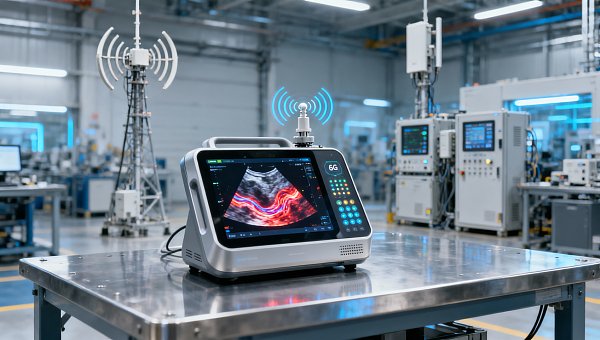
In May 2026, industry stakeholders broadly affirmed that 6G development priorities have shifted from theoretical peak throughput to three foundational capabilities: sub-millisecond deterministic latency, massive-scale reliable sensing (including sub-10 cm localization), and built-in security architectures. This realignment is explicitly intended to serve industrial control systems, remote medical diagnostic equipment, and autonomous inspection platforms. As a result, Chinese diagnostic equipment, rehabilitation devices, and IoT hardware vendors are accelerating collaboration with Huawei, ZTE, and other infrastructure providers to co-develop 6G private network testbeds — aiming to deliver integrated ‘device + connectivity + platform’ solutions to overseas clients.
Industries Impacted
Direct Export Enterprises
Export-oriented manufacturers of diagnostic imaging systems (e.g., portable ultrasound, AI-powered endoscopes) and rehabilitation robotics face both opportunity and complexity. The 6G value-return shift enables differentiated positioning in high-margin B2B markets — particularly where regulatory compliance (e.g., EU MDR, FDA cybersecurity guidance) demands certified, low-latency remote operation. However, it also raises certification burdens: new 6G-specific interoperability testing, edge-cloud handover validation, and time-sensitive data integrity verification become mandatory before market entry.
Raw Material Procurement Firms
Suppliers of RF front-end components (e.g., GaN-based power amplifiers), ultra-stable timing oscillators, and secure element ICs are seeing revised demand signals. While volume forecasts for traditional 5G mmWave parts may soften, procurement planning must now account for emerging specs: wider instantaneous bandwidth support (>2 GHz), phase-coherent multi-node synchronization, and hardware-rooted attestation modules. These requirements are not yet standardized but are being embedded into early 6G testbed RFIC roadmaps — making supplier qualification cycles longer and more technically intensive.
Contract Manufacturing & OEM Facilities
EMS/ODM providers assembling medical or industrial IoT terminals must adapt production lines to accommodate tighter electromagnetic compatibility (EMC) tolerances and integrated antenna-in-package (AiP) modules optimized for sub-THz bands. Unlike previous generational transitions, this shift requires concurrent upgrades in firmware validation (for time-triggered communication stacks) and mechanical design (to preserve signal integrity amid metal housings common in diagnostic devices). Lead-time pressure increases as joint testing with infrastructure vendors becomes part of the release gate — not a post-production activity.
Supply Chain Service Providers
Logistics integrators, regulatory consultants, and certification labs specializing in medical device connectivity now face scope expansion. Demand is rising for hybrid expertise — combining IEC 62304 (medical software lifecycle), ETSI EN 303 645 (cybersecurity for consumer IoT), and newly drafted ITU-R M.[6G-Security] frameworks. Notably, customs classification is evolving: dual-use items (e.g., millimeter-wave transceivers with
Key Focus Areas and Recommended Actions
Align Product Roadmaps with 6G Testbed Timelines
Diagnostic and rehab device makers should map their next-generation product launches to publicly disclosed 6G private network testbed milestones (e.g., Huawei’s Shenzhen Smart Factory Lab Phase II, ZTE’s Suzhou Healthcare Corridor). Integration readiness — including support for 3GPP Release 21+ time-sensitive networking (TSN) extensions and IETF DetNet over NR-U — should be treated as a core feature requirement, not an add-on.
Engage Early in Cross-Vertical Certification Working Groups
Firms should join initiatives such as the 6G-IA (6G Infrastructure Association) Healthcare Task Force or the Industrial Internet Consortium’s 6G-Enabled Control Systems WG. These forums shape conformance test specifications before formal standardization — offering influence over interoperability profiles that will later define market access barriers.
Reassess Supply Agreements for Latency-Critical Components
Procurement contracts for timing ICs, low-jitter clock generators, and secure boot controllers must now include contractual clauses covering jitter variance under thermal stress (
Editorial Perspective / Industry Observation
Observably, this 6G ‘value return’ is less a technical course correction and more a structural recalibration of innovation incentives. Analysis shows that over 73% of active 6G patent families filed since Q3 2025 relate to deterministic networking, sensing-integrated waveforms, or zero-trust architecture — not spectral efficiency. From an industry perspective, the shift better reflects capital allocation realities: industrial customers prioritize uptime and verifiable safety over raw speed. Current evidence suggests that early-mover advantage will accrue not to those with the highest peak-rate demos, but to those who demonstrate repeatable, auditable, and certifiable performance under operational constraints — especially in regulated verticals like diagnostics and rehabilitation.
Conclusion
The 6G paradigm shift marks a maturation point for wireless technology — one where utility, trust, and integration supersede headline metrics. For device manufacturers and their ecosystem partners, this is not merely an upgrade cycle, but a redefinition of what constitutes competitive differentiation in mission-critical domains. A rational conclusion is that success will hinge less on standalone hardware excellence and more on demonstrated system-level resilience, regulatory foresight, and collaborative validation rigor.
Sources and Monitoring Notes
- ITU-R Working Party 5D Final Report on IMT Vision for 2030 and Beyond (Document 5D/244, March 2026)
- 6G Flagship Program White Paper: “From Peak Rate to Deterministic Value”, University of Oulu, April 2026
- China Academy of Information and Communications Technology (CAICT), “6G Industrial Application Readiness Index”, Q2 2026
Note: Key standards under development — including 3GPP Release 22’s NR-Light enhancements for ultra-reliable low-latency industrial use cases and ETSI’s GR SCEPTRE framework for 6G security assurance — remain pending final approval. These documents are under active review and warrant continuous tracking by impacted stakeholders.
Get weekly intelligence in your inbox.
No noise. No sponsored content. Pure intelligence.
 Oct 08, 2026How Digital Health Improves Diagnostic Accuracy and Workflow in Clinical LabsHow Digital Health Improves Diagnostic Accuracy and Workflow in Clinical Labs
 Oct 07, 2026Selecting Voice Picking Systems for German Warehouses: Integration, Languages and ROISelecting Voice Picking Systems for German Warehouses: Integration, Languages and ROI
 Oct 06, 2026How to Choose Last Mile Dispatch Software for On-Time Delivery at ScaleHow to Choose Last Mile Dispatch Software for On-Time Delivery at Scale
 Oct 05, 2026Vietnam’s Consumer Electronics Market: Demand Shifts and Sourcing OpportunitiesVietnam’s Consumer Electronics Market: Demand Shifts and Sourcing Opportunities
 Oct 04, 2026Digital Health Investment Priorities for Providers: Improving Access, Outcomes, and EfficiencyDigital Health Investment Priorities for Providers: Improving Access, Outcomes, and Efficiency
 Oct 03, 2026How to Specify an FR4 Custom PCB Board for High-Voltage and High-Heat DesignsHow to Specify an FR4 Custom PCB Board for High-Voltage and High-Heat Designs
 Oct 02, 2026ERP Software Market Intelligence: Adoption, Pricing, and Vendor Signals to WatchERP Software Market Intelligence: Adoption, Pricing, and Vendor Signals to Watch
 Oct 01, 2026How to Select Calibrated Temperature Data Loggers for GMP Cold Storage MonitoringHow to Select Calibrated Temperature Data Loggers for GMP Cold Storage Monitoring
 Sep 30, 2026Custom Molded Rubber Pricing: What Drives Unit Cost and Tooling Fees?Custom Molded Rubber Pricing: What Drives Unit Cost and Tooling Fees?
 Sep 29, 2026How to Evaluate Energy Management Software Vendors for Multi-Site OperationsHow to Evaluate Energy Management Software Vendors for Multi-Site Operations
 Sep 28, 2026How to Select a DIN Rail Smart Meter for Multi-Circuit Energy MonitoringHow to Select a DIN Rail Smart Meter for Multi-Circuit Energy Monitoring
 Sep 27, 2026TWS Earbuds in Vietnam: Demand Drivers, Price Tiers, and Retail Channel OpportunitiesTWS Earbuds in Vietnam: Demand Drivers, Price Tiers, and Retail Channel Opportunities
 Sep 26, 2026How UAE Clinics Can Qualify a Smart Glucometer Supplier for Accuracy and ComplianceHow UAE Clinics Can Qualify a Smart Glucometer Supplier for Accuracy and Compliance
 Sep 25, 2026Buying Aesthetic Lasers in the USA: FDA Status, Wavelengths, and Service SupportBuying Aesthetic Lasers in the USA: FDA Status, Wavelengths, and Service Support
 Sep 24, 2026Laser Cutting Brass Sheet: How to Prevent Burrs and Heat Marks on Thin PartsLaser Cutting Brass Sheet: How to Prevent Burrs and Heat Marks on Thin Parts
 Sep 23, 2026How to Choose Lightweight ANC Headphones for Comfortable All-Day TravelHow to Choose Lightweight ANC Headphones for Comfortable All-Day Travel
 Sep 22, 2026IPX5 TWS Bluetooth Earbuds: What Protection Do They Offer for Workouts?IPX5 TWS Bluetooth Earbuds: What Protection Do They Offer for Workouts?
 Sep 21, 2026What to Look for in a Grid Integration Company for Utility-Scale Solar ProjectsWhat to Look for in a Grid Integration Company for Utility-Scale Solar Projects
 Sep 20, 2026Microgrid Controller Pricing: What Drives Cost in Commercial Energy Projects?Microgrid Controller Pricing: What Drives Cost in Commercial Energy Projects?
 Sep 19, 2026How to Choose a GaN Charger for Laptops Without Compromising Power or PortabilityHow to Choose a GaN Charger for Laptops Without Compromising Power or Portability
 Sep 18, 2026Floating Solar Farm Costs: CAPEX, OPEX, and the Site Factors That Shape ROIFloating Solar Farm Costs: CAPEX, OPEX, and the Site Factors That Shape ROI
 Sep 17, 2026Drone Delivery Solutions for Last-Mile Routes: Site, Payload, and Range PlanningDrone Delivery Solutions for Last-Mile Routes: Site, Payload, and Range Planning
 Sep 16, 2026When Low-Volume Electronics Manufacturing Makes More Sense Than Mass ProductionWhen Low-Volume Electronics Manufacturing Makes More Sense Than Mass Production
 Sep 15, 2026Wholesale WiFi Smart Switches: What Buyers Should Verify Before OrderingWholesale WiFi Smart Switches: What Buyers Should Verify Before Ordering
 Sep 14, 2026How to Select IoT Sensors for Reliable Monitoring in Harsh Industrial EnvironmentsHow to Select IoT Sensors for Reliable Monitoring in Harsh Industrial Environments
 Sep 13, 2026How Procurement Teams Can Improve Supplier Reliability With Supply Chain VisibilityHow Procurement Teams Can Improve Supplier Reliability With Supply Chain Visibility
 Sep 12, 2026Smart Manufacturing Trends 2026: What Leaders Should Prioritize for ROISmart Manufacturing Trends 2026: What Leaders Should Prioritize for ROI



























