
China Releases AI Terminal Intelligence Grading Standard
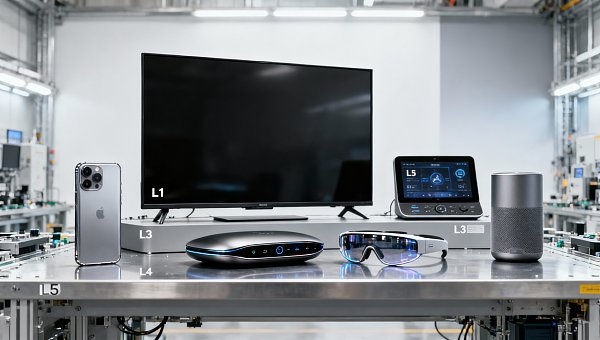
On May 8, 2026, China’s Ministry of Industry and Information Technology (MIIT) and other authorities jointly issued the national guideline Grading of Artificial Intelligence Capabilities for Terminals (GB/Z 177—2026), establishing L1–L5 intelligence levels for AI-enabled devices including smartphones, smart TVs, automotive cockpits, AR glasses, and smart speakers. This standard mandates labeling at point of manufacture and directly affects export readiness for Chinese-made IoT devices, smart home products, and electronic component modules — particularly in markets where EU CE and US FCC conformity assessments may now reference this grading framework. Export-oriented manufacturers, component suppliers, and certification service providers in the intelligent hardware supply chain should take note.
Event Overview
On May 8, 2026, MIIT and co-issuing agencies published GB/Z 177—2026, titled Grading of Artificial Intelligence Capabilities for Terminals. The document defines five standardized intelligence levels (L1 to L5) applicable to AI terminals such as mobile phones, televisions, vehicle infotainment systems, augmented reality eyewear, and voice-controlled speakers. It requires that all covered devices indicate their certified intelligence level at time of出厂 (manufacturing release). No further implementation timelines, enforcement mechanisms, or transitional provisions have been publicly disclosed as of the release date.
Industries Affected
Direct Exporters of Smart Hardware
Exporters of IoT devices, smart home appliances, and embedded electronic modules face new technical documentation and labeling obligations before shipment. Since the standard is expected to be cited by EU CE and US FCC authorities in future technical evaluations, non-compliant products may encounter delays or rejections during market access procedures — especially where AI functionality is declared or advertised.
Electronic Component and Module Suppliers
Suppliers of AI-accelerating chips, sensor fusion modules, and edge inference SoCs may see revised procurement specifications from OEMs. Device-level L1–L5 grading depends on underlying hardware capabilities (e.g., on-device model size, latency, multimodal input support); thus, module-level performance metrics may need alignment with terminal-level grading criteria.
Contract Manufacturers and ODMs
Manufacturers producing AI terminals for global brands must now integrate intelligence-level verification into quality control workflows. As labeling is required at manufacturing release, production lines may need updated test protocols, firmware versioning logic, and traceability systems to ensure correct L-level attribution per unit or batch.
Supply Chain Certification and Compliance Service Providers
Third-party testing labs and certification bodies will likely begin developing assessment methodologies aligned with GB/Z 177—2026. While the standard is currently a guidance document (GB/Z), its adoption as a de facto benchmark for international regulators implies growing demand for accredited L-level validation services — particularly for cross-border clients targeting EU or North American markets.
What Enterprises and Practitioners Should Focus On Now
Monitor official updates on enforcement scope and transition arrangements
The standard is published as a GB/Z (guideline), not a mandatory GB (national standard). Enterprises should track whether MIIT or SAMR issues supplementary notices specifying which product categories fall under mandatory compliance, effective dates, or conformity assessment pathways.
Identify high-risk product categories and target markets
Smartphones, automotive cockpit systems, and AR glasses are explicitly named in the standard and carry higher regulatory visibility. Firms exporting these items to the EU or U.S. should prioritize internal gap analysis — especially where AI features (e.g., real-time translation, gesture recognition, autonomous scene understanding) are central to marketing claims.
Distinguish between policy signaling and operational impact
While EU CE and US FCC have not formally adopted GB/Z 177—2026, observably, both frameworks are increasingly incorporating AI-specific evaluation elements (e.g., EU AI Act’s requirements for transparency and human oversight). This standard serves more as an early signal of technical harmonization direction than an immediate import barrier — but one requiring proactive alignment planning.
Prepare internal documentation and labeling workflows
Manufacturers should review current product datasheets, firmware build processes, and packaging templates to assess readiness for L-level labeling. Where AI capabilities vary across software versions or regional SKUs, traceability systems must support accurate, version-aware L-level assignment — ahead of any formal rollout.
Editorial Perspective / Industry Observation
Analysis shows this standard functions primarily as a technical coordination mechanism — not a standalone regulatory instrument. Its significance lies less in immediate enforceability and more in its potential to anchor AI capability definitions across China’s hardware ecosystem and influence downstream conformity practices abroad. Observably, it reflects a strategic shift: from regulating AI applications at the service layer (e.g., generative AI content rules) toward standardizing intelligence attributes at the device layer. From an industry perspective, this marks the beginning of a broader effort to embed verifiable AI performance metrics into physical product specifications — a trend likely to accelerate as global AI governance matures. Current implementation remains voluntary, but its inclusion in international technical assessments would substantially raise its practical weight.
Conclusion: GB/Z 177—2026 does not yet constitute a binding export requirement, but it introduces a structured, tiered framework for evaluating AI capabilities in consumer and industrial terminals. Its value lies in standardizing terminology, enabling comparative benchmarking, and preparing stakeholders for tighter integration between domestic technical guidelines and international conformity regimes. For now, it is best understood as a forward-looking alignment tool — one that signals evolving expectations rather than imposing immediate compliance obligations.
Source: Official announcement by the Ministry of Industry and Information Technology (MIIT) and co-issuing agencies, released May 8, 2026; standard designation GB/Z 177—2026.
Noted for ongoing observation: Whether the standard transitions from GB/Z (guideline) to mandatory GB status, and whether EU Notified Bodies or FCC-recognized labs formally reference it in technical assessment reports.
Get weekly intelligence in your inbox.
No noise. No sponsored content. Pure intelligence.
 Oct 08, 2026How Digital Health Improves Diagnostic Accuracy and Workflow in Clinical LabsHow Digital Health Improves Diagnostic Accuracy and Workflow in Clinical Labs
 Oct 07, 2026Selecting Voice Picking Systems for German Warehouses: Integration, Languages and ROISelecting Voice Picking Systems for German Warehouses: Integration, Languages and ROI
 Oct 06, 2026How to Choose Last Mile Dispatch Software for On-Time Delivery at ScaleHow to Choose Last Mile Dispatch Software for On-Time Delivery at Scale
 Oct 05, 2026Vietnam’s Consumer Electronics Market: Demand Shifts and Sourcing OpportunitiesVietnam’s Consumer Electronics Market: Demand Shifts and Sourcing Opportunities
 Oct 04, 2026Digital Health Investment Priorities for Providers: Improving Access, Outcomes, and EfficiencyDigital Health Investment Priorities for Providers: Improving Access, Outcomes, and Efficiency
 Oct 03, 2026How to Specify an FR4 Custom PCB Board for High-Voltage and High-Heat DesignsHow to Specify an FR4 Custom PCB Board for High-Voltage and High-Heat Designs
 Oct 02, 2026ERP Software Market Intelligence: Adoption, Pricing, and Vendor Signals to WatchERP Software Market Intelligence: Adoption, Pricing, and Vendor Signals to Watch
 Oct 01, 2026How to Select Calibrated Temperature Data Loggers for GMP Cold Storage MonitoringHow to Select Calibrated Temperature Data Loggers for GMP Cold Storage Monitoring
 Sep 30, 2026Custom Molded Rubber Pricing: What Drives Unit Cost and Tooling Fees?Custom Molded Rubber Pricing: What Drives Unit Cost and Tooling Fees?
 Sep 29, 2026How to Evaluate Energy Management Software Vendors for Multi-Site OperationsHow to Evaluate Energy Management Software Vendors for Multi-Site Operations
 Sep 28, 2026How to Select a DIN Rail Smart Meter for Multi-Circuit Energy MonitoringHow to Select a DIN Rail Smart Meter for Multi-Circuit Energy Monitoring
 Sep 27, 2026TWS Earbuds in Vietnam: Demand Drivers, Price Tiers, and Retail Channel OpportunitiesTWS Earbuds in Vietnam: Demand Drivers, Price Tiers, and Retail Channel Opportunities
 Sep 26, 2026How UAE Clinics Can Qualify a Smart Glucometer Supplier for Accuracy and ComplianceHow UAE Clinics Can Qualify a Smart Glucometer Supplier for Accuracy and Compliance
 Sep 25, 2026Buying Aesthetic Lasers in the USA: FDA Status, Wavelengths, and Service SupportBuying Aesthetic Lasers in the USA: FDA Status, Wavelengths, and Service Support
 Sep 24, 2026Laser Cutting Brass Sheet: How to Prevent Burrs and Heat Marks on Thin PartsLaser Cutting Brass Sheet: How to Prevent Burrs and Heat Marks on Thin Parts
 Sep 23, 2026How to Choose Lightweight ANC Headphones for Comfortable All-Day TravelHow to Choose Lightweight ANC Headphones for Comfortable All-Day Travel
 Sep 22, 2026IPX5 TWS Bluetooth Earbuds: What Protection Do They Offer for Workouts?IPX5 TWS Bluetooth Earbuds: What Protection Do They Offer for Workouts?
 Sep 21, 2026What to Look for in a Grid Integration Company for Utility-Scale Solar ProjectsWhat to Look for in a Grid Integration Company for Utility-Scale Solar Projects
 Sep 20, 2026Microgrid Controller Pricing: What Drives Cost in Commercial Energy Projects?Microgrid Controller Pricing: What Drives Cost in Commercial Energy Projects?
 Sep 19, 2026How to Choose a GaN Charger for Laptops Without Compromising Power or PortabilityHow to Choose a GaN Charger for Laptops Without Compromising Power or Portability
 Sep 18, 2026Floating Solar Farm Costs: CAPEX, OPEX, and the Site Factors That Shape ROIFloating Solar Farm Costs: CAPEX, OPEX, and the Site Factors That Shape ROI
 Sep 17, 2026Drone Delivery Solutions for Last-Mile Routes: Site, Payload, and Range PlanningDrone Delivery Solutions for Last-Mile Routes: Site, Payload, and Range Planning
 Sep 16, 2026When Low-Volume Electronics Manufacturing Makes More Sense Than Mass ProductionWhen Low-Volume Electronics Manufacturing Makes More Sense Than Mass Production
 Sep 15, 2026Wholesale WiFi Smart Switches: What Buyers Should Verify Before OrderingWholesale WiFi Smart Switches: What Buyers Should Verify Before Ordering
 Sep 14, 2026How to Select IoT Sensors for Reliable Monitoring in Harsh Industrial EnvironmentsHow to Select IoT Sensors for Reliable Monitoring in Harsh Industrial Environments
 Sep 13, 2026How Procurement Teams Can Improve Supplier Reliability With Supply Chain VisibilityHow Procurement Teams Can Improve Supplier Reliability With Supply Chain Visibility
 Sep 12, 2026Smart Manufacturing Trends 2026: What Leaders Should Prioritize for ROISmart Manufacturing Trends 2026: What Leaders Should Prioritize for ROI



























