Steel Forging for Automotive Parts: When It Outperforms Casting and Machining
Steel Forging for Automotive Parts: When It Outperforms Casting and Machining
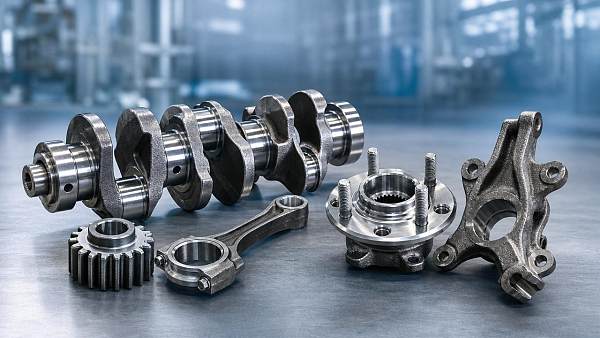
For procurement teams, the choice between forging, casting, and machining is rarely just technical. It directly affects part life, warranty risk, lead time, and total landed cost.
In many vehicle programs, steel forging for automotive parts stands out when strength, impact resistance, and fatigue performance matter more than simple shape complexity.
That is especially true for steering, drivetrain, suspension, axle, and powertrain components working under repeated loads and harsh road conditions.
Casting can reduce material waste in complex geometries. Machining can deliver tight dimensions for lower volumes. But neither always matches forged steel in structural reliability.
In real sourcing decisions, the better question is not which process is cheaper per piece. It is which process creates the lowest risk-adjusted cost over program life.
Why steel forging for automotive parts performs differently
The main advantage comes from grain flow. During forging, metal deforms under pressure and aligns its internal structure with the part shape.
This usually improves toughness and fatigue strength compared with cast parts, where porosity, shrinkage, or internal defects may appear more easily.
Compared with fully machined parts from bar stock, steel forging for automotive parts often keeps better material continuity while reducing unnecessary stock removal.
That also means forged parts can achieve strong mechanical performance without carrying excess weight, which matters in vehicle efficiency targets.
- Higher impact resistance in safety-critical applications
- Better fatigue life under cyclic loading
- More consistent strength across batches
- Lower risk of hidden internal discontinuities
- Good balance between durability and material efficiency
These benefits are not theoretical. They show up in service intervals, field failure rates, and downstream machining consistency.
When forging beats casting
Casting works well for complex shapes, internal channels, and parts where ultimate strength is not the top priority.
However, steel forging for automotive parts usually wins when the part sees shock loads, repeated stress, or strict safety demands.
Think of connecting rods, gear blanks, crankshafts, wheel hubs, spindle components, and heavy-duty brackets.
In these cases, the hidden cost of casting is not always unit price. It can be scrap, testing intensity, failure investigation, and reputation damage.
Forging is often the stronger choice when
- The part carries high dynamic loads
- Fatigue cracks would create safety or recall exposure
- The design requires high toughness at lower temperatures
- Dimensional stability after heat treatment matters
- Long service life is valued over minimum upfront price
From a cost-control view, this matters because quality escapes in structural parts are far more expensive than modest savings on raw production.
When forging beats machining
Machining from rolled bar or billet offers flexibility. It is useful for prototypes, low-volume orders, and parts requiring frequent design changes.
But when annual volumes rise, machining-only routes often become less efficient in both material use and cycle time.
Steel forging for automotive parts can lower raw material waste by bringing the blank closer to final shape before finishing operations begin.
That reduces cutting time, tool wear, chip loss, and machine occupancy. Across large programs, those savings become significant.
So the break-even point depends on program duration, annual demand, and how much finish machining remains after forging.
Key cost drivers buyers should compare
A narrow piece-price comparison can mislead sourcing teams. Total cost must include process yield, tooling life, inspection burden, and field reliability.
When evaluating steel forging for automotive parts, five cost drivers usually deserve the closest attention.
- Raw material utilization and scrap rate
- Tooling amortization over forecast volume
- Secondary machining time and fixture complexity
- Heat treatment, testing, and certification cost
- Warranty exposure and replacement risk
In actual business, the fourth and fifth items are often underestimated. A cheaper process that needs heavier inspection is not always cheaper.
The same goes for a part that meets drawings but performs inconsistently in long-term fatigue testing.
Supplier questions that improve sourcing decisions
Supplier selection is where many cost assumptions become real. Steel forging for automotive parts only delivers value when process control is stable.
A capable supplier should explain not just capacity, but also die design logic, material traceability, and post-forging quality systems.
Useful questions during supplier review
- What steel grades are routinely forged for similar automotive applications?
- How is grain flow validated for critical geometries?
- Which NDT methods are used and at what frequency?
- What are the typical Cp and Cpk levels on key dimensions?
- How are die wear and dimensional drift managed over production runs?
- Can the supplier support PPAP, traceability, and audit documentation?
These questions help separate true forging capability from simple price competition. That difference becomes critical in long-running global programs.
Typical automotive parts where forging creates value
Not every component needs forging. The process brings the strongest return in parts where failure consequences are high and duty cycles are demanding.
Common examples of steel forging for automotive parts include:
- Connecting rods and crankshaft sections
- Steering knuckles and suspension arms
- Transmission gears and gear blanks
- Axle shafts, flanges, and wheel hubs
- Heavy-load brackets and chassis connectors
A more visible signal in the market is the push for lighter, stronger, and longer-life components. That trend supports forged solutions in many platforms.
How to decide if steel forging for automotive parts is the right sourcing move
A practical decision framework can keep the choice objective. Start with performance demands, then move to volume economics and supplier capability.
- Define load case, fatigue target, and safety importance
- Compare forging, casting, and machining on total cost
- Estimate tooling payback across the full program lifecycle
- Review quality control depth, not just quoted tolerance
- Audit supply resilience, traceability, and capacity stability
If the part is structurally critical, medium to high volume, and exposed to repeated stress, forging often becomes the smarter sourcing path.
If geometry is highly complex, demand is low, or design changes remain frequent, casting or machining may still be more practical.
The best decisions usually come from matching process strengths to business risk, not from chasing the lowest visible quote.
For teams comparing long-term cost, performance, and supply reliability, steel forging for automotive parts deserves serious consideration whenever durability and consistency drive program success.
Get weekly intelligence in your inbox.
No noise. No sponsored content. Pure intelligence.
 Sep 15, 2026Wholesale WiFi Smart Switches: What Buyers Should Verify Before OrderingWholesale WiFi Smart Switches: What Buyers Should Verify Before Ordering
 Sep 14, 2026How to Select IoT Sensors for Reliable Monitoring in Harsh Industrial EnvironmentsHow to Select IoT Sensors for Reliable Monitoring in Harsh Industrial Environments
 Sep 13, 2026How Procurement Teams Can Improve Supplier Reliability With Supply Chain VisibilityHow Procurement Teams Can Improve Supplier Reliability With Supply Chain Visibility
 Sep 12, 2026Smart Manufacturing Trends 2026: What Leaders Should Prioritize for ROISmart Manufacturing Trends 2026: What Leaders Should Prioritize for ROI
 Sep 11, 2026B2B Market Analysis: How Buyers Evaluate Suppliers, Pricing, and Delivery RiskB2B Market Analysis: How Buyers Evaluate Suppliers, Pricing, and Delivery Risk
 Sep 10, 2026Residential Solar Kits in Canada: How to Size a System for Your Home and ClimateResidential Solar Kits in Canada: How to Size a System for Your Home and Climate
 Sep 09, 2026How to Specify a Syringe Assembly Line for High-Volume Sterile ProductionHow to Specify a Syringe Assembly Line for High-Volume Sterile Production
 Sep 08, 2026How to Evaluate Warehouse Robotics System Suppliers for Reliable Multi-Site DeploymentHow to Evaluate Warehouse Robotics System Suppliers for Reliable Multi-Site Deployment
 Sep 07, 2026Renewable Geothermal Energy Explained: How It Works for Heating and PowerRenewable Geothermal Energy Explained: How It Works for Heating and Power
 Sep 07, 2026How to Choose an Industrial Packaging Robot Manufacturer for Your Production LineHow to Choose an Industrial Packaging Robot Manufacturer for Your Production Line
 Sep 05, 2026How to Evaluate a Turnkey Hydro Turbine Generator Supplier for Remote Power ProjectsHow to Evaluate a Turnkey Hydro Turbine Generator Supplier for Remote Power Projects
 Sep 04, 2026Automated Ultrasonic Welding for Thermoplastic Assemblies: Process Controls That MatterAutomated Ultrasonic Welding for Thermoplastic Assemblies: Process Controls That Matter
 Sep 03, 2026Energy Forecasting for Grid Planning: Sizing Solar and Storage CapacityEnergy Forecasting for Grid Planning: Sizing Solar and Storage Capacity
 Sep 02, 2026Which Metrics Should an Energy Analytics Dashboard Track for Factory Energy Management?Which Metrics Should an Energy Analytics Dashboard Track for Factory Energy Management?
 Sep 01, 2026How Warehouse Voice Picking Improves Accuracy and Throughput in Order FulfillmentHow Warehouse Voice Picking Improves Accuracy and Throughput in Order Fulfillment
 Aug 31, 2026How to Automate Dropshipping Order Processing Without Overselling StockHow to Automate Dropshipping Order Processing Without Overselling Stock
 Aug 30, 2026How to Evaluate a Smart Lighting Supplier for Multi-Site Commercial ProjectsHow to Evaluate a Smart Lighting Supplier for Multi-Site Commercial Projects
 Aug 29, 2026Recent Advances in Smart Manufacturing and Materials Reshaping Factory InvestmentRecent Advances in Smart Manufacturing and Materials Reshaping Factory Investment
 Aug 29, 2026Selecting Lightweight Aluminum Extrusions for Strength-Critical Industrial DesignsSelecting Lightweight Aluminum Extrusions for Strength-Critical Industrial Designs
 Aug 29, 2026Vertical Powder Anodizing Explained: Process Controls for Uniform Coating QualityVertical Powder Anodizing Explained: Process Controls for Uniform Coating Quality
 Aug 29, 2026PV Module Product Due Diligence: What Buyers Should Verify Before ContractingPV Module Product Due Diligence: What Buyers Should Verify Before Contracting
 Aug 29, 2026Solar Design for Challenging Terrain: Managing Slope, Soil, and Shading RisksSolar Design for Challenging Terrain: Managing Slope, Soil, and Shading Risks
 Aug 29, 2026IS 16444 Smart Meter Requirements: Key Functions, Tests, and ComplianceIS 16444 Smart Meter Requirements: Key Functions, Tests, and Compliance
 Aug 29, 2026Rehabilitation Equipment Market Outlook: Demand Drivers and Growth SegmentsRehabilitation Equipment Market Outlook: Demand Drivers and Growth Segments
 Aug 29, 2026When Does Container Handling Automation Deliver ROI in Port Yard Operations?When Does Container Handling Automation Deliver ROI in Port Yard Operations?
 Aug 29, 2026Customs API Integration: A Practical Checklist for Automated Trade ComplianceCustoms API Integration: A Practical Checklist for Automated Trade Compliance
 Aug 29, 2026Returnable Packaging for Automotive: How to Cut Damage and Reverse Logistics CostsReturnable Packaging for Automotive: How to Cut Damage and Reverse Logistics Costs