
EU EN 1175:2025 Electrical Safety Standard Enters Force on May 31, 2026
The European Union’s updated electrical safety standard for industrial trucks—EN 1175:2025—will become mandatory on May 31, 2026. This regulation directly affects manufacturers, exporters, and integrators of electrically powered industrial vehicles operating in or supplying the EU market. Its enforcement marks a significant tightening of functional safety requirements, with implications spanning technical compliance, certification pathways, and supply chain readiness.
Event Overview
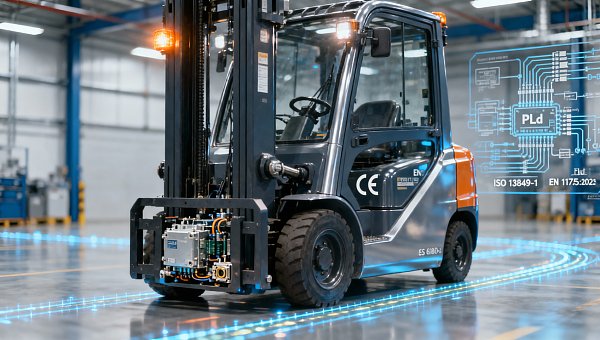
EN 1175:2025 replaces the previous edition and fully enters into force on May 31, 2026. It strengthens electrical protection and functional safety requirements for industrial vehicles—including counterbalanced forklifts, pallet trucks, automated guided vehicles (AGVs), and autonomous mobile robots (AMRs)—and explicitly aligns with EN ISO 13849-1:2023 for safety-related parts of control systems. Compliance must be verified by EU-recognized Notified Bodies such as TÜV Rheinland or SGS.
Industries Affected
Direct Exporters and Trading Companies
Companies exporting industrial vehicles or integrated smart warehouse systems from China to the EU will face immediate market access barriers if their products lack valid EN 1175:2025 certification. Non-compliant units may be rejected at customs or withdrawn post-import, triggering contractual penalties, warranty liabilities, and reputational damage—particularly for turnkey system providers delivering full automation packages.
Raw Material and Component Suppliers
Suppliers of electrical subsystems—including battery management systems, motor controllers, safety PLCs, and emergency stop interfaces—must ensure their components meet the new architecture-level safety validation criteria. Under EN 1175:2025, component-level conformity alone is insufficient; integration into the vehicle’s overall safety function must be verified. This shifts responsibility upstream and increases demand for pre-certified, safety-rated modules.
Manufacturers and System Integrators
Manufacturers of forklifts, AGVs, and AMRs must revise electrical schematics, conduct new risk assessments per ISO 12100, and implement safety validation protocols aligned with EN ISO 13849-1:2023 (e.g., PLd/PLe performance levels, diagnostic coverage, MTTFd calculations). Retrospective redesigns are not required for legacy units already placed on the market before May 31, 2026—but all new type approvals and serial production after that date must comply.
Supply Chain Service Providers
Certification consultants, testing laboratories, and technical documentation agencies are seeing rising demand for EN 1175:2025 gap analysis, safety file preparation, and Notified Body liaison support. Lead times for full certification have extended to 4–6 months in some cases, underscoring the need for early engagement. Logistics and compliance verification platforms must also update their regulatory rule sets to flag non-conforming SKUs ahead of shipment.
Key Focus Areas and Recommended Actions
Verify Current Certification Status Against the New Standard
Organizations should audit existing EN 1175:2013 certifications to determine whether they cover the scope and safety architecture now mandated under EN 1175:2025. A formal gap assessment—especially regarding electrical isolation, fault reaction time, and safe torque off (STO) implementation—is strongly advised before initiating re-certification.
Prioritize Integration-Level Testing Over Component-Only Validation
Because EN 1175:2025 emphasizes system-level functional safety, companies should shift testing focus from individual component certifications (e.g., CE-marked drives) to full vehicle behavior under fault conditions—including simultaneous failure scenarios and electromagnetic compatibility (EMC) resilience during safety-function activation.
Engage EU-Recognized Notified Bodies Early
TÜV Rheinland, SGS, and DEKRA report increasing application volumes for EN 1175:2025. Early engagement—ideally by Q3 2025—allows time for iterative design feedback, documentation review cycles, and alignment with the Notified Body’s interpretation of Annex A (informative guidance on software safety and diagnostics).
Editorial Perspective / Industry Observation
Analysis shows that EN 1175:2025 is less a standalone update and more a strategic harmonization step within the EU’s broader Machinery Regulation (EU) 2023/1230 framework. Observably, its timing coincides with rapid growth in AI-driven warehouse robotics—suggesting regulators are proactively closing safety gaps before autonomy scales. From an industry perspective, this standard signals a structural shift: safety compliance is no longer a final-stage certification hurdle but a foundational design requirement embedded from concept phase onward. Current more critical than certification timing is the capacity of Chinese engineering teams to interpret and implement safety integrity requirements without over-reliance on external consultants—a capability gap still evident in mid-tier OEMs.
Conclusion
The enforcement of EN 1175:2025 does not merely raise technical bars—it recalibrates expectations around accountability in intelligent material handling. For global suppliers, it reinforces that functional safety is inseparable from digital innovation. A rational conclusion is that early adopters who treat this as a product development enabler—not just a regulatory obligation—will gain measurable advantages in EU tender evaluations, insurance premiums, and long-term serviceability.
Source Attribution
Official text published by CEN (European Committee for Standardization), adopted March 2025; referenced against EU Commission Guidance Document SANCO/11624/2022 on Machinery Regulation alignment. Implementation timeline confirmed via TÜV Rheinland Technical Bulletin #EN1175-2025-04/2025 and SGS Regulatory Alert EU-MACH-2025-05. Note: Interpretation of Annex A clauses related to wireless safety communication remains under active discussion among Notified Bodies and is subject to clarification prior to May 2026.
Get weekly intelligence in your inbox.
No noise. No sponsored content. Pure intelligence.
 Oct 08, 2026How Digital Health Improves Diagnostic Accuracy and Workflow in Clinical LabsHow Digital Health Improves Diagnostic Accuracy and Workflow in Clinical Labs
 Oct 07, 2026Selecting Voice Picking Systems for German Warehouses: Integration, Languages and ROISelecting Voice Picking Systems for German Warehouses: Integration, Languages and ROI
 Oct 06, 2026How to Choose Last Mile Dispatch Software for On-Time Delivery at ScaleHow to Choose Last Mile Dispatch Software for On-Time Delivery at Scale
 Oct 05, 2026Vietnam’s Consumer Electronics Market: Demand Shifts and Sourcing OpportunitiesVietnam’s Consumer Electronics Market: Demand Shifts and Sourcing Opportunities
 Oct 04, 2026Digital Health Investment Priorities for Providers: Improving Access, Outcomes, and EfficiencyDigital Health Investment Priorities for Providers: Improving Access, Outcomes, and Efficiency
 Oct 03, 2026How to Specify an FR4 Custom PCB Board for High-Voltage and High-Heat DesignsHow to Specify an FR4 Custom PCB Board for High-Voltage and High-Heat Designs
 Oct 02, 2026ERP Software Market Intelligence: Adoption, Pricing, and Vendor Signals to WatchERP Software Market Intelligence: Adoption, Pricing, and Vendor Signals to Watch
 Oct 01, 2026How to Select Calibrated Temperature Data Loggers for GMP Cold Storage MonitoringHow to Select Calibrated Temperature Data Loggers for GMP Cold Storage Monitoring
 Sep 30, 2026Custom Molded Rubber Pricing: What Drives Unit Cost and Tooling Fees?Custom Molded Rubber Pricing: What Drives Unit Cost and Tooling Fees?
 Sep 29, 2026How to Evaluate Energy Management Software Vendors for Multi-Site OperationsHow to Evaluate Energy Management Software Vendors for Multi-Site Operations
 Sep 28, 2026How to Select a DIN Rail Smart Meter for Multi-Circuit Energy MonitoringHow to Select a DIN Rail Smart Meter for Multi-Circuit Energy Monitoring
 Sep 27, 2026TWS Earbuds in Vietnam: Demand Drivers, Price Tiers, and Retail Channel OpportunitiesTWS Earbuds in Vietnam: Demand Drivers, Price Tiers, and Retail Channel Opportunities
 Sep 26, 2026How UAE Clinics Can Qualify a Smart Glucometer Supplier for Accuracy and ComplianceHow UAE Clinics Can Qualify a Smart Glucometer Supplier for Accuracy and Compliance
 Sep 25, 2026Buying Aesthetic Lasers in the USA: FDA Status, Wavelengths, and Service SupportBuying Aesthetic Lasers in the USA: FDA Status, Wavelengths, and Service Support
 Sep 24, 2026Laser Cutting Brass Sheet: How to Prevent Burrs and Heat Marks on Thin PartsLaser Cutting Brass Sheet: How to Prevent Burrs and Heat Marks on Thin Parts
 Sep 23, 2026How to Choose Lightweight ANC Headphones for Comfortable All-Day TravelHow to Choose Lightweight ANC Headphones for Comfortable All-Day Travel
 Sep 22, 2026IPX5 TWS Bluetooth Earbuds: What Protection Do They Offer for Workouts?IPX5 TWS Bluetooth Earbuds: What Protection Do They Offer for Workouts?
 Sep 21, 2026What to Look for in a Grid Integration Company for Utility-Scale Solar ProjectsWhat to Look for in a Grid Integration Company for Utility-Scale Solar Projects
 Sep 20, 2026Microgrid Controller Pricing: What Drives Cost in Commercial Energy Projects?Microgrid Controller Pricing: What Drives Cost in Commercial Energy Projects?
 Sep 19, 2026How to Choose a GaN Charger for Laptops Without Compromising Power or PortabilityHow to Choose a GaN Charger for Laptops Without Compromising Power or Portability
 Sep 18, 2026Floating Solar Farm Costs: CAPEX, OPEX, and the Site Factors That Shape ROIFloating Solar Farm Costs: CAPEX, OPEX, and the Site Factors That Shape ROI
 Sep 17, 2026Drone Delivery Solutions for Last-Mile Routes: Site, Payload, and Range PlanningDrone Delivery Solutions for Last-Mile Routes: Site, Payload, and Range Planning
 Sep 16, 2026When Low-Volume Electronics Manufacturing Makes More Sense Than Mass ProductionWhen Low-Volume Electronics Manufacturing Makes More Sense Than Mass Production
 Sep 15, 2026Wholesale WiFi Smart Switches: What Buyers Should Verify Before OrderingWholesale WiFi Smart Switches: What Buyers Should Verify Before Ordering
 Sep 14, 2026How to Select IoT Sensors for Reliable Monitoring in Harsh Industrial EnvironmentsHow to Select IoT Sensors for Reliable Monitoring in Harsh Industrial Environments
 Sep 13, 2026How Procurement Teams Can Improve Supplier Reliability With Supply Chain VisibilityHow Procurement Teams Can Improve Supplier Reliability With Supply Chain Visibility
 Sep 12, 2026Smart Manufacturing Trends 2026: What Leaders Should Prioritize for ROISmart Manufacturing Trends 2026: What Leaders Should Prioritize for ROI



























