Why Energy Management Projects Miss Savings Targets
Many energy management projects promise quick returns, yet fall short when weak energy monitoring, siloed data, and poor execution undermine results. As facilities add hydrogen energy systems, smart warehousing, AGV robots, ASRS systems, automated storage and retrieval, electronic shelf labels, warehouse automation, and TMS software, the path to measurable savings becomes more complex. This article explores why targets are missed and how decision-makers can close the gap.
In most cases, energy management projects do not miss savings targets because the technology is fundamentally wrong. They miss because the baseline was weak, the operating reality changed, ownership was fragmented, and savings were never measured in a way that finance, operations, and engineering could all trust. For procurement leaders, plant managers, project owners, and budget approvers, the key question is not simply “Which system should we buy?” but “How do we make savings real, trackable, and durable after deployment?”
Why energy management projects underperform in real operations
The most common reason projects underperform is that expected savings are modeled in ideal conditions, while actual facilities operate with variability, production shifts, maintenance issues, and human workarounds. A vendor proposal may assume stable demand, consistent equipment loading, clean data, and disciplined control logic. Real sites rarely match that picture.
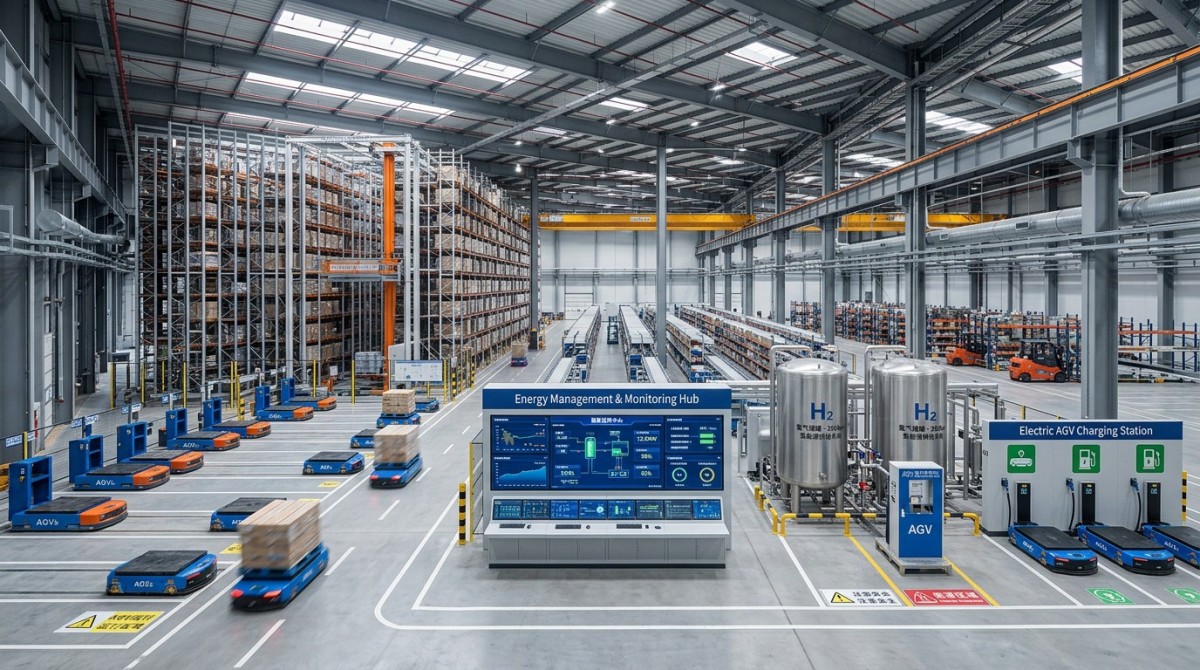
In industrial and logistics environments, this gap grows wider as operations become more automated. A facility may deploy warehouse automation, AGV robots, automated storage and retrieval systems, and electronic shelf labels while also adding new HVAC loads, charging infrastructure, compressed air demand, or hydrogen energy support systems. Energy use then changes across multiple layers at once. If the project team does not update assumptions continuously, savings targets quickly become outdated.
Typical root causes include:
- Poor baseline definition: historical energy use was not normalized for weather, occupancy, throughput, shift patterns, or production mix.
- Siloed data: utility bills, BMS data, process equipment data, and logistics software metrics sit in separate systems.
- Overstated business cases: projected savings include best-case assumptions but ignore ramp-up losses and operator behavior.
- Weak post-installation governance: nobody owns verification after commissioning.
- Operational drift: controls are overridden, setpoints are changed, and maintenance declines over time.
For decision-makers, the practical takeaway is simple: energy savings are not created at the procurement stage alone. They are created through measurement discipline, operational alignment, and active management after go-live.
Where savings targets usually break down: baseline, data, and accountability
If a company cannot prove where energy was used before a project started, it will struggle to prove what was saved afterward. This is the first major breakdown point.
Many organizations still rely on monthly utility invoices or broad facility-level energy monitoring. That may be enough for high-level reporting, but not enough for project-level verification. If you install variable speed drives, optimize warehouse automation schedules, or redesign refrigeration controls, total site consumption alone will not show the true impact. At the same time, other changes in production, storage density, automation throughput, or transport routing may mask the savings.
This becomes especially important in operations that combine physical automation and digital orchestration. For example:
- An ASRS system may reduce forklift traffic but increase electricity use in lifts, conveyors, and controls.
- AGV robots may improve labor efficiency but create new charging peaks.
- TMS software may reduce empty miles and fuel use, yet warehouse dwell times may increase if scheduling is not aligned.
- Electronic shelf labels may improve retail or warehouse accuracy, but their direct energy impact is often small compared with the broader digital infrastructure supporting them.
- Hydrogen energy systems may improve decarbonization strategy, but savings claims can be distorted if infrastructure losses and utilization rates are not measured properly.
Without a shared measurement framework, each department tells a different story. Operations may say the project improved throughput. Finance may say utility costs did not fall as expected. Engineering may argue that weather, product mix, or uptime changes distorted the comparison. All three may be partly right.
This is why accountability matters as much as technology. Someone must own:
- baseline methodology,
- metering scope,
- data integrity,
- exception handling,
- and savings verification cadence.
Without that ownership, savings targets become assumptions rather than managed outcomes.
How new automation and energy systems make savings harder to verify
The more complex the facility, the harder it becomes to isolate energy savings from operational change. This is now a major issue across advanced manufacturing, healthcare logistics, electronics distribution, and smart warehousing.
Consider a site that adds automated storage and retrieval, smart warehouse controls, and TMS software in the same 12-month period. Throughput rises, picking errors fall, transport routing improves, and labor hours per unit decline. These are real business benefits. But energy savings may not appear clearly if total output rises faster than energy efficiency improves.
That does not mean the project failed. It may mean the wrong KPI was chosen.
Instead of looking only at total energy spend, many organizations should track a combination of metrics such as:
- energy per unit produced,
- energy per order fulfilled,
- energy per pallet moved,
- energy per storage cycle in an ASRS system,
- fuel or electricity per route optimized via TMS software,
- downtime avoided through better control or monitoring,
- and peak demand reductions.
This matters for finance approvers as well. A project may create value through resilience, reduced maintenance, lower carbon exposure, or improved service levels, even if the utility bill reduction alone is below the original estimate. Good energy management should therefore be evaluated as part of operational performance, not as a standalone utility exercise.
What procurement teams and project owners should check before approving a project
For buyers and approvers, the biggest mistake is treating energy savings projections as fixed outcomes rather than conditional scenarios. Before approving a project, teams should test whether the expected results are built on measurable and controllable assumptions.
Key questions to ask suppliers, integrators, and internal stakeholders include:
- How was the baseline built? Was it adjusted for seasonality, throughput, occupancy, and process variation?
- What exactly will be metered? Site level, line level, asset level, or process level?
- Which savings are direct and which are indirect? Energy reduction, maintenance savings, labor productivity, carbon cost avoidance, or service improvement?
- Who owns post-implementation verification? Vendor, site engineering, energy manager, or PMO?
- What happens if operating conditions change? Is there a method to re-baseline fairly?
- What is the ramp-up period? Many projects do not achieve stable performance in the first few months.
- Are operator training and maintenance included? Savings often erode because teams are not prepared to sustain new settings or processes.
Procurement professionals should also be cautious when vendors bundle broad claims across multiple benefits. If a warehouse automation project is sold as simultaneously reducing labor, increasing throughput, improving accuracy, cutting damages, and lowering energy use, each value stream should be validated separately. Otherwise, one strong result can hide another weak one.
How to improve the odds of hitting savings targets
Organizations that consistently hit energy savings targets usually do a few things differently. They do not rely on a one-time installation and a promised ROI slide. They build a management system around the project.
A practical approach includes the following steps:
- Establish a defensible baseline. Use interval data where possible and normalize for the drivers that materially affect consumption.
- Define the right KPIs. Combine total cost metrics with intensity metrics tied to production or logistics output.
- Improve energy monitoring before or alongside implementation. Better metering often delivers as much decision value as the equipment upgrade itself.
- Create cross-functional ownership. Finance, operations, engineering, EHS, and procurement should agree on how savings will be measured.
- Plan for commissioning and re-commissioning. Initial setup is not enough; settings drift and systems interact in unexpected ways.
- Review savings monthly during ramp-up. Early deviations are easier to correct than year-end surprises.
- Separate efficiency gains from growth effects. If output increases, evaluate whether energy intensity improved even if total consumption did not fall.
For facilities integrating hydrogen energy, smart electronics, or automated logistics systems, digital visibility becomes even more important. The project team needs a unified view of equipment performance, process demand, and energy consumption. Otherwise, the organization may improve one layer of the operation while losing efficiency in another.
What a more realistic success standard looks like
Many companies set savings targets too narrowly. A more useful success standard asks whether the project improved controllability, resilience, unit economics, and long-term efficiency, not just whether it hit a headline percentage in the original proposal.
A realistic evaluation framework should include:
- verified energy reduction against an agreed baseline,
- performance under actual operating conditions,
- impact on throughput and service levels,
- maintenance and reliability outcomes,
- safety and compliance implications,
- and the organization’s ability to sustain gains over time.
This broader view is especially relevant for enterprise decision-makers balancing decarbonization, automation, and cost pressure at the same time. In such environments, a project that misses an aggressive short-term savings number may still be strategically sound if it creates durable operational value and a platform for future optimization.
Conclusion
Energy management projects usually miss savings targets for reasons that are operational and organizational, not just technical. Weak baselines, limited energy monitoring, siloed data, unrealistic assumptions, and poor post-launch ownership are the main causes. As businesses adopt hydrogen energy systems, warehouse automation, AGV robots, ASRS systems, automated storage and retrieval, electronic shelf labels, and TMS software, the challenge becomes less about buying technology and more about managing complexity.
The organizations that perform best are those that define savings clearly, measure them credibly, and govern them across departments. For procurement teams, project managers, financial approvers, and operations leaders, the smartest next step is to ask not only how much a project could save, but how those savings will be proven, sustained, and linked to real business performance.
Get weekly intelligence in your inbox.
No noise. No sponsored content. Pure intelligence.
 Apr 24, 2026India BIS Mandates IS 13252:2025 for PLCs & HMIs by Oct 2026India BIS Mandates IS 13252:2025 for PLCs & HMIs by Oct 2026
 Apr 24, 2026SASO EV Charger Regulation: Sand-Resistant Grid Compatibility Testing RequiredSASO EV Charger Regulation: Sand-Resistant Grid Compatibility Testing Required
 Apr 24, 2026Japan Updates JIS for Rehab Devices: IEC 62366-1:2024 Usability Compliance RequiredJapan Updates JIS for Rehab Devices: IEC 62366-1:2024 Usability Compliance Required
 Apr 24, 2026China Customs Launches RCEP Origin Smart Pre-Review SystemChina Customs Launches RCEP Origin Smart Pre-Review System
 Apr 24, 2026ANATEL Mandates Localized Voice Assistants for Smart Home Devices in BrazilANATEL Mandates Localized Voice Assistants for Smart Home Devices in Brazil
 Apr 24, 2026TÜV Rheinland Updates IoT EMC Standard with AI Edge抗扰度 RequirementTÜV Rheinland Updates IoT EMC Standard with AI Edge抗扰度 Requirement
 Apr 24, 20262M Alliance Shortens Ningbo–Rotterdam Route to 18 Days Amid 35% Slot Premium2M Alliance Shortens Ningbo–Rotterdam Route to 18 Days Amid 35% Slot Premium
 Apr 24, 2026Vietnam Enforces Bilingual Safety Labels for Imported Electronic Components from Apr 22, 2026Vietnam Enforces Bilingual Safety Labels for Imported Electronic Components from Apr 22, 2026
 Apr 24, 2026USTR Launches Sunset Review on China Solar PV AD/CVD DutiesUSTR Launches Sunset Review on China Solar PV AD/CVD Duties
 Apr 24, 2026EU New Battery Regulation Fully Effective Apr 24, 2026EU New Battery Regulation Fully Effective Apr 24, 2026
 Apr 23, 2026Taobao Factory Spark 3.0 Launches AI Workbench for SME Export FactoriesTaobao Factory Spark 3.0 Launches AI Workbench for SME Export Factories
 Apr 23, 2026TENENG Group Inspects IoT Safety Compliance at Jiangnan ChemicalTENENG Group Inspects IoT Safety Compliance at Jiangnan Chemical
 Apr 23, 2026China Launches First Embodied AI Open Data CommunityChina Launches First Embodied AI Open Data Community
 Apr 23, 2026PV Glass Prices Flat for 9 Weeks Amid Rising Integrated ProcurementPV Glass Prices Flat for 9 Weeks Amid Rising Integrated Procurement
 Apr 23, 20262984 NQI One-Stop Platforms Launched Nationwide2984 NQI One-Stop Platforms Launched Nationwide
 Apr 23, 2026China’s Green Smart Ship Tech Norms Accelerate BMS & Shore Power ExportChina’s Green Smart Ship Tech Norms Accelerate BMS & Shore Power Export
 Apr 23, 2026China Builds World's Largest Agri-Meteorological IoT NetworkChina Builds World's Largest Agri-Meteorological IoT Network
 Apr 23, 2026EU CBAM Carbon Tariff Enters Enforcement on April 1, 2026EU CBAM Carbon Tariff Enters Enforcement on April 1, 2026
 Apr 23, 2026Five Ministries Issue Zero-Carbon Factory Guidance for Export IndustriesFive Ministries Issue Zero-Carbon Factory Guidance for Export Industries
 Apr 23, 2026ISO Releases First Zero-Carbon City Standard — China’s Practices IncludedISO Releases First Zero-Carbon City Standard — China’s Practices Included
 Apr 22, 2026China Leads Global Offshore Wind Installations for 5th YearChina Leads Global Offshore Wind Installations for 5th Year
 Apr 22, 2026China Launches National Mine Safety IoT Monitoring NetworkChina Launches National Mine Safety IoT Monitoring Network
 Apr 22, 2026Yinchuan Boiler Pure Water Solution Certified for Middle East ProjectsYinchuan Boiler Pure Water Solution Certified for Middle East Projects
 Apr 22, 2026China to Enforce Mandatory EV Battery Recycling Standards by 2026China to Enforce Mandatory EV Battery Recycling Standards by 2026
 Apr 22, 2026Vietnam Launches Anti-Circumvention Probe on Electronic ComponentsVietnam Launches Anti-Circumvention Probe on Electronic Components
 Apr 22, 20262026 Shanghai Fastener Show: Robotic Fasteners Drive Overseas Procurement2026 Shanghai Fastener Show: Robotic Fasteners Drive Overseas Procurement
 Apr 22, 2026US BIS Adds EV On-Board Charger Crypto Modules to EAR Appendix 7US BIS Adds EV On-Board Charger Crypto Modules to EAR Appendix 7