Custom PCB Boards: How to Choose Stackup, Copper Weight, and Tolerances
Custom PCB Boards: How to Choose Stackup, Copper Weight, and Tolerances
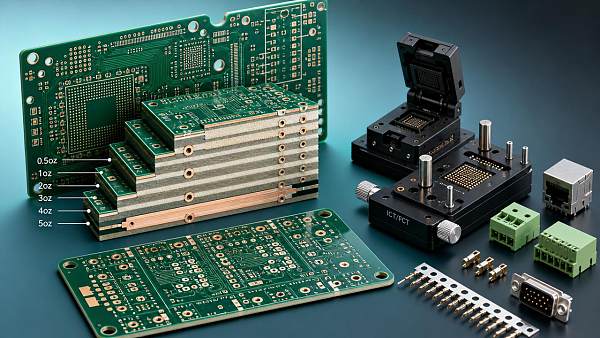
Choosing custom PCB boards is not only a layout exercise. It starts with specification decisions that shape performance, yield, and cost.
Among the most important factors are stackup, copper weight, and fabrication tolerances. These three items influence nearly every downstream result.
If they are defined too loosely, reliability risks increase. If they are defined too tightly, sourcing options shrink and pricing rises.
That balance matters when comparing suppliers, checking manufacturability, or validating whether a design can scale from prototype to production.
For custom PCB boards used in smart electronics, industrial controls, medical devices, and energy systems, poor early decisions often create expensive late-stage corrections.
A practical evaluation should ask three simple questions. What electrical behavior is required, what thermal load is expected, and what process window can suppliers repeat consistently?
Once those questions are clear, selecting custom PCB boards becomes less about guesswork and more about controlled engineering tradeoffs.
Why These Specifications Matter Early
Many sourcing problems begin before supplier contact. They begin when core design assumptions are copied from an older board without checking the new application.
A stackup that worked for a low-speed controller may fail in a dense RF module. A copper weight that passed current tests may overcomplicate fine-pitch routing.
Tolerance expectations create the same issue. Tight tolerances may improve fit or impedance control, but they can also reduce yield and extend lead times.
This is why custom PCB boards should be evaluated as a system. Electrical, thermal, mechanical, and manufacturing variables need to support each other.
- Stackup affects impedance, EMI behavior, layer utilization, and board thickness.
- Copper weight affects current capacity, heat spreading, etching limits, and trace geometry.
- Tolerances affect assembly fit, repeatability, test performance, and supplier capability.
In actual procurement work, the best custom PCB boards are rarely the most aggressive on paper. They are the ones that achieve the needed result with stable production margins.
How to Evaluate PCB Stackup
Stackup defines the arrangement of copper and dielectric layers. It directly affects signal return paths, crosstalk, impedance control, and mechanical rigidity.
For custom PCB boards, stackup should not be chosen only by layer count. The real issue is how each layer supports routing and reference integrity.
Start with application demands
Low-speed power control boards may work well with simple four-layer designs. High-speed digital boards often need dedicated reference planes and controlled impedance structures.
Mixed-signal products need additional care. Sensitive analog sections should be protected from noisy switching paths and poor return routing.
Check layer symmetry
Balanced stackups reduce warpage and improve lamination stability. This becomes more important for larger panels, BGAs, and reflow-sensitive assemblies.
Confirm dielectric materials
Not all materials behave the same. Dk, Df, thermal expansion, and moisture response can change performance and reliability.
For high-frequency custom PCB boards, material selection is often as critical as the layer arrangement itself.
Review stackup questions before release
- Are all critical signals adjacent to a clean reference plane?
- Is controlled impedance required, and has it been modeled?
- Does the layer order support power integrity and EMI control?
- Can multiple suppliers build the same structure consistently?
A good stackup for custom PCB boards is not the one with the most layers. It is the one that solves the electrical problem without creating unnecessary manufacturing complexity.
How to Choose Copper Weight
Copper weight is usually selected by current, temperature rise, and mechanical needs. But real-world choices involve more than ampacity charts.
Heavier copper can carry more current and spread heat better. At the same time, it makes fine-feature etching harder and can reduce routing flexibility.
That is why custom PCB boards often use different copper weights on inner and outer layers, depending on thermal and routing priorities.
Typical selection logic
What to verify with suppliers
- Finished copper thickness versus base copper thickness.
- Minimum trace and spacing under the selected copper weight.
- Potential etch compensation requirements.
- Thermal relief and via design recommendations.
This step is often overlooked. A board may look acceptable in CAD, yet become difficult to fabricate once heavy copper and tight spacing meet in the same area.
How to Set Realistic Tolerances
Tolerance decisions should be driven by function, not habit. Over-specifying every dimension is a common reason custom PCB boards become more expensive than necessary.
Some tolerances matter a great deal. Others have little impact on field performance but still raise process difficulty.
Focus on critical tolerances first
- Board thickness tolerance for connectors and enclosure fit.
- Hole size tolerance for press-fit parts or controlled pin insertion.
- Trace width and dielectric tolerance for impedance-sensitive routing.
- Registration tolerance for BGAs, fine pitch, and multilayer alignment.
Match tolerance to risk
If the product runs at modest speeds and sits in a forgiving enclosure, standard tolerances may be enough. There is no value in paying for precision that the design never uses.
By contrast, custom PCB boards for compact modules, high-speed data paths, or sealed assemblies usually need more controlled dimensional performance.
Ask for capability, not promises
Supplier drawings may list impressive limits. The more useful question is whether those limits are standard, conditional, or dependent on panel utilization and volume.
When reviewing custom PCB boards, ask for capability data tied to similar builds. That tells more than a broad brochure claim.
A Practical Decision Framework for Custom PCB Boards
A useful evaluation framework should connect board design with sourcing reality. It should also make supplier comparisons easier and more objective.
- Define the electrical environment, including speed, noise sensitivity, and impedance requirements.
- Map thermal load, current density, and hot-spot zones.
- Separate critical tolerances from standard fabrication dimensions.
- Check whether the stackup and copper plan fit mainstream supplier capability.
- Review DFM feedback before finalizing release files.
- Compare suppliers on consistency, not only unit price.
This approach is especially helpful when custom PCB boards move from prototype to volume production. A design that works once is not always a design that scales well.
From a strategic sourcing view, the best decision is usually the one that protects quality while keeping alternate supply options open.
Common Mistakes to Avoid
- Using an old stackup without checking new signal-speed or EMI demands.
- Selecting heavy copper everywhere instead of only where current paths require it.
- Applying tight tolerances across the full drawing instead of critical features only.
- Ignoring supplier process notes until after layout completion.
- Comparing custom PCB boards only by price per piece.
These mistakes are common because each decision seems small on its own. In practice, they interact and can multiply manufacturing risk.
A slightly heavier copper layer may force wider traces. That may change layer usage, which then affects stackup, thickness, and tolerance sensitivity.
Final Selection Takeaway
Choosing custom PCB boards well means treating stackup, copper weight, and tolerances as connected decisions. None of them should be finalized in isolation.
The strongest evaluation process starts with product function, then checks manufacturability, then confirms sourcing flexibility. That sequence reduces redesign risk and improves production confidence.
For teams reviewing custom PCB boards before supplier selection, the most practical move is to build a short specification checklist and validate it with at least two capable manufacturers.
That extra step often reveals whether a design is truly robust or simply acceptable under narrow conditions.
When the stackup is purposeful, the copper weight is appropriate, and tolerances are realistic, custom PCB boards become easier to source, easier to scale, and far more reliable in the field.
Get weekly intelligence in your inbox.
No noise. No sponsored content. Pure intelligence.
 Sep 15, 2026Wholesale WiFi Smart Switches: What Buyers Should Verify Before OrderingWholesale WiFi Smart Switches: What Buyers Should Verify Before Ordering
 Sep 14, 2026How to Select IoT Sensors for Reliable Monitoring in Harsh Industrial EnvironmentsHow to Select IoT Sensors for Reliable Monitoring in Harsh Industrial Environments
 Sep 13, 2026How Procurement Teams Can Improve Supplier Reliability With Supply Chain VisibilityHow Procurement Teams Can Improve Supplier Reliability With Supply Chain Visibility
 Sep 12, 2026Smart Manufacturing Trends 2026: What Leaders Should Prioritize for ROISmart Manufacturing Trends 2026: What Leaders Should Prioritize for ROI
 Sep 11, 2026B2B Market Analysis: How Buyers Evaluate Suppliers, Pricing, and Delivery RiskB2B Market Analysis: How Buyers Evaluate Suppliers, Pricing, and Delivery Risk
 Sep 10, 2026Residential Solar Kits in Canada: How to Size a System for Your Home and ClimateResidential Solar Kits in Canada: How to Size a System for Your Home and Climate
 Sep 09, 2026How to Specify a Syringe Assembly Line for High-Volume Sterile ProductionHow to Specify a Syringe Assembly Line for High-Volume Sterile Production
 Sep 08, 2026How to Evaluate Warehouse Robotics System Suppliers for Reliable Multi-Site DeploymentHow to Evaluate Warehouse Robotics System Suppliers for Reliable Multi-Site Deployment
 Sep 07, 2026Renewable Geothermal Energy Explained: How It Works for Heating and PowerRenewable Geothermal Energy Explained: How It Works for Heating and Power
 Sep 07, 2026How to Choose an Industrial Packaging Robot Manufacturer for Your Production LineHow to Choose an Industrial Packaging Robot Manufacturer for Your Production Line
 Sep 05, 2026How to Evaluate a Turnkey Hydro Turbine Generator Supplier for Remote Power ProjectsHow to Evaluate a Turnkey Hydro Turbine Generator Supplier for Remote Power Projects
 Sep 04, 2026Automated Ultrasonic Welding for Thermoplastic Assemblies: Process Controls That MatterAutomated Ultrasonic Welding for Thermoplastic Assemblies: Process Controls That Matter
 Sep 03, 2026Energy Forecasting for Grid Planning: Sizing Solar and Storage CapacityEnergy Forecasting for Grid Planning: Sizing Solar and Storage Capacity
 Sep 02, 2026Which Metrics Should an Energy Analytics Dashboard Track for Factory Energy Management?Which Metrics Should an Energy Analytics Dashboard Track for Factory Energy Management?
 Sep 01, 2026How Warehouse Voice Picking Improves Accuracy and Throughput in Order FulfillmentHow Warehouse Voice Picking Improves Accuracy and Throughput in Order Fulfillment
 Aug 31, 2026How to Automate Dropshipping Order Processing Without Overselling StockHow to Automate Dropshipping Order Processing Without Overselling Stock
 Aug 30, 2026How to Evaluate a Smart Lighting Supplier for Multi-Site Commercial ProjectsHow to Evaluate a Smart Lighting Supplier for Multi-Site Commercial Projects
 Aug 29, 2026Recent Advances in Smart Manufacturing and Materials Reshaping Factory InvestmentRecent Advances in Smart Manufacturing and Materials Reshaping Factory Investment
 Aug 29, 2026Selecting Lightweight Aluminum Extrusions for Strength-Critical Industrial DesignsSelecting Lightweight Aluminum Extrusions for Strength-Critical Industrial Designs
 Aug 29, 2026Vertical Powder Anodizing Explained: Process Controls for Uniform Coating QualityVertical Powder Anodizing Explained: Process Controls for Uniform Coating Quality
 Aug 29, 2026PV Module Product Due Diligence: What Buyers Should Verify Before ContractingPV Module Product Due Diligence: What Buyers Should Verify Before Contracting
 Aug 29, 2026Solar Design for Challenging Terrain: Managing Slope, Soil, and Shading RisksSolar Design for Challenging Terrain: Managing Slope, Soil, and Shading Risks
 Aug 29, 2026IS 16444 Smart Meter Requirements: Key Functions, Tests, and ComplianceIS 16444 Smart Meter Requirements: Key Functions, Tests, and Compliance
 Aug 29, 2026Rehabilitation Equipment Market Outlook: Demand Drivers and Growth SegmentsRehabilitation Equipment Market Outlook: Demand Drivers and Growth Segments
 Aug 29, 2026When Does Container Handling Automation Deliver ROI in Port Yard Operations?When Does Container Handling Automation Deliver ROI in Port Yard Operations?
 Aug 29, 2026Customs API Integration: A Practical Checklist for Automated Trade ComplianceCustoms API Integration: A Practical Checklist for Automated Trade Compliance
 Aug 29, 2026Returnable Packaging for Automotive: How to Cut Damage and Reverse Logistics CostsReturnable Packaging for Automotive: How to Cut Damage and Reverse Logistics Costs