Solar Panels Wholesale Buying Guide: MOQ, Tier Ratings, Warranties, and Price Risks
Solar Panels Wholesale Buying Guide: MOQ, Tier Ratings, Warranties, and Price Risks
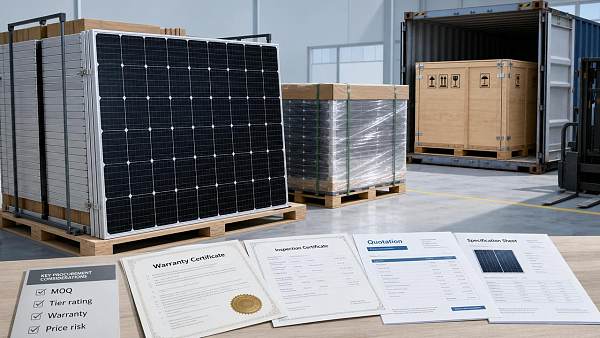
For procurement teams evaluating solar panels wholesale options, early decisions on MOQ, tier ratings, warranties, and pricing terms can directly affect margin, supply stability, and project risk.
This guide explains what to compare before signing with suppliers, so enterprise buyers can reduce uncertainty and scale with more confidence.
In practice, solar panels wholesale sourcing is not only about getting the lowest unit price. It is about locking in dependable output, stable lead times, and bankable product support.
That is why experienced buyers usually review commercial terms and technical risk together, not as separate decisions.
Why Solar Panels Wholesale Decisions Need a Broader Cost View
A cheap quote can become expensive very quickly. The most common reason is that visible price and actual landed cost are rarely the same.
When comparing solar panels wholesale offers, buyers should separate four layers of cost.
- Module price per watt
- Packaging, freight, and insurance
- Duties, local compliance, and testing
- Warranty exposure and replacement handling
From recent market shifts, a clearer signal is that price volatility now comes from polysilicon, shipping, exchange rates, and regional policy changes.
That also means a quote that looks attractive today may carry hidden risk if validity is short or price adjustment clauses are vague.
MOQ in Solar Panels Wholesale: What It Really Tells You
MOQ is more than a negotiation point. It often reflects production flexibility, inventory policy, and the supplier’s real interest in your account.
For solar panels wholesale orders, MOQ may be defined by container quantity, wattage, pallet count, or a model-specific threshold.
How to read MOQ correctly
A very high MOQ can signal strong factory utilization, limited customization tolerance, or priority given to larger distributors.
A very low MOQ can be convenient, but it may also mean higher pricing, mixed inventory, or non-priority production windows.
In actual business, the useful question is not only “What is the MOQ?” but also “What changes above the MOQ?”
- Does pricing improve at one container, three containers, or quarterly volume?
- Can packaging, labels, or connectors change after a threshold?
- Will lead times shorten for rolling forecasts?
- Can the supplier reserve production capacity for repeat orders?
Strong solar panels wholesale sourcing usually includes an MOQ discussion tied to forecast visibility, not just first-order pressure.
Tier Ratings: Useful Signal, Not a Complete Decision Tool
Many buyers ask first whether a manufacturer is Tier 1. That is understandable, but the answer should not end the review.
Tier ratings are often used as shorthand for bankability, market acceptance, and project finance confidence.
Still, solar panels wholesale decisions need more than a label. A tier status does not automatically confirm product fit, after-sales execution, or shipment reliability.
What to verify beyond tier status
- Factory capacity and utilization rate
- Bill of materials consistency
- Third-party test reports and certification scope
- Degradation guarantees and power tolerance
- Regional shipment history and claim response record
This matters because a bankable brand may still have limited flexibility on delivery terms, while a lesser-known supplier may perform well in narrower applications.
The better approach is simple: use tier ratings as an entry filter, then validate operational credibility with documents and references.
Warranties in Solar Panels Wholesale: Read the Service Reality
Warranty language often looks impressive in sales material. The real question is how the warranty works when something goes wrong.
Most solar panels wholesale contracts involve two layers: product warranty and performance warranty.
Key warranty points to compare
- Warranty duration for materials and workmanship
- Annual degradation rate and end-of-term output
- Claim evidence requirements
- Response timeline and approval process
- Who pays freight, inspection, and replacement logistics
This is where many procurement mistakes happen. Buyers compare years, but not the practical burden of enforcing the warranty.
For example, a 25-year performance warranty sounds strong, yet claim success depends on traceability, installation records, and accepted testing methods.
In solar panels wholesale procurement, it is smart to ask for a sample claim workflow before placing the first order.
Price Risks: Why Today’s Quote May Not Protect Tomorrow’s Margin
Price risk in solar panels wholesale sourcing usually appears in three stages: before order confirmation, during production, and after shipment.
Common price risk triggers
- Raw material fluctuations
- Currency movements
- Freight rate spikes
- Trade policy changes or tariffs
- Specification changes after quotation
More importantly, some risks are built into quote structure. A low starting price may exclude key accessories, testing, or packaging standards.
That is why solar panels wholesale buyers should request quote validity, adjustment conditions, and Incoterms in writing.
Supplier Comparison Checklist for Solar Panels Wholesale
Once pricing, MOQ, and warranty basics are clear, the next step is structured supplier comparison.
This keeps solar panels wholesale decisions objective, especially when internal stakeholders focus on different priorities.
Recommended comparison points
- Module efficiency, dimensions, and power class
- Certification match for target market
- MOQ flexibility and repeat-order support
- Lead time under normal and peak demand
- Payment terms and credit exposure
- Packaging strength and breakage history
- Warranty process and local support options
- Reference projects in similar climates or applications
In real sourcing cycles, this kind of checklist also makes supplier conversations sharper. Weak areas appear faster when questions are specific.
Negotiation Tactics That Improve Solar Panels Wholesale Outcomes
Better solar panels wholesale terms do not always come from pushing only on price.
Often, the smarter gains come from reducing uncertainty elsewhere in the deal.
- Link volume forecasts to staged discounts instead of demanding one-time concessions.
- Ask for production slot reservations during peak season.
- Negotiate spare module ratios for damage or field replacement.
- Request clear penalty or remedy terms for late delivery.
- Align payment milestones with inspection and shipment events.
This approach protects margin without turning the relationship into a narrow price contest.
A Practical Buying Path Before You Commit
Before confirming any solar panels wholesale supplier, move through a short sequence.
- Define the target application, compliance market, and acceptable performance band.
- Compare at least three suppliers on landed cost, not just module price.
- Validate tier claims, certifications, and recent shipment capability.
- Review MOQ, quote validity, and warranty execution details.
- Run a small pilot order or sample verification if project timing allows.
- Lock terms in writing before raw material or freight conditions shift.
Taken together, these steps make solar panels wholesale procurement more resilient and easier to scale.
The strongest buying decisions balance price discipline with supply confidence. That is usually where long-term value appears.
If your team is evaluating new suppliers, use this framework to challenge assumptions early, compare offers consistently, and reduce avoidable risk before the purchase order is issued.
Get weekly intelligence in your inbox.
No noise. No sponsored content. Pure intelligence.
 Sep 15, 2026Wholesale WiFi Smart Switches: What Buyers Should Verify Before OrderingWholesale WiFi Smart Switches: What Buyers Should Verify Before Ordering
 Sep 14, 2026How to Select IoT Sensors for Reliable Monitoring in Harsh Industrial EnvironmentsHow to Select IoT Sensors for Reliable Monitoring in Harsh Industrial Environments
 Sep 13, 2026How Procurement Teams Can Improve Supplier Reliability With Supply Chain VisibilityHow Procurement Teams Can Improve Supplier Reliability With Supply Chain Visibility
 Sep 12, 2026Smart Manufacturing Trends 2026: What Leaders Should Prioritize for ROISmart Manufacturing Trends 2026: What Leaders Should Prioritize for ROI
 Sep 11, 2026B2B Market Analysis: How Buyers Evaluate Suppliers, Pricing, and Delivery RiskB2B Market Analysis: How Buyers Evaluate Suppliers, Pricing, and Delivery Risk
 Sep 10, 2026Residential Solar Kits in Canada: How to Size a System for Your Home and ClimateResidential Solar Kits in Canada: How to Size a System for Your Home and Climate
 Sep 09, 2026How to Specify a Syringe Assembly Line for High-Volume Sterile ProductionHow to Specify a Syringe Assembly Line for High-Volume Sterile Production
 Sep 08, 2026How to Evaluate Warehouse Robotics System Suppliers for Reliable Multi-Site DeploymentHow to Evaluate Warehouse Robotics System Suppliers for Reliable Multi-Site Deployment
 Sep 07, 2026Renewable Geothermal Energy Explained: How It Works for Heating and PowerRenewable Geothermal Energy Explained: How It Works for Heating and Power
 Sep 07, 2026How to Choose an Industrial Packaging Robot Manufacturer for Your Production LineHow to Choose an Industrial Packaging Robot Manufacturer for Your Production Line
 Sep 05, 2026How to Evaluate a Turnkey Hydro Turbine Generator Supplier for Remote Power ProjectsHow to Evaluate a Turnkey Hydro Turbine Generator Supplier for Remote Power Projects
 Sep 04, 2026Automated Ultrasonic Welding for Thermoplastic Assemblies: Process Controls That MatterAutomated Ultrasonic Welding for Thermoplastic Assemblies: Process Controls That Matter
 Sep 03, 2026Energy Forecasting for Grid Planning: Sizing Solar and Storage CapacityEnergy Forecasting for Grid Planning: Sizing Solar and Storage Capacity
 Sep 02, 2026Which Metrics Should an Energy Analytics Dashboard Track for Factory Energy Management?Which Metrics Should an Energy Analytics Dashboard Track for Factory Energy Management?
 Sep 01, 2026How Warehouse Voice Picking Improves Accuracy and Throughput in Order FulfillmentHow Warehouse Voice Picking Improves Accuracy and Throughput in Order Fulfillment
 Aug 31, 2026How to Automate Dropshipping Order Processing Without Overselling StockHow to Automate Dropshipping Order Processing Without Overselling Stock
 Aug 30, 2026How to Evaluate a Smart Lighting Supplier for Multi-Site Commercial ProjectsHow to Evaluate a Smart Lighting Supplier for Multi-Site Commercial Projects
 Aug 29, 2026Recent Advances in Smart Manufacturing and Materials Reshaping Factory InvestmentRecent Advances in Smart Manufacturing and Materials Reshaping Factory Investment
 Aug 29, 2026Selecting Lightweight Aluminum Extrusions for Strength-Critical Industrial DesignsSelecting Lightweight Aluminum Extrusions for Strength-Critical Industrial Designs
 Aug 29, 2026Vertical Powder Anodizing Explained: Process Controls for Uniform Coating QualityVertical Powder Anodizing Explained: Process Controls for Uniform Coating Quality
 Aug 29, 2026PV Module Product Due Diligence: What Buyers Should Verify Before ContractingPV Module Product Due Diligence: What Buyers Should Verify Before Contracting
 Aug 29, 2026Solar Design for Challenging Terrain: Managing Slope, Soil, and Shading RisksSolar Design for Challenging Terrain: Managing Slope, Soil, and Shading Risks
 Aug 29, 2026IS 16444 Smart Meter Requirements: Key Functions, Tests, and ComplianceIS 16444 Smart Meter Requirements: Key Functions, Tests, and Compliance
 Aug 29, 2026Rehabilitation Equipment Market Outlook: Demand Drivers and Growth SegmentsRehabilitation Equipment Market Outlook: Demand Drivers and Growth Segments
 Aug 29, 2026When Does Container Handling Automation Deliver ROI in Port Yard Operations?When Does Container Handling Automation Deliver ROI in Port Yard Operations?
 Aug 29, 2026Customs API Integration: A Practical Checklist for Automated Trade ComplianceCustoms API Integration: A Practical Checklist for Automated Trade Compliance
 Aug 29, 2026Returnable Packaging for Automotive: How to Cut Damage and Reverse Logistics CostsReturnable Packaging for Automotive: How to Cut Damage and Reverse Logistics Costs