
How factory automation cuts defects in electronics lines
In electronics production, even small errors can cascade into scrap, warranty claims, shipment delays, and unstable yields.
Factory automation for electronics manufacturing reduces variation across assembly, inspection, handling, and testing.
It also creates traceable data, faster feedback loops, and stronger process control for high-mix, high-volume environments.
Across the broader industrial landscape, automation has become a practical route to better quality, not only a route to labor efficiency.
That matters in electronics, where micro-defects often escape manual checks until final test or even field use.
What factory automation for electronics manufacturing means in practice
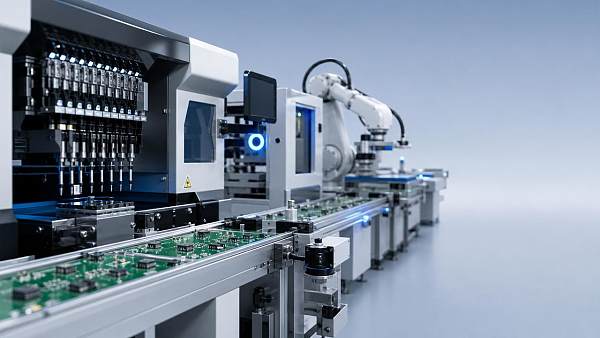
Factory automation for electronics manufacturing combines machines, software, sensors, robotics, and control systems across production stages.
The goal is consistent execution of tasks that affect solder quality, placement accuracy, component integrity, and final product reliability.
Automation may include SMT placement systems, automated optical inspection, robotic handling, inline metrology, MES integration, and closed-loop process control.
It does not remove human judgment entirely.
Instead, it shifts attention toward exception handling, engineering optimization, maintenance discipline, and root-cause analysis.
In defect reduction, the strongest value comes from repeatability.
Automated systems perform the same task with tighter tolerances, stable timing, and less operator-to-operator variability.
Core building blocks
- Machine vision for solder joint, polarity, and alignment verification
- Robotic motion systems for repeatable placement and material transfer
- Sensor networks for temperature, pressure, vibration, and torque control
- Inline testing for electrical, functional, and parametric validation
- Production software linking quality events with process settings and lot history
Why defect control is a priority in current electronics lines
Electronics lines now face finer pitches, denser boards, more variants, and shorter product cycles.
Those trends increase the probability that minor process drift becomes a visible quality failure.
Manual inspection alone struggles to keep pace with this complexity.
The issue is not effort.
The issue is consistency at speed, across thousands of placements and repeated production runs.
Because of these pressures, factory automation for electronics manufacturing is increasingly treated as a quality infrastructure decision.
It supports throughput, but its strategic value often appears first in lower defect rates and stronger predictability.
How automation reduces defects across the production flow
Defects in electronics lines rarely come from one isolated cause.
They emerge from cumulative variation across materials, machines, operators, environment, and timing.
Factory automation for electronics manufacturing cuts defects by narrowing that variation at each step.
1. Material preparation and feeding
Automated feeder verification reduces wrong-part loading and component mix-ups.
Barcode scanning and recipe checks prevent mismatched reels from entering active production.
2. Solder paste printing
Paste deposition quality strongly affects bridges, opens, and weak joints.
Automated stencil alignment, pressure control, and paste inspection stabilize this early step.
3. Component placement
Placement machines use vision systems to correct orientation and position in real time.
That reduces tombstoning, skew, missing parts, and polarity mistakes.
4. Reflow and thermal control
Sensors and software keep thermal profiles within validated windows.
Consistent heat exposure lowers the risk of cold joints, warpage, and component stress.
5. Inspection and test
Automated optical inspection identifies visible anomalies earlier than end-of-line checks.
Automated X-ray and functional test extend coverage to hidden joints and electrical behavior.
6. Closed-loop correction
The biggest gain appears when inspection data automatically adjusts upstream process settings.
This turns quality control from passive detection into active prevention.
Business value beyond lower scrap rates
Lower defect density is the visible outcome, but the broader value is operational resilience.
Factory automation for electronics manufacturing supports more stable planning, stronger compliance, and faster quality learning.
- Reduced rework time improves available capacity without adding floor space
- Digital traceability supports audits, customer reporting, and failure containment
- Standardized execution simplifies scaling across plants or contract partners
- Faster defect detection shortens root-cause investigation cycles
- Better process consistency improves confidence during new product introductions
For organizations balancing cost, quality, and continuity, these effects often outweigh simple headcount calculations.
This is especially true when customer expectations include zero-defect programs, fast changeovers, and documented quality history.
Typical application areas and defect risks
Not every electronics line has the same defect profile.
Automation priorities should follow product complexity, regulatory demands, and field failure consequences.
This range shows why factory automation for electronics manufacturing should be mapped to actual failure modes, not generic equipment lists.
Implementation priorities and common pitfalls
Automation projects can underperform when defect mechanisms are poorly defined before equipment selection.
A structured rollout usually delivers better quality results than isolated automation purchases.
Recommended priorities
- Identify the top recurring defects by frequency, cost, and customer impact.
- Map those defects to the exact process step where variation begins.
- Select automation that prevents or detects errors at that earliest point.
- Connect machines and inspection tools to unified production data.
- Track yield, escape rate, false calls, and rework time after deployment.
Common pitfalls
- Automating unstable processes without first establishing control limits
- Treating inspection as enough without closed-loop response capability
- Ignoring maintenance, calibration, and software governance
- Measuring output speed while overlooking hidden defect costs
Reliable gains depend on process discipline, data quality, and realistic integration planning.
That is where trusted industrial intelligence becomes valuable.
TradeNexus Pro examines these shifts across advanced manufacturing and smart electronics with verified technical context.
A practical next step for quality-focused operations
Factory automation for electronics manufacturing is most effective when viewed as a defect-reduction system, not only a productivity upgrade.
The strongest programs start with defect data, align automation to failure risk, and build feedback loops across the line.
A useful next step is a line-level review of the highest-cost defects, current inspection gaps, and missing traceability links.
That assessment can clarify where automation will deliver the fastest quality returns and the most durable operational advantage.
For ongoing analysis of factory automation for electronics manufacturing, supply chain shifts, and industrial technology signals, follow TradeNexus Pro.
Get weekly intelligence in your inbox.
No noise. No sponsored content. Pure intelligence.
 Oct 08, 2026How Digital Health Improves Diagnostic Accuracy and Workflow in Clinical LabsHow Digital Health Improves Diagnostic Accuracy and Workflow in Clinical Labs
 Oct 07, 2026Selecting Voice Picking Systems for German Warehouses: Integration, Languages and ROISelecting Voice Picking Systems for German Warehouses: Integration, Languages and ROI
 Oct 06, 2026How to Choose Last Mile Dispatch Software for On-Time Delivery at ScaleHow to Choose Last Mile Dispatch Software for On-Time Delivery at Scale
 Oct 05, 2026Vietnam’s Consumer Electronics Market: Demand Shifts and Sourcing OpportunitiesVietnam’s Consumer Electronics Market: Demand Shifts and Sourcing Opportunities
 Oct 04, 2026Digital Health Investment Priorities for Providers: Improving Access, Outcomes, and EfficiencyDigital Health Investment Priorities for Providers: Improving Access, Outcomes, and Efficiency
 Oct 03, 2026How to Specify an FR4 Custom PCB Board for High-Voltage and High-Heat DesignsHow to Specify an FR4 Custom PCB Board for High-Voltage and High-Heat Designs
 Oct 02, 2026ERP Software Market Intelligence: Adoption, Pricing, and Vendor Signals to WatchERP Software Market Intelligence: Adoption, Pricing, and Vendor Signals to Watch
 Oct 01, 2026How to Select Calibrated Temperature Data Loggers for GMP Cold Storage MonitoringHow to Select Calibrated Temperature Data Loggers for GMP Cold Storage Monitoring
 Sep 30, 2026Custom Molded Rubber Pricing: What Drives Unit Cost and Tooling Fees?Custom Molded Rubber Pricing: What Drives Unit Cost and Tooling Fees?
 Sep 29, 2026How to Evaluate Energy Management Software Vendors for Multi-Site OperationsHow to Evaluate Energy Management Software Vendors for Multi-Site Operations
 Sep 28, 2026How to Select a DIN Rail Smart Meter for Multi-Circuit Energy MonitoringHow to Select a DIN Rail Smart Meter for Multi-Circuit Energy Monitoring
 Sep 27, 2026TWS Earbuds in Vietnam: Demand Drivers, Price Tiers, and Retail Channel OpportunitiesTWS Earbuds in Vietnam: Demand Drivers, Price Tiers, and Retail Channel Opportunities
 Sep 26, 2026How UAE Clinics Can Qualify a Smart Glucometer Supplier for Accuracy and ComplianceHow UAE Clinics Can Qualify a Smart Glucometer Supplier for Accuracy and Compliance
 Sep 25, 2026Buying Aesthetic Lasers in the USA: FDA Status, Wavelengths, and Service SupportBuying Aesthetic Lasers in the USA: FDA Status, Wavelengths, and Service Support
 Sep 24, 2026Laser Cutting Brass Sheet: How to Prevent Burrs and Heat Marks on Thin PartsLaser Cutting Brass Sheet: How to Prevent Burrs and Heat Marks on Thin Parts
 Sep 23, 2026How to Choose Lightweight ANC Headphones for Comfortable All-Day TravelHow to Choose Lightweight ANC Headphones for Comfortable All-Day Travel
 Sep 22, 2026IPX5 TWS Bluetooth Earbuds: What Protection Do They Offer for Workouts?IPX5 TWS Bluetooth Earbuds: What Protection Do They Offer for Workouts?
 Sep 21, 2026What to Look for in a Grid Integration Company for Utility-Scale Solar ProjectsWhat to Look for in a Grid Integration Company for Utility-Scale Solar Projects
 Sep 20, 2026Microgrid Controller Pricing: What Drives Cost in Commercial Energy Projects?Microgrid Controller Pricing: What Drives Cost in Commercial Energy Projects?
 Sep 19, 2026How to Choose a GaN Charger for Laptops Without Compromising Power or PortabilityHow to Choose a GaN Charger for Laptops Without Compromising Power or Portability
 Sep 18, 2026Floating Solar Farm Costs: CAPEX, OPEX, and the Site Factors That Shape ROIFloating Solar Farm Costs: CAPEX, OPEX, and the Site Factors That Shape ROI
 Sep 17, 2026Drone Delivery Solutions for Last-Mile Routes: Site, Payload, and Range PlanningDrone Delivery Solutions for Last-Mile Routes: Site, Payload, and Range Planning
 Sep 16, 2026When Low-Volume Electronics Manufacturing Makes More Sense Than Mass ProductionWhen Low-Volume Electronics Manufacturing Makes More Sense Than Mass Production
 Sep 15, 2026Wholesale WiFi Smart Switches: What Buyers Should Verify Before OrderingWholesale WiFi Smart Switches: What Buyers Should Verify Before Ordering
 Sep 14, 2026How to Select IoT Sensors for Reliable Monitoring in Harsh Industrial EnvironmentsHow to Select IoT Sensors for Reliable Monitoring in Harsh Industrial Environments
 Sep 13, 2026How Procurement Teams Can Improve Supplier Reliability With Supply Chain VisibilityHow Procurement Teams Can Improve Supplier Reliability With Supply Chain Visibility
 Sep 12, 2026Smart Manufacturing Trends 2026: What Leaders Should Prioritize for ROISmart Manufacturing Trends 2026: What Leaders Should Prioritize for ROI



























