SASO EV Charger Rules: Grid Compatibility & Sand Resistance Required
Saudi Arabia’s Standards, Metrology and Quality Organization (SASO) issued supplementary technical requirements SASO IEC 61851-23:2026 on April 20, 2026, mandating real-world grid interaction testing for all EV charging infrastructure sold in the Kingdom. This update directly impacts EV charger manufacturers, exporters, certification service providers, and grid-integration solution developers operating in or targeting the Saudi market.
Event Overview
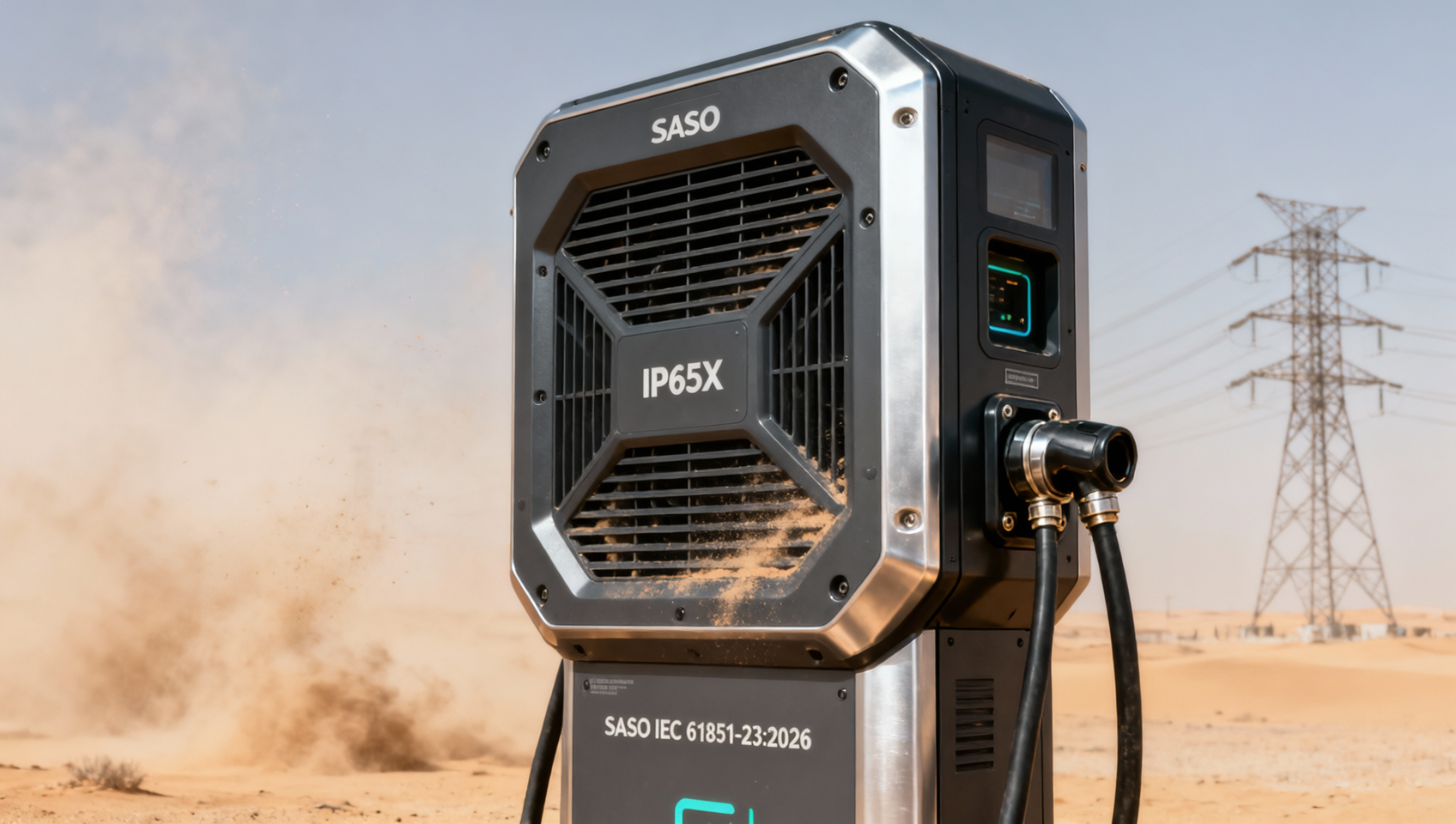
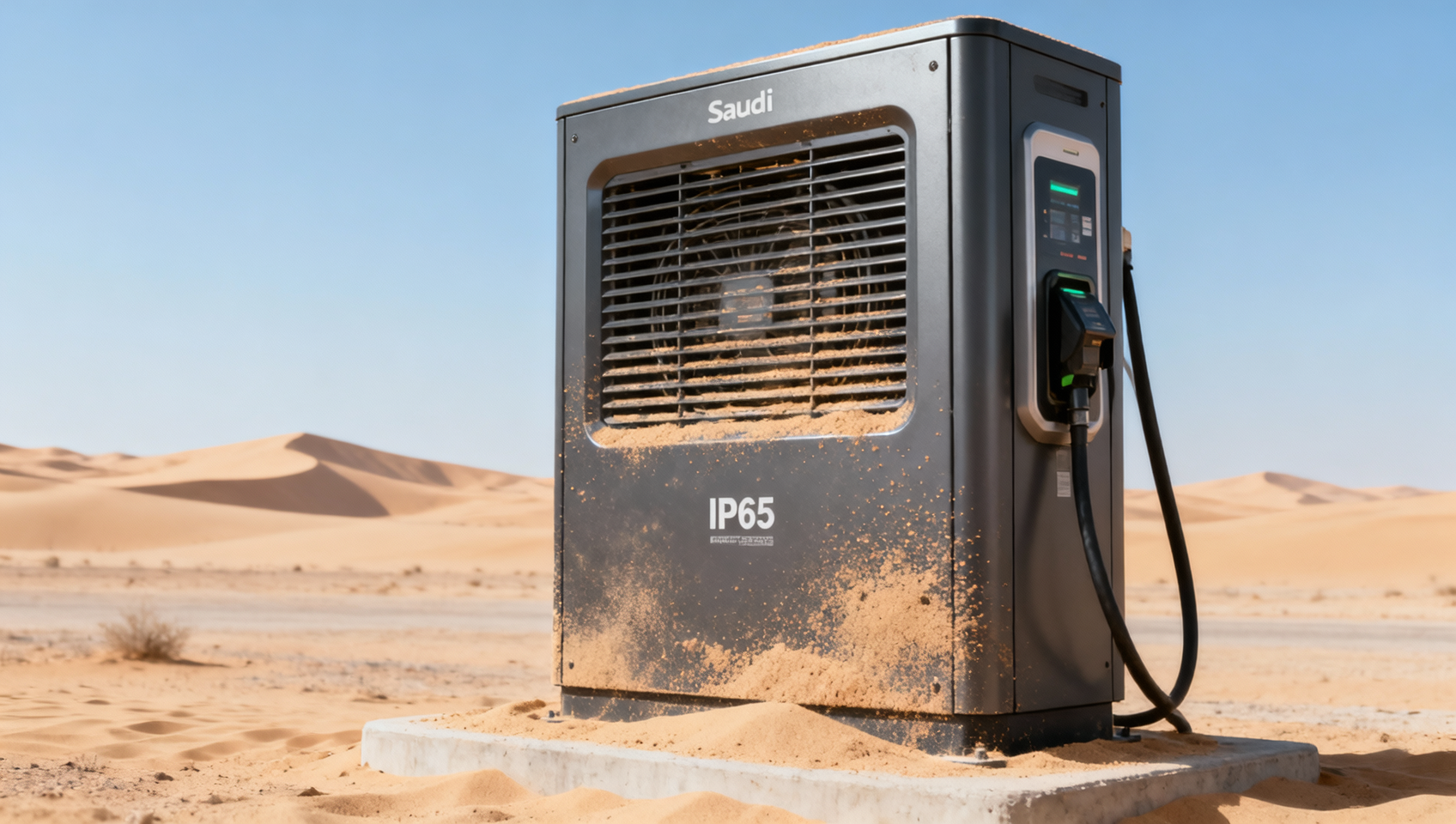
On April 20, 2026, SASO published SASO IEC 61851-23:2026 — a supplement to the international standard for EV conductive charging systems. The document requires all AC and DC EV chargers intended for sale in Saudi Arabia to undergo mandatory real-time compatibility testing with the Saudi Electricity Company (SEC) national grid. Testing must be conducted under three specified environmental conditions: high temperature (55°C), high humidity (95% RH), and sand exposure (IP65X-rated dust resistance). Certification must be completed through SASO-authorized local laboratories; Chinese export enterprises are required to partner with such labs, extending typical certification timelines to 12 weeks.
Industries Affected by Segment
Direct Exporters (e.g., Chinese EV Charger OEMs)
Exporters supplying EV chargers to Saudi Arabia will face extended time-to-market due to the new mandatory on-site grid testing. Unlike previous conformity assessments based on lab simulations or documentation review, this requirement introduces physical deployment and live-grid validation — increasing both cost and logistical complexity. Impact includes delayed shipment schedules, revised quotation lead times, and potential renegotiation of delivery clauses in commercial contracts.
Manufacturers with Integrated Power Electronics (e.g., Inverter/Converter Suppliers)
Chargers relying on proprietary or non-Saudi-validated power conversion topologies may fail stability tests under SEC’s dynamic load and voltage fluctuation profiles — especially during sand-induced thermal stress or humidity-triggered insulation degradation. Manufacturers must now verify not only component-level IP65X compliance but also system-level reactive power response and harmonic injection behavior under combined environmental stressors.
Certification & Compliance Service Providers
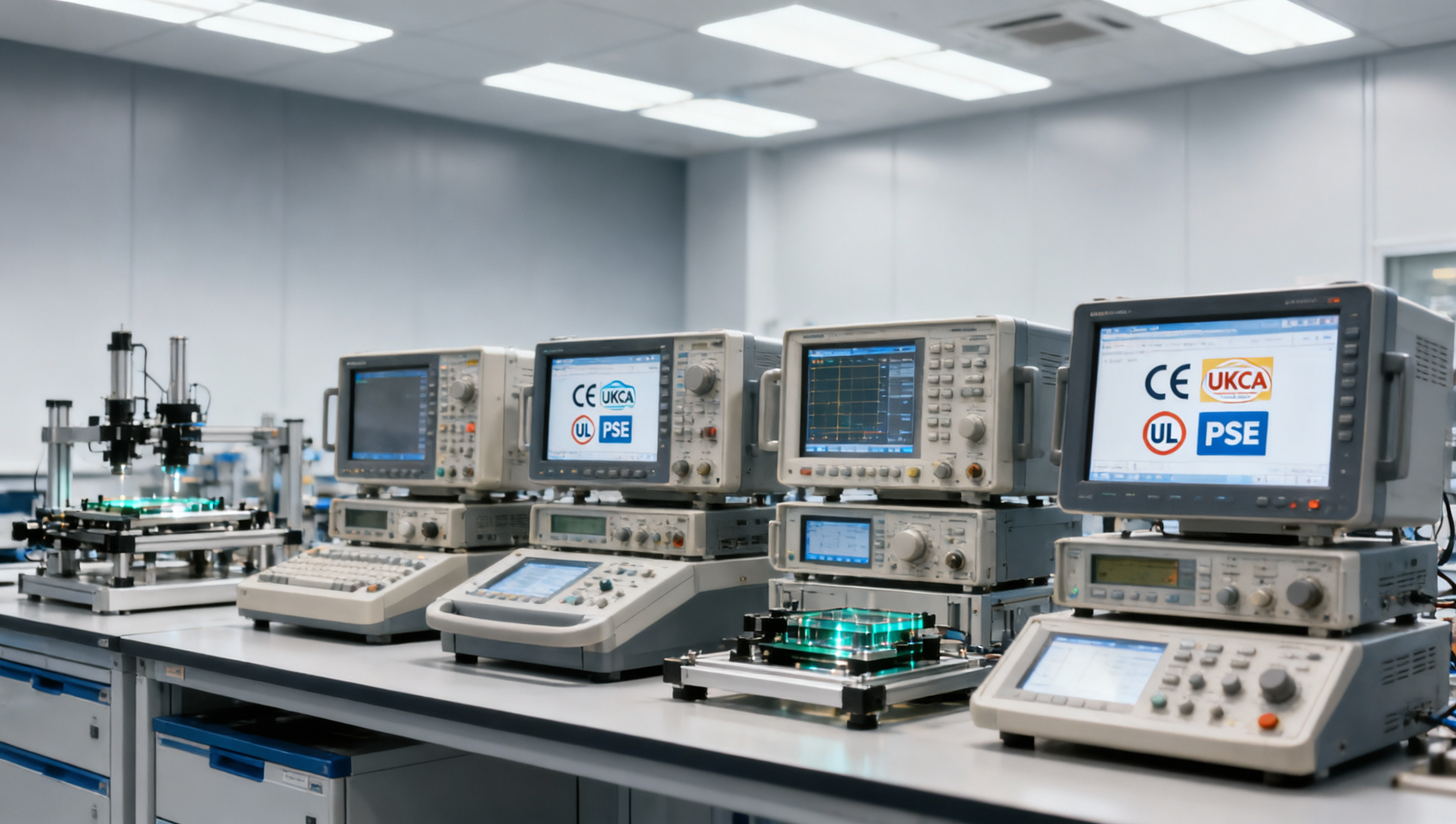
Third-party testing and certification bodies authorized by SASO — particularly those with SEC grid access and localized environmental test chambers — will see increased demand for integrated verification services. However, capacity constraints are expected given the 12-week minimum cycle and limited number of SASO-recognized labs capable of executing full SEC-interfaced validation. Service providers must clarify scope boundaries: “SASO IEC 61851-23:2026 compliance” now explicitly excludes standalone lab reports without SEC co-validation.
Distribution & Channel Partners in KSA
Local distributors and integrators must revise inventory planning and pre-sales engineering support. Stocking uncertified units risks customs rejection or post-import non-compliance penalties. Partners will need updated technical documentation packages — including SEC test logs and localized Arabic-language operation manuals referencing sand-filter maintenance intervals — before product launch.
What Relevant Enterprises Should Monitor and Do Now
Track official SASO implementation guidance and SEC test protocol updates
SASO has not yet published detailed test procedures, pass/fail thresholds, or SEC interface specifications (e.g., communication protocols, fault ride-through timing). Enterprises should monitor SASO’s official portal and SEC’s technical bulletins for clarifications expected in Q3 2026.
Confirm laboratory authorization status before initiating testing
Only SASO-listed labs with documented SEC collaboration agreements are permitted to perform the required tests. Exporters must verify lab credentials via SASO’s public registry — not rely on generic ISO/IEC 17025 accreditation alone — as unauthorized submissions will invalidate results.
Review existing product thermal management and enclosure design against IP65X + 55°C + 95% RH synergy
IP65X dust resistance alone does not guarantee stable grid synchronization under simultaneous high heat and humidity. Analysis来看, thermal runaway risk in power modules and condensation-induced arcing in control boards may emerge as critical failure modes — requiring design validation beyond standard IEC 60068-2 environmental testing.
Adjust supply chain timelines and contractual terms for 12-week certification cycles
The extended timeline applies to first-time certification and major design revisions. From industry perspective, companies should revise internal project gates, update customer delivery commitments, and allocate buffer time for potential retesting — especially if initial SEC validation reveals unexpected harmonic distortion or voltage sag recovery delays.
Editorial Perspective / Industry Observation
This regulation is better understood as an operational signal than a finalized enforcement outcome. While the rule is formally published, its practical impact hinges on SEC’s capacity to scale test infrastructure and SASO’s enforcement consistency across ports. Observation来看, the emphasis on real-grid testing — rather than simulation-based assessment — signals Saudi Arabia’s prioritization of grid resilience over rapid market entry. It also reflects a broader regional trend toward context-specific EV infrastructure standards, moving beyond harmonized IEC baselines. Current more appropriate interpretation is that this marks the start of a phased regulatory maturation process — not a static compliance endpoint.
Conclusion
The SASO IEC 61851-23:2026 supplement establishes a higher, environment-anchored bar for EV charger market access in Saudi Arabia. Its significance lies less in novelty and more in enforceability: it shifts compliance from paper-based conformity to physical, location-bound performance. For stakeholders, the most rational stance is to treat this as a structural recalibration — requiring technical adaptation, timeline realism, and close coordination with locally authorized partners — rather than a temporary hurdle.
Source Attribution
Main source: SASO official publication notice for SASO IEC 61851-23:2026, dated April 20, 2026.
Points under ongoing observation: SEC’s published test methodology, pass criteria, and list of fully authorized labs with live-grid access — none confirmed as of publication date.
Get weekly intelligence in your inbox.
No noise. No sponsored content. Pure intelligence.
 Apr 25, 2026Vietnam Enforces CN-EN Bilingual Safety Labels on Electronic Components from Apr 22, 2026Vietnam Enforces CN-EN Bilingual Safety Labels on Electronic Components from Apr 22, 2026
 Apr 25, 2026ANATEL Mandates Portuguese Offline Voice Assistants for Smart Home Devices in BrazilANATEL Mandates Portuguese Offline Voice Assistants for Smart Home Devices in Brazil
 Apr 25, 2026India BIS Mandates IS 13252:2025 for PLCs & HMIs by Oct 2026India BIS Mandates IS 13252:2025 for PLCs & HMIs by Oct 2026
 Apr 25, 2026SASO EV Charger Rules: Grid Compatibility & Sand Resistance RequiredSASO EV Charger Rules: Grid Compatibility & Sand Resistance Required
 Apr 25, 2026JIS T 0011:2026 Enforces IEC 62366-1:2024 for Rehab Devices in JapanJIS T 0011:2026 Enforces IEC 62366-1:2024 for Rehab Devices in Japan
 Apr 25, 2026THE Alliance Cuts Ningbo–Rotterdam Transit to 18 Days, +35% Spot RateTHE Alliance Cuts Ningbo–Rotterdam Transit to 18 Days, +35% Spot Rate
 Apr 25, 2026TÜV Rheinland Updates IoT EMC Standard: AI Edge Module Immunity Now MandatoryTÜV Rheinland Updates IoT EMC Standard: AI Edge Module Immunity Now Mandatory
 Apr 25, 2026USTR Launches Five-Year China Solar PV AD/CVD ReviewUSTR Launches Five-Year China Solar PV AD/CVD Review
 Apr 25, 2026EU New Battery Regulation Enters Force Apr 24, 2026EU New Battery Regulation Enters Force Apr 24, 2026
 Apr 25, 2026China Customs Launches RCEP Origin Smart Pre-Review for ASEAN机电 ExportsChina Customs Launches RCEP Origin Smart Pre-Review for ASEAN机电 Exports
 Apr 24, 2026India BIS Mandates IS 13252:2025 for PLCs & HMIs by Oct 2026India BIS Mandates IS 13252:2025 for PLCs & HMIs by Oct 2026
 Apr 24, 2026SASO EV Charger Regulation: Sand-Resistant Grid Compatibility Testing RequiredSASO EV Charger Regulation: Sand-Resistant Grid Compatibility Testing Required
 Apr 24, 2026Japan Updates JIS for Rehab Devices: IEC 62366-1:2024 Usability Compliance RequiredJapan Updates JIS for Rehab Devices: IEC 62366-1:2024 Usability Compliance Required
 Apr 24, 2026China Customs Launches RCEP Origin Smart Pre-Review SystemChina Customs Launches RCEP Origin Smart Pre-Review System
 Apr 24, 2026ANATEL Mandates Localized Voice Assistants for Smart Home Devices in BrazilANATEL Mandates Localized Voice Assistants for Smart Home Devices in Brazil
 Apr 24, 2026TÜV Rheinland Updates IoT EMC Standard with AI Edge抗扰度 RequirementTÜV Rheinland Updates IoT EMC Standard with AI Edge抗扰度 Requirement
 Apr 24, 20262M Alliance Shortens Ningbo–Rotterdam Route to 18 Days Amid 35% Slot Premium2M Alliance Shortens Ningbo–Rotterdam Route to 18 Days Amid 35% Slot Premium
 Apr 24, 2026Vietnam Enforces Bilingual Safety Labels for Imported Electronic Components from Apr 22, 2026Vietnam Enforces Bilingual Safety Labels for Imported Electronic Components from Apr 22, 2026
 Apr 24, 2026USTR Launches Sunset Review on China Solar PV AD/CVD DutiesUSTR Launches Sunset Review on China Solar PV AD/CVD Duties
 Apr 24, 2026EU New Battery Regulation Fully Effective Apr 24, 2026EU New Battery Regulation Fully Effective Apr 24, 2026
 Apr 23, 2026Taobao Factory Spark 3.0 Launches AI Workbench for SME Export FactoriesTaobao Factory Spark 3.0 Launches AI Workbench for SME Export Factories
 Apr 23, 2026TENENG Group Inspects IoT Safety Compliance at Jiangnan ChemicalTENENG Group Inspects IoT Safety Compliance at Jiangnan Chemical
 Apr 23, 2026China Launches First Embodied AI Open Data CommunityChina Launches First Embodied AI Open Data Community
 Apr 23, 2026PV Glass Prices Flat for 9 Weeks Amid Rising Integrated ProcurementPV Glass Prices Flat for 9 Weeks Amid Rising Integrated Procurement
 Apr 23, 20262984 NQI One-Stop Platforms Launched Nationwide2984 NQI One-Stop Platforms Launched Nationwide
 Apr 23, 2026China’s Green Smart Ship Tech Norms Accelerate BMS & Shore Power ExportChina’s Green Smart Ship Tech Norms Accelerate BMS & Shore Power Export
 Apr 23, 2026China Builds World's Largest Agri-Meteorological IoT NetworkChina Builds World's Largest Agri-Meteorological IoT Network