2026 Shanghai Fastener Show: 1427 Exhibitors, Robot-Specific Fasteners in Focus
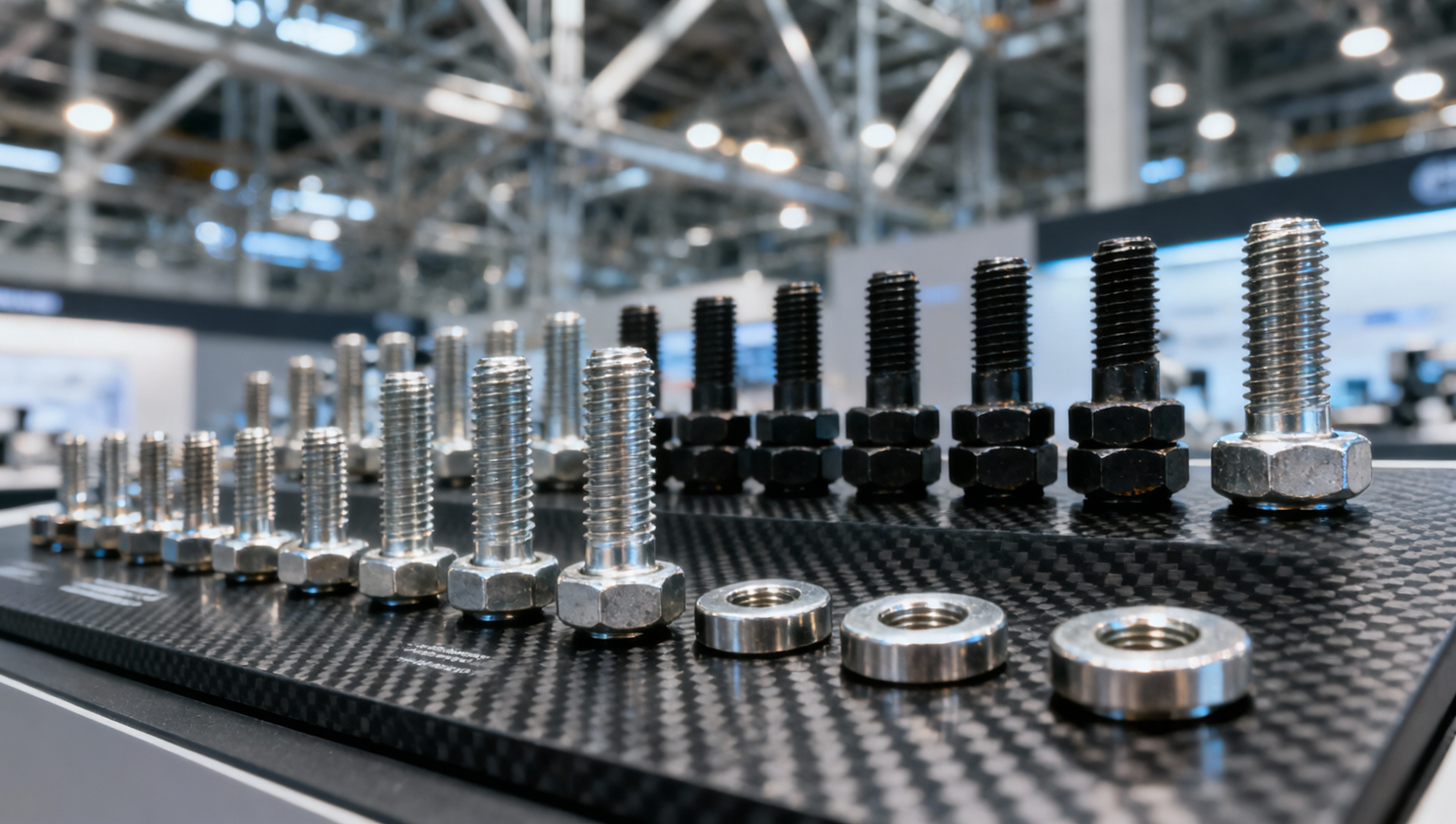
Confirmed exhibitor count for the 16th Shanghai International Fastener Exhibition (June 24–26, 2026) has reached 1,427 as of April 19, 2026 — with industrial automation–focused high-strength, corrosion-resistant fastener suppliers now accounting for 31% of all participants. The event signals growing alignment between fastener supply capabilities and the structural integration needs of industrial robots, particularly for manufacturers targeting German and Japanese robot OEMs.
Event Overview
The 16th Shanghai International Fastener Exhibition is scheduled for June 24–26, 2026. As of April 19, 2026, 1,427 brands have confirmed participation. Among them, suppliers specializing in Factory Automation applications — specifically high-strength, corrosion-resistant fasteners — represent 31% of total exhibitors. During the exhibition, the International Selection Guide for Fasteners Used in Industrial Robot Bodies will be released jointly by the China Machinery Industry Federation (CMIF) and the German Engineering Federation (VDMA). The guide aims to provide standardized interface references for Chinese fastener producers seeking qualification with German and Japanese industrial robot integrators and OEMs.
Impact on Specific Industry Segments
Direct Trading Enterprises
These firms act as intermediaries between Chinese fastener producers and overseas robot OEMs. With VDMA’s involvement in the new selection guide, technical documentation requirements — such as material traceability, torque-tension consistency testing, and surface treatment validation — are likely to become mandatory entry criteria for EU/Japan-bound robot body components. Their role may shift from order facilitation toward pre-qualification support and compliance coordination.
Raw Material Procurement Enterprises
Suppliers of specialty steels (e.g., A286, Inconel 718, or precipitation-hardened stainless grades) face increased demand visibility. The 31% share of automation-focused exhibitors reflects upstream demand concentration — not just volume growth, but stricter material certification expectations (e.g., EN 10204 3.1/3.2 mill certificates, heat lot traceability). Procurement teams should prioritize vendors with documented audit readiness for ISO 9001:2015 and IATF 16949-aligned processes.
Component Manufacturing Enterprises
Manufacturers producing fasteners for robot joints, end-effectors, or structural frames must align production parameters with the upcoming guide’s dimensional tolerances, thread engagement depth recommendations, and preload stability thresholds. Unlike general-purpose fasteners, robot-body applications require verified repeatability under dynamic load cycles — meaning process capability (Cpk ≥ 1.33) and in-process metrology (e.g., optical thread inspection) are no longer optional.
Supply Chain Service Providers
Logistics, testing, and certification service providers serving fastener exporters may see rising demand for batch-level mechanical testing reports (e.g., proof load, stress rupture), salt spray test documentation (ASTM B117, ≥720 hrs for critical joints), and bilingual technical dossiers compliant with both GB/T and DIN/ISO standards. These services are prerequisites for inclusion in the VDMA–CMIF guide’s recommended supplier pool.
What Relevant Enterprises or Practitioners Should Monitor and Act On
Track official release timing and scope of the VDMA–CMIF guide
While announced for launch at the exhibition, the final version’s applicability — whether advisory, contractual, or qualification-mandatory — remains unconfirmed. Enterprises should monitor CMIF and VDMA press channels post-June 26 for implementation timelines, version control, and any annexes covering specific robot families (e.g., KUKA KR series, Yaskawa GP models).
Verify alignment of current product specs with robot-body application benchmarks
Current fastener catalogs rarely distinguish between ‘automation-grade’ and ‘general industrial’ performance tiers. Companies should cross-check their existing high-strength offerings against publicly available robot OEM technical bulletins (e.g., ABB’s IRB mounting specifications, Fanuc’s R-30iB joint fastener notes) — focusing on thread class, surface finish Ra values, and hydrogen embrittlement mitigation protocols.
Prepare for enhanced documentation rigor — not just certification
Certifications (e.g., ISO, RoHS) alone won’t suffice. The guide emphasizes application-specific validation: test reports tied to exact heat lots, torque-angle curves per batch, and third-party verification of coating adhesion strength. Production teams should begin archiving digital records of every critical process step — especially for batches intended for automation-sector customers.
Engage early with domestic robot integrators on interface standardization efforts
Chinese robot OEMs (e.g., UBTECH, Hikrobot, CloudMinds) are not co-authors of the guide but are key downstream adopters. Suppliers should initiate technical dialogues now — not to influence the guide, but to understand how its recommendations may be interpreted or extended in domestic robot platform design specifications over 2026–2027.
Editor Perspective / Industry Observation
From industry perspective, this development is less a finalized market requirement and more a formalized signal of convergence between two previously loosely coupled sectors: precision fastening and robotic structural engineering. The 31% exhibitor share reflects actual commercial traction — not just vendor positioning — suggesting procurement teams at robot makers have already begun qualifying specialized fastener suppliers. However, the VDMA–CMIF guide itself remains a reference framework; its operational weight depends on whether major German and Japanese robot OEMs formally adopt it as a sourcing prerequisite. Current more appropriate interpretation is that it marks the start of standardization maturation — not its completion.
Conclusion
This milestone reflects an evolving supply chain reality: industrial robot structural integrity is increasingly treated as a systems-integration challenge, where fasteners are no longer commoditized hardware but engineered interfaces. For stakeholders, the event confirms directional demand — but does not yet mandate immediate process overhaul. It is better understood as a calibration point: validating current specialization efforts while clarifying the technical documentation and validation depth required to move from ‘capable supplier’ to ‘qualified tier-1 component partner’.
Information Source
Main source: Official exhibitor update and guide announcement released by Shanghai Fastener Exhibition Organizing Committee (as of April 19, 2026). The scope and enforcement status of the International Selection Guide for Fasteners Used in Industrial Robot Bodies remain subject to confirmation following its June 2026 release.
Get weekly intelligence in your inbox.
No noise. No sponsored content. Pure intelligence.
 Apr 20, 2026China Academy of IMT Releases Digital Passport White Paper for Industrial MaterialsChina Academy of IMT Releases Digital Passport White Paper for Industrial Materials
 Apr 20, 2026Suez Canal AI Speed & Load Limits Effective Apr 19, 2026Suez Canal AI Speed & Load Limits Effective Apr 19, 2026
 Apr 20, 2026IEC 63275:2026 Published for Warehouse Robotics EMC TestingIEC 63275:2026 Published for Warehouse Robotics EMC Testing
 Apr 20, 20262026 Shanghai Fastener Show: 1427 Exhibitors, Robot-Specific Fasteners in Focus2026 Shanghai Fastener Show: 1427 Exhibitors, Robot-Specific Fasteners in Focus
 Apr 20, 2026US BIS Expands EV Infrastructure Export ControlsUS BIS Expands EV Infrastructure Export Controls
 Apr 20, 2026TÜV Rheinland Updates ESS Certification with Propagation Blocking RequirementTÜV Rheinland Updates ESS Certification with Propagation Blocking Requirement
 Apr 20, 2026Shanghai Port Launches Green Clearance Channel for PV InvertersShanghai Port Launches Green Clearance Channel for PV Inverters
 Apr 20, 2026Vietnam Launches Anti-Circumvention Probe on Chinese Electronic ComponentsVietnam Launches Anti-Circumvention Probe on Chinese Electronic Components
 Apr 20, 2026CPSC Urges Recall of China-Made Smart Plugs Over Firmware VulnerabilitiesCPSC Urges Recall of China-Made Smart Plugs Over Firmware Vulnerabilities
 Apr 20, 2026EU AI Act CE Compliance for IoT Devices Takes Effect Apr 18, 2026EU AI Act CE Compliance for IoT Devices Takes Effect Apr 18, 2026
 Apr 19, 20262026 Dongguan Whole-House Customization List Released2026 Dongguan Whole-House Customization List Released
 Apr 19, 2026Global Shipping Alliances Launch Green Slot Priority for Asia-Europe RoutesGlobal Shipping Alliances Launch Green Slot Priority for Asia-Europe Routes
 Apr 19, 2026Vietnam Imposes AD Duties on Chinese Electronic ComponentsVietnam Imposes AD Duties on Chinese Electronic Components
 Apr 19, 2026Dongguan Victor Tops Local Full-Home Customization ListDongguan Victor Tops Local Full-Home Customization List
 Apr 19, 2026Guosheng Zhike Launches High-Precision Mold Machine Project in TaizhouGuosheng Zhike Launches High-Precision Mold Machine Project in Taizhou
 Apr 19, 2026CRRC Changchun Wins Jiaxing Urban Rail EMU ProjectCRRC Changchun Wins Jiaxing Urban Rail EMU Project
 Apr 19, 2026China Releases Green Design Guidelines 2026 for Industrial ProductsChina Releases Green Design Guidelines 2026 for Industrial Products
 Apr 19, 2026CATL Establishes $3B Era Resources Group for Global Mineral ControlCATL Establishes $3B Era Resources Group for Global Mineral Control
 Apr 19, 2026Shanghai Electric Gas Turbine Backlog Extends to 2028Shanghai Electric Gas Turbine Backlog Extends to 2028
 Apr 19, 2026Hormuz Strait Reopens, China Fertilizer Export Quota Easing ExpectedHormuz Strait Reopens, China Fertilizer Export Quota Easing Expected
 Apr 18, 2026TradeNexus Pro Launches Global Compliance RadarTradeNexus Pro Launches Global Compliance Radar
 Apr 18, 2026JIS T 2304:2026 Takes Effect June 1, 2026 for IVD SoftwareJIS T 2304:2026 Takes Effect June 1, 2026 for IVD Software
 Pathway for Rehab Devices with AI Modules") Apr 18, 2026FDA Updates 510(k) Pathway for Rehab Devices with AI ModulesFDA Updates 510(k) Pathway for Rehab Devices with AI Modules
Apr 18, 2026FDA Updates 510(k) Pathway for Rehab Devices with AI ModulesFDA Updates 510(k) Pathway for Rehab Devices with AI Modules Apr 18, 2026India BIS Approves 3 Chinese IoT Labs for IS 16444:2026 CertificationIndia BIS Approves 3 Chinese IoT Labs for IS 16444:2026 Certification
 Apr 18, 2026THE Alliance Launches Green Slot Priority for China PortsTHE Alliance Launches Green Slot Priority for China Ports
 Apr 18, 2026TÜV Rheinland Releases Dual-Standard ESS Certification Guide for ChinaTÜV Rheinland Releases Dual-Standard ESS Certification Guide for China
 Apr 18, 2026Vietnam Imposes AD Duties on Chinese Electronic ComponentsVietnam Imposes AD Duties on Chinese Electronic Components