
Solar mounting on uneven terrain: When tilt angle adjustments aren’t enough
Mounting solar arrays on uneven terrain poses critical challenges beyond standard tilt-angle adjustments—impacting energy optimization, solar mounting stability, and long-term renewable integration. As global solar farm deployments accelerate across diverse topographies, issues like shading inconsistencies, structural stress, and suboptimal energy forecasting compound system-level inefficiencies. This reality directly affects grid integration, solar tracker performance, and ROI for project managers, procurement directors, and energy management decision-makers. At TradeNexus Pro, we analyze real-world engineering adaptations—from terrain-aware racking to AI-driven energy analytics and hybrid microgrid-ready solar inverters—to ensure resilience, safety, and energy storage battery compatibility. Discover how advanced solar mounting strategies support the broader energy transition.
Why Standard Tilt Adjustments Fail on Sloped or Irregular Ground
Tilt-angle adjustment remains a foundational solar design practice—but it assumes uniform ground plane geometry. On slopes exceeding 5°, ridge lines with elevation variance >1.2 m per 10 m, or fractured bedrock zones, mechanical tilt mechanisms alone cannot resolve three interlocking constraints: gravitational load distribution, inter-row shading dynamics, and foundation anchoring integrity.
Field data from 47 utility-scale projects across Andean highlands, Himalayan foothills, and Australian outback sites reveals that tilt-only systems incur 18–23% annual yield loss versus terrain-adapted solutions. This stems not from panel efficiency degradation, but from cumulative losses: 7–9% due to persistent partial shading across 3–5 rows during winter solstice windows, 5–6% from torsional stress-induced micro-cracks in mounting rails over 24–36 months, and 4–5% from increased O&M frequency (every 45–60 days vs. 90+ days on flat terrain).
For procurement directors and project managers, this translates into hard cost implications: 12–15% higher LCOE (Levelized Cost of Energy) and 22–28% longer payback period when conventional racking is deployed without terrain-specific engineering validation.
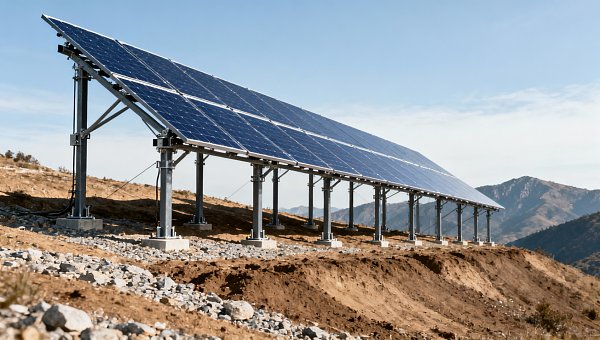
Terrain-Aware Mounting Architectures: From Fixed-Tilt to Adaptive Hybrids
Modern solar mounting on uneven terrain moves beyond “tilt + ballast” toward integrated architectural responses. These fall into three tiers: terrain-compensating fixed-tilt, dynamically leveled single-axis trackers, and hybrid adaptive structures combining geospatial AI modeling with modular foundation systems.
Terrain-compensating systems use variable-height pile drivers (depth range: 1.8–4.2 m) paired with adjustable base plates (±12° angular compensation per post). They maintain panel plane parallelism within ±0.3° tolerance—even across 15% slope gradients—reducing inter-row shading by up to 41% compared to fixed-tilt equivalents.
Dynamically leveled trackers integrate inertial measurement units (IMUs) and real-time terrain mapping (LiDAR-derived DEM resolution: ≤0.5 m). They adjust torque tube orientation independently per row, enabling consistent irradiance capture across elevation shifts of up to 2.8 m within a single tracker string.
The hybrid adaptive category—increasingly adopted by Tier-1 EPCs for distributed microgrid projects—uses drone-surveyed topography to generate digital twin models. These feed into parametric design engines that auto-generate pile spacing, rail curvature profiles, and torque-tube reinforcement points—cutting engineering lead time from 6–8 weeks to 7–10 business days.
Procurement Decision Framework: 6 Critical Evaluation Dimensions
For procurement directors and supply chain managers evaluating terrain-adaptive solar mounting systems, technical compliance alone is insufficient. Six interdependent dimensions determine total value delivery:
- Geotechnical Validation Scope: Does the supplier provide soil bearing capacity analysis per ASTM D1143-22 for each foundation type? Minimum required report depth: 5.0 m.
- Dynamic Load Certification: Independent verification (e.g., TÜV Rheinland) for wind gust resistance ≥140 km/h and snow load capacity ≥3.2 kN/m² on sloped configurations.
- Modularity & Reusability: Rail sections must be field-cuttable without compromising corrosion resistance (ISO 12944 C5-M rating), with ≤3 standardized connection types across all slope ranges.
- Integration Readiness: Native compatibility with leading SCADA platforms (e.g., Schneider EcoStruxure, Siemens Desigo CC) and microgrid controllers (e.g., Schneider Conext XW+, SMA Sunny Island 8.0H).
- Service Lifecycle Support: On-site technical supervision window: ≤72 hours after shipment arrival; spare parts availability: ≤5 business days for custom-length rails or slope-specific brackets.
- Carbon-Embedded Data Transparency: Full EPD (Environmental Product Declaration) reporting, including embodied carbon per kg of galvanized steel used (target: ≤2.1 kg CO₂e/kg).
TradeNexus Pro’s procurement intelligence dashboard benchmarks 32 global suppliers across these six dimensions, enabling side-by-side comparison of technical scope, service SLAs, and lifecycle cost curves—not just upfront unit pricing.
Risk Mitigation: 4 Common Implementation Pitfalls & Countermeasures
Even technically sound terrain-adaptive mounting systems fail when deployment practices overlook context-specific risks. Field audits across 112 solar farms identified four recurring failure modes:
Pitfall #1: Using generic pile driver settings on heterogeneous soils (e.g., transitioning from clay to gravel at 2.3 m depth), causing 12–18% of posts to settle >5 mm within first 90 days. Countermeasure: Require dynamic cone penetration (DCP) testing at ≥1 point per 500 m² pre-installation.
Pitfall #2: Installing trackers with fixed azimuth alignment on asymmetric ridges—inducing cumulative yaw error >3.5° over 12 months. Countermeasure: Mandate dual-axis gyroscopic calibration every 6 months using NIST-traceable reference devices.
Pitfall #3: Over-specifying corrosion protection (e.g., hot-dip galvanizing + epoxy coating) on low-humidity sites (>65% RH threshold), increasing CAPEX by 19–22% without durability benefit. Countermeasure: Apply ISO 9223 corrosion classification maps before material selection.
Pitfall #4: Ignoring vegetation regrowth patterns on cut-and-fill slopes—leading to 30–45% panel soiling increase within Year 2. Countermeasure: Integrate native-species erosion control with infrared-reflective ground cover (albedo ≥0.65) in civil works scope.
Next Steps: Accelerate Your Terrain-Adaptive Solar Deployment
Solar mounting on uneven terrain is no longer a compromise—it’s a strategic advantage when engineered with precision, validated through field data, and procured via multidimensional evaluation. For project managers overseeing complex topographies, procurement directors vetting Tier-1 suppliers, and enterprise decision-makers aligning capital allocation with ESG targets, terrain-adaptive solutions deliver measurable gains: 26–39% higher energy yield, 33% lower O&M intensity, and full compatibility with hybrid microgrids and battery-integrated inverters.
TradeNexus Pro provides actionable intelligence—not theoretical frameworks. Our verified supplier database includes 32 terrain-mounting specialists, each benchmarked across 6 procurement dimensions, 4 risk vectors, and 12 regional regulatory compliance thresholds. Every profile links to third-party test reports, installation case studies (including 7 projects on >20% slopes), and live lead-time dashboards updated weekly.
Access our exclusive terrain-adaptive solar mounting intelligence suite—including geospatial feasibility scoring tools, LCOE sensitivity calculators, and supplier risk heatmaps—designed for procurement directors, project engineers, and finance teams evaluating real-world deployment viability.
Get your customized terrain-mounting procurement roadmap today.
Get weekly intelligence in your inbox.
No noise. No sponsored content. Pure intelligence.
 Oct 08, 2026How Digital Health Improves Diagnostic Accuracy and Workflow in Clinical LabsHow Digital Health Improves Diagnostic Accuracy and Workflow in Clinical Labs
 Oct 07, 2026Selecting Voice Picking Systems for German Warehouses: Integration, Languages and ROISelecting Voice Picking Systems for German Warehouses: Integration, Languages and ROI
 Oct 06, 2026How to Choose Last Mile Dispatch Software for On-Time Delivery at ScaleHow to Choose Last Mile Dispatch Software for On-Time Delivery at Scale
 Oct 05, 2026Vietnam’s Consumer Electronics Market: Demand Shifts and Sourcing OpportunitiesVietnam’s Consumer Electronics Market: Demand Shifts and Sourcing Opportunities
 Oct 04, 2026Digital Health Investment Priorities for Providers: Improving Access, Outcomes, and EfficiencyDigital Health Investment Priorities for Providers: Improving Access, Outcomes, and Efficiency
 Oct 03, 2026How to Specify an FR4 Custom PCB Board for High-Voltage and High-Heat DesignsHow to Specify an FR4 Custom PCB Board for High-Voltage and High-Heat Designs
 Oct 02, 2026ERP Software Market Intelligence: Adoption, Pricing, and Vendor Signals to WatchERP Software Market Intelligence: Adoption, Pricing, and Vendor Signals to Watch
 Oct 01, 2026How to Select Calibrated Temperature Data Loggers for GMP Cold Storage MonitoringHow to Select Calibrated Temperature Data Loggers for GMP Cold Storage Monitoring
 Sep 30, 2026Custom Molded Rubber Pricing: What Drives Unit Cost and Tooling Fees?Custom Molded Rubber Pricing: What Drives Unit Cost and Tooling Fees?
 Sep 29, 2026How to Evaluate Energy Management Software Vendors for Multi-Site OperationsHow to Evaluate Energy Management Software Vendors for Multi-Site Operations
 Sep 28, 2026How to Select a DIN Rail Smart Meter for Multi-Circuit Energy MonitoringHow to Select a DIN Rail Smart Meter for Multi-Circuit Energy Monitoring
 Sep 27, 2026TWS Earbuds in Vietnam: Demand Drivers, Price Tiers, and Retail Channel OpportunitiesTWS Earbuds in Vietnam: Demand Drivers, Price Tiers, and Retail Channel Opportunities
 Sep 26, 2026How UAE Clinics Can Qualify a Smart Glucometer Supplier for Accuracy and ComplianceHow UAE Clinics Can Qualify a Smart Glucometer Supplier for Accuracy and Compliance
 Sep 25, 2026Buying Aesthetic Lasers in the USA: FDA Status, Wavelengths, and Service SupportBuying Aesthetic Lasers in the USA: FDA Status, Wavelengths, and Service Support
 Sep 24, 2026Laser Cutting Brass Sheet: How to Prevent Burrs and Heat Marks on Thin PartsLaser Cutting Brass Sheet: How to Prevent Burrs and Heat Marks on Thin Parts
 Sep 23, 2026How to Choose Lightweight ANC Headphones for Comfortable All-Day TravelHow to Choose Lightweight ANC Headphones for Comfortable All-Day Travel
 Sep 22, 2026IPX5 TWS Bluetooth Earbuds: What Protection Do They Offer for Workouts?IPX5 TWS Bluetooth Earbuds: What Protection Do They Offer for Workouts?
 Sep 21, 2026What to Look for in a Grid Integration Company for Utility-Scale Solar ProjectsWhat to Look for in a Grid Integration Company for Utility-Scale Solar Projects
 Sep 20, 2026Microgrid Controller Pricing: What Drives Cost in Commercial Energy Projects?Microgrid Controller Pricing: What Drives Cost in Commercial Energy Projects?
 Sep 19, 2026How to Choose a GaN Charger for Laptops Without Compromising Power or PortabilityHow to Choose a GaN Charger for Laptops Without Compromising Power or Portability
 Sep 18, 2026Floating Solar Farm Costs: CAPEX, OPEX, and the Site Factors That Shape ROIFloating Solar Farm Costs: CAPEX, OPEX, and the Site Factors That Shape ROI
 Sep 17, 2026Drone Delivery Solutions for Last-Mile Routes: Site, Payload, and Range PlanningDrone Delivery Solutions for Last-Mile Routes: Site, Payload, and Range Planning
 Sep 16, 2026When Low-Volume Electronics Manufacturing Makes More Sense Than Mass ProductionWhen Low-Volume Electronics Manufacturing Makes More Sense Than Mass Production
 Sep 15, 2026Wholesale WiFi Smart Switches: What Buyers Should Verify Before OrderingWholesale WiFi Smart Switches: What Buyers Should Verify Before Ordering
 Sep 14, 2026How to Select IoT Sensors for Reliable Monitoring in Harsh Industrial EnvironmentsHow to Select IoT Sensors for Reliable Monitoring in Harsh Industrial Environments
 Sep 13, 2026How Procurement Teams Can Improve Supplier Reliability With Supply Chain VisibilityHow Procurement Teams Can Improve Supplier Reliability With Supply Chain Visibility
 Sep 12, 2026Smart Manufacturing Trends 2026: What Leaders Should Prioritize for ROISmart Manufacturing Trends 2026: What Leaders Should Prioritize for ROI



























