Dental Milling Machines: Wet or Dry Milling for Better Lab Results?
Choosing between wet and dry dental milling machines affects more than a single production step. It shapes restoration accuracy, material selection, turnaround time, tool life, cleanup routines, and total operating cost across the lab. In current digital dentistry workflows, the decision is rarely about which method is universally better. It is about which milling approach aligns with precision goals, zirconia or glass ceramic output, equipment utilization, and maintenance discipline. For labs comparing dental milling machines, a clear evaluation framework helps reduce waste, improve consistency, and support better long-term results.
Understanding Wet and Dry Dental Milling Machines
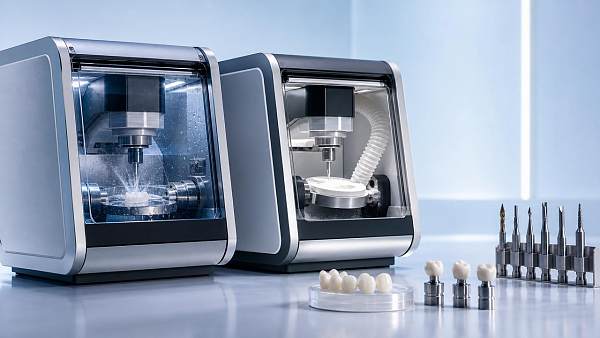
Dental milling machines use CAD/CAM data to shape restorations from solid blocks or discs with rotating burs. The main distinction lies in whether coolant is used during cutting. Wet dental milling machines deliver a continuous flow of water or coolant to reduce heat, flush debris, and support smoother machining of brittle materials. Dry dental milling machines operate without liquid during the milling cycle, relying instead on suction, airflow, and dust management systems.
This distinction matters because different materials respond differently to heat, friction, and chip removal. Glass ceramics, hybrid ceramics, PMMA, wax, titanium, and pre-sintered zirconia all place different demands on dental milling machines. In many labs, wet and dry milling are not competing ideas but complementary capabilities. Even so, budget limits, floor space, training requirements, and production focus often force a choice between one platform and another.
A practical comparison starts with four core factors: material compatibility, surface quality, throughput stability, and cost of ownership. Those variables usually determine whether a lab benefits more from wet dental milling machines, dry dental milling machines, or a hybrid solution with dual-mode capability.
Current Industry Priorities in Digital Dental Production
The market for dental milling machines continues to evolve as labs seek higher automation, tighter quality control, and broader material coverage. The most important signals shaping equipment decisions today include:
- Rising demand for full-contour zirconia restorations with repeatable marginal accuracy
- Continued use of glass ceramics for aesthetic anterior cases and chairside-style workflows
- Pressure to shorten delivery cycles without increasing remakes
- Greater attention to contamination control and machine cleaning protocols
- Interest in compact dental milling machines that can support flexible production cells
- Need for measurable ROI from tools, burs, coolant, filters, and machine downtime
These priorities make the wet-versus-dry decision highly operational. A lab focused on zirconia volume may optimize around dry dental milling machines for efficiency and simplified material flow. A lab producing a higher share of lithium disilicate or other glass ceramics may find wet dental milling machines more consistent for edge integrity and surface finish. The right answer is shaped by case mix, not by generic product positioning.
Performance Value of Dental Milling Machines in Lab Operations
When evaluated correctly, dental milling machines become a strategic production asset rather than a simple equipment purchase. Their value appears in three measurable areas: restoration quality, workflow continuity, and cost predictability.
Restoration quality and fit stability
Wet dental milling machines often perform strongly where heat-sensitive or brittle materials are involved. Coolant helps preserve edge detail and reduces microfracture risk during cutting. This can support better surface integrity for aesthetic restorations. Dry dental milling machines, meanwhile, are highly effective for pre-sintered zirconia because the material mills efficiently before final densification. With stable calibration and correct bur management, dry systems can deliver excellent fit consistency across routine crown and bridge production.
Workflow efficiency and machine uptime
Dry dental milling machines are often favored for straightforward zirconia throughput because they eliminate coolant fill, circulation, and drying steps. However, dust control becomes mission-critical. Poor extraction can affect machine life and contaminate work areas. Wet dental milling machines may require more cleaning discipline, but they can reduce thermal stress during demanding cuts and may offer a smoother path for multi-material production where glass ceramics are common.
Operating cost and consumable planning
Total cost of ownership for dental milling machines should include burs, coolant, filters, spindle wear, labor time for maintenance, remake rates, and idle capacity. Dry milling may lower fluid-related costs while increasing dependence on dust extraction and air management. Wet milling adds coolant handling but may protect quality in applications where poor finish would generate expensive rework. The lower-cost option on paper is not always the lower-cost option in production.
Material-Based Selection: Where Wet and Dry Milling Perform Best
Material mix is usually the strongest selection criterion for dental milling machines. A lab should map current and expected case volume by substrate before comparing spindle speed, axes, or software features.
For mixed-output labs, hybrid dental milling machines can be attractive, but only if mode switching is practical and contamination control is well defined. Shared platforms should be evaluated for actual cleaning time, software ease, tool change reliability, and whether the machine maintains accuracy across different materials without frequent recalibration.
Typical Lab Scenarios for Dental Milling Machines
Different production environments prioritize different machine strengths. The following scenarios help narrow the choice:
- High-zirconia crown and bridge production: dry dental milling machines usually provide the cleanest productivity model.
- Aesthetic case concentration with lithium disilicate: wet dental milling machines often support better detail preservation.
- Prototype, model, and provisional workflows: dry systems are commonly efficient for PMMA and wax.
- Broad material portfolio with lower daily batch size: dual-capability dental milling machines may offer flexibility if maintenance routines are disciplined.
- Labs with limited technical staffing: simpler maintenance architecture may be more valuable than a longer feature list.
In practice, many disappointing equipment outcomes come from mismatch rather than machine failure. A technically capable unit can still underperform if its preferred materials, cleanup burden, or software logic do not fit the actual production pattern.
Implementation Considerations and Risk Control
Before selecting dental milling machines, it is useful to test beyond brochure specifications. Focus on process control points that influence real production quality:
- Verify marginal fit consistency across repeated jobs, not just one sample restoration.
- Review bur lifespan by material type and actual replacement cost.
- Measure cleanup and maintenance time per shift.
- Check whether dust or coolant management creates contamination risks between materials.
- Assess software integration with existing CAD/CAM workflow and nesting logic.
- Confirm local technical support, spare parts access, and calibration service response.
It is also important to distinguish peak accuracy from sustainable accuracy. Dental milling machines may perform well during demonstration conditions but drift in daily operation if spindle maintenance, extraction performance, or coolant hygiene are inconsistent. Standard operating procedures should cover cleaning intervals, tool tracking, calibration checks, and material-specific milling parameters.
A Practical Next Step for Better Lab Results
The best choice between wet and dry dental milling machines comes from aligning machine capability with the real case mix, quality standard, and maintenance capacity of the lab. If zirconia dominates and throughput is the priority, dry milling is often the strongest fit. If glass ceramics and finish-sensitive restorations are central, wet milling often provides better control. Where material diversity is essential, a hybrid approach can work if cleaning, calibration, and workflow discipline are strong.
A useful next step is to build a simple evaluation matrix using current monthly material volume, remake rate, consumable spend, maintenance time, and target turnaround time. That comparison will reveal which dental milling machines support the most reliable return in real operating conditions. For organizations tracking broader digital manufacturing trends, TradeNexus Pro provides the kind of technical market context needed to connect equipment selection with long-range production strategy, supplier intelligence, and resilient growth planning.
Get weekly intelligence in your inbox.
No noise. No sponsored content. Pure intelligence.
 Sep 21, 2026What to Look for in a Grid Integration Company for Utility-Scale Solar ProjectsWhat to Look for in a Grid Integration Company for Utility-Scale Solar Projects
 Sep 20, 2026Microgrid Controller Pricing: What Drives Cost in Commercial Energy Projects?Microgrid Controller Pricing: What Drives Cost in Commercial Energy Projects?
 Sep 19, 2026How to Choose a GaN Charger for Laptops Without Compromising Power or PortabilityHow to Choose a GaN Charger for Laptops Without Compromising Power or Portability
 Sep 18, 2026Floating Solar Farm Costs: CAPEX, OPEX, and the Site Factors That Shape ROIFloating Solar Farm Costs: CAPEX, OPEX, and the Site Factors That Shape ROI
 Sep 17, 2026Drone Delivery Solutions for Last-Mile Routes: Site, Payload, and Range PlanningDrone Delivery Solutions for Last-Mile Routes: Site, Payload, and Range Planning
 Sep 16, 2026When Low-Volume Electronics Manufacturing Makes More Sense Than Mass ProductionWhen Low-Volume Electronics Manufacturing Makes More Sense Than Mass Production
 Sep 15, 2026Wholesale WiFi Smart Switches: What Buyers Should Verify Before OrderingWholesale WiFi Smart Switches: What Buyers Should Verify Before Ordering
 Sep 14, 2026How to Select IoT Sensors for Reliable Monitoring in Harsh Industrial EnvironmentsHow to Select IoT Sensors for Reliable Monitoring in Harsh Industrial Environments
 Sep 13, 2026How Procurement Teams Can Improve Supplier Reliability With Supply Chain VisibilityHow Procurement Teams Can Improve Supplier Reliability With Supply Chain Visibility
 Sep 12, 2026Smart Manufacturing Trends 2026: What Leaders Should Prioritize for ROISmart Manufacturing Trends 2026: What Leaders Should Prioritize for ROI
 Sep 11, 2026B2B Market Analysis: How Buyers Evaluate Suppliers, Pricing, and Delivery RiskB2B Market Analysis: How Buyers Evaluate Suppliers, Pricing, and Delivery Risk
 Sep 10, 2026Residential Solar Kits in Canada: How to Size a System for Your Home and ClimateResidential Solar Kits in Canada: How to Size a System for Your Home and Climate
 Sep 09, 2026How to Specify a Syringe Assembly Line for High-Volume Sterile ProductionHow to Specify a Syringe Assembly Line for High-Volume Sterile Production
 Sep 08, 2026How to Evaluate Warehouse Robotics System Suppliers for Reliable Multi-Site DeploymentHow to Evaluate Warehouse Robotics System Suppliers for Reliable Multi-Site Deployment
 Sep 07, 2026Renewable Geothermal Energy Explained: How It Works for Heating and PowerRenewable Geothermal Energy Explained: How It Works for Heating and Power
 Sep 07, 2026How to Choose an Industrial Packaging Robot Manufacturer for Your Production LineHow to Choose an Industrial Packaging Robot Manufacturer for Your Production Line
 Sep 05, 2026How to Evaluate a Turnkey Hydro Turbine Generator Supplier for Remote Power ProjectsHow to Evaluate a Turnkey Hydro Turbine Generator Supplier for Remote Power Projects
 Sep 04, 2026Automated Ultrasonic Welding for Thermoplastic Assemblies: Process Controls That MatterAutomated Ultrasonic Welding for Thermoplastic Assemblies: Process Controls That Matter
 Sep 03, 2026Energy Forecasting for Grid Planning: Sizing Solar and Storage CapacityEnergy Forecasting for Grid Planning: Sizing Solar and Storage Capacity
 Sep 02, 2026Which Metrics Should an Energy Analytics Dashboard Track for Factory Energy Management?Which Metrics Should an Energy Analytics Dashboard Track for Factory Energy Management?
 Sep 01, 2026How Warehouse Voice Picking Improves Accuracy and Throughput in Order FulfillmentHow Warehouse Voice Picking Improves Accuracy and Throughput in Order Fulfillment
 Aug 31, 2026How to Automate Dropshipping Order Processing Without Overselling StockHow to Automate Dropshipping Order Processing Without Overselling Stock
 Aug 30, 2026How to Evaluate a Smart Lighting Supplier for Multi-Site Commercial ProjectsHow to Evaluate a Smart Lighting Supplier for Multi-Site Commercial Projects
 Aug 29, 2026Recent Advances in Smart Manufacturing and Materials Reshaping Factory InvestmentRecent Advances in Smart Manufacturing and Materials Reshaping Factory Investment
 Aug 29, 2026Selecting Lightweight Aluminum Extrusions for Strength-Critical Industrial DesignsSelecting Lightweight Aluminum Extrusions for Strength-Critical Industrial Designs
 Aug 29, 2026Vertical Powder Anodizing Explained: Process Controls for Uniform Coating QualityVertical Powder Anodizing Explained: Process Controls for Uniform Coating Quality
 Aug 29, 2026PV Module Product Due Diligence: What Buyers Should Verify Before ContractingPV Module Product Due Diligence: What Buyers Should Verify Before Contracting