Endoscopy Equipment Upgrades: What Actually Improves Throughput?
For business evaluators, upgrades to endoscopy equipment are only worthwhile when they deliver measurable gains in throughput, reliability, and cost control. This article examines which investments actually reduce turnaround time, improve room utilization, and support higher procedural capacity—helping decision-makers separate high-impact improvements from expensive features that add little operational value.
In practical terms, throughput in an endoscopy unit is not determined by a single scope, processor, or software module. It is shaped by the full operational chain: patient intake, procedure room turnover, image capture, reprocessing, preventive maintenance, staff handoff, and unplanned downtime. For procurement teams and business evaluators, the right question is not simply whether new endoscopy equipment looks more advanced, but whether it shortens the cycle time per case by 5 to 15 minutes, increases same-day room availability, or reduces repair-related cancellations over a 12-month period.
That distinction matters because capital budgets in healthcare technology are tight, while procedure demand continues to expand in gastrointestinal, pulmonary, and ENT settings. A facility may invest in premium visualization or accessory compatibility, yet still fail to improve daily case volume if washer-disinfector capacity, drying cabinet availability, or documentation workflow remains the bottleneck. The most effective endoscopy equipment upgrades are therefore system-level decisions tied to measurable operating outcomes.
Where Throughput Actually Improves in an Endoscopy Workflow
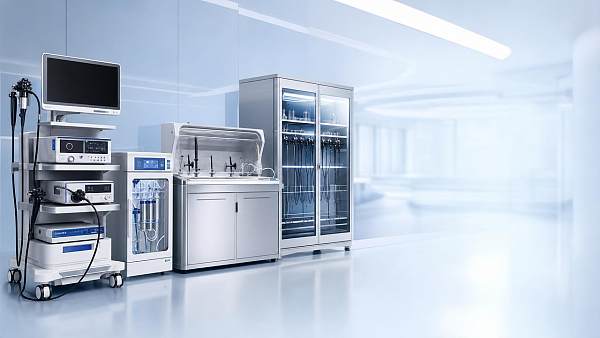
Business evaluators should begin with the baseline workflow. In many facilities, a single endoscopy procedure occupies more than the scheduled exam time. A 20-minute colonoscopy can trigger 45 to 70 minutes of total resource use when room turnover, scope transport, leak testing, cleaning, disinfection, drying, and chart completion are included. That is why throughput gains often come from reducing friction between steps rather than from adding isolated device features.
The four bottlenecks that most often limit capacity
Across ambulatory centers and hospital-based units, four bottlenecks appear repeatedly. First, slow reprocessing creates scope shortages during peak hours. Second, room turnover delays reduce procedural starts per room. Third, equipment downtime causes case rescheduling. Fourth, fragmented documentation slows discharge and physician workflow. Upgrades that target these four points usually generate stronger return than cosmetic improvements or overspecified imaging options that exceed clinical need.
- Reprocessing bottlenecks during 2 to 3 daily peak blocks
- Room reset times exceeding 10 to 15 minutes between standard cases
- Scope fleet utilization above 80%, leaving little contingency capacity
- Documentation or image transfer steps requiring duplicate manual entry
Which upgrade categories tend to move the needle
In most evaluations, the highest-impact endoscopy equipment investments fall into five categories: faster and more consistent reprocessing systems, expanded scope fleet balance, integrated imaging and reporting, durable components that reduce service interruption, and room-standardized accessories that simplify staff setup. Each of these affects throughput differently, so decision-makers should compare them against the facility’s dominant constraint.
The table below shows how common upgrade types typically influence operational capacity. The ranges are not a promise of performance; they reflect common evaluation frameworks used in capital planning and process redesign.
The core conclusion is straightforward: endoscopy equipment upgrades improve throughput most when they attack waiting time, not just procedure time. A 4K image chain may improve clinical visibility, but if the unit still waits 30 minutes for a cleaned scope or loses 2 procedure slots per week to preventable downtime, throughput will remain constrained.
A practical screening question for evaluators
Before approving any capital request, ask whether the proposed upgrade directly influences one of these measurable outputs within 90 to 180 days: more cases per room per day, lower reprocessing queue time, fewer delayed starts, lower repair frequency, or fewer overtime hours. If the answer is unclear, the investment may be clinically useful but operationally weak.
High-Impact Endoscopy Equipment Upgrades by Priority
Not all endoscopy equipment should be upgraded at the same time. For most business evaluations, the best sequence is to address constraints in order of operational dependency. If scopes are unavailable, imaging improvements will not add capacity. If documentation is slow, adding procedure rooms may not improve discharge flow. Priority should follow the real bottleneck.
1. Reprocessing systems and drying infrastructure
The biggest throughput gains often come from reprocessing. Manual steps vary by staff experience, while automated washer-disinfectors and well-designed drying storage reduce variability and improve release readiness. In busy units running 20 to 40 cases per day, even a 15-minute reduction in average scope turnaround can unlock additional scheduling capacity without adding another procedure room.
Evaluators should examine how many scopes are in circulation, how many are usually in reprocessing, and whether peak demand creates a queue. If a unit operates with a narrow scope buffer, a reprocessing bottleneck can trigger cascading delays across the morning list.
2. Fleet balance instead of simple fleet expansion
Buying more scopes is not always the same as buying the right scopes. Throughput improves when the fleet mix matches procedure demand across upper GI, lower GI, specialty cases, and backup inventory. A center with 12 scopes may still face shortages if 8 are concentrated in one modality while the fastest-growing service line lacks enough units. The goal is not maximum inventory, but an efficient operating buffer, often around 15% to 25% above average simultaneous need.
3. Reporting, imaging, and workflow integration
Software is frequently underestimated in endoscopy equipment planning. When image capture, reporting, and records integration are fragmented, clinicians and nurses lose time to repeat entry, manual export, and delayed report finalization. Saving 4 minutes across 25 daily cases creates more than 100 minutes of recovered staff time, which can be redeployed to room turnover, patient flow, or same-day add-ons.
4. Reliability-oriented hardware replacement
Some upgrades do not make a single case faster, but they still increase throughput by reducing interruptions. Aging processors, light sources, and support modules may create sporadic failures that are hard to quantify until a backlog appears. If a component causes even 1 cancelled list per quarter, the operational and revenue impact may justify replacement sooner than cosmetic equipment refresh cycles would suggest.
The next table helps evaluators rank endoscopy equipment upgrades by operational urgency, capital intensity, and expected time to benefit.
This ranking also shows why capital committees should avoid one-dimensional procurement logic. The lowest-cost option is not always the most economical if it leaves daily constraints unresolved. Conversely, the most technically sophisticated endoscopy equipment may not improve throughput if the underlying process bottleneck sits elsewhere.
How to Evaluate ROI Without Overestimating Feature Value
A disciplined evaluation framework should combine throughput, reliability, and total operational cost. Many healthcare buyers overemphasize purchase price while underweighting lost capacity. In endoscopy, a single room that loses 30 minutes per day due to scope availability, downtime, or documentation friction can forfeit meaningful procedure capacity over 48 to 50 working weeks per year.
Use five operational metrics before and after upgrade
- Average procedure room turnaround time
- Scope reprocessing cycle time from bedside return to release
- Delayed starts linked to equipment availability
- Downtime hours and mean time to repair
- Cases completed per room per day or per session block
These metrics should be tracked for at least 4 to 8 weeks before purchase and again for 8 to 12 weeks after implementation. That timeframe is long enough to smooth out one-off staffing disruptions and reveal whether the new endoscopy equipment changed the operating pattern rather than merely improving perception.
Separate clinically valuable features from throughput drivers
Some enhancements matter mainly for visualization quality, specialist preference, or future-proofing. Those may still be justified, but they should not be credited with throughput gains unless they reduce repeat handling, simplify setup, or streamline workflow. Evaluators should ask a direct question during vendor review: which feature saves measurable minutes, reduces manual steps, or lowers failure frequency, and which feature primarily improves user experience or image quality?
Common overvaluation traps
- Assuming higher image resolution automatically increases daily case count
- Buying excess accessory compatibility without a verified procedure mix need
- Ignoring maintenance response time in multi-site operations
- Counting theoretical capacity gains without validating staffing and room availability
A strong ROI model includes direct and indirect impacts. Direct impacts include fewer delays, lower overtime, and reduced outsourced repairs. Indirect impacts include better schedule resilience, improved physician adoption, and fewer cancellations caused by equipment-related failures. In larger networks, standardized endoscopy equipment can also reduce spare-parts complexity and training time across multiple sites.
Implementation Risks, Procurement Checks, and Operational Best Practice
Even the right endoscopy equipment can underperform if rollout is poorly managed. Throughput gains often fail to materialize when sites skip workflow mapping, underestimate training needs, or maintain old documentation habits after digital integration. Procurement teams should treat implementation as a 3-stage program: pre-purchase validation, operational rollout, and post-launch measurement.
Pre-purchase validation checklist
Before signing, confirm compatibility across scopes, processors, reprocessing tools, storage, reporting interfaces, and service support coverage. Validate lead times as well. In current global supply conditions, delivery windows for healthcare technology components may range from 4 to 12 weeks depending on configuration, import route, and installation requirements.
Rollout discipline matters as much as hardware
Facilities should schedule training by role, not just by department. Reprocessing staff, nurses, physicians, and biomedical support teams all interact with endoscopy equipment differently. A 2-hour general session is rarely enough. More effective programs use 3 to 5 role-based modules, followed by supervised operation during the first 1 to 2 weeks.
Post-launch review should be mandatory
Within 30, 60, and 90 days, compare projected benefits against actual metrics. If turnaround time has not changed, the root cause may be process discipline rather than equipment design. This review protects capital efficiency and helps separate procurement success from implementation drift.
Questions business evaluators should ask suppliers
- What are the recommended preventive maintenance intervals: quarterly, semiannual, or annual?
- What is the standard service response window for critical failures?
- Which components most commonly drive unplanned downtime?
- How is user training structured across procedure staff and reprocessing teams?
- What data outputs are available for utilization tracking and workflow reporting?
For procurement leaders working through platforms such as TradeNexus Pro, the advantage lies in comparing endoscopy equipment decisions through a wider supply-chain and lifecycle lens. That means evaluating support continuity, spare-part access, implementation readiness, and interoperability alongside upfront product capability. In a market where equipment performance is only one part of operational success, this broader intelligence is what turns purchasing into capacity planning.
The endoscopy equipment upgrades that truly improve throughput are rarely the ones with the longest feature list. The highest-value investments are those that reduce reprocessing delays, stabilize equipment uptime, streamline reporting, and align scope availability with actual demand. For business evaluators, the winning decision is measurable within weeks, defensible over 12 months, and scalable across growing procedural volumes. To assess upgrade priorities, compare suppliers, or build a more rigorous procurement case, contact us to get a tailored solution and explore more healthcare technology sourcing insights.
Get weekly intelligence in your inbox.
No noise. No sponsored content. Pure intelligence.
 Sep 21, 2026What to Look for in a Grid Integration Company for Utility-Scale Solar ProjectsWhat to Look for in a Grid Integration Company for Utility-Scale Solar Projects
 Sep 20, 2026Microgrid Controller Pricing: What Drives Cost in Commercial Energy Projects?Microgrid Controller Pricing: What Drives Cost in Commercial Energy Projects?
 Sep 19, 2026How to Choose a GaN Charger for Laptops Without Compromising Power or PortabilityHow to Choose a GaN Charger for Laptops Without Compromising Power or Portability
 Sep 18, 2026Floating Solar Farm Costs: CAPEX, OPEX, and the Site Factors That Shape ROIFloating Solar Farm Costs: CAPEX, OPEX, and the Site Factors That Shape ROI
 Sep 17, 2026Drone Delivery Solutions for Last-Mile Routes: Site, Payload, and Range PlanningDrone Delivery Solutions for Last-Mile Routes: Site, Payload, and Range Planning
 Sep 16, 2026When Low-Volume Electronics Manufacturing Makes More Sense Than Mass ProductionWhen Low-Volume Electronics Manufacturing Makes More Sense Than Mass Production
 Sep 15, 2026Wholesale WiFi Smart Switches: What Buyers Should Verify Before OrderingWholesale WiFi Smart Switches: What Buyers Should Verify Before Ordering
 Sep 14, 2026How to Select IoT Sensors for Reliable Monitoring in Harsh Industrial EnvironmentsHow to Select IoT Sensors for Reliable Monitoring in Harsh Industrial Environments
 Sep 13, 2026How Procurement Teams Can Improve Supplier Reliability With Supply Chain VisibilityHow Procurement Teams Can Improve Supplier Reliability With Supply Chain Visibility
 Sep 12, 2026Smart Manufacturing Trends 2026: What Leaders Should Prioritize for ROISmart Manufacturing Trends 2026: What Leaders Should Prioritize for ROI
 Sep 11, 2026B2B Market Analysis: How Buyers Evaluate Suppliers, Pricing, and Delivery RiskB2B Market Analysis: How Buyers Evaluate Suppliers, Pricing, and Delivery Risk
 Sep 10, 2026Residential Solar Kits in Canada: How to Size a System for Your Home and ClimateResidential Solar Kits in Canada: How to Size a System for Your Home and Climate
 Sep 09, 2026How to Specify a Syringe Assembly Line for High-Volume Sterile ProductionHow to Specify a Syringe Assembly Line for High-Volume Sterile Production
 Sep 08, 2026How to Evaluate Warehouse Robotics System Suppliers for Reliable Multi-Site DeploymentHow to Evaluate Warehouse Robotics System Suppliers for Reliable Multi-Site Deployment
 Sep 07, 2026Renewable Geothermal Energy Explained: How It Works for Heating and PowerRenewable Geothermal Energy Explained: How It Works for Heating and Power
 Sep 07, 2026How to Choose an Industrial Packaging Robot Manufacturer for Your Production LineHow to Choose an Industrial Packaging Robot Manufacturer for Your Production Line
 Sep 05, 2026How to Evaluate a Turnkey Hydro Turbine Generator Supplier for Remote Power ProjectsHow to Evaluate a Turnkey Hydro Turbine Generator Supplier for Remote Power Projects
 Sep 04, 2026Automated Ultrasonic Welding for Thermoplastic Assemblies: Process Controls That MatterAutomated Ultrasonic Welding for Thermoplastic Assemblies: Process Controls That Matter
 Sep 03, 2026Energy Forecasting for Grid Planning: Sizing Solar and Storage CapacityEnergy Forecasting for Grid Planning: Sizing Solar and Storage Capacity
 Sep 02, 2026Which Metrics Should an Energy Analytics Dashboard Track for Factory Energy Management?Which Metrics Should an Energy Analytics Dashboard Track for Factory Energy Management?
 Sep 01, 2026How Warehouse Voice Picking Improves Accuracy and Throughput in Order FulfillmentHow Warehouse Voice Picking Improves Accuracy and Throughput in Order Fulfillment
 Aug 31, 2026How to Automate Dropshipping Order Processing Without Overselling StockHow to Automate Dropshipping Order Processing Without Overselling Stock
 Aug 30, 2026How to Evaluate a Smart Lighting Supplier for Multi-Site Commercial ProjectsHow to Evaluate a Smart Lighting Supplier for Multi-Site Commercial Projects
 Aug 29, 2026Recent Advances in Smart Manufacturing and Materials Reshaping Factory InvestmentRecent Advances in Smart Manufacturing and Materials Reshaping Factory Investment
 Aug 29, 2026Selecting Lightweight Aluminum Extrusions for Strength-Critical Industrial DesignsSelecting Lightweight Aluminum Extrusions for Strength-Critical Industrial Designs
 Aug 29, 2026Vertical Powder Anodizing Explained: Process Controls for Uniform Coating QualityVertical Powder Anodizing Explained: Process Controls for Uniform Coating Quality
 Aug 29, 2026PV Module Product Due Diligence: What Buyers Should Verify Before ContractingPV Module Product Due Diligence: What Buyers Should Verify Before Contracting