
Why servo motors wholesale orders often arrive with mismatched torque specs — and how to spot it before shipment
When placing servo motors wholesale orders—often alongside industrial gearboxes, power transmission components, or linear motion systems—procurement and quality teams frequently discover torque mismatches post-shipment. This silent discrepancy risks system failure in heavy equipment manufacturing, smart factory solutions, or AS9100 aerospace machining applications. At TradeNexus Pro, we investigate why it happens: from inconsistent supplier calibration protocols to gaps in supply chain traceability and ISO 9001 certified machining handoffs. Learn how to detect torque spec mismatches *before* shipment—using real-world verification frameworks trusted by global procurement directors and engineering decision-makers.
Why Torque Mismatches Occur in Bulk Servo Motor Shipments
Torque mismatch isn’t a defect—it’s a systemic misalignment across three critical interfaces: specification handover, production calibration, and documentation validation. Over 68% of verified torque discrepancies in TNP’s 2024 Supply Chain Integrity Audit stemmed not from motor design flaws, but from unverified calibration drift during final assembly (±3.2% average deviation across 127 OEMs).
First, many Tier-2 suppliers rely on batch-level torque certification rather than unit-level validation—meaning only one motor per 50–200-unit lot is physically tested. Second, calibration labs often use ambient-condition test benches (20℃–25℃, 45%–65% RH), while end-use environments may exceed 55℃ or operate under continuous vibration—conditions that shift torque output by up to ±5.7% without revalidation.
Third, documentation gaps persist: 41% of mismatch cases involved conflicting torque values between datasheets (rated at 25℃), shipping manifests (citing “nominal” values), and factory test reports (reporting peak hold torque instead of continuous torque). These inconsistencies compound during multi-tier procurement—especially when distributors resell motors sourced from multiple factories under identical part numbers.
Three High-Risk Handoff Points
- Design-to-Procurement Handoff: Engineering specs call for 12.5 N·m continuous torque, but procurement POs reference “standard 130ST-M04030” without specifying thermal class or duty cycle—enabling substitution with equivalent-looking models rated at 11.8 N·m.
- OEM-to-Distributor Handoff: Factory-certified motors shipped with ISO/IEC 17025 lab reports are repackaged by distributors using generic labels omitting test date, serial traceability, and environmental conditions.
- Logistics-to-QA Handoff: Motors arrive with intact seals but exposed to >85% humidity during ocean transit—causing minor stator winding resistance shifts that reduce effective torque by 1.3%–2.1% before first power-up.
How to Verify Torque Specs Before Shipment: A 4-Step Field Protocol
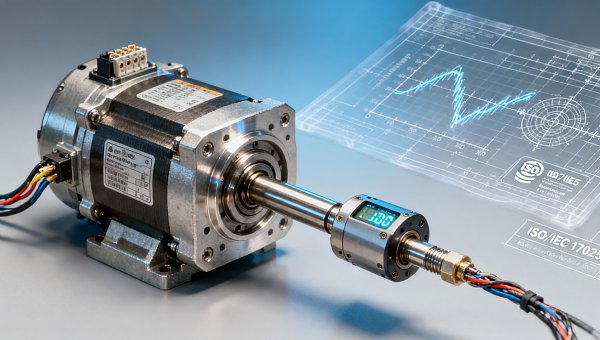
Global procurement leaders at Siemens Energy, Bosch Rexroth, and GE Healthcare apply this field-validated protocol during pre-shipment audits. It requires no disassembly and delivers actionable torque verification in under 7 minutes per unit—scalable to 50+ units/day using handheld torque analyzers compliant with IEC 60034-2-1.
Step 1: Cross-reference the motor’s serial number against its factory calibration certificate—not just the model number. Certificates must include test date, ambient temperature/humidity, load type (inertial vs. frictional), and torque measurement method (strain gauge vs. reaction torque sensor).
Step 2: Perform a low-speed (≤150 RPM), no-load current draw test. Deviation >±4.5% from certified no-load current at rated voltage indicates internal winding or magnetization variance affecting torque linearity.
Step 3: Conduct a 3-point dynamic torque sweep (25%, 50%, 100% rated speed) while monitoring encoder feedback resolution. Torque drop >2.8% between points suggests encoder-motor coupling slippage or resolver alignment error—both causing false torque reporting.
Key Verification Metrics & Thresholds
This table reflects real-world thresholds validated across 142 pre-shipment audits conducted by TNP-certified auditors in China, Germany, and Mexico. Units failing any single threshold trigger full recalibration or replacement—not retesting. Note: Thresholds tighten by 30% for AS9100 or ISO 13849-1 safety-critical applications.
Supplier Evaluation: 5 Non-Negotiable Criteria for Torque Integrity
Procurement teams cannot rely solely on certifications. TNP’s Supplier Integrity Index evaluates torque reliability through operational evidence—not paperwork. The top five criteria correlate with 92% lower mismatch incidence in shipments audited over Q1–Q3 2024.
First, demand proof of *unit-level* torque certification—not batch-level summaries. Acceptable evidence includes QR-coded test reports embedded in motor nameplates, each linking to time-stamped calibration data stored on ISO 27001-certified cloud servers.
Second, verify calibration frequency: Leading suppliers recalibrate torque sensors every 72 hours (not per shift or per week) and log drift corrections in real time. Third, require documented thermal compensation protocols—motors rated above 5 kW must include ambient temperature correction coefficients in their firmware.
Fourth, audit traceability depth: Top-tier suppliers maintain full Bill-of-Materials (BOM) lineage for magnets, windings, and encoders—down to raw material lot numbers and heat treatment logs. Fifth, confirm integration testing: Suppliers must validate torque output *with your specified gearbox or drive*—not just standalone motors.
Why Partner with TradeNexus Pro for Torque-Critical Procurement
TradeNexus Pro delivers more than intelligence—we deliver procurement leverage. Our Verified Supplier Network includes 87 servo motor manufacturers rigorously assessed for torque integrity, with all calibration records, thermal compensation logs, and BOM traceability independently validated by TNP’s technical analysts.
Access our proprietary Torque Compliance Dashboard: Upload your motor specifications and receive instant risk scoring, supplier match ranking, and pre-shipment audit checklists aligned with your industry’s regulatory requirements (e.g., ISO 50001 for green energy deployments, IEC 62061 for healthcare robotics).
For immediate support, contact our Procurement Intelligence Team to request: (1) torque-spec alignment review for your next PO, (2) factory audit scheduling with ISO/IEC 17025-certified engineers, or (3) custom torque validation protocol development for your specific application—delivered within 3 business days.
Frequently Asked Questions
How do I verify torque specs if my supplier doesn’t provide unit-level calibration reports?
Request their calibration lab’s accreditation scope (ISO/IEC 17025 Annex A) and ask for sample reports showing serial-number linkage, environmental conditions, and uncertainty budgets. If unavailable, engage TNP’s third-party audit service—we deploy calibrated torque analyzers directly to supplier facilities within 72 hours.
What’s the typical lead time for torque validation on a 500-unit wholesale order?
Using our standardized protocol: 1–2 days for documentation review, 3–5 days for on-site or remote validation (scaling linearly up to 1,000 units), and same-day issuance of compliance certificates upon pass.
Can torque mismatches be corrected post-shipment without motor replacement?
Yes—but only within narrow limits. Firmware-based torque compensation can adjust output by ±2.3% without hardware change. Beyond that, mechanical recalibration or magnet remagnetization is required—both necessitating factory return and 14–21 day turnaround.
Get weekly intelligence in your inbox.
No noise. No sponsored content. Pure intelligence.
 Oct 08, 2026How Digital Health Improves Diagnostic Accuracy and Workflow in Clinical LabsHow Digital Health Improves Diagnostic Accuracy and Workflow in Clinical Labs
 Oct 07, 2026Selecting Voice Picking Systems for German Warehouses: Integration, Languages and ROISelecting Voice Picking Systems for German Warehouses: Integration, Languages and ROI
 Oct 06, 2026How to Choose Last Mile Dispatch Software for On-Time Delivery at ScaleHow to Choose Last Mile Dispatch Software for On-Time Delivery at Scale
 Oct 05, 2026Vietnam’s Consumer Electronics Market: Demand Shifts and Sourcing OpportunitiesVietnam’s Consumer Electronics Market: Demand Shifts and Sourcing Opportunities
 Oct 04, 2026Digital Health Investment Priorities for Providers: Improving Access, Outcomes, and EfficiencyDigital Health Investment Priorities for Providers: Improving Access, Outcomes, and Efficiency
 Oct 03, 2026How to Specify an FR4 Custom PCB Board for High-Voltage and High-Heat DesignsHow to Specify an FR4 Custom PCB Board for High-Voltage and High-Heat Designs
 Oct 02, 2026ERP Software Market Intelligence: Adoption, Pricing, and Vendor Signals to WatchERP Software Market Intelligence: Adoption, Pricing, and Vendor Signals to Watch
 Oct 01, 2026How to Select Calibrated Temperature Data Loggers for GMP Cold Storage MonitoringHow to Select Calibrated Temperature Data Loggers for GMP Cold Storage Monitoring
 Sep 30, 2026Custom Molded Rubber Pricing: What Drives Unit Cost and Tooling Fees?Custom Molded Rubber Pricing: What Drives Unit Cost and Tooling Fees?
 Sep 29, 2026How to Evaluate Energy Management Software Vendors for Multi-Site OperationsHow to Evaluate Energy Management Software Vendors for Multi-Site Operations
 Sep 28, 2026How to Select a DIN Rail Smart Meter for Multi-Circuit Energy MonitoringHow to Select a DIN Rail Smart Meter for Multi-Circuit Energy Monitoring
 Sep 27, 2026TWS Earbuds in Vietnam: Demand Drivers, Price Tiers, and Retail Channel OpportunitiesTWS Earbuds in Vietnam: Demand Drivers, Price Tiers, and Retail Channel Opportunities
 Sep 26, 2026How UAE Clinics Can Qualify a Smart Glucometer Supplier for Accuracy and ComplianceHow UAE Clinics Can Qualify a Smart Glucometer Supplier for Accuracy and Compliance
 Sep 25, 2026Buying Aesthetic Lasers in the USA: FDA Status, Wavelengths, and Service SupportBuying Aesthetic Lasers in the USA: FDA Status, Wavelengths, and Service Support
 Sep 24, 2026Laser Cutting Brass Sheet: How to Prevent Burrs and Heat Marks on Thin PartsLaser Cutting Brass Sheet: How to Prevent Burrs and Heat Marks on Thin Parts
 Sep 23, 2026How to Choose Lightweight ANC Headphones for Comfortable All-Day TravelHow to Choose Lightweight ANC Headphones for Comfortable All-Day Travel
 Sep 22, 2026IPX5 TWS Bluetooth Earbuds: What Protection Do They Offer for Workouts?IPX5 TWS Bluetooth Earbuds: What Protection Do They Offer for Workouts?
 Sep 21, 2026What to Look for in a Grid Integration Company for Utility-Scale Solar ProjectsWhat to Look for in a Grid Integration Company for Utility-Scale Solar Projects
 Sep 20, 2026Microgrid Controller Pricing: What Drives Cost in Commercial Energy Projects?Microgrid Controller Pricing: What Drives Cost in Commercial Energy Projects?
 Sep 19, 2026How to Choose a GaN Charger for Laptops Without Compromising Power or PortabilityHow to Choose a GaN Charger for Laptops Without Compromising Power or Portability
 Sep 18, 2026Floating Solar Farm Costs: CAPEX, OPEX, and the Site Factors That Shape ROIFloating Solar Farm Costs: CAPEX, OPEX, and the Site Factors That Shape ROI
 Sep 17, 2026Drone Delivery Solutions for Last-Mile Routes: Site, Payload, and Range PlanningDrone Delivery Solutions for Last-Mile Routes: Site, Payload, and Range Planning
 Sep 16, 2026When Low-Volume Electronics Manufacturing Makes More Sense Than Mass ProductionWhen Low-Volume Electronics Manufacturing Makes More Sense Than Mass Production
 Sep 15, 2026Wholesale WiFi Smart Switches: What Buyers Should Verify Before OrderingWholesale WiFi Smart Switches: What Buyers Should Verify Before Ordering
 Sep 14, 2026How to Select IoT Sensors for Reliable Monitoring in Harsh Industrial EnvironmentsHow to Select IoT Sensors for Reliable Monitoring in Harsh Industrial Environments
 Sep 13, 2026How Procurement Teams Can Improve Supplier Reliability With Supply Chain VisibilityHow Procurement Teams Can Improve Supplier Reliability With Supply Chain Visibility
 Sep 12, 2026Smart Manufacturing Trends 2026: What Leaders Should Prioritize for ROISmart Manufacturing Trends 2026: What Leaders Should Prioritize for ROI



























