Flexible printed circuits: where bending starts to add risk
Flexible printed circuits unlock lighter, denser, and more adaptable product designs, but every bend can introduce reliability concerns that technical evaluators, buyers, and project leaders cannot ignore. From smart electronics to electronic components wholesale sourcing, understanding where flexibility becomes failure risk is essential for smarter specification, supplier screening, and long-term cost control.
For most B2B buyers and technical decision-makers, the core question is not whether flexible printed circuits are useful. It is where the performance advantage stops and the reliability risk begins. In practice, risk starts to rise when a flex circuit is bent more often, more tightly, or under less-controlled conditions than its material stack-up, copper design, and assembly process were built to withstand. That is why successful sourcing and specification decisions depend less on marketing claims about “high flexibility” and more on understanding bend radius, cycle life, material selection, reinforcement design, and supplier process discipline.
If you are evaluating suppliers, approving project budgets, or validating a new product design, the most valuable approach is to treat flexible printed circuits as an engineered reliability decision rather than a simple space-saving component. The difference directly affects warranty exposure, field failure rates, maintenance cost, and time-to-market confidence.
Where does bending start to add real reliability risk?
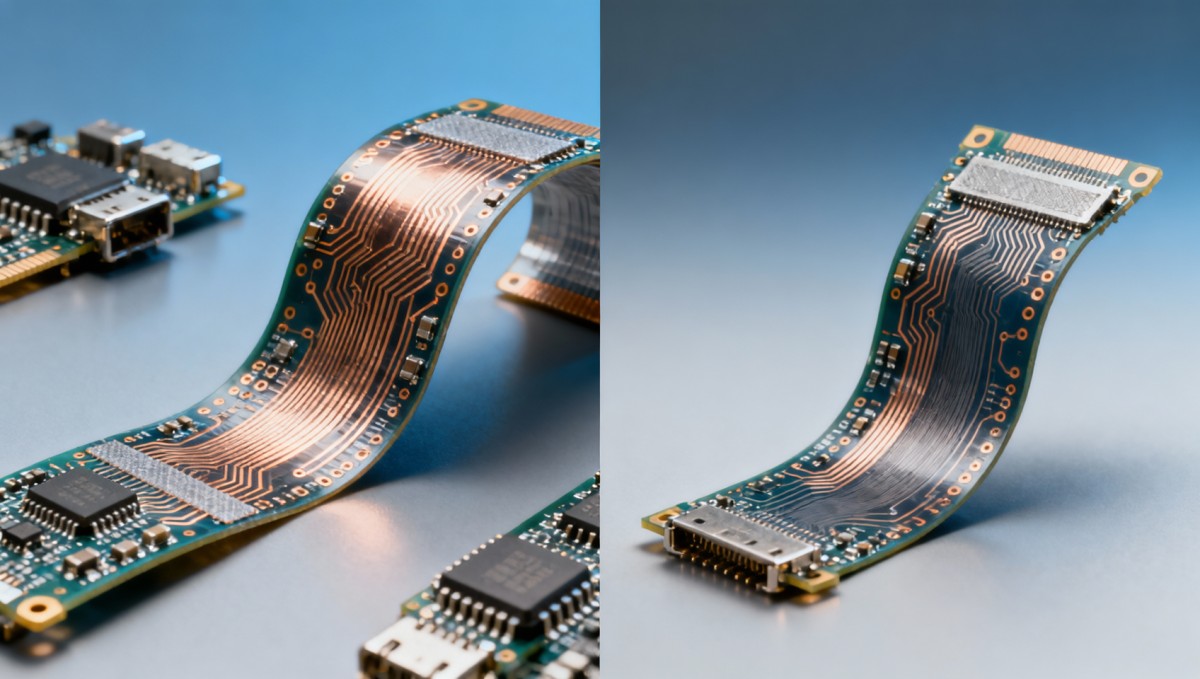
The short answer: bending becomes risky when the mechanical stress placed on the circuit exceeds what the copper traces, dielectric materials, adhesive system, and interconnect structure can repeatedly tolerate. This does not happen at one universal angle or one universal radius. It depends on how the flex PCB is designed, how often it moves, and what environment it operates in.
For buyers and project teams, the most important distinction is between static flex and dynamic flex applications:
- Static flex: The circuit is bent mainly during installation and then remains in place. Risk is comparatively manageable if bend radius and assembly handling are controlled.
- Dynamic flex: The circuit bends repeatedly during normal product use. Reliability requirements rise sharply, and design errors become much more expensive.
In many failed projects, teams assume a design proven in static use will also survive dynamic motion. That assumption is often wrong. Repeated flexing can cause copper work hardening, trace cracking, delamination, coverlay damage, or failure at solder joints and transition zones.
As a practical rule, risk increases quickly when any of the following are present:
- Very tight bend radius
- High bending frequency or long cycle life requirements
- Thicker copper in repeatedly flexed areas
- Improper trace routing across bend zones
- Vias, pads, or stiffeners placed too close to bend lines
- Temperature variation, vibration, or chemical exposure
- Low-cost material substitution without validation
For procurement and technical review teams, this means supplier comparison should never be based on price alone. The reliability boundary in flexible printed circuits is set by design discipline and manufacturing capability as much as by raw material choice.
What problems matter most to technical evaluators, buyers, and approval teams?
Different stakeholders look at flexible printed circuits from different angles, but their concerns usually converge around a few critical issues.
1. Will the flex circuit survive the real use case?
Technical evaluators want evidence that the part can survive expected bend cycles, installation handling, vibration, and thermal stress. They are not looking for generic compliance language. They need application-specific validation, especially for wearables, automotive electronics, compact medical devices, industrial controls, and moving smart electronics assemblies.
2. Is the supplier selling capability or just a low initial quote?
Procurement teams often face a misleading pricing gap in electronic components wholesale and flex PCB sourcing. A lower quote may come from thinner process control, less suitable polyimide systems, weaker copper treatment, or poor documentation of bend-life testing. The apparent saving can disappear quickly if field failures, returns, or line stoppages occur.
3. Where are the hidden lifecycle costs?
Financial approvers and enterprise decision-makers care about total cost, not only unit cost. Flexible printed circuits may reduce connectors, save installation space, lower assembly complexity, and improve product packaging efficiency. But if the bend zone is underdesigned, those benefits can be offset by rework, warranty claims, replacement logistics, and damaged brand trust.
4. Can quality and safety teams verify risk control?
Quality control and safety management teams need traceability, material consistency, process records, and failure analysis capability. For regulated or high-reliability sectors, undocumented material substitutions or inconsistent lamination quality are major warning signs.
5. Can project managers trust schedule commitments?
Project leaders often underestimate how long it takes to validate a flex design properly. Bend testing, design revisions, tooling adjustments, and sample verification all affect launch timing. A supplier that cannot support DFM review early may create expensive delays later.
What design and sourcing factors most strongly determine flex circuit risk?
When decision-makers want a fast but accurate way to assess flexible printed circuit risk, the following factors deserve the most attention.
Bend radius
This is one of the clearest predictors of reliability. A tighter bend radius concentrates more stress into the copper and dielectric layers. If the application requires frequent movement, a generous bend radius is one of the most effective ways to extend service life.
Copper type and thickness
Rolled annealed copper generally performs better in dynamic flexing than electrodeposited copper because it tolerates repeated bending more effectively. Thicker copper may support current demands, but it also reduces flexibility and raises fatigue risk in moving sections.
Layer count and stack-up complexity
Single-sided and simpler constructions usually perform better in demanding bend applications than more complex multilayer designs. Every additional layer changes stiffness and strain distribution. If multilayer flex is necessary, the bend zones require much stricter design control.
Trace layout in bend areas
Traces routed perpendicular to the bend line experience more stress than carefully designed curved or staggered routing strategies. Sharp corners also concentrate strain. Good flex design reduces stress points instead of merely fitting electrical connections into limited space.
Transition zones and reinforcement structures
Many failures occur where flexible and rigid sections meet, or where stiffeners, components, and solder joints are too close to motion zones. These areas need careful mechanical transition design, not just electrical layout optimization.
Adhesive and dielectric system
Material selection affects not only heat resistance and insulation but also long-term fatigue behavior. Low-cost substitutions can appear equivalent on a basic datasheet while performing very differently in cyclic bending or harsh environments.
Assembly handling and installation process
Even a strong design can fail if operators crease, fold, twist, or overstress the flex during assembly. Procurement teams evaluating suppliers should ask how handling controls are documented in production and customer installation guidance.
How should buyers and engineers evaluate suppliers before approving a project?
For high-value sourcing decisions, the most useful supplier evaluation method is not a generic quality checklist. It is a bend-risk validation checklist tied to the actual application.
Ask suppliers these questions:
- Is the design intended for static flex or dynamic flex use?
- What bend radius is recommended, and on what test basis?
- What is the expected cycle life under the target operating condition?
- What copper type is used in the bend area?
- Have you produced similar applications in volume before?
- Can you share failure analysis examples and corrective actions?
- How do you control via placement, stiffener location, and trace geometry near bend zones?
- What material substitutions are allowed, and how are they approved?
- What validation data exists for temperature, humidity, vibration, or chemical exposure?
- How do you package and ship flex circuits to avoid handling damage?
Strong suppliers usually answer with specific engineering rationale, process controls, and test references. Weak suppliers often answer with broad statements such as “our flex boards are high quality” without application-linked evidence.
For distributor, agent, and sourcing intermediary audiences, this is also a commercial advantage. Being able to explain why one flexible printed circuit option is more reliable than another builds trust faster than competing only on lead time or unit price.
When are flexible printed circuits worth the risk?
Flexible printed circuits are often the right choice when they create measurable system-level value that rigid alternatives cannot deliver efficiently. Common high-value scenarios include:
- Products with tight packaging constraints
- Devices requiring weight reduction
- Assemblies where connectors and wire harnesses can be reduced
- Compact smart electronics with moving modules
- Medical and instrumentation designs needing compact routing
- Applications that benefit from fewer interconnect points and cleaner assembly
However, they are a poor fit when teams choose flex only because it seems modern or compact, without fully accounting for movement, installation behavior, and environmental stress. In these cases, a rigid-flex redesign, a larger bend radius, or even a conventional interconnect solution may produce a better total-cost outcome.
The right decision is not “use flex whenever possible.” It is “use flex where the business and engineering gains clearly outweigh the reliability management burden.”
How can organizations reduce failure risk without losing the benefits of flex?
Companies that succeed with flexible printed circuits usually follow a few disciplined practices:
- Define the motion profile early: one-time bend, occasional service bend, or continuous dynamic bend
- Set reliability targets before sourcing: required life cycles, environmental conditions, and allowable failure rates
- Review DFM and DFA with the supplier early: especially bend zones, transition areas, and assembly constraints
- Prototype under realistic conditions: not only electrical test, but motion, thermal, and installation stress
- Control engineering changes tightly: small material or geometry changes can alter bend performance significantly
- Train assembly teams: many avoidable failures come from mishandling rather than core design defects
- Measure total cost of ownership: include reliability, field service, scrap, and warranty impact
For enterprise buyers and approval teams, this framework supports better decisions across technical performance, sourcing confidence, and financial accountability.
Final takeaway for B2B sourcing and technical decision-making
Flexible printed circuits create real competitive advantages in miniaturization, weight reduction, and design freedom, but they are not forgiving components. Bending starts to add risk when the actual mechanical demands of the application outrun the design margin built into the materials, layout, and manufacturing process.
For technical evaluators, procurement leaders, quality teams, and project managers, the best decision is rarely based on headline flexibility claims. It comes from verifying the actual bend scenario, identifying the stress points, checking supplier engineering discipline, and comparing total lifecycle cost rather than purchase price alone.
In other words, the smartest flex circuit strategy is not simply to ask, “Can this circuit bend?” It is to ask, “Can it bend enough, for long enough, in real operating conditions, without creating downstream cost and reliability exposure?” That is the question that leads to better specifications, stronger supplier selection, and more durable business outcomes.
Get weekly intelligence in your inbox.
No noise. No sponsored content. Pure intelligence.
 Apr 25, 2026Vietnam Enforces CN-EN Bilingual Safety Labels on Electronic Components from Apr 22, 2026Vietnam Enforces CN-EN Bilingual Safety Labels on Electronic Components from Apr 22, 2026
 Apr 25, 2026ANATEL Mandates Portuguese Offline Voice Assistants for Smart Home Devices in BrazilANATEL Mandates Portuguese Offline Voice Assistants for Smart Home Devices in Brazil
 Apr 25, 2026India BIS Mandates IS 13252:2025 for PLCs & HMIs by Oct 2026India BIS Mandates IS 13252:2025 for PLCs & HMIs by Oct 2026
 Apr 25, 2026SASO EV Charger Rules: Grid Compatibility & Sand Resistance RequiredSASO EV Charger Rules: Grid Compatibility & Sand Resistance Required
 Apr 25, 2026JIS T 0011:2026 Enforces IEC 62366-1:2024 for Rehab Devices in JapanJIS T 0011:2026 Enforces IEC 62366-1:2024 for Rehab Devices in Japan
 Apr 25, 2026THE Alliance Cuts Ningbo–Rotterdam Transit to 18 Days, +35% Spot RateTHE Alliance Cuts Ningbo–Rotterdam Transit to 18 Days, +35% Spot Rate
 Apr 25, 2026TÜV Rheinland Updates IoT EMC Standard: AI Edge Module Immunity Now MandatoryTÜV Rheinland Updates IoT EMC Standard: AI Edge Module Immunity Now Mandatory
 Apr 25, 2026USTR Launches Five-Year China Solar PV AD/CVD ReviewUSTR Launches Five-Year China Solar PV AD/CVD Review
 Apr 25, 2026EU New Battery Regulation Enters Force Apr 24, 2026EU New Battery Regulation Enters Force Apr 24, 2026
 Apr 25, 2026China Customs Launches RCEP Origin Smart Pre-Review for ASEAN机电 ExportsChina Customs Launches RCEP Origin Smart Pre-Review for ASEAN机电 Exports
 Apr 24, 2026India BIS Mandates IS 13252:2025 for PLCs & HMIs by Oct 2026India BIS Mandates IS 13252:2025 for PLCs & HMIs by Oct 2026
 Apr 24, 2026SASO EV Charger Regulation: Sand-Resistant Grid Compatibility Testing RequiredSASO EV Charger Regulation: Sand-Resistant Grid Compatibility Testing Required
 Apr 24, 2026Japan Updates JIS for Rehab Devices: IEC 62366-1:2024 Usability Compliance RequiredJapan Updates JIS for Rehab Devices: IEC 62366-1:2024 Usability Compliance Required
 Apr 24, 2026China Customs Launches RCEP Origin Smart Pre-Review SystemChina Customs Launches RCEP Origin Smart Pre-Review System
 Apr 24, 2026ANATEL Mandates Localized Voice Assistants for Smart Home Devices in BrazilANATEL Mandates Localized Voice Assistants for Smart Home Devices in Brazil
 Apr 24, 2026TÜV Rheinland Updates IoT EMC Standard with AI Edge抗扰度 RequirementTÜV Rheinland Updates IoT EMC Standard with AI Edge抗扰度 Requirement
 Apr 24, 20262M Alliance Shortens Ningbo–Rotterdam Route to 18 Days Amid 35% Slot Premium2M Alliance Shortens Ningbo–Rotterdam Route to 18 Days Amid 35% Slot Premium
 Apr 24, 2026Vietnam Enforces Bilingual Safety Labels for Imported Electronic Components from Apr 22, 2026Vietnam Enforces Bilingual Safety Labels for Imported Electronic Components from Apr 22, 2026
 Apr 24, 2026USTR Launches Sunset Review on China Solar PV AD/CVD DutiesUSTR Launches Sunset Review on China Solar PV AD/CVD Duties
 Apr 24, 2026EU New Battery Regulation Fully Effective Apr 24, 2026EU New Battery Regulation Fully Effective Apr 24, 2026
 Apr 23, 2026Taobao Factory Spark 3.0 Launches AI Workbench for SME Export FactoriesTaobao Factory Spark 3.0 Launches AI Workbench for SME Export Factories
 Apr 23, 2026TENENG Group Inspects IoT Safety Compliance at Jiangnan ChemicalTENENG Group Inspects IoT Safety Compliance at Jiangnan Chemical
 Apr 23, 2026China Launches First Embodied AI Open Data CommunityChina Launches First Embodied AI Open Data Community
 Apr 23, 2026PV Glass Prices Flat for 9 Weeks Amid Rising Integrated ProcurementPV Glass Prices Flat for 9 Weeks Amid Rising Integrated Procurement
 Apr 23, 20262984 NQI One-Stop Platforms Launched Nationwide2984 NQI One-Stop Platforms Launched Nationwide
 Apr 23, 2026China’s Green Smart Ship Tech Norms Accelerate BMS & Shore Power ExportChina’s Green Smart Ship Tech Norms Accelerate BMS & Shore Power Export
 Apr 23, 2026China Builds World's Largest Agri-Meteorological IoT NetworkChina Builds World's Largest Agri-Meteorological IoT Network