What drives cost differences in flexible printed circuits?
Cost differences in flexible printed circuits stem from far more than material pricing alone. For buyers comparing electronic components wholesale options, factors such as layer count, substrate selection, design complexity, yield rates, certification demands, and supplier scale can significantly change total cost. This article helps procurement teams, technical evaluators, and business decision-makers understand which variables truly influence pricing and how to balance performance, reliability, and sourcing efficiency.
Which cost drivers matter most in flexible printed circuits procurement?
In flexible printed circuits, the quoted unit price is only the visible layer of the cost structure. Technical teams often focus on copper thickness or base material, while procurement and finance teams look at piece price, tooling, and lead time. In practice, 5 core drivers usually shape the final number: material system, layer count, circuit geometry, production yield, and compliance burden.
For low-volume prototypes, engineering setup and tooling can represent a disproportionate share of the spend. For mid-volume and large-batch orders, yield loss, panel utilization, and process stability often become more decisive. That is why two flexible printed circuits with similar outlines can still show major cost differences across a 2–4 week sourcing cycle.
Buyers in smart electronics, healthcare technology, advanced manufacturing, and green energy also face different risk thresholds. A wearable sensor circuit, a battery management interconnect, and an industrial motion-control flex cable may all use flexible PCB technology, but the tolerance expectations, bend cycles, and documentation depth are not the same.
For enterprise decision-makers, the right question is not only “Why is one supplier cheaper?” but also “What assumptions are built into the quote?” A lower price may exclude stiffeners, testing coverage, special packaging, traceability documents, or quick-turn support. These missing items usually reappear later as change costs, qualification delays, or field risk.
A practical cost breakdown buyers should review
Before comparing flexible printed circuits suppliers, many sourcing teams benefit from separating visible and hidden cost items. This keeps engineering, quality, and finance aligned during vendor review and reduces disputes during quotation rounds.
This breakdown shows why cost differences in flexible printed circuits are rarely explained by copper and polyimide alone. Technical complexity, quality assurance depth, and production efficiency can shift the total landed cost more than a single raw material change.
The 4 checks that prevent misleading quote comparisons
- Confirm whether tooling, test fixtures, and NRE are included or listed separately.
- Check if the supplier quote assumes standard lead time, expedited production, or staged delivery.
- Verify if the quotation includes stiffeners, surface finish, shielding films, or connector assembly.
- Review whether inspection is sample-based, 100% electrical test, or tied to customer-specific documentation.
How do design choices raise or lower flexible PCB cost?
Design decisions made in the first 3 stages of product development often lock in most of the downstream cost. A flex circuit designed only for electrical function may become expensive to manufacture if bend zones are too narrow, pad geometry is too dense, or the outline forces poor panel utilization. Procurement teams usually inherit these consequences after the design release.
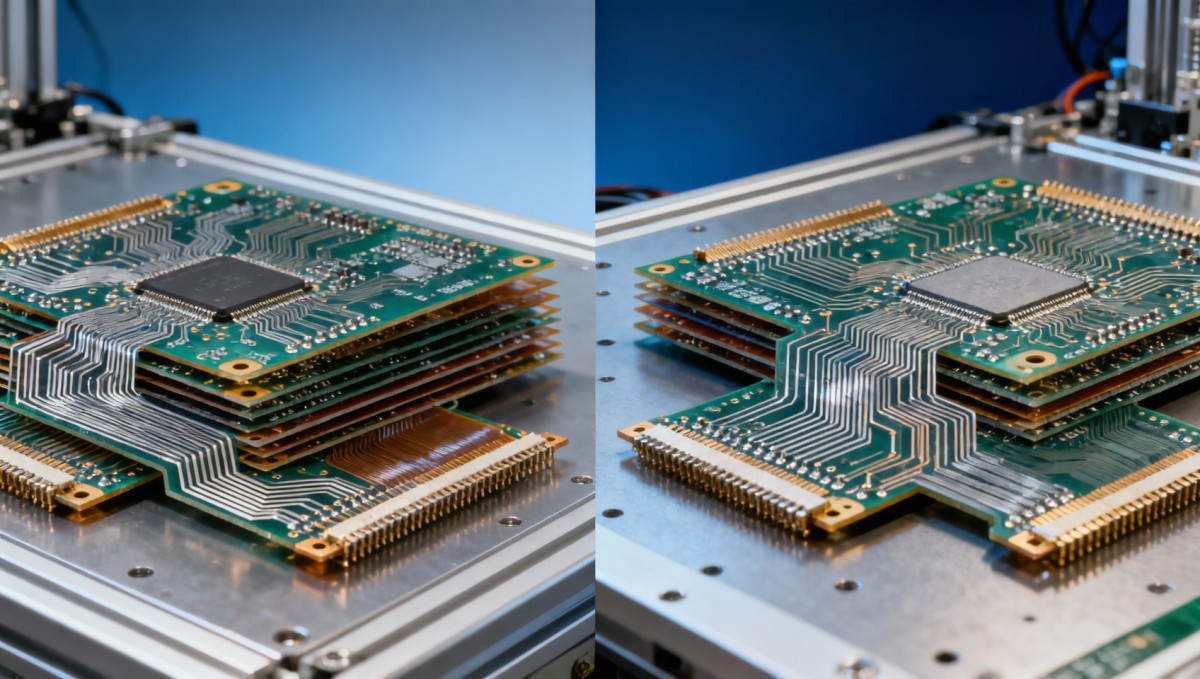
Layer count remains one of the clearest price multipliers. A single-sided flexible printed circuit may suit simple dynamic or static applications, while 2-layer and multilayer structures support denser routing and better signal management. Each added layer typically increases lamination complexity, registration control, test time, and scrap exposure.
Trace width, spacing, and via strategy matter just as much. When the design moves into fine-line territory, manufacturers may need tighter imaging controls and more process monitoring. This directly affects yield. A design that looks efficient on screen can become expensive if too many panels fail electrical test or dimensional inspection.
Mechanical features also change cost. Stiffeners, coverlays, selective adhesive areas, EMI shielding, and reinforcement around connectors add labor and process steps. For applications requiring repeated flexing over thousands of cycles, the bend architecture must be engineered carefully, otherwise a lower initial purchase price can lead to costly reliability issues later.
Design variables that commonly influence manufacturing efficiency
The table below helps technical evaluators and project managers identify which design choices usually have the greatest impact on flexible printed circuits cost, lead time, and sourcing risk.
For sourcing teams, this comparison matters because low-cost quoting is often tied to unchallenged assumptions. If a supplier prices the drawing exactly as issued, while another suggests a manufacturability adjustment, the higher initial quote may still lead to lower cost per accepted unit over a 6–12 month production horizon.
Where engineering and procurement should align early
- Freeze application conditions first: static bend, dynamic bend, temperature window, and expected service cycles.
- Review whether routing density is driven by actual system constraints or legacy layout practices.
- Assess if integration of stiffeners, connectors, or shielding should stay with the PCB supplier or move to final assembly.
- Translate technical requirements into clear RFQ language so commercial comparison remains fair.
What procurement teams should compare beyond unit price
A flexible printed circuits sourcing decision is rarely successful when based on nominal unit price alone. Buyers must compare total procurement value across at least 6 dimensions: technical fit, yield stability, quality documentation, lead time reliability, change-management responsiveness, and supply continuity. These matter even more in regulated or high-uptime environments.
Lead time is a frequent blind spot. A quote with a 7–10 day prototype cycle may look attractive, but if engineering feedback is slow or approval documentation is incomplete, the real project timeline can still extend to 3–5 weeks. For production runs, schedule stability often matters more than the shortest headline promise.
Quality cost should also be treated as a business variable, not only a factory variable. If incoming inspection failures delay assembly lines, finance sees expediting fees, project managers see missed milestones, and distributors see customer dissatisfaction. A slightly higher upfront cost can be justified when it reduces rework, returns, and line interruption risk.
This is where market intelligence becomes useful. TradeNexus Pro helps B2B teams frame supplier evaluation with a broader understanding of sector shifts, sourcing risks, and technology readiness. That perspective is especially valuable when comparing suppliers serving advanced manufacturing, medical-adjacent electronics, clean energy devices, or fast-scaling industrial platforms.
A sourcing checklist for commercial and technical reviewers
- Request a quote split into material, fabrication, tooling/NRE, testing, and optional assembly so hidden costs are visible.
- Ask for standard lead time and expedited lead time separately; this reveals actual capacity flexibility.
- Clarify whether the supplier supports prototype, pilot, and volume stages or only one segment of the lifecycle.
- Confirm documentation expectations, including electrical test records, material declarations, and lot traceability where relevant.
- Review packaging and logistics assumptions, especially for moisture control, anti-static handling, and international shipment conditions.
Typical procurement trade-offs by order stage
The evaluation priority shifts across prototype, pilot, and full production. Teams that use the same vendor scorecard for all 3 stages often miss the real drivers of cost differences in flexible printed circuits.
When teams compare suppliers by order stage instead of using a single price lens, they usually gain a clearer basis for approval. This approach is useful for financial approvers as well, because it connects quoted price to project phase, technical risk, and expected downstream cost exposure.
How do compliance, testing, and application scenarios change total cost?
Not all flexible printed circuits enter the same operating environment. A circuit used in consumer accessories may only need standard electrical validation and basic material declarations, while one used in healthcare technology equipment, industrial controls, or green energy subsystems may require stricter process documentation, traceability, and quality review. These requirements affect both price and supplier availability.
Testing depth is a meaningful cost variable. Some projects accept routine electrical testing and dimensional checks, while others ask for additional inspection steps, sample retention, or batch-level records. Each added layer of verification consumes time, labor, and quality system resources. The result is not just a higher quote, but often a longer approval cycle.
Application conditions also influence material selection. Flex circuits exposed to repeated bending, vibration, heat, or chemical contact may need more robust material stacks and tighter process control. In many cases, the real decision is whether to pay more upfront for durability or accept lower initial cost with a shorter maintenance window.
For quality managers and safety reviewers, a useful method is to divide requirements into 3 tiers: mandatory compliance, application-specific reliability, and customer-preferred reporting. This prevents over-specification. Many projects become more expensive because teams request a documentation package designed for the most demanding market, even when the final product does not need that level of control.
Common application scenarios and their cost implications
The same flexible printed circuits technology can serve very different commercial contexts. Reviewing application scenarios helps buyers understand why supplier quotations diverge even when the drawing looks similar.
- Static internal interconnects in compact electronics usually prioritize thin profile, fit, and assembly convenience over extreme flex life.
- Dynamic bend applications in printers, robotics, or moving instrumentation typically require stronger design control around bend radius and conductor layout.
- Battery packs, power modules, and energy storage interfaces may introduce thermal and insulation concerns that change stack-up decisions.
- Healthcare technology and precision devices often need stronger traceability discipline, change control, and documentation readiness during supplier approval.
Common misconceptions that create avoidable spend
One misconception is that thinner always means cheaper. In reality, very thin structures can require more careful handling, more specialized processing, and lower yield. Another is that the lowest quotation on a 10-piece prototype will automatically scale to the best volume price. That is often false if the supplier lacks repeatable process capability.
A third misconception is that every project should ask for the broadest certification and test package available. Over-specifying quality documentation can slow procurement and inflate cost without improving functional performance. The better approach is to define what the end market, operating environment, and customer contract actually require.
A fourth misconception is that redesign is always more expensive than accepting the original layout. In many cases, a small manufacturability adjustment made before the first production release can reduce total cost across 3–4 quarters of purchasing, especially when yield or assembly efficiency improves.
FAQ: what buyers and evaluators ask before approving a flex circuit supplier
How can we compare flexible printed circuits quotes fairly?
Use a side-by-side RFQ matrix with at least 5 fields: material stack-up, layer count, testing scope, lead time, and included secondary operations. Then add tooling, NRE, and logistics terms. If any supplier quote lacks one of these items, the price is not yet comparable. This method helps procurement, engineering, and finance review the same baseline.
What lead time is typical for prototypes and repeat orders?
Lead time varies by complexity, but common market ranges are about 7–15 days for straightforward prototypes and 2–4 weeks for repeat production under standard scheduling. Expedited service may be available, but buyers should confirm whether speed affects testing scope, price, or shipment method. A short quoted lead time means little if engineering clarifications remain unresolved.
When should we pay more for a higher-spec material stack?
Paying more is usually justified when the application includes dynamic bending, higher thermal exposure, long service intervals, or stricter failure consequences. If the circuit sits in a static, low-stress environment, a simpler material set may be sufficient. The decision should be tied to the use case, not to a generic preference for premium specifications.
What are the most overlooked hidden costs?
The most overlooked items are redesign delay, low yield, incomplete documentation, and incoming quality problems that disrupt assembly. Buyers also miss packaging assumptions, change-order fees, and split-shipment costs. These hidden costs often emerge after PO approval, which is why total sourcing value matters more than initial line-item price.
Why work with TradeNexus Pro when evaluating flexible printed circuits suppliers?
TradeNexus Pro supports B2B decision-makers who need more than generic supplier lists. Our focus on advanced manufacturing, smart electronics, healthcare technology, green energy, and supply chain SaaS makes us especially useful for teams navigating complex component sourcing decisions across multiple regions and qualification requirements.
For procurement directors, project managers, technical evaluators, and finance approvers, we provide context that helps separate apparent savings from durable sourcing value. That includes interpreting supplier positioning, understanding where cost differences in flexible printed circuits typically originate, and identifying which requirements may be driving unnecessary spend.
If you are reviewing electronic components wholesale options, planning a prototype-to-volume transition, or comparing vendors for a regulated or reliability-sensitive application, you can use TradeNexus Pro as a decision support resource. We help teams frame the right questions before they commit budget and timeline.
Contact us to discuss parameter confirmation, supplier shortlisting, flexible printed circuits selection logic, expected lead-time ranges, sample support planning, certification expectations, or quote comparison structure. For enterprises managing cross-border sourcing or distributor evaluation, we can also help define a more practical assessment framework before the next RFQ round begins.
Get weekly intelligence in your inbox.
No noise. No sponsored content. Pure intelligence.
 Apr 25, 2026Vietnam Enforces CN-EN Bilingual Safety Labels on Electronic Components from Apr 22, 2026Vietnam Enforces CN-EN Bilingual Safety Labels on Electronic Components from Apr 22, 2026
 Apr 25, 2026ANATEL Mandates Portuguese Offline Voice Assistants for Smart Home Devices in BrazilANATEL Mandates Portuguese Offline Voice Assistants for Smart Home Devices in Brazil
 Apr 25, 2026India BIS Mandates IS 13252:2025 for PLCs & HMIs by Oct 2026India BIS Mandates IS 13252:2025 for PLCs & HMIs by Oct 2026
 Apr 25, 2026SASO EV Charger Rules: Grid Compatibility & Sand Resistance RequiredSASO EV Charger Rules: Grid Compatibility & Sand Resistance Required
 Apr 25, 2026JIS T 0011:2026 Enforces IEC 62366-1:2024 for Rehab Devices in JapanJIS T 0011:2026 Enforces IEC 62366-1:2024 for Rehab Devices in Japan
 Apr 25, 2026THE Alliance Cuts Ningbo–Rotterdam Transit to 18 Days, +35% Spot RateTHE Alliance Cuts Ningbo–Rotterdam Transit to 18 Days, +35% Spot Rate
 Apr 25, 2026TÜV Rheinland Updates IoT EMC Standard: AI Edge Module Immunity Now MandatoryTÜV Rheinland Updates IoT EMC Standard: AI Edge Module Immunity Now Mandatory
 Apr 25, 2026USTR Launches Five-Year China Solar PV AD/CVD ReviewUSTR Launches Five-Year China Solar PV AD/CVD Review
 Apr 25, 2026EU New Battery Regulation Enters Force Apr 24, 2026EU New Battery Regulation Enters Force Apr 24, 2026
 Apr 25, 2026China Customs Launches RCEP Origin Smart Pre-Review for ASEAN机电 ExportsChina Customs Launches RCEP Origin Smart Pre-Review for ASEAN机电 Exports
 Apr 24, 2026India BIS Mandates IS 13252:2025 for PLCs & HMIs by Oct 2026India BIS Mandates IS 13252:2025 for PLCs & HMIs by Oct 2026
 Apr 24, 2026SASO EV Charger Regulation: Sand-Resistant Grid Compatibility Testing RequiredSASO EV Charger Regulation: Sand-Resistant Grid Compatibility Testing Required
 Apr 24, 2026Japan Updates JIS for Rehab Devices: IEC 62366-1:2024 Usability Compliance RequiredJapan Updates JIS for Rehab Devices: IEC 62366-1:2024 Usability Compliance Required
 Apr 24, 2026China Customs Launches RCEP Origin Smart Pre-Review SystemChina Customs Launches RCEP Origin Smart Pre-Review System
 Apr 24, 2026ANATEL Mandates Localized Voice Assistants for Smart Home Devices in BrazilANATEL Mandates Localized Voice Assistants for Smart Home Devices in Brazil
 Apr 24, 2026TÜV Rheinland Updates IoT EMC Standard with AI Edge抗扰度 RequirementTÜV Rheinland Updates IoT EMC Standard with AI Edge抗扰度 Requirement
 Apr 24, 20262M Alliance Shortens Ningbo–Rotterdam Route to 18 Days Amid 35% Slot Premium2M Alliance Shortens Ningbo–Rotterdam Route to 18 Days Amid 35% Slot Premium
 Apr 24, 2026Vietnam Enforces Bilingual Safety Labels for Imported Electronic Components from Apr 22, 2026Vietnam Enforces Bilingual Safety Labels for Imported Electronic Components from Apr 22, 2026
 Apr 24, 2026USTR Launches Sunset Review on China Solar PV AD/CVD DutiesUSTR Launches Sunset Review on China Solar PV AD/CVD Duties
 Apr 24, 2026EU New Battery Regulation Fully Effective Apr 24, 2026EU New Battery Regulation Fully Effective Apr 24, 2026
 Apr 23, 2026Taobao Factory Spark 3.0 Launches AI Workbench for SME Export FactoriesTaobao Factory Spark 3.0 Launches AI Workbench for SME Export Factories
 Apr 23, 2026TENENG Group Inspects IoT Safety Compliance at Jiangnan ChemicalTENENG Group Inspects IoT Safety Compliance at Jiangnan Chemical
 Apr 23, 2026China Launches First Embodied AI Open Data CommunityChina Launches First Embodied AI Open Data Community
 Apr 23, 2026PV Glass Prices Flat for 9 Weeks Amid Rising Integrated ProcurementPV Glass Prices Flat for 9 Weeks Amid Rising Integrated Procurement
 Apr 23, 20262984 NQI One-Stop Platforms Launched Nationwide2984 NQI One-Stop Platforms Launched Nationwide
 Apr 23, 2026China’s Green Smart Ship Tech Norms Accelerate BMS & Shore Power ExportChina’s Green Smart Ship Tech Norms Accelerate BMS & Shore Power Export
 Apr 23, 2026China Builds World's Largest Agri-Meteorological IoT NetworkChina Builds World's Largest Agri-Meteorological IoT Network